Questions

3 Marks Question

🎯

Test yourself on this topic

7 questions · timed · auto-graded

Question 13 Marks
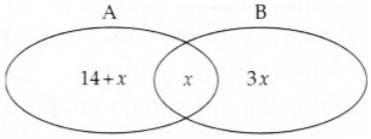
A and B are two sets such that n(A - B) = 14 + x, n(B - A) = 3x and $n ( A \cap B )= x$. Draw a Venn diagram to illustrate this information. If n(A) = n(B), find
i. the value of x
ii. $n(A \cup B)$
Answer
The adjoining Venn diagram represents the information given in the question.
Image
i. From the Venn diagram, we get
$\begin{array}{l}n(A)=n(A-B)+n(A \cap B) \\ =(14+x)+x=14+2 x \text { and } \\ n(B)=n(B-A)+n(A \cap B) \\ =3 x+x=4 x\end{array}$
But n(A) = n(B) (given)
$\Rightarrow 14+2 x=4 x \Rightarrow 2 x=14 \Rightarrow x=7$
ii. $n(A \cup B)=n(A-B)+n(B-A)+n(A \cap B)$
= (14 + x) + 3x + x = 14 + 5x
= 14 + 5 × 7 = 14 + 35 = 49
View full question & answer
Question 23 Marks
Mr. Rajesh in Bengaluru, Karnataka consumed 159 kL of water in a month. Calculate the water bill for the month. The tariff plan of Bengaluru is as given below:
Units of Consumption (in kL):up to 8Aug-2525-50> 50
Price per kL consumed :₹ 7₹ 11₹ 25₹ 45
Meter rent = ₹ 56 per month; Sewerage charges are flat ₹ 14 if the consumption is less than 8 KL and 25% of the consumption charges if the consumption is more than 8 kL.
Answer
Here, the consumption of water is given to be 159 kL
According to the given tariff plan:
Water consumption charges = ₹[(8 × 7) + (17 × 11) + (25 × 25) + (109 × 45)]
= ₹ (56 + 187 + 625 + 4905)
= ₹ 5773
Sewerage charges for consumption above 8kL in 25% of the consumption charges
$\therefore$ Sewerage charge = 25% of ₹ 5773
= ₹ 1443.25
Meter rent = ₹56 per month
$\therefore$ Total Water Bill = Consumption charge + Sewerage charge + Meter rent
= ₹5773 + ₹1443.25 + ₹56
= ₹ 7272.25
View full question & answer
Question 33 Marks
In what time will ₹ 25000 amount to ₹ 35000 at 6% compounded quarterly?
Answer
$A=P\left(1+\frac{\frac{r}{k}}{100}\right)^{k \times n}$
Here A = 35000 ; P = 25000 ; r = 6%, n = ?; k = 4
$\begin{array}{l}35000=25000\left(1+\frac{\frac{6}{4}}{100}\right)^{4 \times n} \\ \frac{35000}{25000}=\left(1+\frac{3}{200}\right)^{4 \times n} \\ \frac{7}{5}=\left(\frac{203}{200}\right)^{4 \times n} \\ \frac{7}{5}=(1.015)^{4 \times n} \\ (1.4)^{\frac{1}{4}}=(1.015)^n \\ \frac{1}{4} \log (1.4)=n . \log (1.015) \\ 0.0365= n .(0.00647) \\ n =\frac{0.0365}{0.00647} \\ n =5.64 \text { years }\end{array}$
View full question & answer
Question 43 Marks
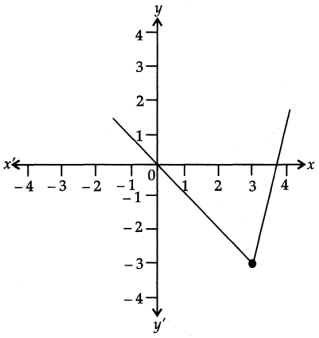
Find the domain and range of f(x) = |2x - 3| - 3.
Answer
Given, f(x) = |2x - 3| - 3
The domain of the expression is all real number except where the expression is undefined. In this case, there is not real number that makes the expression undefined.
$\therefore$ Domain of $f=(-\infty, \infty)=R$
The absolute value of expression has a 'V' shape. The range of a positive absolute value expression starts at its vertex and extends to infinity.
Range of $f =[-3, \infty)$ or $\{y: y \geq-3\}$
Image
View full question & answer
Question 53 Marks
Rohit is the husband of Vanshika. Sumita is the sister of Rohit. Anushka is the sister of Vanshika. How Anushka is related to Rohit?
Answer
Rohit is the husband of Vanshika
Image
Sumita is the sister of Rohit
Image
Anushka is the sister of Vanshika
Image
So Anushka is Rohit's wife's sister
Anushka is the sister-in-law of Rohit.
View full question & answer
Question 63 Marks
Find three numbers in G.P. whose product is 216 and the sum of their products in pairs is 156.
Answer
Let three numbers in G.P. be $\frac{a}{r}, a , ar$
$\therefore$ Their product $=\frac{a}{r} \cdot a \cdot ar =216$ (given)
$\Rightarrow a^3=216=(6)^3 \Rightarrow a=6$
Also sum of their products in pairs = 156 (given)
$\begin{array}{l}\Rightarrow \frac{a}{r} \cdot a + a \cdot ar + ar \cdot \frac{a}{r}=156 \\ \Rightarrow a^2\left(\frac{1}{r}+r+1\right)=156 \\ \Rightarrow 6^2 \cdot \frac{1+r^2+r}{r}=156 \\ \Rightarrow 3 \cdot \frac{r^2+r+1}{r}=13 \\ \Rightarrow 3 r ^2+3 r +3=13 r \\ \Rightarrow 3 r ^2-10 r +3=0 \\ \Rightarrow( r -3)\left(r-\frac{1}{3}\right)=0 \Rightarrow r =3, \frac{1}{3}\end{array}$
When $r=3$, numbers are $2,6,18$ and when $r=\frac{1}{3}$, numbers are $18,6,2$
View full question & answer
Question 73 Marks
If a, b, c are in A.P. show that a $\left(\frac{1}{b}+\frac{1}{c}\right), b\left(\frac{1}{c}+\frac{1}{a}\right), c\left(\frac{1}{a}+\frac{1}{b}\right)$ are also in A.P.
Answer
a, b, c are in A.P.
$\Rightarrow \frac{a}{a b c}, \frac{b}{a b c}, \frac{c}{a b c}$ are in A.P.
[on dividing each term by abc]
$\begin{array}{l}\Rightarrow \frac{1}{b c}, \frac{1}{c a}, \frac{1}{a b} \text { are in A.P. } \\ \Rightarrow \frac{a b+b c+c a}{b c}, \frac{a b+b c+c a}{c a}, \frac{a b+b c+c a}{a b} \text { are in A.P. }\end{array}$
[on multiplying each term by ab + bc + ca]
$\Rightarrow \frac{a b+b c+c a}{b c}-1, \frac{a b+b c+c a}{c a}-1, \frac{a b+b c+c a}{a b}-1$
are also in A.P.
[On adding -1 to each term]
$\begin{array}{l}\Rightarrow \frac{a b+a c}{h c}, \frac{a b+b c}{c a}, \frac{b c+c a}{a b} \text { are in A.P. } \\ \Rightarrow a\left(\frac{1}{b}+\frac{1}{c}\right), b\left(\frac{1}{c}+\frac{1}{a}\right), c\left(\frac{1}{a}+\frac{1}{b}\right) \text { are in A.P. }\end{array}$
View full question & answer
3 Marks Question - Applied Maths STD 11 Science Questions - Vidyadip


