Questions

MCQ

🎯

Test yourself on this topic

18 questions · timed · auto-graded

MCQ 11 Mark
If A = {1, 2, 4}, B = {2, 4, 5}, c = {2, 5}, then (A - B) × (B - C) is
  • {(1, 4)}
  • B
    (2, 5)
  • C
    {(1, 2), (1, 5), (2, 5)}
  • D
    (1, 4)
Answer
Correct option: A.
{(1, 4)}
(a) {(1, 4)}
Explanation: (A – B) = {1, 2, 4} – {2, 4, 5} = {1}
and (B - C) = {2, 4, 5} – {2, 5}
= {4}
Now, (A−B) × (B − C) = {1} × {4}
= {(1, 4)}
Since, it is a set so it is written in curly braces.
Therefore, option B is correct.
View full question & answer
MCQ 21 Mark
In how many ways can the letters of the word 'PENCIL' be arranged so that N is always next to E?
  • A
    1440
  • 120
  • C
    240
  • D
    720
Answer
Correct option: B.
120
(b) 120
Explanation: Keeping EN together and considering it as one letter, we have to arrange 5 letters at 5 places.
This can be done in ${ }^5 P_5=5!=120$ ways.
View full question & answer
MCQ 31 Mark
Time value of money supports the comparison of cash flows recorded at different time period by
i. Discounting all cash flows to a common point of time
ii. Compounding all cash flows to a common point of time
iii. Using either Discounting all cash flows to a common point of time or Compounding all cash flows to a common point of time
iv. not Discounting all cash flows to a common point of time nor Compounding all cash flows to a common point of time
  • Statement (c) is correct
  • B
    Statement (b) is correct.
  • C
    Statement (a) is correct.
  • D
    Statement (d) is correct.
Answer
Correct option: A.
Statement (c) is correct
(a) Statement (c) is correct.
Explanation: Time value of money supports the comparison of cash flows recorded at different time period by either compounding or discounting all cash flows to common point of time.
View full question & answer
MCQ 41 Mark
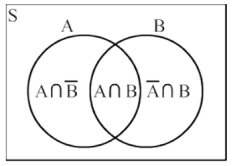
If A and B are two events, then $P (\bar{A} \cap B)=$
  • $P ( B )- P ( A \cap B )$
  • B
    $P(\bar{A}) P(\bar{B})$
  • C
    1 - P(A) - P(B)
  • D
    $P ( A )+ P ( B )- P ( A \cap B )$
Answer
Correct option: A.
$P ( B )- P ( A \cap B )$
(a) $P ( B )- P ( A \cap B )$
Explanation: $P(B)-P(A \cap B)$
Image
From the diagram, we get $A \cap B$ and $\bar{A} \cap B$ are mutually exclusive events such that $( A \cap B ) \cup(\bar{A} \cap B)= B$ Therefore by addition theorem of probability we have
$P(A \cap B)+P(\bar{A} \cap B)= P ( B )$
$\therefore P(A \cap B)=P(B)-P(A \cap B)$
View full question & answer
MCQ 51 Mark
Four cards are drawn from a well-shuffled pack of 52 cards. The probability of obtaining 3 diamonds and one spade is:
  • $\frac{{ }^{13} C _3 \times{ }^{13} C _1}{{ }^{52} C _4}$
  • B
    $\frac{{ }^{13} C _3 \times{ }^{10} C _1}{{ }^{52} C _4}$
  • C
    $\frac{{ }^{26} C_2 \times{ }^{26} C_2}{{ }^{52} C_1}$
  • D
    $\frac{{ }^{26} C _4}{{ }^{52} C _4}$
Answer
Correct option: A.
$\frac{{ }^{13} C _3 \times{ }^{13} C _1}{{ }^{52} C _4}$
(a) $\frac{{ }^{13} C _3 \times{ }^{13} C _1}{{ }^{52} C _4}$
Explanation: Number of ways of drawing 4 cards from 52 cards = ${ }^{52} C _4$
In a deck of 52 cards, there are 13 diamonds and 13 spades.
$\therefore$ Number of ways of drawing 3 diamonds and one spade $={ }^{13} C _3 \times{ }^{13} C _1$
Thus the probability of obtaining 3 diamonds and one spade $=\frac{{ }^{13} C _3 \times{ }^{13} C _1}{{ }^{52} C _4}$
View full question & answer
MCQ 61 Mark
A shopkeeper bought a TV from a distributor at a discount of 25% of the listed price of 7 32000. The shopkeeper sells the TV to a consumer at the listed price. If the sales are intra-state and the rate of GST is 18%, the selling price of the TV including tax (under GST) by the distributor is:
  • A
    ₹ 26160
  • B
    ₹ 32000
  • C
    ₹ 28320
  • ₹ 28320
Answer
Correct option: D.
₹ 28320
(d) ₹ 28320
Explanation: ₹ 28320
View full question & answer
MCQ 71 Mark
What does the P stands for in this formula?
Present value $=P\left[\frac{1-(1+i)^n}{i}\right]$
  • A
    The present value
  • B
    The future value
  • C
    The number of payments
  • The fixed payment amount
Answer
Correct option: D.
The fixed payment amount
(d) The fixed payment amount
Explanation: Present value = cash flow $\times \frac{\left[(1+i)^n-1\right]}{i(1+i)^n}$
$=$ fixed payment amount $\times\left[\frac{1-(1+i)^n}{i}\right]$
View full question & answer
MCQ 81 Mark
The value of $5^{\sqrt{\log 57}}-7^{\sqrt{\log _7 5}}$, is:
  • 0
  • B
    1
  • C
    log 2
  • D
    -1
Answer
Correct option: A.
0
(a) 0
Explanation: 0
View full question & answer
MCQ 91 Mark
The variance of first 5 natural numbers is
  • A
    4
  • B
    3
  • C
    1
  • 2
Answer
Correct option: D.
2
(d) 2
Explanation: The variance of first n natural number is $\frac{n^2-1}{12}$
Here n = 5
$\begin{array}{l}\text { So, Variance }=\frac{5^2-1}{12} \\ =\frac{25-1}{12} \\ =\frac{24}{12} \\ =2\end{array}$
View full question & answer
MCQ 101 Mark
In a certain code CAT in written as SATC and DEAF as SEARD, then SING will be with as
a. TSING
b. TINGS
c. GSING
d. SINGS
  • A
    TSING
  • B
    TINGS
  • SINGS
  • D
    GSING
Answer
Correct option: C.
SINGS
(c) SINGS
Explanation: SINGS
View full question & answer
MCQ 111 Mark
The vertex of the parabola $y^2=4 a(x-a)$ is
  • A
    (0, a)
  • (a, 0)
  • C
    (0, 0)
  • D
    (a, a)
Answer
Correct option: B.
(a, 0)
(b) (a, 0)
Explanation: $y^2=4 a(x-a)$
Let $Y = y$ and $X = x - a$
For standard parbola $Y^2=4 a X$ the vertex is $(0,0)$
So put $X=0$ and $Y=0$.
i.e. put $x - a =0$ and $y =0$
So vertex is $( a , 0)$
View full question & answer
MCQ 121 Mark
If A and B are any two events having P(A ∪ B) =$\frac{2}{3}$ and $P (\bar{B})=\frac{1}{2}$, then $P ( A \cap \bar{B})$ is:
  • A
    $\frac{1}{3}$
  • B
    $\frac{2}{3}$
  • C
    $\frac{1}{2}$
  • $\frac{1}{6}$
Answer
Correct option: D.
$\frac{1}{6}$
(d) $\frac{1}{3}$
Explanation: We know that $P ( A \cap \bar{B})= P ( A - B )= P ( A \cup B )- P ( B )$
$=\frac{2}{3}-\left(1-\frac{1}{2}\right)=\frac{2}{3}-\frac{1}{2}=\frac{1}{6}$.
View full question & answer
MCQ 131 Mark
log (1 × 2 × 3) is equal to
  • A
    log 3
  • B
    log 1
  • C
    log 2
  • log 1 + log 2 + log 3
Answer
Correct option: D.
log 1 + log 2 + log 3
(d) log 1 + log 2 + log 3
Explanation: Since, $\log _a(m n)=\log _a m+\log _a n$
One extending this rule for three variables, we get
$\log _a(m n p)=\log _a m+\log _a n+\log _a p$
Therefore, log(1 × 2 × 3) = log 1 + log 2 + log 3
View full question & answer
MCQ 141 Mark
For two non empty sets A and B, if n(A) = m and n(B) = n then the total number of relations from set A to set B is
  • A
    $2^m+2^n$
  • $2^{ mn }$
  • C
    mn
  • D
    m + n
Answer
Correct option: B.
$2^{ mn }$
(b) $2^{m n}$
Explanation: as n(A) = m, n(B) = n
$\Rightarrow$n(A × B) = mn
So, number of relations = $2^{m n}$
View full question & answer
MCQ 151 Mark
$2^4=16$ in logarithmic form is
  • A
    4 log 2 = log 16
  • B
    $\log _4 16=2$
  • C
    $\log _4 2=16$
  • $\log _2 16=4$
Answer
Correct option: D.
$\log _2 16=4$
(d) $\log _2 16=4$
Explanation: $2^4=16$ in logarithmic form.
As we know that
if $a^y=x$
then $\log _a x=y$
$\therefore \log _2 16=4$
View full question & answer
MCQ 161 Mark
A shopkeeper bought a TV from a distributor at a discount of 25% of the listed price of ₹ 32000. The shopkeeper sells the TV to a consumer at the listed price. If the sales are intra-state and the rate of CST is 18%, the selling price of the TV including tax (under GST) by the distributor is
  • A
    ₹32000
  • ₹28320
  • C
    ₹24000
  • D
    ₹26160
Answer
Correct option: B.
₹28320
(b) ₹ 28320
Explanation: Listed price = ₹ 32000, discount = 25% of ₹ 32000 = ₹ 8000
$\therefore$ S.P. of distributor = ₹ 32000 - ₹ 8000 = ₹ 24000
CGST = 9% of ₹ 24000 = ₹ 2160
SGST = 9% of ₹ 24000 = ₹ 2160
$\therefore$ S.P. including tax = ₹ 24000 + ₹ 2160 + ₹ 2160 = ₹ 28320
View full question & answer
MCQ 171 Mark
The mean and standard deviation of 100 items are 50, 5 and that of 150 items are 40, 6 respectively. What is the combined mean of all 250 items?
  • A
    43
  • B
    46
  • 44
  • D
    45
Answer
Correct option: C.
44
(c) 44
Explanation: Given that, mean of 100 items, $\bar{x}_{100}=50$
Mean of 150 items, $\bar{x}_{100}=50$ and standard deviation of 100 items, $\sigma_{100}=5$
Standard deviation of 150 items, $\sigma_{100}=6$
Here, $n _1=100, \bar{x}_{100}=50$ and $n _2=150, \bar{x}_{150}=40$
$\therefore$ Combined mean of all 250 items, $\bar{x}_{250}=\frac{n_1 \cdot \bar{x}_{100}+n_2 \cdot \bar{x}_{150}}{n_1+n_2}$
$=\frac{100 \times 50+150 \times 40}{100+150}=\frac{5000+6000}{250}=\frac{11000}{250}=44$
View full question & answer
MCQ 181 Mark
A bag contains 5 black balls, 4 white balls and 3 red balls. If a ball is selected random wise, the probability that it is black or red ball is
  • $\frac{2}{3}$
  • B
    $\frac{5}{12}$
  • C
    $\frac{1}{3}$
  • D
    $\frac{1}{4}$
Answer
Correct option: A.
$\frac{2}{3}$
(a) $\frac{2}{3}$
Explanation: $\frac{2}{3}$
We know that the bag contains 5 (black), 4W (white) and 3R (red) balls.
Now,
$\begin{array}{l}P(B)=\frac{5}{12} \\ P(R)=\frac{3}{12} \\ P ( B \text { or } R )= P ( B )+ P ( R ) \\ =\frac{5}{12}+\frac{3}{12} \\ =\frac{8}{12}=\frac{2}{3}\end{array}$
View full question & answer
MCQ - Applied Maths STD 11 Science Questions - Vidyadip