Questions

4 Marks Questions

🎯

Test yourself on this topic

6 questions · timed · auto-graded

Question 14 Marks
$( 2 5 . 1 2 5 )_{10}$
Answer
Given decimal number is 25.125
Whole part of given decimal number is 25 .
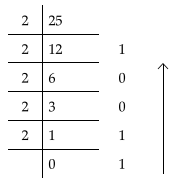
Its binary conversion is as follows :
Image
Thus,$
(25)_{10}=(11001)_2
$
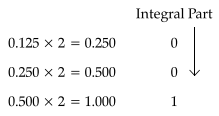
The fractional part of given decimal number is 0.125
Image
Since, we get the integral part as 1 , So, we stopped are multiplication. Now, write integral part from top to bottom to get equivalent binary number.
i.e.,$
(0.125)_{10}=(0.001)_2
$
Hence, $\quad(25.125)_{10}=(11001.001)_2$
View full question & answer
Question 24 Marks
$(645)_{10}$
Answer
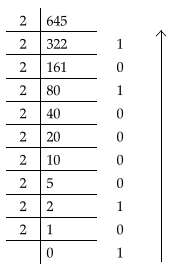
(i) To get a binary equivalent of $(645)_{10}$, we divide the number by 2 and obtain remainders as :
Image
Hence, $(645)_{10}=(1010000101)_2$
View full question & answer
Question 34 Marks
$( 1 1 1 . 1 0 1 0 1 )_2$
Answer
Given digits $\quad \begin{array}{lllllllll}1 & 1 & 1 & . & 1 & 0 & 1 & 0 & 1\end{array}$
Fractional Value     $2^2 2^1 2^0 \quad . \quad 2^{-1} 2^{-2} 2^{-3} 2^{-4} 2^{-5}$
Decimal Value        $1 \times 2^2 1 \times 2^1 1 \times 2^0 .1 \times 2^{-1} 0 \times 2^{-2} 1 \times 2^{-3}$
$0 \times 2^{-4} 1 \times 2^{-5}$
$
\begin{array}{l}=4+2+1.0 .5+0+0.125+0+0.03125 \\
=7.65625
\end{array}
$
Thus, $(111.10101)_2=(7.65625)_{10}$
View full question & answer
Question 44 Marks
$( 1 0 1 0 1 0 )_2$
Answer
(i) Given, binary number is 101010
$\begin{array}{lllllll}\text { Given digits }         & 1 & 0 & 1 & 0 & 1 & 0\end{array}$
$\begin{array}{lllllll}\text { Position Number } & 5 & 4 & 3 & 2 & 1 & 0\end{array}$
$\begin{array}{llllll}\text { Positional Value }   2^5 & 2^4 & 2^3 & 2^2 & 2^1 & 2^0\end{array}$
Decimal Number $\begin{aligned} 1 \times 2^5+0 \times 2^4+1 & \times 2^3+0 \times 2^2 +1 \times 2^1+0 \times 2^0\end{aligned}$$
\begin{array}{l}
=32+0+8+0+2+0 \\
=42
\end{array}
$
Thus,$
(101010)_2=(42)_{10}
$
View full question & answer
Question 54 Marks
110110101
Answer
(ii) 110110101
Octal Conversion
$\begin{array}{ccccc}\text { Grouping in } & \overline{110} & \overline{110} & \overline{001} \\ \text { 3-bits } & \downarrow & \downarrow & \downarrow & \\ & 6 & 6 & 5 \end{array}$
Thus, $(110110101)_2=(665)_8$
Hexadecimal Conversion
$\begin{array}{cccc}\text { Grouping in } & \overline{0001} & \overline{1011} & \overline{0101} \\ \text { 4-bits } & \downarrow & \downarrow & \downarrow \\ & 1 & B& 5\end{array}$
Thus, $(110110101)_2=(1B5)_{16}$
View full question & answer
Question 64 Marks
1110001000
Answer
(i) 1110001000
Octal Conversion
$\begin{array}{ccccc}\text { Grouping in } & \overline{001} & \overline{110} & \overline{001} & \overline{000} \\ \text { 3-bits } & \downarrow & \downarrow & \downarrow & \downarrow \\ & 1 & 6 & 1 & 0\end{array}$
Thus, $(1110001000)_2=(1610)_8$
Hexadecimal Conversion
$\begin{array}{cccc}\text { Grouping in } & \overline{0011} & \overline{1000} & \overline{1000} \\ \text { 4-bits } & \downarrow & \downarrow & \downarrow \\ & 3 & 8 & 8\end{array}$
Thus, $(1110001000)_2=(388)_{16}$
View full question & answer
4 Marks Questions - Applied Maths STD 11 Science Questions - Vidyadip