Question 12 Marks
In a shower, 10 cm of rain falls. What will be the volume of water that falls on 1 hectare area of ground?
Answer
$
\begin{aligned}
\text { Since, } \quad 1 \text { hectare } & =10000 m^2 \\
\text { Volume of water } & =\text { Area of base } \times \text { height } \\
& =10000 \times \frac{10}{100} m^3 \\
& =1000 m^3
\end{aligned}
$
$\therefore$ Volume of water is $1000 m^3=1000 KL$
View full question & answer→Question 22 Marks
If the area of trapezium, whose parallel sides are 6 cm and 10 cm is $32 sq . cm$, then find the distance between the parallel sides.
AnswerArea of trapezium $=\frac{1}{2}(a+b) \times h$
where, $a$ and $b$ are parallel sides and $h$ is altitude (distance)
$
\begin{aligned}
32 & =\frac{1}{2}(6+10) \times h \\
\Rightarrow \quad h & =4 cm
\end{aligned}
$
Therefore, the distance between parallel sides is 4 cm .
View full question & answer→Question 32 Marks
If the diagonal of a square is doubled to make the diagonal of another square. Find the area of the new square.
AnswerLet the diagonal be $a$.
Then,$
\text { area }=\frac{1}{2} a^2
$
New, $\quad$ diagonal $=2 a$
$
\begin{aligned}
\therefore \quad \text { New area } & =\frac{1}{2}(2 a)^2=2 a^2 \\
& =4 \times \frac{1}{2} a^2
\end{aligned}
$
$\therefore \quad$ New area $=4 \times$ old area
Therefore, new area is 4 times of old area.
View full question & answer→Question 42 Marks
The radii of two cylinders are in the ratio $3: 5$ and their heights are in the ratio $2: 3$. Find the ratio of their curved surface areas.
AnswerLet the radii of the cylinders be $3 x, 5 x$ and their heights be $2 y, 3 y$, respectively.
Ratio of their curved surface areas
$
\begin{array}{l}
=\frac{2 \pi \times 3 x \times 2 y}{2 \pi \times 5 x \times 3 y} \\
=\frac{2}{5}=2: 5
\end{array}
$
Thus, ratio of their curved surface areas is $2: 5$.
View full question & answer→Question 52 Marks
2.2 cubic dm of lead is to be drawn into a cylindrical wire 0.50 cm in diameter. Find the length of the wire in metres.
AnswerLet the length of the wire be $h$ meters. Then,
$
\begin{aligned}
\pi r^2 h & =2.2 \text { cubic } dm \\
\text { i.e., } \quad \pi\left(\frac{0.50}{2 \times 100}\right)^2 \times h & =\frac{2.2}{1000}
\end{aligned}
$
$\begin{aligned} {[d=0.5 cm \Rightarrow} & r=\frac{0.5}{2} cm \text { or } \frac{0.5}{2 \times 100} m \\ & \left.\text { and } 1 \text { cubic } dm =\frac{1}{1000} \text { metre }\right]\end{aligned}$
or,
$
\begin{aligned}
h & =\left(\frac{2.2}{1000} \times \frac{100 \times 100}{0.25 \times 0.25} \times \frac{7}{22}\right) \\
& =112 m
\end{aligned}
$
Hence, length of the wire is 112 metres.
View full question & answer→Question 62 Marks
Walking at $\frac{5}{6}$ of its usual speed, a train is 10 minutes too late. Find its usual time to cover the journey?
Answer$\quad$ New speed $=\frac{5}{6}$ of the usual speed
$\therefore \quad$ New time taken $=\frac{6}{5}$ of usual speed
So, $\left(\frac{6}{5}\right.$ of the usual time) $-($ usual time $)=10 min$
$\Rightarrow \quad \frac{1}{5}$ of the usual time $=10 min$
$\Rightarrow \quad$ usual time $=50 min$.
View full question & answer→Question 72 Marks
$X$ can do $\frac{1}{4}$ of a work in 10 days, $Y$ can do $40 \%$ of the work in 40 days and $Z$ can do $\frac{1}{3}$ of the work in 13 days, who will complete the work first?
AnswerWhole work will be done by $X$ in $(10 \times 4)=40$ days
Whole work will be done by $Y$ in $\left(40 \times \frac{100}{40}\right)$$
=100 \text { days }
$
Whole work will be done by Z in $(13 \times 3)=39$ days
$\therefore Z$ will complete the work first.
View full question & answer→Question 82 Marks
A can do a certain job in 12 days, B is $60 \%$ more efficient than $A$. How many days does $B$ alone take to do the same job ?
AnswerRatio of times taken by $A$ and $B=160: 100=8: 5$
suppose B alone take $x$ days to do the same job.
Then, $8: 5:: 12: x$
$
\begin{array}{ll}
\Rightarrow & \frac{8}{5}=\frac{12}{x} \\
\Rightarrow & x=\frac{12 \times 5}{8}=\frac{60}{8}=7 \frac{1}{2} \text { days }
\end{array}
$
Hence, $B$ can alone to the job in $7 \frac{1}{2}$ days.
View full question & answer→Question 92 Marks
$A, B$ and $C$ can complete a piece of work in 24 , 6 and 12 days respectively, working together, they will complete the same work in how many days?
Answer$(A+B+C)$ 's 1 day's work $=\frac{1}{24}+\frac{1}{6}+\frac{1}{12}=\frac{7}{24}$ th work
So, $A, B$ and $C$ together will complete the job in $\frac{24}{7}$ days
$
=3 \frac{3}{7} \text { days. }
$
View full question & answer→Question 102 Marks
How many times in a day, are the hands of a clock in straight line but opposite in direction ?
AnswerThe hands of a clock point in opposite directions (in the same straight line) 11 times in every 12 hours (Because between 5 and 7, they point in opposite directions at 6 o'clock only). So, in a day, the hands point in the opposite directions 22 times.
View full question & answer→Question 112 Marks
How many times are the hands of a clock at right angles in a day ?
AnswerIn 12 hours, they are right angles 22 times.
$\therefore$ In 24 hours, they are at right angles 44 times.
View full question & answer→Question 122 Marks
In $8^{\text {th }}$ Feb., 2005 it was Tuesday. What was the day of the week on $8^{\text {th }}$ Feb, 2004 ?
AnswerThe year 2004 is a leap year. It has 2 odd days.
$\therefore$ The day on 8 th Feb, 2004 is 2 days before the day on $8^{\text {th }}$ Feb, 2005.
Hence, this day is Sunday.
View full question & answer→Question 132 Marks
Today is Monday, then what is the day after 61 days.
AnswerEach day of the week is repeated after 7 days.
So, after 63 days, it will be Monday.
Thus, after 61 days, it will be Saturday.
View full question & answer→Question 142 Marks
A student was asked to find the arithmetic mean of the numbers $3,11,7,9,15,13,8,19,17,21,14$ and $x$. He found the mean to be 12 . What should be the number in place of $x$ ?
AnswerClearly, We have
$
\frac{3+11+7+9+15+13+8+19+17+21+14+x}{12}=12
$
$\begin{aligned} \text { or, } & & 137+x & =144 \\ \Rightarrow & & x & =144-137=7 .\end{aligned}$
View full question & answer→Question 152 Marks
The average of five consecutive odd numbers is 61. What is the difference between the highest and lowest number ?
AnswerLet the numbers be $x, x+2, x+4, x+6$ and $x+8$.
$
\begin{array}{l}
\text { Then, } \frac{x+(x+2)+(x+4)+(x+6)+(x+8)}{5}=61 \\
\Rightarrow 5 x+20=305\\
\Rightarrow x = 57
\end{array}
$
So, required difference $=(57+8)-57=8$.
View full question & answer→Question 162 Marks
Of the three numbers, second is twice the first and is also thrice the third. If the average of the three numbers is 44 , find the largest number.
AnswerLet the third number be $x$.
Then, second number $=3 x$
$
\begin{array}{rlrl}
\text { first number } =\frac{3 x}{2} \\
\therefore x+3 x+\frac{3 x}{2} =44 \times 3 \\
\text { or, } \frac{11}{2} x =44 \times 3 \\ \Rightarrow x = 24\
\end{array}
$
So, largest number $=2^{\text {nd }}$ number $=3 \times 24=72$.
View full question & answer→Question 172 Marks
Find the average of the two digit numbers, which remain the same, when the digits interchange their positions.
AnswerThe two digit numbers, which remain the same, when the digits interchange their positions are :
$
\begin{array}{l}
11,22,33,44,55,66,77,88,99 \\
\therefore \text { Average }=\frac{11+22+33+44+55+66+77+88+99}{9}
\end{array}
$
$\begin{array}{l}=\left[\frac{(11+99)+(22+88)+(33+77)+(66+44)+55}{9}\right] \\ =\left[\frac{(4 \times 110)+55}{9}\right]=\frac{495}{9}=55 .\end{array}$
View full question & answer→Question 182 Marks
Four men $A, B, C$ and $D$ and four women $W, X, Y$ and $Z$ are sitting round a table facing each other,
(i) No two men or women are sitting together
(ii) $W$ is the right to $B$
(iii) $Y$ is facing $X$ and is to the left of $A$
(iv) $C$ is to the right of $Z$.Find, who are the two persons sitting adjacent to $D$ ?
Answer
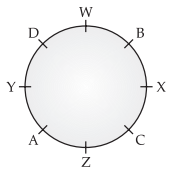
The above figure shows the sitting arrangement of the 8 persons.
It is clear from the figure, $W$ and $Y$ are adjacent to $D$. View full question & answer→Question 192 Marks
Find the number of lead balls, each 1 cm in diameter that can be made from a sphere of diameter 12 cm .
Answer
$
\begin{array}{l}
\text { Volume of larger sphere }=\frac{4}{3} \pi \times(6)^3 \\
=288 \pi cm^3 \\
\text { [Volume of sphere }=\frac{4}{3} \pi r^3 \text {. Here, } r=\frac{d}{2}=6 \text { ] } \\
\text { Volume of } 1 \text { small lead ball }=\frac{4}{3} \pi \times\left(\frac{1}{2}\right)^3=\frac{\pi}{6} cm^3 \\
\therefore \text { No. of lead balls }=\frac{\text { Volume of larger sphere }}{\text { Volume of } 1 \text { small lead ball }} \\
=\frac{288 \pi}{\pi / 6}=288 \times 6=1728
\end{array}
$
Therefore, number of lead balls are 1728 .
View full question & answer→Question 202 Marks
A conical vessel, whose internal radius is 12 cm and height 50 cm , is full of liquid. The contents are emptied into a cylindrical vessel with internal radius 10 cm . Find the height to which the liquid rises in the cylindrical vessel.
AnswerVolume of the liquid in the cylindrical vessel$
\begin{aligned}
= & \text { Volume of the conical vessel } \\
\Rightarrow\left(\frac{1}{3} \times \frac{22}{7} \times 12 \times 12 \times 50\right) & cm^3 \\
=\left(\frac{22 \times 4 \times 12 \times 50}{7}\right) cm^3
\end{aligned}
$
Let the height of the liquid in the vessel be $h$.
Then $\frac{22}{7} \times 10 \times 10 \times h=\frac{22 \times 4 \times 12 \times 50}{7}$
or $
h=\frac{4 \times 12 \times 50}{10 \times 10}=24 cm .
$
View full question & answer→Question 212 Marks
If 1 cubic cm of cast iron weighs 21 gms , then find the weight of a cast iron pipe of length 1 metre with a bore of 3 cm and in which thickness of the metal is 1 cm .
Answer
$\begin{array}{l} \text { Inner radius }=\left(\frac{3}{2}\right) cm =1.5 cm \\ \text { Outer radius }=(1.5+1) cm =2.5 cm\end{array}$
$\therefore \quad$ Volume of iron $=\left[\pi(2.5)^2 \times 100-\pi(1.5)^2\right.$$\times 100] cm ^3$
$=\frac{22}{7} \times 100\left[(2.5)^2-(1.5)^2\right] cm ^3$
$=\frac{8800}{7} cm^3$
$\therefore$ Weight of the pipe $=\left(\frac{8800}{7} \times \frac{21}{1000}\right) kg$
= 26.4 kg
View full question & answer→Question 222 Marks
If the side of a square is increased by 5 cm , the area increased by $165 sq . cm$. Find the side of the square.
AnswerLet, original side $=x cm$
$
\begin{aligned}
\text { Then, } & & (x+5)^2-x^2 & =165 \\
\Rightarrow & & 10 x & =140 \\
\Rightarrow & & x & =14
\end{aligned}
$
Therefore, side of square is 14 cm .
View full question & answer→Question 232 Marks
A man travelled from the village to the post-office at the rate of 25 km/hr and walked back at the rate of 4 km/hr. If the whole journey took 5 hours 48 minutes, find the distance of the post-office from the village.
Answer
$\begin{aligned}
\text { Average speed } & =\left(\frac{2 x y}{x+y}\right) km / hr \\
& =\left(\frac{2 \times 25 \times 4}{25+4}\right) km / hr \\
& =\frac{200}{29} km / hr
\end{aligned}
$
Distance travelled in 5 hours 48 minutes i.e., $5 \frac{4}{5} hrs$
$
\begin{array}{l}
=\left(\frac{200}{29} \times \frac{29}{5}\right) km \\
=40 km
\end{array}
$
$\therefore$Distance of the post-office from the village
$
=\frac{40}{2}=20 km
$
View full question & answer→Question 242 Marks
Peter can cover a certain distance in 1 hr 24 min by covering two-third of the distance at $4 km / hr$ and the rest at $5 km / hr$. Find the total distance.
AnswerLet the total distance be $x\ km$.
Then,
$\begin{array}{l}
\frac{\frac{2}{3} x}{4}+\frac{\frac{1}{3} x}{5}=\frac{7}{5} \\
{\left[\because 1 hr 24 min=\left(1+\frac{24}{60}\right) hr=\frac{7}{5} hr\right]}
\end{array}
$
$
\Rightarrow \quad \frac{x}{6}+\frac{x}{15}=\frac{7}{5}
$
$
\Rightarrow \quad 7 x=42
$
$
\Rightarrow \quad x=6
$
Thus, total distance $=6 km$.
View full question & answer→Question 252 Marks
$A$ and $B$ undertake to do a piece of work for ₹ 600, $A$ alone can do it in 6 days while $B$ alone can do it in 8 days. With the help of $C$, they finish it in 3 days find the share of each.
Answer
$\begin{array}\text { C's 1 days' work } =\frac{1}{3}-\left(\frac{1}{6}+\frac{1}{8}\right)=\frac{1}{24} \\
\therefore A: B: C =\text { Ratio of their } 1 \text { day's work } \\
=\frac{1}{6}: \frac{1}{8}: \frac{1}{24}=4: 3: 1 \\
\end{array}
$
$\text { A's share }=\left(600 \times \frac{4}{8}\right)= 300$
$\begin{array}{l}\text { B's share }=\left(600 \times \frac{3}{8}\right)= 225 \\ \text { C's share }=\left(600 \times \frac{1}{8}\right)= 75\end{array}$
View full question & answer→Question 262 Marks
can do a piece of work in 80 days. He works at it for 10 days and then $B$ alone finishes the remaining work in 42 days. In how much time will $A$ and $B$, working together, finish the work ?
AnswerWork done by $A$ in 10 days $=\frac{1}{80} \times 10=\frac{1}{8}$
$
\text { Remaining work }=\left(1-\frac{1}{8}\right)=\frac{7}{8}
$
Now, $\frac{7}{8}$ work is done by $B$ in 42 days
Whole work will be done by $B$ in $\left(42 \times \frac{8}{7}\right)$
$
\begin{array}{l}
=48 \text { days } \\
\therefore A^{\prime} \text { s } 1 \text { day's work }=\frac{1}{80} \text { and } B^{\prime} \text { 's days' work }=\frac{1}{48} \\
\therefore(A+B)^{1 / 2} \text { 's days' work }=\frac{1}{80}+\frac{1}{48}=\frac{8}{240}=\frac{1}{30}
\end{array}
$
Hence, both will finish the work in 30 days.
View full question & answer→Question 272 Marks
A watch which gains uniformly, is 5 min. Slow at 8 o'clock in the morning on Sunday and it is 5 min. 48 sec on the following Sunday. When was it correct?
AnswerTime from 8 a.m. on Sunday to 8 p.m. on following
$
\begin{aligned}
\text { Sunday } & =7 \text { days } 12 \text { hours } \\
& =180 \text { hours }
\end{aligned}
$
$\therefore$ The watch gains $\left(5+5 \frac{4}{5}\right) min$. or $\frac{54}{5} min$ in 180 hrs
Now, $\frac{54}{5}$ min. are gained in 180 hrs .
$\begin{aligned} \therefore 5 min \text {. are gained in } & \left(180 \times \frac{5}{54} \times 5\right) \text { hrs. } \\ & =83\ hrs\ 20\ min \\ & =3 \text { days } 11\ hrs\ 20\ min .\end{aligned}$
$\therefore$ Watch is correct 3 days 11 hrs 20 min after 8 p.m. of Sunday.
$\therefore$ It will correct at 20 min. past 7 p.m. on Wednesday.
View full question & answer→Question 282 Marks
A clock is set right at 5 a.m . The clock loses 16 minutes in 24 hours. What will be the true time when the clock indicates $10 p . m$. on $4^{\text {th }}$ day ?
AnswerTime from $5 a . m$. on a day to $10 p . m$. on $4^{\text {th }}$ day $=89$ hours
Now, 23 hrs 44 min of this clock$
=24 \text { hours of correct clock }
$
$\therefore \frac{356}{15}$ hrs of this clock $=24$ hrs of correct clock
89 hrs of this clock $=\left(24 \times \frac{15}{356} \times 89\right)$ hrs ofcorrect clock
$=90 hrs \text { of correct clock }$
So, the correct time is 11 p.m.
View full question & answer→Question 292 Marks
It was sunday on Jan 1, 2006. What was the day of the week on Jan 1, 2010 ?
AnswerOn $31^{\text {st }}$ Dec, 2005, it was Saturday.
Number of odd days from the year 2006 to the year $2009=(1+1+2+1)=5$ days
$\therefore$ On $31^{\text {st }}$ Dec, 2009, it was Thursday.
Thus, on $1^{\text {st }}$ Jan, 2010, it was Friday.
View full question & answer→Question 302 Marks
The calendar for the year 2007 will be same for which year?
AnswerCount the number of odd days from the year 2007 onwards to get the sum equal to 0 odd day.| Year | 2007 | 2008 | 2009 | 2010 | 2011 | 2012 | 2013 | 2014 | 2015 | 2016 | 2017 |
| Odd Day | 1 | 2 | 1 | 1 | 1 | 2 | 1 | 1 | 1 | 2 | 1 |
Sum $=14$ odd days $\equiv 0$ odd day
$\therefore$ Calender for the year 2018 will be same as for the year 2007. View full question & answer→Question 312 Marks
The average weight of 10 oarsmen in a boat is increased by 1.8 kg , when one of the crew, who weights 53 kg is replaced by a new man. Find the weight of the new man.
AnswerTotal weight increased $=(1.8 \times 10)=18 kg$
$\therefore$ Weight of new man $=(53+18)=71 kg$.
View full question & answer→Question 322 Marks
In an examination, a pupil's average marks were 63 per paper. If he had obtained 20 more marks for his Geography paper and 2 more marks for his History paper, his average marks per paper would be 65 . How many papers were there in the examination.
Answer Let the number of papers be $x$.
Then, $63 x+20+2=65 x$
$
\begin{aligned}
\Rightarrow & 2 x & =22 \\
\Rightarrow & x & =11
\end{aligned}
$
Hence, there are 11 papers in the examination.
View full question & answer→Question 332 Marks
The average of $2,7,6$ and $x$ is 5 and the average of $18,1,6, x$ and $y$ is 10 . What is the value of $y$ ?
AnswerWe have,
$
\begin{array}{l}
\frac{2+7+6+x}{4}=5 \\
\text { or, } \\15+x=20 \\
\Rightarrow \quad x=5\ \ldots(i)\\
\text { Also, } \frac{18+1+6+x+y}{5}=10 \\
\text { or, } \quad 25+x+y=50
\end{array}
$
or, $\quad 25+5+y=50 \quad[$ from (i) $]$
or, $y=20 $
Hence, value of $y$ is 20 .
View full question & answer→Question 342 Marks
The average annual income (in ₹) of certain agriculture workers is $S$ and that of other workers is $T$. The number of agriculture workers is 11 times that of the other workers. Then find the average monthly income (in ₹) of all workers.
AnswerLet the number of other workers be $x$.
Then, number of agriculture workers $=11 x$
Total number of workers $=11 x+x=12 x$
$
\begin{aligned}
\therefore \text { Average monthly income } & =\frac{S \times 11 x+T \times x}{12 x} \\
& =\frac{11 S+T}{12} .
\end{aligned}
$
View full question & answer→Question 352 Marks
In Arun's opinion, his weight is greater than 65 kg but less than 72 kg . His brother does not agree with Arun and he thinks that Arun's weight is greater than 60 but less than 70 kg . His mother's view is that his weight cannot be greater than 68 kg . If all of them are correct in their estimation, what is the average of different probable weight of Arun?
AnswerLet Arun's weight be $x kg$.
According to Arun, $65 < x < 72$
According to Arun's brother, $60 < x < 70$
According to Arun's mother, $x < 68$
The values satisfying all the above conditions are 66 and 67.
$\therefore$ Required average $=\frac{66+67}{2}=\frac{133}{2}=66.5 kg $
View full question & answer→