Questions

4 Marks Questions

🎯

Test yourself on this topic

14 questions · timed · auto-graded

Question 14 Marks
Study the following information to answer the given questions
(i) Eight friends $A, B, C, D, E, F, G$ and $H$ are seated in a circle facing centre.
(ii) $D$ is between $B$ and $G$ and $F$ is between $A$ and $H$
(iii) $E$ is second to the right of $A$.
(a) Determine the position of $A$ ?
(b) Which of the informations statement are not required to ascertain the position of $C$ ?
(c) Determine the position of $C$ ?
Answer
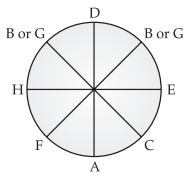
On the basis of the information given in the question, we have the sitting arrangement :
Image
From figure conclude the following :
(i) $A$ is sitting left or right to $C$.
(ii) All informations given in the question are required to ascertain the position of $C$.
(iii) $C$ is sitting between $A$ and $E$.
View full question & answer
Question 24 Marks
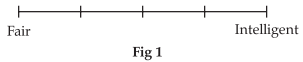
Read the information carefully and answer the questions based on it.
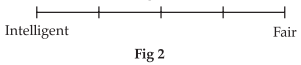
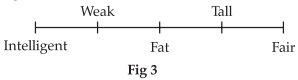
Five persons are sitting in a row. One of the two persons at the extreme ends in intelligent and other one is fair. A fat person is sitting to the right of a weak person. A tall person is to left of the fair person and the weak person is sitting between the intelligent and the fat person.
(i) Tall person is at which place counting from right?
(ii) Person to the left of weak person possesses which characteristic?
(iii) Which person is sitting at the centre?
View full question & answer
Question 34 Marks
The frustum of a right circular cone has a diameter of base 10 cm , top of 6 cm and a height of 5 cm , find the area of its whole surface and volume.
Answer
Here,
$
\begin{aligned}
r & =5 cm, r_2=3 cm \\
and\   h & =5 cm \\
l & =\sqrt{h^2+\left(r_1-r_2\right)^2} \\
& =\sqrt{5^2+(5-3)^2}=\sqrt{29} cm \\
& =5.383 cm
\end{aligned}
$
$\therefore$ Whole surface of the frustum
$
\begin{array}{l}
=\pi l\left(r_1+r_2\right)+\pi r_1^2+\pi r_2^2 \\
=\frac{22}{7} \times 5.383(5+3)+\frac{22}{7} \times 5^2+\frac{22}{7} \times 3^2 \\
=242.25 \text { sq. cm }
\end{array}
$
 $\begin{aligned} & and\ Volume =\frac{\pi h}{3}\left(r_1^2+r_2^2+r_1 r_2\right) \\ & =\frac{22}{7} \times \frac{5}{3}\left(5^2+3^2+5 \times 3\right) \\ & =256.67 cu . cm \end{aligned}$
View full question & answer
Question 44 Marks
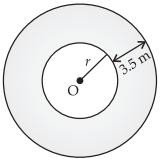
The circumference of a circular garden is 1012 m . Find the area of outsides road of 3.5 m width runs around it. Calculate the area of this road and find the cost of gravelling the road at ₹ 32 per 100 sq.m.
View full question & answer
Question 54 Marks
Two cyclists start from the same place to ride in the same direction. $A$ starts at noon at8 km / hr and $B$ at 1.30 p . m. at 10 km / h. How far will $A$ have ridden before he is overtaken by $B$ ? Find also at what times $A$ and $B$ will be 5 km apart.
Answer
If $A$ rides for $X$ hours before he is overtaken, then $B$ rides for $(X-1.5) hrs$
$
\begin{array}{ll}
\Rightarrow & 8 X=10(X-1.5) \\
\Rightarrow & X=7.5
\end{array}
$
$\Rightarrow$ A will have ridden $8 \times 7.5 km$ or 60 km .
For the second part, if the required number of hours after noon $=Y$, then
$8 X=10(X-1.5) \pm 5$
$\Rightarrow X=10$ or 5 according as $B$ is ahead or behind $A$
$\Rightarrow \text { The required times are } 5 \text { p.m. and } 10 \text { p.m. } $
View full question & answer
Question 64 Marks
A and B can do a piece of work in 45 days and 40 days respectively. They began to do the work together but A leaves after some days and then B complete the remaining work in 23 days. Find the number of days after which A left the work.
Answer
$(A+B)$ 's 1 day's work $=\left(\frac{1}{45}+\frac{1}{40}\right)=\frac{17}{360}$
Work done by B in 23 days $=\left(\frac{1}{40} \times 23\right)=\frac{23}{40}$
Remaining work $=\left(1-\frac{23}{40}\right)=\frac{17}{40}$
$\because \frac{17}{360}$ work was done by $(A+B)$ in 1 day
$\therefore \frac{17}{40}$ work done by $(A+B)$ in $\left(1 \times \frac{360}{17} \times \frac{17}{40}\right)$$
=9 \text { days }
$
Therefore, A left after 9 days.
View full question & answer
Question 74 Marks
$A$ is $50 \%$ as efficient as $B . C$ does half of the work done by $A$ and $B$ together. If $C$ alone does the work in 40 days, then in how many days $A, B$ and $C$ together finish the work.
Answer

$\begin{aligned}\text { (A's } 1 \text { day's work }):(B ' s ~ 1 \text { day's work }) & =150: 100 \\ & =3: 2 .\end{aligned}$
Let $A$ 's and $B^{\prime}$ s 1 day's work be $3 x$ and $2 x$, respectively.
$
\begin{array}{ll}
\text { Then, } & \text { C's } 1 \text { day's work }=\left(\frac{3 x+2 x}{2}\right)=\frac{5 x}{2} \\
\therefore & \frac{5 x}{2}=\frac{1}{40} \text { or } x=\left(\frac{1}{40} \times \frac{2}{5}\right)=\frac{1}{100}
\end{array}
$
$\begin{array}{l}\text { A's } 1 \text { day's work }=\frac{3}{100} \\ \text { B's } 1 \text { days work }=\frac{1}{50} \\ \text { C's } 1 \text { day work }=\frac{1}{40}\end{array}$
$\begin{aligned}(A+B+C) \text { 's } 1 \text { day's work } & =\left(\frac{3}{100}+\frac{1}{50}+\frac{1}{40}\right) \\ & =\frac{15}{200}=\frac{3}{40}\end{aligned}$
So, $A, B$ and $C$ together can do the work in
$\frac{40}{3}=13 \frac{1}{3}$ days.
View full question & answer
Question 84 Marks
A man who went out between 5 and 6 and returned between 6 and 7 found that the hands of the watch had exactly changed place. When did he go out?
Answer
Between 5 and 6 to 6 and 7 , hands will change place after crossing each other one time. i.e., they together will make $1+1=2$ complex revolutions.
Hour hand will move through $2 \times \frac{60}{13}$ or $\frac{120}{13}$ minute divisions.
Between 5 and $6 \rightarrow \frac{120}{13}$ minute divisions.
At 5, minute hand is 25 minute division behind the hour hand.
Hence, it will have to gain $25+\frac{120}{13}$ minute divisions on the hour-hand $=\frac{445}{13}$ minute divisions on the hour hand.
The minute hand gains $\frac{445}{13}$ minute divisions in $\frac{445}{13} \times \frac{12}{11}$ minutes
$
\begin{array}{l}
=\frac{5340}{143} \\
=37 \frac{49}{143} \text { minutes }
\end{array}
$
$\therefore$ The required time of departure is $37 \frac{49}{143} min$ past 5.
View full question & answer
Question 94 Marks
What was the day on the week on $17^{\text {th }}$ June, $1998 ?$
Answer
$\quad 17^{\text {th }}$ June, $1998=(1997$ years + Period from 1.1.1998 to 17.6 .1998 )
$\begin{array}{l} \text { odd day in } 1600 \text { years }=0 \\ \text { odd day in } 300 \text { years }=(5 \times 3) \equiv 1 \\ 97 \text { years has } 24 \text { leap year }+73 \text { ordinary years } \\ \begin{array}{l} \text { Number of odd days in } 97 \text { years } \\ =(24 \times 2+73) \\ =121 \\ \equiv 2 \text { odd days }\end{array}\end{array}$
Jan. Feb. March April May June
$
\begin{aligned}
(31+28+31+30 & +31+17) \\
& =168 \text { days } \\
& =24 \text { weeks } \\
& =0 \text { odd day }
\end{aligned}
$
$
\begin{aligned}
\text { Total number of odd days } & =0+1+2+0 \\
& =3
\end{aligned}
$
Thus, required day is Wednesday.
View full question & answer
Question 114 Marks
The average age of students of a class is 15.8 years. The average age of boys in the class is 16.4 years and that of the girl is 15.4 years. Find the ratio of the number of boys to the number of girls in the class.
Answer
Let the number of boys in the class be $x$.
Let the number of girls in the class be $y$.
$\therefore$ Sum of the ages of the boys $=16.4 x$
and sum of the age of the girls $=15.4 y$
Since, average age of students of class $=15.8$
$
\begin{aligned}
\therefore & & 15.8(x+y) & =16.4 x+15.4 y \\
\Rightarrow & & 0.6 x & =0.4 y \\
\Rightarrow & & \frac{x}{y} & =\frac{2}{3}
\end{aligned}
$
Hence, required ratio $=2: 3$.
View full question & answer
Question 124 Marks
Average salary of all the 50 employees including 5 officers of a company is ₹ 850 . If the average salary of the officer is ₹ 2500 . Find the average salary of the remaining staff of company.
Answer

$\begin{aligned} \text { Total salary of all } 50 \text { employees } & =850 \times 50 \\ & = ₹ 42500\end{aligned}$
$\begin{aligned} \text { Total salary of } 5 \text { officers } & =2500 \times 5 \\ & = ₹12500\end{aligned}$
$\begin{aligned} Remaining\ salary\ of\ 45 & =(50-5) \text { staff } \\ & =42500-12500 \\ & = ₹ 30000\end{aligned}$$
\begin{aligned}
\text { Average salary of remaining staff } & =\frac{30000}{45} \\
& = ₹ 667 \text { (approx.) }
\end{aligned}
$
Hence, average salary of the remaining staff of company is ₹ 667 (approx).
View full question & answer
Question 134 Marks
The average age of a class of 39 students is 15 years. If the age of the teacher be included, then the average increases by 3 months. Find the age of the teacher.
Answer

$\begin{aligned} \text { Total age of } 39 \text { students } & =39 \times 15=585 \text { years } \\ \text { Average age of } 40 \text { persons } & =15 \text { years } 3 \text { months } \\ & =\frac{61}{4} \text { years } \\ \text { Total age of } 40 \text { persons } & =\frac{61}{4} \times 40 \\ & =610 \text { years } \\ \therefore \quad \text { Age of teacher } & =610-585 \\ & =25 \text { years. }\end{aligned}$
View full question & answer
Question 144 Marks
The average weight of $A, B, C$ is 45 kg , If the average weight of $A$ and $B$ be 40 kg and that of $B$ and $C$ be 43 kg , find the weight of $B$.
Answer
Let $A, B, C$ represents their individual weights.
$
\begin{array}{l}
\text { Then, } \quad \frac{A+B+C}{3}=45 \\
\Rightarrow \quad A+B+C=45 \times 3=135 kg \\
A+B=40 \times 2=80 kg \\
\text { and } B+C=43 \times 2=86 kg
\end{array}
$
$
\begin{array}{ll}
\therefore \quad B & =(A+B)+(B+C) -(A + B + C) \\
& =80+86-135 \\
& =31 kg
\end{array}
$
Hence, weight of $B$ is 31 kg .
View full question & answer
4 Marks Questions - Applied Maths STD 11 Science Questions - Vidyadip