Questions

4 Marks Questions

🎯

Test yourself on this topic

7 questions · timed · auto-graded

Question 14 Marks
A girl throws a die. If she gets a 5 or 6, she tosses a coin three times and notes the number of heads. If she gets 1, 2, 3, or 4, she tosses a coin two times and notes the number of heads obtained. If she obtained exactly two heads, what is the probability that she threw 1, 2, 3, or 4 with the die?
Answer
When a die is thrown,
Sample space $=\{1,2,3,4,5,6\}$
Let $\quad$$E_1:$ Girl gets 5 or 6
$E_2:$ Girl gets $1,2,3$ or 4
Then, $\quad P\left(E_1\right)=\frac{2}{6}=\frac{1}{3}$
and$\quad$$P\left(E_2\right)=\frac{4}{6}=\frac{2}{3}$
When she get 5 or 6, she throws a coin three times.
Sample Space = {HHH, HHT, HTH, THH, HTT, THT, TTH, TTT}
Out of these 8 outcomes, exactly two heads are obtained in the 3 outcomes i.e., HHH, HHT, ΤΗΗ. If A denotes the event of getting exactly two heads, then
$P\left(\frac{A}{E_1}\right)=\frac{3}{8}$
Again, when she gets 1, 2, 3 or 4 she throws a coin two times.
Sample space = (HH, HT, TH, TT)
$\therefore \quad P\left(\frac{A}{E_2}\right)=\frac{1}{4}$
Thus, by Bayes' theorem, we have probability that girl gets exactly two heads, when she threw 1, 2, 3 or 4 with the die
$P\left(\frac{E_2}{A}\right)=\frac{P \cdot\left(E_2\right) \cdot P\left(\frac{A}{E_2}\right)}{P \cdot\left(E_1\right) \cdot P\left(\frac{A}{E_1}\right)+P\left(E_2\right) \cdot P\left(\frac{A}{E_2}\right)}$
$=\frac{\frac{2}{3} \times \frac{1}{4}}{\frac{1}{3} \times \frac{3}{8}+\frac{2}{3} \times \frac{1}{4}}=\frac{\frac{1}{6}}{\frac{1}{8}+\frac{1}{6}}=\frac{4}{7}$
View full question & answer
Question 24 Marks
In an automobile factory, certain parts are to be fixed into the chassis in a section before it moves into another section. On a given day, one of the three people $A, B$ and $C$ carries out this task. $A$ has $45 \%$ chance, $B$ has $35 \%$ chance and $C$ has $20 \%$ chance of doing the task. The probability that $A$, $B$ and $C$ will take more than the allotted time is $\frac{1}{6}, \frac{1}{10}$ and $\frac{1}{20}$, respectively. If it is found that the time taken is more than the allotted time, what is the probability that $A$ has done the task?
Answer
Let $E_1, E_2$ and $E_3$ denote the events of carrying out the task $A, B$ and $C$, respectively.
Let $H$ denote the event of taking more time.
Then, $P\left(E_1\right)=0.45, P\left(E_2\right)=0.35$ and $P\left(E_3\right)=0.20 \quad 1$
Also,
$P\left(\frac{H}{E_1}\right)=\frac{1}{6}, P\left(\frac{H}{E_2}\right)=\frac{1}{10}$ and $P\left(\frac{H}{E_3}\right)=\frac{1}{20}$
$\therefore P\left(\frac{E_1}{H}\right)$
$=\frac{P\left(E_1\right) \cdot P\left(\frac{H}{E_1}\right)}{P\left(E_1\right) \cdot P\left(\frac{H}{E_1}\right)+P\left(E_2\right) \cdot P\left(\frac{H}{E_2}\right)+P\left(E_3\right) \cdot P\left(\frac{H}{E_3}\right)}$
$=\frac{0.45 \times \frac{1}{6}}{\left(0.45 \times \frac{1}{6}\right)+\left(0.35 \times \frac{1}{10}\right)+\left(0.20 \times \frac{1}{20}\right)}$
$=\frac{0.075}{0.075+0.035+0.01}$
= 0.625
View full question & answer
Question 34 Marks
In a college, 70% students pass in Physics, 75% pass in Mathematics and 10% students fail in both. One student is chosen at random. What is the probability that :
(i) he passes in Physics given that he passes in Mathematics.
(ii) he passes in Mathematics given that he passes in Physics.
Answer
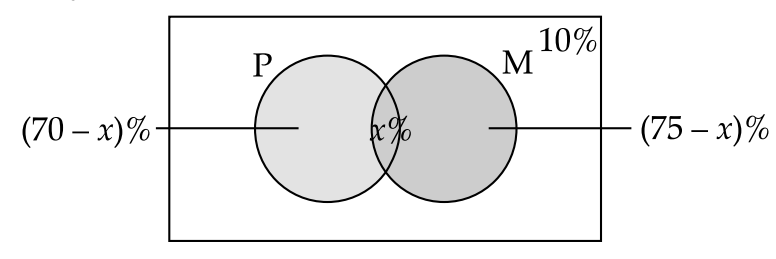
Let x% students passes in both Mathematics and Physics.
Image
Students who pass in Physics = 70%
$\therefore \quad P( P )=\frac{70}{100}$
Students who pass in Physics = 75%
$\therefore \quad P(M)=\frac{75}{100}$
Students who fail in both = 10%
Now, $70 \%-x+x+75 \%-x=90 \%$
$\Rightarrow \quad x=55 \%$
$\therefore \quad P(M \cap P)=\frac{55}{100}$
(i) Probability that student passes in Physics given that he passes in Mathematics is
$P\left(\frac{P}{M}\right)=\frac{P(M \cap P)}{P(M)}=\frac{\frac{55}{100}}{\frac{75}{100}}=\frac{55}{75}=\frac{11}{15}$.
(ii) Probability that student passes in Mathematics given that he passes in Physics is
$P\left(\frac{M}{P}\right)=\frac{P(M \cap P)}{P(P)}=\frac{\frac{55}{100}}{\frac{70}{100}}=\frac{55}{70}=\frac{11}{14}$.
View full question & answer
Question 44 Marks
A bag contains 8 red and 5 white balls. Two successive draws of all 3 balls are made at random from the bag without replacements. Find the probability that the first draw yields 3 white balls and second draw yields 3 red balls.
Answer
Let E: Event that 3 balls in the first draw are all white.
$F$ : Event that 3 balls in the second draw are all red. Now, 3 balls can be drawn out of 13 in ${ }^{13} C_3$ ways and 3 white balls can be drawn out of 5 in ${ }^5 C_3$ ways
$P(E)=\frac{{ }^5 C_3}{{ }^{13} C_3}=\frac{5!}{3!\times 2!} \times \frac{3!\times 10!}{13!}=\frac{5}{143}$
Since, 3 balls are not replaced before the second draw, we are left with 8 red and 2 white balls.
Now, 3 balls can be drawn in ${ }^{10} C _3$ ways and 3 red balls can be drawn in ${ }^8 C_3$ ways.
$P\left(\frac{F}{E}\right)=\frac{{ }^8 C_3}{{ }^{10} C_3}$
$=\frac{8!}{3!\times 5!} \times \frac{3!\times 7!}{10!}=\frac{7}{15}$
$\therefore \quad P(E \cap F)=P(E) \cdot P\left(\frac{F}{E}\right)=\frac{5}{143} \times \frac{7}{15}$
$=\frac{7}{429}$
View full question & answer
Question 54 Marks
A company has estimated the probabilities of success for three products introduced in the market are $\frac{1}{3}, \frac{2}{5}$ and $\frac{2}{3}$, respectively. Assuming independence, find the probability that
(i) the three products are successful.
(ii) none of the products is successful.
Answer
Let
$A=$ First product is successful
$B=$ Second product is successful
$C=$ Third product is successful
We have,
$P(A)=\frac{1}{3}, P(B)=\frac{2}{5}$
and $\quad P(C)=\frac{2}{3}$
(i) P (All three products are successful)
$=P(A \cap B \cap C)$
$=P(A) \cdot P(B) \cdot P(C)$
$(\because$ Given $A, B$ and $C$ are independent events$)$
$=\frac{1}{3} \times \frac{2}{5} \times \frac{2}{3}$
$=\frac{4}{45}$
(ii) P (None of the products is successful)
$=P(\bar{A} \cap \bar{B} \cap \bar{C})$
$=P(\bar{A}) \cdot P(\bar{B}) \cdot P(\bar{C})$
$=[1-P(A)] \cdot[1-P(B)] \cdot[1-P(C)]$
$=\left(1-\frac{1}{3}\right) \times\left(1-\frac{2}{5}\right) \times\left(1-\frac{2}{3}\right)$
$=\frac{2}{3} \times \frac{3}{5} \times \frac{1}{3}$
$=\frac{2}{15}$
View full question & answer
Question 64 Marks
If $P(E)=\frac{7}{13}, P(F)=\frac{9}{13}$ and $P(E \cap F)=\frac{4}{13}$, then evaluate: (i) $P\left(\frac{\bar{E}}{F}\right)$ (ii) $P\left(\frac{\bar{E}}{\bar{F}}\right)$.
Answer
Given, $P(E)=\frac{7}{13}, P(F)=\frac{9}{13}$ and $P(E \cap F)=\frac{4}{13}$
(i) $P\left(\frac{\bar{E}}{F}\right)=\frac{P(\bar{E} \cap F)}{P(F)}$
$=\frac{P(F)-P(E \cap F)}{P(F)}$
$=1-\frac{P(E \cap F)}{P(F)}$
$=1-\frac{4 / 13}{9 / 13}$
$=1-\frac{4}{9}=\frac{5}{9}$
(ii) $P(\bar{E} / \bar{F})=\frac{P(\bar{E} \cap \bar{F})}{P(\bar{F})}$
$=\frac{P(\overline{E \cup F})}{P(\bar{F})}$
$=\frac{1-P(E \cup F)}{1-P(F)}$
$\because \quad P(E \cup F)=P(E)+P(F)-P(E \cap F)$
$=\frac{7}{13}+\frac{9}{13}-\frac{4}{13}=\frac{12}{13}$
$\therefore \quad P\left(\frac{\bar{E}}{\bar{F}}\right)=\frac{1-\frac{12}{13}}{1-\frac{9}{13}}=\frac{\frac{1}{13}}{\frac{4}{13}}=\frac{1}{4}$
View full question & answer
Question 74 Marks
A die is rolled. If $E=\{1,3,5\}, F=\{2,3\}$ and $G=$ $\{2,3,4,5\}$, find (a) $P((E \cup F) / G)$, (b) $P((E \cap F) / G)$
Answer
Given, $E=\{1,3,5\}, F=\{2,3\}$ and $G=\{2,3,4,5\}$
$P(E)=\frac{3}{6}=\frac{1}{2}, P(F)=\frac{2}{6}=\frac{1}{3}$ and $P(G)=\frac{4}{6}=\frac{2}{3}$
Also, $\quad P(E \cap F)=\frac{1}{6}$
and $\quad P(E \cup F)=P(E)+P(F)-P(E \cap F)=\frac{2}{3}$
(i) $\quad(E \cup F) \cap G=\{2,3,5\}$
$\therefore \quad P[(E \cup F) \cap G]=\frac{3}{6}=\frac{1}{2}$
Therefore,
$p\left[\frac{(E \cup F)}{G}\right]=\frac{p[(E \cup F) \cap G]}{P(G)}$
$=\frac{\frac{1}{2}}{\frac{2}{3}}=\frac{3}{4}$
(ii) $\quad(E \cap F) \cap G=\{3\}$
$\therefore \quad P[(E \cap F) \cap G]=\frac{1}{6}$
Therefore,
$p \frac{[(E \cap F)]}{G}=p \frac{[(E \cap F) \cap G]}{P(G)}$
$=\frac{\frac{1}{6}}{\frac{2}{3}}=\frac{3}{2 \times 6}=\frac{1}{4}$
View full question & answer
4 Marks Questions - Applied Maths STD 11 Science Questions - Vidyadip