Question 12 Marks
The cartesian product $A \times A$ has 9 elements among which are found $(-1,0)$ and $(0,1)$. Find the set $A$ and the remaining elements of $A \times A$.
AnswerGiven, $(-1,0) \in A \times A$ and $(0,1) \in A \times A$
$\Rightarrow \quad A=\{-1,0,1\}$
$\therefore \quad A \times A=\{-1,0,1\} \times\{-1,0,1\}$
={(-1,-1),(-1,0),(-1,1),(0,-1),(0,0),(0,1),(1,-1),(1,0),(1,1)}
Thus, remaining elements are {(-1,-1),(-1,1)(0,-1), (0,0),(1,0),(1,-1),(1,1)}
$\therefore \quad$ Domain $=\{-1,0,1\}$
and $\quad$ Range $=\{-1,0,1\}$
View full question & answer→Question 22 Marks
Let $A=\{2,3,4,5,6,7,8,9\}$. Let $R$ be the relation on $A$ defined by $\{(x, y): x, y \in A, x$ is a multiple of $y$ and $x \neq y\}$.
(i) Find the relation.
(ii) Find the domain of $R$.
(iii) Find the range of $R$.
(iv) Find the inverse relation.
Answer(i) $R=\{(4,2)(6,2)(8,2)(6,3)(9,3)(8,4)\}$
(ii) Domain of $R=\{4,6,8,9\}$
(iii) Range of $R=\{2,3,4\}$
(iv) $R^{-1}=\{(2,4)(2,6)(2,8)(3,6)(3,9)(4,8)\}$
View full question & answer→Question 32 Marks
Let $A=\{1,2,3,4\}, B=\{1,4,9,16,25\}$ and $R$ be a relation defined from $A$ to $B$ as, $R=\{(x, y): x \in A$, $y \in B$ and $\left.y=x^2\right\}$
(i) Depict this relation using arrow diagram.
(ii) Find domain of $R$.
(iii) Find range of $R$.
(iv) Write co-domain of $R$.
AnswerGiven, $A=\{1,2,3,4\}$ and $B=\{1,4,9,16,25\}$ and
$R=\left\{(x, y): x \in A, y \in B\right.$ and $\left.y=x^2\right\}$
(i) Relation $R=\{(1,1),(2,4),(3,9),(4,16)\}$
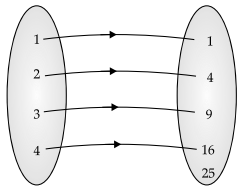
(ii) Domain of $R=\{1,2,3,4\}$
(iii) Range of $R=\{1,4,9,16\}$
(iv) Co-domain of $R=\{1,4,9,16,25\}$ View full question & answer→Question 42 Marks
$A=\{1,2,3,4,5\}, S=\{(x, y): x \in A, y \in A\}$, then find the ordered which satisfy the conditions given below. (i) $x+y<5$ (ii) $x+y>8$
Answer Given,
$ \begin{aligned} A & =\{1,2,3,4,5\} \\ and\ S & =\{(x, y): x \in A, y \in A\} \end{aligned} $
(i) The set of ordered pairs satisfying $x+y<5$ is $\{(1$, 1), $(1,2),(1,3),(2,1),(2,2),(3,1)\}$.
(ii) The set of ordered pairs satisfying $x+y>8$ is $\{(4$, $5),(5,4),(5,5)\}$
View full question & answer→Question 52 Marks
If $R_2=\left\{(x, y) \mid x\right.$ and $y$ are integers and $x^2+y^2=$ $64\}$ is a relation, then find the value of $R_2$.
Answer Given, $R_2=\left\{(x, y) \mid x\right.$ and $y$ are integers and $x^2+y^2$ $=64 \}$
Since, 64 is the sum of squares of 0 and $\pm 8$.
When $x=0$, then $y^2=64 \Rightarrow y= \pm 8$
When $x=8$, then $y^2=64-8^2 \Rightarrow 64-64=0$
When $x=-8$, then $y^2=64-(-8)^2 \Rightarrow 64-64=0$
$\therefore R_2=\{(0,8),(0,-8),(8,0),(-8,0)\}$
View full question & answer→Question 62 Marks
Let $R$ be the relation on $Z$ defined by $R=\{(a, b)$ : $a, b \in Z_r a-b$ is an integer $\}$. Find the domain and range of $R$.
Answer Given, $R=\{(a, b): a, b \in Z, a-b$ is an integer $\}$
We know that, if two numbers are integer, then their difference is also integer.
$\therefore$ Domain $=Z$, Range $=Z$
View full question & answer→Question 72 Marks
Let $A=\{$ All prime numbers less than 10$\}$ and $B=\{$ all odd number less than 10$\}$. Find $(A-(A \cap B))$.
Answer Here, $A=\{2,3,5,7\}$ and $B=\{1,3,5,7,9\}$
$
\begin{array}{lll}
A \cap B=\{2,3,5,7\} \cap\{1,3,5,7,9\}=\{3,5,7\} \\
A-(A \cap B)=\{2,3,5,7\}-\{3,5,7\}=\{2\}
\end{array}
$
View full question & answer→Question 82 Marks
Are sets $A=\{1,2,3,4\}, B=\{x: x \in N$ and $5 \leq x \leq 7\}$ disjoint ? Why?
Answer Yes, sets $A$ and $B$ are disjoint, because $A \cap B=\phi$.
$
\begin{array}{lrlr}
\because A =\{1,2,3,4\} \\
\text { and } B =\{5,6,7\} \\
A \cap B =\{1,2,3,4\} \cap\{5,6,7\}=\phi
\end{array}
$
View full question & answer→Question 92 Marks
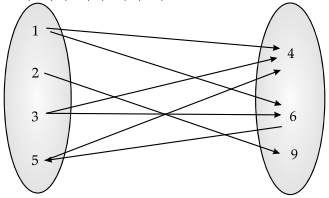
$A=\{1,2,3,5\}$ and $B=\{4,6,9\}$. Define a relation $R$ from $A$ to $B$ by $R=\{(x, y)$ : the difference between $x$ and $y$ is odd; $x \in A, y \in B\}$. Write $R$ in roster form.
AnswerHere Given, $R=\{(x, y)$ : the difference between $x$ and $y$ is odd, $x \in A, y \in B\}$ or, $R=\{(1,4),(1,6),(2,9)$, $(3,4),(3,6),(5,4),(5,6)\}$.
View full question & answer→Question 102 Marks
Let $A$ and $B$ be two sets such that $n(A)=3$ and $n(B)$ $=2$. If $(x, 1),(y, 2),(z, 1)$ are in $A \times B$, find $A$ and $B$, where $x, y, z$ are distinct elements.
AnswerGiven, $A \times B=\{(x, 1),(y, 2),(z, 1)\}$
Here, $x, y, z \in A$ and $1,2 \in B \Rightarrow A=\{x, y, z\}$ and $B$ $=\{1,2\}$.
View full question & answer→Question 112 Marks
Find the number of elements from set $X$ to set $Y$ if $X=\{1,2,3\}$ and $Y=\{a, b\}$.
AnswerGiven, $X=\{1,2,3\}$ and $Y=\{a, b\}$
Since, $X \times Y=$ $\{(1, a),(1, b),(2, a),(2, b),(3, a),(3, b)\}$
Therefore, number of elements from set $X$ to set $Y=6$
View full question & answer→Question 122 Marks
If $P=\{1,3\}, Q=\{2,3,5\}$, find the number of relations from $P$ to $Q$.
AnswerGiven,
$P=\{1,3\}$ and $Q=\{2,3,5\}$
$
\begin{array}{l}
\therefore n(P)=2 \text { and } n(Q)=3 \\
\quad \text { Number of relations }=2^{n(P)} \times n(Q)
\end{array}
$
$\begin{array}{l}=2^{2 \times 3} \\ =2^6 \\ =64\end{array}$
View full question & answer→Question 132 Marks
If $A=\{-1,1\}$, find $A \times A \times A$.
AnswerGiven,
$\begin{array}{l}A=\{-1,1\}, A \times A=\{-1,1\} \times\{-1,1\}= \\ \{(-1,-1),(-1,1),(1,-1),(1,1)\} \\ \text { Again, } A \times A \times A=\{(-1,-1),(-1,1),(1,-1),(1,1)\} \times\{-1,1\} \\ =\{(-1,-1,-1),(-1,-1,1),(-1,1,-1),(-1,1,1),(1, \\ -1,-1),(1,-1,1),(1,1,-1),(1,1,1)\}\end{array}$
View full question & answer→Question 142 Marks
If $A=$ set of letters of the word 'DELHI' and $B=$ the set of letters the word 'DOLL' find $A \cup B$.
AnswerHere, $A=\{ D , E , H , I , L \}$ and $B=\{ D , L , O \}$
$
\begin{aligned}
A \cup B & =\{D, E, H, I, L\} \cup\{D, L, O\} \\
& =\{D, E, H, I, L, O\}
\end{aligned}
$
View full question & answer→Question 152 Marks
The collection of difficult topics in Mathematics is a set or not. Justify your answer.
AnswerThe collection of difficult topic in Mathematics is not a set, because the term 'difficult topic' is not well defined.
View full question & answer→Question 162 Marks
List all the proper subsets of $\{0,1,2,3\}$.
AnswerProper subsets of the given set are :
$\phi$, {0}, {1}, {2}, {3}, {0,1}, {0,2), {0,3}, {1,2}, {1,3}, {2,3}, {0,1,2}, {0,1,3}, {0,2,3}, {1,2,3},{0,1,2,3}.
View full question & answer→Question 172 Marks
Write the set of all positive integers whose cube is odd in the builder form.
Answer$\{x: x$ is an odd positive integer $\}$ as we are aware cube of an even positive integer is an even positive integer and cube of an odd integer is always an odd positive integer, therefore, the members of the required set are all positive odd integers. Also, it can be written as $\{x: x=2 p+1$ and $p \in W\}$.
View full question & answer→Question 182 Marks
If $A=\{3 n+5: n \leq N$ and $n \leq 6\}$, then represent set $A$ in the roster form.
Answer$A=\{3 n+5: n \in N, n \leq 6\}=\{8,11,14,17,20,23\}$.
View full question & answer→