Question types

Model Paper 1 question types

27 questions across 14 question groups — pick any mix to generate a English Core paper with step-by-step answer keys.

27
Questions
14
Question groups
5
Question types
Sample Questions

Model Paper 1 questions

One sample from each question group in this chapter. Select any group above to see the full set with answer keys.

As the years rolled by we saw less of each other. For some time she continued to wake me up and get me ready for school. When I came back she would ask me what the teacher had taught me. I would tell her English words and little things of western science and learning, the law of gravity, Archimedes' Principle, the world being round, etc. This made her unhappy. She could not help me with my lessons. She did not believe in the things they taught at the English school and was distressed that there was no teaching about God and the scriptures. One day I announced that we were being given music lessons. She was very disturbed. To her music had lewd associations. It was the monopoly of harlots and beggars and not meant for gentlefolk. She said nothing but her silence meant disapproval. She rarely talked to me after that.
i. Why was the grandmother distressed about the education the narrator received at the English school?
ii. As the grandson, how would you persuade your grandmother that music and English education are valuable, considering her disapproval and traditional beliefs?
iii. Pick evidence from passage that suggests that the protagonist's grandmother was unhappy with the content of his school education.
View full solution
My headache soon cleared as we careered down the other side of the pass. It was two o'clock by the time we stopped for lunch. We ate hot noodles inside a long canvas tent, part of a workcamp erected beside a dry salt lake. The plateau is pockmarked with salt flats and brackish lakes, vestiges of the Tethys Ocean which bordered Tibet before the great continental collision that lifted it skyward. This one was a hive of activity, men with pickaxes and shovels trudging back and forth in their long sheepskin coats and salt-encrusted boots. All wore sunglasses against the glare as a steady stream of blue trucks emerged from the blindingly white lake laden with piles of salt.
By late afternoon we had reached the small town of Hor, back on the main east- west highway that followed the old trade route from Lhasa to Kashmir. Daniel, who was returning to Lhasa, found a ride in a truck so Tsetan and I bade him farewell outside a tyre-repair shop. We had suffered two punctures in quick succession on the drive down from the salt lake and Tsetan was eager to have them fixed since they left him with no spares. Besides, the second tyre he'd changed had been replaced by one that was as smooth as my bald head.
i. Describe the scene at the workcamp beside the dry salt lake.
ii. Provide one possible interpretation or inference that can be made from the statement, "The plateau is pockmarked with salt flats and brackish lakes, vestiges of the Tethys Ocean which bordered Tibet before the great continental collision that lifted it skyward."
iii. Identify the line from the passage that provides evidence of the geographical features of the plateau near the dry salt lake and their connection to the ancient Tethys Ocean.
View full solution
The poet Shirley Toulson has paid a tribute to her mother. Similar instances can be seen in The Portrait of a Lady. This made you think that writing about a loved one is much better than building their statues or drawing their portraits. Comment.
View full solution
Silence surrounds us. I would have
Him prodigal, returning to
His father's house, the home he knew,
Rather than see him make and move
His world. I would forgive him too,
Shaping from sorrow a new love.
i. Explain: 'Silence surrounds us'.
ii. What does the father want his son to do?
iii. What is the father prepared to accept?
View full solution
That year we lived at the edge of town, on Walnut Avenue. Behind our house was the country: vineyards, orchards, irrigation ditches, and country roads. In less than three minutes we were on Olive Avenue, and then the horse began to trot. The air was new and lovely to breathe. The feel of the horse running was wonderful. My cousin Mourad who was considered one of the craziest members of our family began to sing. I mean, he began to roar.
i. Complete the sentence appropriately.
The phrase " he began to roar" suggests that ________.
ii. List ant two sensory details present in the extract.
iii. Identify a line from the extract that supports the fact that the narrator and his cousin resided in a rural area.
iv. What is the central idea of this extract?
A. A boy's joyful ride with his cousin
B. A boy's dark secret
C. A boy's school picnic
D. A boy's narrow escape from a fatal accident
View full solution
Inside, a narrow stair led up to a small bedroom, clean but poorly furnished, and lit only by an oil lamp. Here Mrs Morgan's mother, a tall, grey-haired woman of nearly seventy, and the stout, elderly midwife waited beside the patient, watching Andrew's expression as he moved about the room. "Let me make you a cup of tea, Doctor, bach," said the former quickly, after a few moments. Andrew smiled faintly. He saw that the old woman, wise in experience, realised there must be a period of waiting that, she was afraid he would leave the case, saying he would return later. "Don't fret, mother, I'll not run away." Down in the kitchen he drank the tea which she gave him. Overwrought as he was, he knew he could not snatch even an hour's sleep if he went home. He knew, too, that the case here would demand all his attention. A queer lethargy of spirit came upon him. He decided to remain until everything was over.
i. Complete the sentence appropriately.
The author has described the Morgan's place that Andrew saw. It was a ________.
ii. In the given extract, which of the following emotions was NOT displayed in Mrs. Morgan's mother's disposition?
a. Afraid
b. Anxious
c. Worried
d. Irate
iii. What trait of the old lady has the author reflected through her words, "Let me make you a cup of tea, Doctor, bach"?
iv. What was Andrew "Overwrought" with? What did he ultimately decide?
View full solution
Read the text carefully and answer the questions :
1. As a form of expression, graffiti is famously characterized by outlaw values; the creation and display of graffiti countered societal rules and was considered by some as vandalism. Not only was it symbolic of rebel values but was also linked to destruction of property. These links between graffiti culture and rebellion were age-old and some say, were popularized by hip-hop culture.
2. Imagine waking up one morning, to see your walls smeared with black paint names, symbols, messages. The most interesting bit is that these wall artists were never caught red-handed. It was all done stealthily. It was almost as though people were marking their territory using painted symbols and slogans. The change was creeping in. Mobile numbers and captivating phrases gradually became marketing tools for free advertising. Catchy phrases tickled the curiosity and calls were made to those numbers.
3. Over a period of time, there was a shift in perception. Blank walls beckoned invitingly and artists saw whitewashed walls as an opportunity to display their work in free and open settings. The city became one large canvas; the illegal 'gang activity' became an art form on display in walking galleries. Graffiti was gradually being replaced and the stigma of illegality was being dropped. There was a move to embrace rather than condemn.
4. The colours, shapes, and subjects became cultural themes. What was once rebellious expression is artistic talent at its vibrant best, rich in images of plants, animals and unspoiled landscapes. The painted walls encouraged by residents and governments have created their own ecosystem a reconciliation of nature with man-made forces.
5. The monotony and uniformity of urban life is today infused with human vitality and beauty. Cities speak proudly about the painted walls and clamour to be the first to preserve culture and history through these. Graphic displays of social awareness issues effectively and economically reach out to the common man. Silent art speaks volumes. Be it hygiene, conservation, education, or rights and duties the message is conveyed in an animated, colourful manner without being an imposition.
(i) Complete the sentence by choosing an appropriate option. Graffiti in the earlier years was
a) considered a valuable legacy. b) supported by society.
c)an expression of rebellion. d) done by prominent artists.
(ii) Comment on the writer's statement, It was all done stealthily.
(iii) List two reasons why graffiti was not popular among people.
(iv) Select the word from para 2 of the passage that conveys the opposite of boring.
(v) The writer would agree with all of the following EXCEPT:
a) Graffiti became popular as a marketing tool. b) Wall art was an age-old tradition.
c) Graffiti art was a paid activity. d) People were curious by what was scribbled on walls.
(vi) Which word from the following most nearly means reconciliation with reference to the given context? (para 4)
a) cease fire b) combination
c) reunion d) resolution
(vii) Why does the writer say that the stigma of illegality was dropped?
(viii) Complete the following sentence with reference to the passage: The city became one large canvas because ________.
(ix) The passage states a shift in attitude. Identify the best option that indicates this shift.
a) dislike to acceptance b)rejection to dismissal
c) imposition to acceptance d) confusion to clarity
(x) List two ways in which wall art is beneficial to society.
View full solution
Read the text carefully and answer the questions:
1. Millions of tons of small waste from plastic bags, bottles and clothes in the world's ocean present a serious threat to human health and marine environment. This is a warming issued by the U.N. in a report on the most dangerous environmental problem facing the world today. Global plastic production has increased considerably in years nearly by 38%.
2. A poor waste management means when we have finished with our takeaways contains cigarette butts and party balloons, they are worn down into trillions of even small particles by the waves. Therefore, there is a growing presence of these micro plastic the world's oceans.
3. It was estimated in 2010 that millions of tons of plastic was washed into the season have since shown up in the stomachs of whales, plankton and other marine life. Richard Thompson, professor of marine biology said that in laboratory experiments the proof that micro plastic an cause harm to organisms.
4. More than a quarter of all fish now contained plastic, according to a recent study why analysed the guts of fish sold in California. Scientist fear that chemical sin plastician also chemicals which attach themselves to plastic in natural environment could each poisoning and many disorders in marine lie if consumed in huge quantities.
5. Even human could be adversely affected by the plastic. People could even be brething in plastic micro-particles suspended in the air with the risk of harmful effect on the lungs similar to air fumes.
6. Volunteers around the world collect trash and tally up what they find on the fall in Ocean's Conservancy's Annual International Coastal Cleanup. The result item- by-item, location-by-location Ocean Trash Index provides the only snapshot of marine debris littering coasts and waterways around the world, according to Ocean Conservancy.
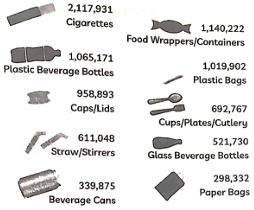
Image
7. Boyance Slat, a Dutch student has developed a technology that could sift dangerous plastic particle out of the ocean and sell them for profit or re-cycling. Richard Thompson recommended that people avoid using products with micro beads and to make sure they dispose of all plastic products in a appropriate way by, if possible.
(i) Select the option that is true for the two statements given below.
(1) More than a quarter of all fish now have plastics present in them.
(2) Millions of tons of plastic waste is present in the world's oceans.
a. (1) is the result of (2)
b. (1) is the reason for (2)
c. Both (1) and (2) are true
d. (1) contradicts (2)
(ii) According to the passage, Richard Thompson is a ________.
(iii) ________ provides the only snapshot of marine debris littering coasts and waterways.
(iv) Through what does the cigarette butts and party balloons worn down into smaller particles?
(v) We can find out that more than a quarter of all fish contained plastics in them by:
a. the stark warming issued by the UN in a report on the most dangerous environmental problems facing the world today.
b. collecting trash and tallying up what they find each day.
c. laboratory experiments performed by Richard Thompson a profession marine biology.
d. analysing the fish sold in California.
(vi) Choose the correct set of statement which is NOT TRUE.
(I) Plastic could have similar effects like car fumes.
(II) Chemicals which attach themselves to plastic in natural environment could cause poisoning in marine life.
(III) Humans will never be adversely affected by the plastic.
(IV) In 2001, Millions of tons of plastic was washed into the sea.
(V) There is a growing presence of micro plastics in the world's oceans.
a. (II), (V)
b. (I), (V)
c. (I), (II)
d. (III), (IV)
(vii) What amount of paper bags in the index are diffused into the oceans?
(viii) Fill in the blank with with the correct option.
There are ________ beverage cans found in the index.
a. 337,865
b. 339,875
c. 339,445
d. 333,347
View full solution
Read the passage given below and answer the questions that follow:
It is surprising that sometimes we don't listen to what people say to us. We hear them, but we don't listen to them. I was curious to know how hearing is different from listening. I had thought both were synonyms, but gradually, I realised there is a big difference between the two words.
Hearing is a physical phenomenon. Whenever somebody speaks, the sound waves generated reach you, and you definitely hear whatever is said to you. However, even if you hear something, it doesn't always mean that you actually understand whatever is being said. Paying attention to whatever you hear means you are really listening. Consciously using your mind to understand whatever is being said is listening.
Diving deeper, I found that listening is not only hearing with attention but is much more than that. Listening is hearing with full attention and applying our mind. Most of the time, we listen to someone, but our minds are full of needless chatter and there doesn't seem to be enough space to accommodate what is being spoken.
We come with a lot of prejudices and preconceived notions about the speaker or the subject on which he is talking. We pretend to listen to the speaker, but deep inside, we sit in judgment and are dying to pronounce right or wrong, true or false, yes or no. Sometimes, we even come prepared with a negative mindset of proving the speaker wrong. Even if the speaker says nothing harmful, we are ready to pounce on him with our own version of things.
What we should ideally do is listen first with full awareness. Once we have done that, we can decide whether we want to make a judgment or not. Once we do that, communication will be perfect and our interpersonal relationship will become so much better. Listening well doesn't mean one has to say the right thing at the right moment. In fact, sometimes if words are left unspoken, there is a feeling of tension and negativity. Therefore, it is better to speak out your mind but do so with awareness after listening to the speaker with full concentration.
Let's look at this in another way. When you really listen, you imbibe not only what is being spoken, but you also understand what is not spoken as well. Most of the time we don't really listen even to people who really matter to us. That's how misunderstandings grow among families, husbands and wives, brothers and sisters.
On the basis of your understanding of the above passage, make notes on it using headings and sub-headings. Use recognizable abbreviations (wherever necessary- minimum four) and a format you consider suitable. Also supply an appropriate title to it.
1. Write a summary of the passage in about 80 words.
View full solution
You are a fitness trainer in a health club. Design a poster in not more than 50 words, to emphasise the importance of exercise in maintaining mental and physical fitness. You are Prem/Priya. ### As an educationist, you have noticed that the present generation has lost the habit of reading. Design a poster in not more than 50 words highlighting the importance of reading and the value of books.
View full solution
You are Anshu/Anita. You have secured 95 percent marks in English. Your English teacher has persuaded you to share the secret of your success with your schoolmates. You decide to deliver a speech 'English is an extremely scoring subject' in the morning assembly. Write the speech in about 150-200 words. ### It is true that water will become a scarce commodity in the near future. We are notorious for wasting water. We waste water during weddings. We waste water at our homes and also at our schools. Write a speech in 150-200 words on the topic, Water is precious; use it wisely to be delivered in the school morning assembly. You are Govind/Govindi.
View full solution
You are Mohan/Mohini, General Manager of PK Industries, Hyderabad. You need an Accountant for your company. Draft in not more than 50 words an advertisement to be published in 'The Hindu' in classified columns. ### You are Ratan/Rani, General Manager of Hotel Green Park, Lucknow. You need a receptionist for your hotel. Draft an advertisement in not more than 50 words to be published in 'Hindustan Times', Lucknow, calling for applications.
View full solution

Generate a Model Paper 1 paper free

Pick question groups from the list above, set marks and difficulty, and export a branded PDF with step-by-step answer keys. First 3 chapters free — no signup.

Download App