Questions

3 Marks Question

🎯

Test yourself on this topic

9 questions · timed · auto-graded

Question 13 Marks
Show that the three points A(2, 3, 4), B(-1, 2, -3) and C(-4, 1, -10) are collinear and find the ratio in which C divides AB.
Answer
Given points are A(2, 3, 4), B(-1, 2, -3) and C(-4, 1, -10)
$\text{AB}=\sqrt{(2+1)^2+(3-2)^2+(4+3)^2}$
$=\sqrt{9+1+49}=\sqrt{59}$
$\text{BC}=\sqrt{(-1+4)^2+(2-1)^2+(-3+10)^2}$
$=\sqrt{9+1+49}=\sqrt{59}$
$\text{AC}=\sqrt{(2+4)^2+(3-1)^2+(4+10)^2}$
$=\sqrt{36+4+196}=\sqrt{236}=2\sqrt{59}$
$\therefore\text{AB}+\text{BC}=\text{AC}$
$\sqrt{59}+\sqrt{59}=2\sqrt{59}$
Hence, A, B and C are collinear and $\text{AC}:\text{BC}=2\sqrt{59}:\sqrt{59}=2:1$
Hence, C divides AB is 2 : 1 externally.

View full question & answer
Question 23 Marks
Let $A, B, C$ be the feet of perpendiculars from a point $P$ on the $x, y, z-$axis respectively. Find the coordinates of $A, B$ and $C$ in each of the following where the point $P$ is:
  1. $A(3, 4, 2).$
  2. $B(-5, 3, 7).$
  3. $C(4, -3, -5).$
Answer
The coordinates of $A, B$ and $C$ are:
  1. $A(3, 0, 0), B(0, 4, 0),$ and $C(0, 0, 2).$
  2. $A(-5, 0, 0), B(0, 3, 0)$ and $C(0, 0, 7)$.
  3. $A(4, 0, 0), B(0, -3, 0)$ and $C(0, 0, -5).$
View full question & answer
Question 33 Marks
Prove that the points (0, -1, -7), (2, 1, -9) and (6, 5, -13) are collinear. Find the ratio in which the first point divides the join of the other two.
Answer
Let the given points are A(0, -1, -7), B(2, 1, -9) and C(6, 5, -13)
$\text{AB}=\sqrt{(2-0)^2+(1+1)^2+(-9+7)^2}$
$=\sqrt{4+4+4}=\sqrt{12}=2\sqrt{3}$
$\text{BC}=\sqrt{(6-2)^2+(5-1)^2+(-13+9)^2}$
$=\sqrt{16+16+16}=\sqrt{48}=4\sqrt{3}$
$\text{AC}=\sqrt{(6-0)^2+(5+1)^2+(-13+7)^2}$
$=\sqrt{36+36+36}=\sqrt{108}=6\sqrt{3}$
$2\sqrt{3}+4\sqrt{3}=6\sqrt{3}$
i.e., $\text{AB}+\text{BC}=\text{AC}$
$\therefore\text{AB}:\text{AC}=2\sqrt{3}:6\sqrt{3}=1:3$
Hence, point A divides B and C in 1 : 3 externally.
View full question & answer
Question 43 Marks
Find the coordinate of the points which trisect the line segment joining the points$ \text{A}(2, 1, -3)$ and $\text{B}(5, -8, 3).$
Answer
Let $\text{P}(x_1, y_1, z_1) $and $\text{Q}(x_2, y_2, z_2)$ trisect line segment $\text{AB}.$

Since point $\text{P}$ divides $\text{AB}$ in the ratio $1 : 2$ internally, we have
$\text{P}(\text{x}_1,\text{y}_1,\text{z}_1)\equiv\text{P}\Big(\frac{1(5)+2(2)}{2+1},\frac{1(-8)+2(1)}{2+1},\frac{1(3)+2(-3)}{2+1}\Big)$
$\equiv\text{P}(3,-2,-1)$
Since point $\text{Q}$ divides $\text{AB}$ in the ratio $2 : 1$ internally, we have
$\text{P}(\text{x}_2,\text{y}_2,\text{z}_2)\equiv\text{Q}\Big(\frac{2(5)+1(2)}{2+1},\frac{2(-8)+1(1)}{2+1},\frac{2(3)+(-3)}{2+1}\Big)$
$\equiv\text{Q}(4,-5,1)$
View full question & answer
Question 53 Marks
Show that the point A(1, -1, 3), B(2, -4, 5) and C(5, -13, 11) are collinear.
Answer
Given points are A(1, -1, 3), B(2, -4, 5) and C(5, -13, 11)
$\text{AB}=\sqrt{(2-1)^2+(-4+1)^2+(5-3)^2}$
$=\sqrt{1+9+4}=\sqrt{14}$
$\text{BC}=\sqrt{(5-2)^2(-13+4)^2+(11-5)^2}$
$=\sqrt{9+81+36}=\sqrt{126}=3\sqrt{14}$
$\text{AC}=\sqrt{(5-1)^2+(-13+1)^2+(11-3)^2}$
$=\sqrt{16+144+64}=\sqrt{224}=4\sqrt{14}$
Here we observe that $\sqrt{14}+3\sqrt{14}=4\sqrt{14}$
So, $\text{AB}+\text{BC}=\text{AC}.$
Hence, the given points are collinear.
View full question & answer
Question 63 Marks
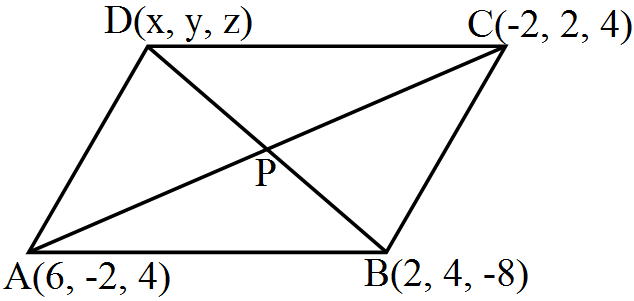
Three consecutive vertices of a parallelogram ABCD are A(6, -2, 4), B(2, 4, -8), C(-2, 2, 4). Find the coordinates of the fourth vertex.
[Hint: Diagonals of a parallelogram have the same mid-point.]
Answer
Let the coordinates of the fourth vertex D be (x, y, z).

Mid-point of diagonal AC is $\text{P}\Big(\frac{6-2}{2},\ \frac{-2+2}{2},\ \frac{4+4}{2}\Big)\equiv\text{P}(2,0,4)$
Also, mid-point of BD is $\text{P}\Big(\frac{\text{x}+2}{2},\frac{\text{y}+4}{2},\frac{\text{z}-8}{2}\Big).$
Now, $\text{P}\Big(\frac{\text{x}+2}{2},\frac{\text{y}+4}{2},\frac{\text{z}-8}{2}\Big)\equiv\text{P}(2,0,4)$
One equating coordinates, we get,
$\frac{\text{x}+2}{2}=2\Rightarrow\text{x}=2;$
$\frac{\text{y}+4}{2}=0\Rightarrow\text{y}=-4;$
$\frac{\text{z}-8}{2}=4\Rightarrow\text{z}=16$
So, the coordinate of fourth vertex D are given as (2, -4, 16).
View full question & answer
Question 73 Marks
Show that the triangle ABC with vertices A(0, 4, 1), B(2, 3, -1) and C(4, 5, 0) is right angled.
Answer
Given vertices are A(0, 4, 1), B(2, 3, -1) and C(4, 5, 0),
$\text{AB}=\sqrt{(2-0)^2+(3-4)^2+(-1-1)^2}$
$=\sqrt{4+1+4}=\sqrt{9}=3$
$\text{BC}=\sqrt{(4-2)^2+(5-3)^2+(0+1)^2}$
$=\sqrt{4+4+1}=\sqrt{9}=3$
$\text{AC}=\sqrt{(4-0)^2+(5-4)^2+(0-1)^2}$
$=\sqrt{16+1+1}=\sqrt{18}$
$\because(3)^2+(3)^2=(\sqrt{18})^2$
So, $\text{AB}^2+\text{BC}^2=\text{AC}^2$
Hence, $\triangle\text{ABC}$ is a right angled triangle.
View full question & answer
Question 83 Marks
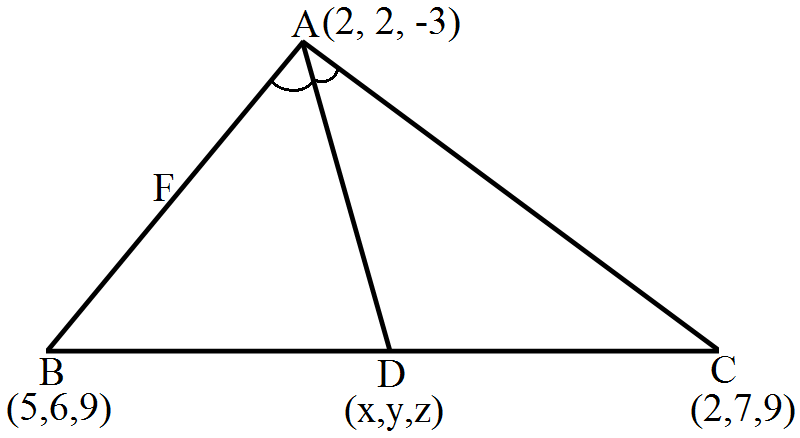
Let A(2, 2, -3), B(5, 6, 9) and C(2, 7, 9) be the vertices of a triangle. The internal bisector of the angle A meets BC at the point D. Find the coordinates of D.
Answer
Let the coordinates of D be (x, y, z).

$\text{AB}=\sqrt{(5-2)^2+(6-2)^2+(9+3)^2}$ $=\sqrt{9+16+144}=\sqrt{169}=13$
$\text{AC}=\sqrt{(2-2)^2+(7-2)^2+(9+3)^2}$ $=\sqrt{0+25+144}=\sqrt{169}=13$
Thus, ABC is isosceles triangle with AB = AC.
So, angle bisector AD bisects BC or we can say that D is mid-point of BC.
$\therefore\text{D}\equiv\Big(\frac{5+2}{2},\frac{6+7}{2},\frac{9+9}{2}\Big)\equiv\Big(\frac{7}{2},\frac{13}{2},9\Big)$
View full question & answer
Question 93 Marks
Let $A, B, C$ be the feet of perpendiculars from a point $P$ on the $xy, yz$ and $zx-$planes respectively. Find the coordinates of $A, B, C$ in each of the following where the point $P$ is:
  1. $(3, 4, 5).$
  2. $(-5, 3, 7).$
  3. $(4, -3, -5).$
Answer
We know that, on $xy-$plane $z = 0,$ on $yz-$plane, $x = 0$ and on $zx-$plane, $y = 0.$ Thus, the coordinates of feet of perpendicular on the $xy, yz$ and $zx-$planes from the given point are as follows:
  1. $A(3, 4, 0), B(0, 4, 5), C(3, 0, 5).$
  2. $A(-5, 3, 0), B(0, 3, 7), C(-5, 0, 7).$
  3. $A(4, -3, 0), B(0, -3, -5), C(4, 0, -5).$
View full question & answer
3 Marks Question - Maths STD 11 Science Questions - Vidyadip