Questions

5 Marks Questions

🎯

Test yourself on this topic

5 questions · timed · auto-graded

Question 15 Marks
Match each item given under the column $C_1$ to its correct answer given under column $C_2$.
  Column $C_1$   Column $C_2$
$a.$ In $xy-$plane. $i.$ $I^{st}$ octant.
$b.$ Point $(2, 3, 4)$ lies in the. $ii.$ $yz-$plane.
$c.$ Locus of the points having $x$ coordinate $0$ is. $iii.$ $z-$coordinate is zero.
$d.$ $A$ line is parallel to $x-$axis if and only. $iv.$ $z-$axis.
$e.$ If $x = 0, y = 0$ taken together will represent the. $v.$ plane parallel to $xy-$plane.
$f.$ $z = c$ represent the plane. $vi.$ if all the points on the line have equal $y$ and $z-$coordinates.
$g.$ Planes $x = a, y = b$ represent the line. $vii.$ from the point on the respective.
$h.$ Coordinates of a point are the distances from the origin to the feet of perpendiculars. $viii.$ parallel to $z-$axis.
$i.$ A ball is the solid region in the space enclosed by a. $ix$ disc.
$j.$ Region in the plane enclosed by a circle is known as a. $x.$ sphere.
Answer
  Column $C_1$   Column $C_2$
$a.$ In $xy-$plane. $iii.$ $z-$coordinate is zero.
$b.$ Point $(2, 3, 4)$ lies in the. $i.$ $1^{st}$ octant.
$c.$ Locus of the points having $x$ coordinate $0$ is. $ii.$ $yz-$plane.
$d.$ $A$ line is parallel to $x-$axis if and only. $vi.$ If all the points on the line have equal $y$ and $z-$coordinates.
$e.$ If $x = 0, y = 0$ taken together will represent the. $iv.$ $z-$axis.
$f.$ $z = c $represent the plane. $v.$ Plane parallel to $xy-$plane.
$g.$ Planes $x = a, y = b$ represent the line. $viii.$ Parallel to $z-$axis.
$h.$ Coordinates of a point are the distances from the origin to the feet of perpendiculars. $vii.$ From the point on the respective.
$i.$ $A$ ball is the solid region in the space enclosed by a. $x$ Sphere.
$j.$ Region in the plane enclosed by a circle is known as a. $ix.$ Disc.
  1. In $xy-$plane, $z-$coordinate is zero.
  2. The point $(2, 3, 4)$ lies in $1^{st}$ octant.
  3. Locus of the points having $x-$coordinate zero is $yz-$plane.
  4. $A$ line is parallel to $x-$axis if and only if all the points on the line have equal $y$ and $z-$coordinates.
  5. $x = 0, y = 0$ represent $z-$axis
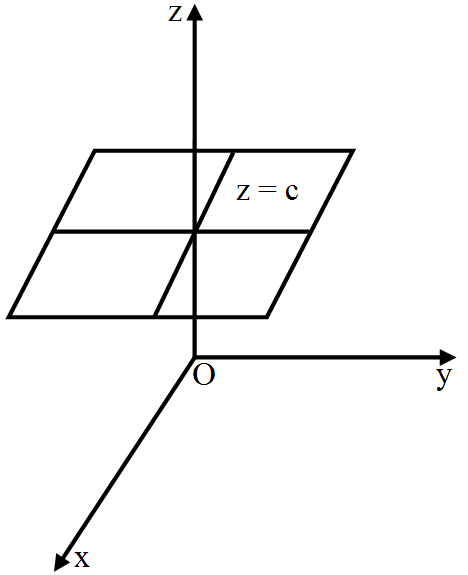
  6. $z = c$ represents the plane parallel to $xy-$plane.
  1. The plane $x = a$ is parallel to $yz-$plane.
Plane $y = b$ is parallel to $xz-$plane.
So, planes $x = a$ and $y = b$ is line of intersection of these planes.
Now, line of intersection of $yz-$plane and $xz-$plane is $z-$axis.
So, line of intersection of planes $x = a$ andy $= b$ is line parallel to $z-$axis.
  1. Coordinates of a point are the distances from the origin to the feet of perpendicular from the point on the respective axis.
  2. A ball is the solid region in the space enclosed by a sphere.
  3. The region in the plane enclosed by a circle is known as a disc.
View full question & answer
Question 25 Marks
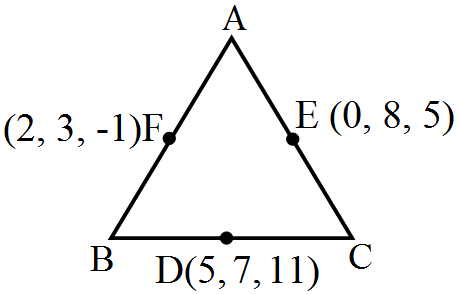
The mid-points of the sides of a triangle are (5, 7, 11), (0, 8, 5) and (2, 3, -1). Find its vertices.
Answer
Given that mid points of the sides of $\triangle\text{ABC}$ D(5, 7, 11), E(0, 8, 5) and F(2, 3, -1).

Let the vertices of triangle be $\text{A}(\text{x}_1, \text{y}_1, \text{z}_1), \text{B}(\text{x}_2, \text{y}_2, \text{z}_2), \text{C}(\text{x}_3, \text{y}_3, \text{z}_3)$.
Mid-point of AC is E.
$\therefore\Big(\frac{\text{x}_1+\text{x}_3}{2},\frac{\text{y}_1+\text{y}_3}{2},\frac{\text{z}_1+\text{z}_3}{2}\Big)\equiv(0,8,5)$
So, $\text{C}(\text{x}_3,\text{y}_3,\text{z}_3)\equiv\text{C}(-\text{x}_1,16-\text{y}_1,10-\text{z}_1)\ \ ..(\text{i})$
Mid-point of AB is F.
$\therefore\Big(\frac{\text{x}_1+\text{x}_2}{2},\frac{\text{y}_1+\text{y}_2}{2},\frac{\text{z}_1+\text{z}_2}{2}\Big)\equiv(2,3,-1)$
So, $\text{C}(\text{x}_2,\text{y}_2,\text{z}_2)\equiv\text{B}(4-\text{x}_1,6-\text{y}_1,-2-\text{z}_1)\ \ ..(\text{ii})$
Mid-point of BC is D
$\therefore\frac{-\text{x}_1+4-\text{x}_1}{2}=5,\ \frac{16-\text{y}_1+6-\text{y}_1}{2}=7,\ \frac{10-\text{z}_1-2-\text{z}_1}{2}=11$
$\Rightarrow\text{x}_1=-3,\text{y}_1=4$ and $\text{z}_1=-7$
$\therefore\text{A}\equiv(-3,4,-7)$
So, $\text{B}\equiv(7,2,5)\ \ [\text{Using (ii)]}$
and $\text{C}\equiv(3,12,17)\ \ [\text{Using (i)]}$
View full question & answer
Question 35 Marks
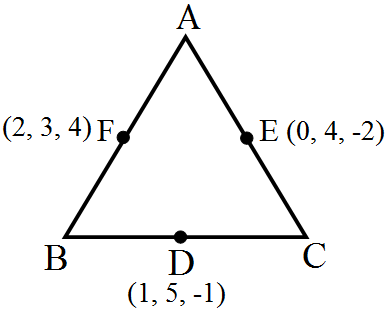
The mid$-$point of the sides of a triangle are $(1, 5, -1), (0, 4, -2)$ and $(2, 3, 4)$. Find its vertices. Also find the centriod of the triangle.
Answer
Given that mid$-$points of the sides of $\text{AABC}$ are $\text{D}(1, 5, -1), \text{E}(0, 4, -2)$ and $\text{F}(2, 3, 4).$

Let the vertices of triangle be $ A(x_1, y_1, z_1), B(x_2, y_2, z_2) and (x_3, y_3, z_3)$
Mid$-$point of $\text{AC}$ is $\text{E}.$
$\therefore\Big(\frac{\text{x}_1+\text{x}_3}{2},\frac{\text{y}_1+\text{y}_3}{2},\frac{\text{x}_1+\text{z}_3}{2}\Big) = (0,4,-2)$
So, $\text{C}(\text{x}_3,\text{y}_3,\text{z}_3) = \text{C}(-\text{x}_1,8-\text{y}_1,-4-\text{z}_1)\ \ ...\text{(i})$
Mid$-$point of AB is F.
$\therefore\Big(\frac{\text{x}_1+\text{x}_2}{2},\frac{\text{y}_1+\text{y}_2}{2},\frac{\text{x}_1+\text{z}_2}{2}\Big) = (2,3,4)$
So, $\text{B}(\text{x}_2,\text{y}_2,\text{z}_2) = \text{B}(4-\text{x}_1,6-\text{y}_1,8-\text{z}_1)\ \ ...\text{(ii})$
Mid$-$point of $BC$ is $D.$
$\therefore\frac{-\text{x}_1+4-\text{x}_1}{2}=1,\frac{8-\text{y}_1+6-\text{y}_1}{2}=5,\frac{-4-\text{z}_1+8-\text{z}_1}{2}=-1$
$\Rightarrow\text{x}_1=1,\text{y}_1=2$ and $\text{z}_1=3$
$\therefore\text{A} = (1,2,3)$
So, $\text{B} = (3,4,5)\ \ [\text{Using (ii)}]$
and $\text{C} = (-1,6,-7)\ \ [\text{Using (i)}]$
Centroid, $\text{G} = \Big(\frac{1+3-1}{3},\frac{2+4+6}{3},\frac{3+5-7}{3}\Big)\equiv\Big(1,4,\frac{1}{3}\Big)$
View full question & answer
Question 45 Marks
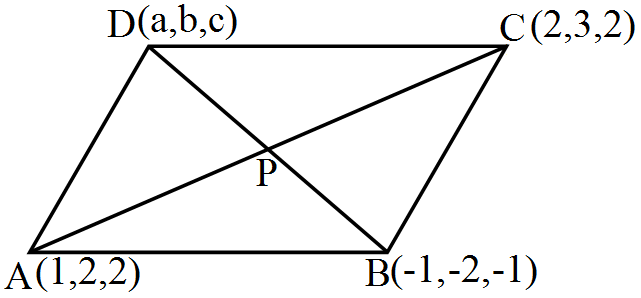
Three vertices of a Parallelogram ABCD are A(1, 2, 3), B(-1, -2, -1) and C(2, 3, 2). Find the fourth vertex D.
Answer
Let the coordinate of D be (a, b, c).

We know that the diagonals of a paralleogram bisect each other.
$\therefore$ Mid-point of AC i.e., $\text{O}=\Big(\frac{1+2}{2},\frac{2+3}{2},\frac{3+2}{2}\Big)$
$=\Big(\frac{3}{2},\frac{5}{2},\frac{5}{2}\Big)$
Mid-point of BD i.e., $\text{O}=\Big(\frac{\text{a}-1}{2},\frac{\text{b}-2}{2},\frac{\text{c}-1}{2}\Big)$
Euating the corresponding coordinate, we have
$\frac{\text{a}-1}{2}=\frac{3}{2}\Rightarrow\text{a}=4$
$\frac{\text{b}-2}{2}=\frac{5}{2}\Rightarrow\text{b}=7$
and $\frac{\text{c}-1}{2}=\frac{5}{2}\Rightarrow\text{c}=6$
Hence, the coordinates of D = (4, 7, 6).
View full question & answer
Question 55 Marks
Name the octant in which each of the following points lies:
  1. $(1, 2, 3).$
  2. $(4, -2, 3).$
  3. $(4, -2, -5).$
  4. $(4, 2, -5).$
  5. $(-4, 2, 5).$
  6. $(-3, -1, 6).$
  7. $(2, -4, -7).$
  8. $(-4, 2, -5).$
Answer
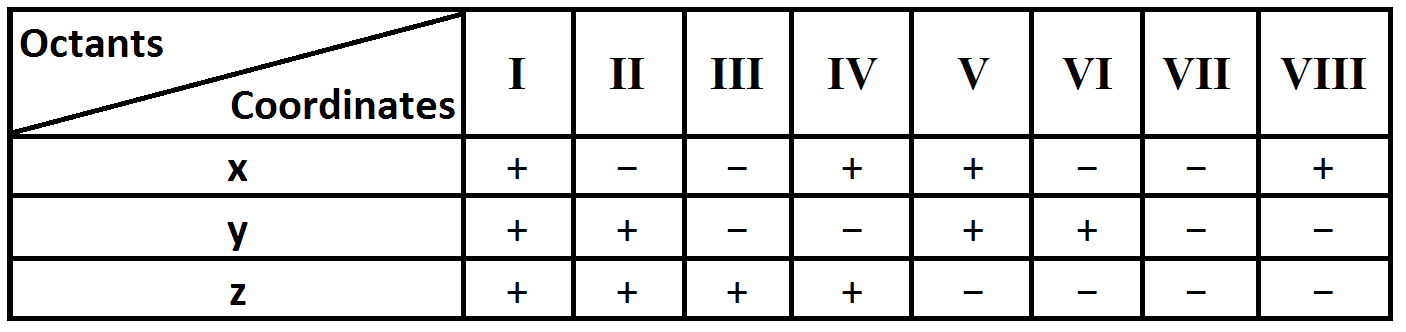
We know that the sign of the coordinates of a point determine the octant in which the point lies. The following table shows the signs of the coordinates in eight octants.
  1. $(1, 2, 3)$ lies in first quadrant.
  2. $(4, -2, 3)$ lies in fourth octant.
  3. $(4, -2, -5)$ lies in eighth octant.
  4. $(4, 2, -5)$ lies in fifth octant.
  5. $(-4, 2, 5)$ lies in second octant.
  6. $(-3, -1, 6)$ lies in third octant.
  7. $(2, -4, -7)$ lies in eighth octant.
  8. $(-4, 2, -5)$ lies in sixth octant.
View full question & answer
5 Marks Questions - Maths STD 11 Science Questions - Vidyadip