Questions

Case study (4 Marks)

🎯

Test yourself on this topic

3 questions · timed · auto-graded

Question 14 Marks
Consider the complex number $Z = 2 - 2i.$ Complex Number in Polar Form
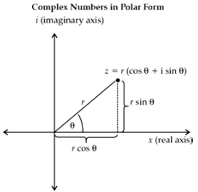
Image
$i.$ Find the principal argument of $Z . (1)$
$ii.$ Find the value of $\bar{z} \bar{z}$ ? $(1)$
$iii.$ Find the value of $| Z |. (2)$
OR
Find the real part of $Z. (2)$
 
Answer
$i =|Z|=2 \cdot \sqrt{2}$
$x = 2, y = -2$
$\cos \theta=\frac{z}{r}=\frac{2}{2 \sqrt{2}}=\frac{1}{\sqrt{2}}$
$\sin \theta=\frac{y}{r}=\frac{-2}{2 \sqrt{2}}=\frac{-1}{\sqrt{2}}$
$\operatorname{Arg}(Z)=\frac{-\pi}{4}$
$ii. \bar{z} \bar{z}=|z|^2=(2 \sqrt{2})^2=8$
$iii. |Z|=\sqrt{2^2+(-2)^2}$
$=\sqrt{8}$
$=2 \sqrt{2}$
OR
Real part of $2 - 2i = 2$
View full question & answer
Question 24 Marks
There are $4$ red, $5$ blue and $3$ green marbles in a basket.
$i.$ If two marbles are picked at randomly, find the probability that both red marbles. $(1)$
$ii.$ If three marbles are picked at randomly, find the probability that all green marbles. $(1)$
$iii$. If two marbles are picked at randomly then find the probability that both are not blue marbles. $(2)$
OR
If three marbles are picked at randomly, then find the probability that atleast one of them is blue. $(2)$
Answer
$i.$ Total marbles $= 4 + 5 + 3 = 12$
Required probability $=\frac{{ }^4 C_2}{{ }^{12} C_2}=\frac{\frac{4 \times 3}{2 \times 1}}{\frac{12 \times 11}{2 \times 1}}=\frac{1}{11}$
$ii.$ Total marbles $= 4 + 5 + 3 = 12$
Required probability $=\frac{{ }^3 C_3}{{ }^{12} C_3}=\frac{1}{\frac{12 \times 11 \times 10}{3 \times 2}}=\frac{1}{220}$
$iii.$ Total marbles $= 4 + 5 + 3 = 12$
Required probability $=\frac{{ }^7 C_2}{{ }^{12} C_2}=\frac{\frac{7 \times 6}{2 \times 1}}{\frac{12 \times 11}{2 \times 1}}=\frac{21}{66}=\frac{7}{22}$
OR
Total marbles $= 4 + 5 + 3 = 12$
Required probability $= 1 - P ($None is blue$)$
$=1-\frac{{ }^7 C_3}{{ }^{12} C_3}$
$=1-\frac{\frac{7 \times 6 \times 5}{3 \times 2}}{\frac{13 \times 11 \times 10}{3 \times 2}}$
$=1-\frac{7}{44}=\frac{37}{44}$
View full question & answer
Question 34 Marks
Answer
i. Number of functions from $A$ to $B$ are $n(B)^{n(A)}=q^p$
ii. Number of relations from A to B is $2^{ n (A) n(B)}=2^{\text {pA }}$.
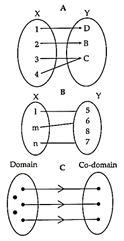
iii. Figures A and B show relations. Figure C shows a function but not a relation.
OR
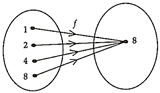
x is a factor of y .
$1,2,4$ and 8 are factors of 8 .
View full question & answer
Case study (4 Marks) - Maths STD 11 Science Questions - Vidyadip