Questions

5 Marks Questions

🎯

Test yourself on this topic

6 questions · timed · auto-graded

Question 15 Marks
Prove that $\cos \frac{2 \pi}{15} \cdot \cos \frac{4 \pi}{15} \cdot \cos \frac{8 \pi}{15} \cdot \cos \frac{16 \pi}{15}=\frac{1}{16}$
Answer
$\text { LHS }=\cos \frac{2 \pi}{15} \cdot \cos \frac{4 \pi}{15} \cdot \cos \frac{8 \pi}{15} \cdot \cos \frac{16 \pi}{15}$
$=\cos \frac{2 \pi}{15} \cos 2\left(\frac{2 \pi}{15}\right) \cos 4\left(\frac{2 \pi}{15}\right) \cos 8\left(\frac{2 \pi}{15}\right)$
Put $\frac{2 \pi}{15}=\alpha$
$\Rightarrow \text { LHS }=\cos \alpha \cdot \cos 2 \alpha \cdot \cos 4 \alpha \cdot \cos 8 \alpha$
$=\frac{2 \sin \alpha[\cos \alpha \cdot \cos 2 \alpha \cdot \cos 4 \alpha \cdot \cos 8 \alpha]}{2 \sin \alpha} [$ multiplying numerator and denominator by  $2 \sin \alpha]$
$=\frac{(2 \sin \alpha \cdot \cos \alpha) \cdot \cos 2 \alpha \cdot \cos 4 \alpha \cdot \cos 8 \alpha}{2 \sin \alpha}$
$=\frac{2(\sin 2 \alpha \cdot \cos 2 \alpha \cdot \cos 4 \alpha \cdot \cos 8 \alpha)}{2(2 \sin \alpha)}[\because 2 \sin \alpha \cos \alpha=\sin 2 \alpha$ and multiplying numerator and denominator by $2]$
$=\frac{(2 \sin 2 \alpha \cdot \cos 2 \alpha) \cdot \cos 4 \alpha \cdot \cos 8 \alpha}{4 \sin \alpha}$
$=\frac{2(\sin 4 \alpha \cdot \cos 4 \alpha) \cos 8 \alpha}{2(4 \sin \alpha)}[\because 2 \sin \alpha \cos \alpha=\sin 2 \alpha$ and multiplying numerator and denominator by $2]$
$=\frac{2(\sin 8 \alpha \cdot \cos 8 \alpha)}{2(8 \sin \alpha)}$
$=\frac{\sin 16 \alpha}{16 \sin \alpha}=\frac{\sin (15 \alpha+\alpha)}{16 \sin \alpha}$
Now, $15 \alpha=2 \pi$,
$=\frac{\sin (2 \pi+\alpha)}{16 \sin \alpha}=\frac{\sin \alpha}{16 \sin \alpha}=\frac{1}{16}=\text{RHS}$
$\therefore \text{LHS=RHS}$
Hence proved.
View full question & answer
Question 25 Marks
Prove that: $\sin 6^{\circ} \sin 42^{\circ} \sin 66^{\circ} \sin 78^{\circ}=\frac{1}{16}$.
Answer
We have to prove that $\sin 6^{\circ} \sin 42^{\circ} \sin 66^{\circ} \sin 78^{\circ}=\frac{1}{16}$.
$\text{LHS} =\sin 6^{\circ} \sin 42^{\circ} \sin 66^{\circ} \sin 78^{\circ}$
By regrouping the $\text{LHS}$ and multiplying and dividing by $4$ we get,
$=\frac{1}{4}\left(2 \sin 66^{\circ} \sin 6^{\circ}\right)\left(2 \sin 78^{\circ} \sin 42^{\circ}\right)$
But $2 \sin A \sin B = \cos (A - B) - \cos (A + B)$
Then the above equation becomes,
$=\frac{1}{4}\left(\cos \left(66^{\circ}-6^{\circ}\right)-\cos \left(66^{\circ}+6^{\circ}\right)\right)\left(\cos \left(78^{\circ}-42^{\circ}\right)-\cos \left(78^{\circ}+42^{\circ}\right)\right)$
$=\frac{1}{4}\left(\cos \left(60^{\circ}\right)-\cos \left(72^{\circ}\right)\right)\left(\cos \left(36^{\circ}\right)-\cos \left(120^{\circ}\right)\right)$
$=\frac{1}{4}\left(\cos \left(60^{\circ}\right)-\cos \left(90^{\circ}-18^{\circ}\right)\right)\left(\cos \left(36^{\circ}\right)-\cos \left(180^{\circ}-120^{\circ}\right)\right)$
But $\cos \left(90^{\circ}-\theta\right)=\sin \theta$ and $\cos \left(180^{\circ}-\theta\right)=-\cos (\theta)$.
Then the above equation becomes,
$=\frac{1}{4}\left(\cos \left(60^{\circ}\right)-\cos \left(18^{\circ}\right)\right)\left(\cos \left(36^{\circ}\right)+\cos \left(60^{\circ}\right)\right)$
Now, $\cos \left(36^{\circ}\right)=\frac{\sqrt{5}+1}{4}$
$\sin \left(18^{\circ}\right)=\frac{\sqrt{5}-1}{4}$
$\cos \left(60^{\circ}\right)=\frac{1}{2}$
Substituting the corresponding values, we get
$=\frac{1}{4}\left(\frac{1}{2}-\frac{\sqrt{5}-1}{4}\right)\left(\frac{\sqrt{5}+1}{4}+\frac{1}{2}\right)$
$=\frac{1}{4}\left(\frac{2-\sqrt{5}+1}{4}\right)\left(\frac{\sqrt{5}+1}{4}+\frac{1}{2}\right)$
$=\frac{1}{4}\left(\frac{3-\sqrt{5}}{4}\right)\left(\frac{3+\sqrt{5}}{4}\right)$
$=\frac{1}{4}\left(\frac{3^2-(\sqrt{5})^2}{4 \times 4}\right)$
$=\frac{1}{4}\left(\frac{9-5}{16}\right)$
$=\frac{1}{16}$
$\text{LHS = RHS}$
Hence proved.
View full question & answer
Question 35 Marks
In an increasing $GP,$ the sum of the first and last terms is $66$, the product of the second and the last but one is $128$ and the sum of the terms is $126.$ How many terms are there in this $GP?$
Answer
Let the given $GP$ contain $n$ terms.
Let abe the first term and $r$ be the common ratio of this $GP.$
Since the given $GP$ is increasing, we have $r > 1$
Now, $T _1+ T _{ n }=66$
$\Rightarrow a + ar ^{( n -1)}=66 \ldots (i)$
And, $T_2 \times T_{n-1}=128$
$\Rightarrow ar \times ar ^{( n -2)}=128$
$\Rightarrow a^2 r^{(n-1)}=128$
$\Rightarrow a r^{(n-1)}=\frac{128}{a} \ldots( ii )$
Using $(ii)$ and $(i),$ we get
$a+\frac{128}{a}=66$
$\Rightarrow a^2-66 a+128=0$
$\Rightarrow a^2-2 a-64 a+128=0$
$\Rightarrow a(a-2)-64(a-2)=0$
$\Rightarrow(a-2)(a-64)=0$
$\Rightarrow a=2 \text { or } a=64$
Putting $a = 2$ in $(ii),$ we get
$r^{(n-1)}=\frac{128}{a^2}=\frac{128}{4}=32 \ldots$
Thus, $a =2$ and $r ^{( n -1)}=32$
Now, $S _{ n }=126$
$\Rightarrow \frac{a\left(r^n-1\right)}{(r-1)}=126$
$\Rightarrow 2\left(\frac{r^n-1}{r-1}\right)=126$
$\Rightarrow \frac{r^n-1}{r-1}=63$
$\Rightarrow \frac{r^{(n-1)} \times r-1}{r-1}=63$
$\Rightarrow \frac{32 r-1}{r-1}=63$
$\Rightarrow 32 r-1=63 r-63$
$\Rightarrow 31 r=62$
$\Rightarrow r=2$
$\therefore r^{(n-1)}=32=25$
$\Rightarrow n-1=5$
$\Rightarrow n=6$
Hence, there are 6 terms in the given $GP$
View full question & answer
Question 45 Marks
Differentiate $x^2 \sin x$ from first principle.
Answer
We have to find derivative of $f(x)=x^2 \sin x$
Derivative of a function $f ( x )$ is given by $f ^{\prime}( x )=\underset{{h \rightarrow 0}}{\lim}=\frac{f(x+h)-f(x)}{h}$ where $h$ is a very small positive number
$\therefore$ Derivative of $f ( x )= x ^2 \sin x$ is given as $f ^{\prime}( x )\underset{{h \rightarrow 0}}{\lim}=\frac{f(x+h)-f(x)}{h}$
$\Rightarrow f ( x )\underset{{h \rightarrow 0}}{\lim} \frac{(x+h)^2 \sin (x+h)-x^2 \sin x}{h}$
$\text { Using }( a + b )^2= a ^2+2 ab + b ^2 \text {, we get }$
$\Rightarrow f ( x )\underset{{h \rightarrow 0}}{\lim} \frac{h^2 \sin (x+h)+x^2 \sin (x+h)+2 h x \sin (x+h)-x^2 \sin x}{h}$
Using the algebra of limits, we have
$\Rightarrow f ( x )\underset{{h \rightarrow 0}}{\lim} \frac{h^2 \sin (x+h)}{h}+\lim _{h \rightarrow 0} \frac{x^2 \sin (x+h)-x^2 \sin x}{h}+\lim _{h \rightarrow 0} \frac{2 h x \sin (x+h)}{h}$
$\Rightarrow f ( x )\underset{{h \rightarrow 0}}{\lim} h \sin ( x + h )+\lim _{h \rightarrow 0} \frac{x^2(\sin (x+h)-\sin x)}{h}+\lim _{h \rightarrow 0} 2 x \sin ( x + h )$
$\Rightarrow f ^{\prime}( x )=0 \times \sin ( x +0)+2 x \sin ( x +0)+ x ^2 \lim _{h \rightarrow 0} \frac{(\sin (x+h)-\sin x)}{h}$
$\Rightarrow f ^{\prime}( x )=2 x \sin + x ^2 \lim _{h \rightarrow 0} \frac{(\sin (x+h)-\sin x)}{h}$
Using the algebra of limits we have
$\therefore f^{\prime}(x)=2 x \sin x+x^2 \lim _{h \rightarrow 0} \frac{(\sin (x+h)-\sin x)}{h}$
We can't evaluate the limits at this stage only as on putting value it will take $\frac{0}{0}$ form.
So, we need to do little modifications.
$\text { Use: } \sin A-\sin B=2 \cos \left(\frac{(A-B)}{2}\right) \sin \left(\frac{(A-B)}{2}\right)$
$\therefore f^{\prime}(x)=2 x \sin x+x^2 \lim _{h \rightarrow 0} \frac{2 \cos \left(\frac{2 x+h}{2}\right) \sin \left(\frac{h}{2}\right)}{h}$
$\Rightarrow f^{\prime}(x)=2 x \sin x+x^2 \lim _{h \rightarrow 0} \frac{\cos \left(x+\frac{h}{2}\right) \sin \left(\frac{A}{2}\right)}{\frac{A}{2}}$
Using the algebra of limits:
$\Rightarrow f^{\prime}(x)=2 x \sin x+x^2 \lim _{h \rightarrow 0} \frac{\sin \left(\frac{h}{2}\right)}{\frac{h}{2}} \times \lim _{h \rightarrow 0} \cos \left(x+\frac{h}{2}\right)$
By using the formula we get $-\lim _{x \rightarrow 0} \frac{\sin x}{x}=1$
$\therefore f ^{\prime}( x )=2 x \sin x + x ^2 \lim _{h \rightarrow 0} \cos \left(x+\frac{h}{2}\right)$
substuite the value of $h$ to evaluate the limit:
Therefore, $f^{\prime}(x)=2 x \sin x+x^2 \cos (x+0)=2 x \sin x+x^2 \cos x$
Hence,
Derivative of $f(x)=\left(x^2 \sin x\right)$ is $\left(2 x \sin x+x^2 \cos x\right)$
View full question & answer
Question 55 Marks
Evaluate: $\lim _{x \rightarrow 2} \frac{x^3+3 x^2-9 x-2}{x^3-x-6}$
Answer
We have to find the value of $\lim _{x \rightarrow 2} \frac{x^3+3 x^2-9 x-2}{x^3-x-6}$
We have,
$\lim _{x \rightarrow 2} \frac{x^3+3 x^2-9 x-2}{x^3-x-6}$
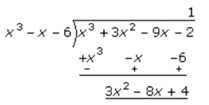
Divide $x^3+3 x^2-9 x-2$ by $x^3-x-6$
Image
$\Rightarrow \lim _{x \rightarrow 2} \frac{x^3+3 x^2-9 x-2}{x^3-x-6}=\lim _{x \rightarrow 2} 1+\lim _{x \rightarrow 2} \frac{3 x^2-8 x+4}{x^3-x-6}$
$=1+\lim _{x \rightarrow 2} \frac{3 x^2-2 x-6 x+4}{x^3-x-6}$
$\Rightarrow \lim _{x \rightarrow 2} \frac{x^3+3 x^2-9 x-2}{x^3-x-6}=1+\lim _{x \rightarrow 2} \frac{(3 x-2)(x-2)}{x^3-x-6}$
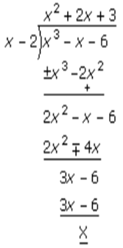
Divide $x^3-x-6$ by $x-2$
Image
$\Rightarrow \lim _{x \rightarrow 2} \frac{x^3+3 x^2-9 x-2}{x^3-x-6}=1+\lim _{x \rightarrow 2} \frac{(3 x-2)(x-2)}{(x-2)\left(x^2+2 x+3\right)}$
$=1+\lim _{x \rightarrow 2} \frac{(3 x-2)}{\left(x^2+2 x+3\right)}$
$=1+\frac{3 \times 2-2}{2^2+2 \times 2+3}$
$=1+\frac{4}{11}$
$=\frac{15}{11}$
View full question & answer
Question 65 Marks
A bag contains $6$ red, $4$ white and $8$ blue balls. If three balls are drawn at random, find the probability that:
$i.$ one is red and two are white
$ii$. two are blue and one is red
$iii$. one is red.
Answer
Bag contains:
$6 -$ Red balls
$4 -$ White balls
$8 -$ Blue balls
Since three ball are drawn,
$\therefore n(S)={ }^{18} C_3$
$i.$ Let $E$ be the event that one red and two white balls are drawn.
$\therefore n(E)={ }^6 C_1 \times{ }^4 C_2$
$\therefore P(E)=\frac{{ }^6 C_1 \times{ }^4 C_2}{{ }^{18} C_3}=\frac{6 \times 4 \times 3}{2} \times \frac{3 \times 2}{18 \times 17 \times 16}$
$P(E)=\frac{3}{68}$
$ii$. Let $E$ be the event that two blue balls and one red ball was drawn.
$\therefore n(E)={ }^8 C_2 \times{ }^6 C_1$
$\therefore P(E)=\frac{{ }^8 C_2 \times{ }^6 C_1}{{ }^{18} C_3}=\frac{8 \times 7}{2} \times 6 \times \frac{3 \times 2 \times 1}{18 \times 17 \times 16}=\frac{7}{34}$
$P(E)=\frac{7}{34}$
$iii$. Let $E$ be the event that one of the ball must be red.
$\therefore E =\{( R , W , B ) \text {or} ( R , W , W ) \text {or} ( R , B , B )\}$
$\therefore n(E)={ }^6 C_1 \times{ }^4 C_1 \times{ }^8 C_1+{ }^6 C_1 \times{ }^4 C_2+{ }^6 C_1 \times{ }^8 C_2$
$\therefore P(E)=\frac{{ }^6 C_1 \times{ }^4 C_1 \times{ }^8 C_1+{ }^6 C_1 \times{ }^4 C_2+{ }^6 C_1 \times{ }^8 C_2}{{ }^{18} C_3}$
$=\frac{6 \times 4 \times 8+\frac{6 \times 4 \times 3}{2 \times 1}+\frac{6 \times 8 \times 7}{2 \times 1}}{\frac{18 \times 17 \times 16}{3 \times 2 \times 1}}$
$=\frac{396}{816}=\frac{33}{68}$
View full question & answer