Question 14 Marks
View full question & answer→Questions
Case study (4 Marks)
🎯
Test yourself on this topic
3 questions · timed · auto-graded



Question 24 Marks
Consider the data.
$i$. Find the mean deviation about median. $(1)$
$ii$. Find the Median. $(1)$
$iii$. Write the formula to calculate the Mean deviation about median? $(2)$
OR
Write the formula to calculate median? $(2)$
| Class | Frequency |
| $0-10$ | $6$ |
| $10-20$ | $7$ |
| $20-30$ | $ 15$ |
| $30-40$ | $ 16$ |
| $40-50$ | $4$ |
| $50-60$ | $2$ |
$ii$. Find the Median. $(1)$
$iii$. Write the formula to calculate the Mean deviation about median? $(2)$
OR
Write the formula to calculate median? $(2)$
Answer
Here, $\frac{N}{2}=\frac{29}{2}=25$
Here, $25^{th}$ item lies in the class $20-30.$
Therefore $, 20-30$ is the median class.
Here $, l = 20, cf = 13, f = 15, b = 10$ and $N = 50$
$\because$ Median, $M =l+\frac{\frac{N}{2}-c f}{f} \times b$
$\Rightarrow M=20+\frac{25-13}{15} \times 10=20+8=28$
Thus, mean deviation about median is given by
$MD ( M )=\frac{1}{N} \sum_{i=1}^6 f_i\left|x_i-M\right|=\frac{1}{50} \times 508=10.16$
Hence, mean deviation about median is $10.16.$
$ii$. Here $, l = 20, cf = 13, f = 15, b = 10$ and $N = 50$
$\because $ Median $, M=l+\frac{\frac{N}{2}-cf}{f} \times b$
$\Rightarrow M =20+\frac{25-13}{15} \times 10=20+8=28$
$\text { iii. } MD=\frac{\Sigma f_4\left|x_1-M\right|^{15}}{N}$
OR $M =1+\frac{\frac{ N}{2}-e f}{f} \times h$
View full question & answer→| Class | $f _{ i }$ | $cf$ | Mid $-$ point $\left( x _{ j }\right)$ | $\left| x _{ i }- M \right|$ | $f _{ i }\left| x _{ i }- M \right|$ |
| $0-10$ | $6$ | $6$ | $5$ | $23$ | $138$ |
| $10-20$ | $7$ | $13$ | $15$ | $13$ | $91$ |
| $20-30$ | $15$ | $28$ | $25$ | $3$ | $45$ |
| $30-40$ | $16$ | $44$ | $35$ | $7$ | $112$ |
| $40-50$ | $4$ | $48$ | $45$ | $17$ | $68$ |
| $50-60$ | $2$ | $50$ | $55$ | $27$ | $54$ |
| $50$ | $508$ |
Here, $25^{th}$ item lies in the class $20-30.$
Therefore $, 20-30$ is the median class.
Here $, l = 20, cf = 13, f = 15, b = 10$ and $N = 50$
$\because$ Median, $M =l+\frac{\frac{N}{2}-c f}{f} \times b$
$\Rightarrow M=20+\frac{25-13}{15} \times 10=20+8=28$
Thus, mean deviation about median is given by
$MD ( M )=\frac{1}{N} \sum_{i=1}^6 f_i\left|x_i-M\right|=\frac{1}{50} \times 508=10.16$
Hence, mean deviation about median is $10.16.$
$ii$. Here $, l = 20, cf = 13, f = 15, b = 10$ and $N = 50$
$\because $ Median $, M=l+\frac{\frac{N}{2}-cf}{f} \times b$
$\Rightarrow M =20+\frac{25-13}{15} \times 10=20+8=28$
$\text { iii. } MD=\frac{\Sigma f_4\left|x_1-M\right|^{15}}{N}$
OR $M =1+\frac{\frac{ N}{2}-e f}{f} \times h$
Question 34 Marks
A farmer wishes to install $2$ handpumps in his field for watering.
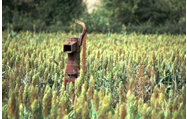
The farmer moves in the field while watering in such a way that the sum of distances between the farmer and each handpump is always $26\ m$.
Also, the distance between the hand pumps is $10 \ m$.
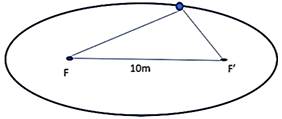
$i.$ Name the curve traced by farmer and hence find the foci of curve. $(1)$
$ii$. Find the equation of curve traced by farmer. $(1)$
$iii$. Find the length of major axis, minor axis and eccentricity of curve along which farmer moves. $(2)$
OR
$iv$. Find the length of latus rectum. $(2)$
The farmer moves in the field while watering in such a way that the sum of distances between the farmer and each handpump is always $26\ m$.
Also, the distance between the hand pumps is $10 \ m$.
$i.$ Name the curve traced by farmer and hence find the foci of curve. $(1)$
$ii$. Find the equation of curve traced by farmer. $(1)$
$iii$. Find the length of major axis, minor axis and eccentricity of curve along which farmer moves. $(2)$
OR
$iv$. Find the length of latus rectum. $(2)$
Answer
View full question & answer→$i$. The curve traced by farmer is ellipse.
Because An ellipse is the set of all points in a plane, the sum of whose distances from two fixed points in the plane is a constant.
Two positions of hand pumps are foci Distance between two foci $=2 c=10$
Hence $c=5$
Here foci lie on $x$ axis coordinates of foci $=( \pm c, 0)$
Hence coordinates of foci $=( \pm 5,0)$
$ii. \frac{x^2}{169}+\frac{y^2}{144}=1$
Sum of distances from the foci $= 2a$
Sum of distances between the farmer and each hand pump is $= 26 = 2a$
$\Rightarrow 2 a=26 $
$\Rightarrow a=13 m$
Distance between the handpump $= 10m = 2c$
$\Rightarrow c=5 m$
$c^2=a^2-b^2$
$\Rightarrow 25=169-b^2$
$\Rightarrow b^2=144$
Equation is $\frac{x^2}{169}+\frac{y^2}{144}=1$
$iii$. Equation of ellipse is $\frac{x^2}{169}+\frac{y^2}{144}=1$
Comparing with standard equation of ellipse $a =13, b=12$ and $c=5 \ ($given$)$
Length of major axis $=2 a =2 \times 13=26$
Length of minor axis $=2 b=2 \times 12=24$
eccentricity $e=\frac{\epsilon}{a}=\frac{5}{13}$
OR
Equation of the ellipse is $\frac{x^2}{169}+\frac{y^2}{144}=1$
Hence $a =13$ and $b =12$
length of latus rectum of ellipse is given by $\frac{2 b^2}{ a }=\frac{2 \times 144}{13}$
Because An ellipse is the set of all points in a plane, the sum of whose distances from two fixed points in the plane is a constant.
Two positions of hand pumps are foci Distance between two foci $=2 c=10$
Hence $c=5$
Here foci lie on $x$ axis coordinates of foci $=( \pm c, 0)$
Hence coordinates of foci $=( \pm 5,0)$
$ii. \frac{x^2}{169}+\frac{y^2}{144}=1$
Sum of distances from the foci $= 2a$
Sum of distances between the farmer and each hand pump is $= 26 = 2a$
$\Rightarrow 2 a=26 $
$\Rightarrow a=13 m$
Distance between the handpump $= 10m = 2c$
$\Rightarrow c=5 m$
$c^2=a^2-b^2$
$\Rightarrow 25=169-b^2$
$\Rightarrow b^2=144$
Equation is $\frac{x^2}{169}+\frac{y^2}{144}=1$
$iii$. Equation of ellipse is $\frac{x^2}{169}+\frac{y^2}{144}=1$
Comparing with standard equation of ellipse $a =13, b=12$ and $c=5 \ ($given$)$
Length of major axis $=2 a =2 \times 13=26$
Length of minor axis $=2 b=2 \times 12=24$
eccentricity $e=\frac{\epsilon}{a}=\frac{5}{13}$
OR
Equation of the ellipse is $\frac{x^2}{169}+\frac{y^2}{144}=1$
Hence $a =13$ and $b =12$
length of latus rectum of ellipse is given by $\frac{2 b^2}{ a }=\frac{2 \times 144}{13}$