Questions

5 Marks Questions

🎯

Test yourself on this topic

6 questions · timed · auto-graded

Question 15 Marks
Prove that: $\cos ^3 x \sin 3 x+\sin ^3 x \cos 3 x=\frac{3}{4} \sin 4 x$.
Answer
We have to prove that $\cos ^3 x \sin 3 x+\sin ^3 x \cos 3 x=\frac{3}{4} \sin 4 x$.
We know that,
$\cos 3 \theta=4 \cos ^3 \theta-3 \cos \theta$
$\Rightarrow 4 \cos ^3 \theta=\cos 3 \theta+3 \cos \theta$
$\Rightarrow \cos ^3 \theta=\frac{\cos 39+3 \cos \theta}{4} \ldots \text { (i) }$
And similarly
$\Rightarrow \sin 3 \theta=3 \sin \theta-4 \sin ^3 \theta$
$\Rightarrow 4 \sin ^3 \theta=3 \sin \theta-\sin 3 \theta$
$\Rightarrow \sin ^3 \theta=\frac{3 \sin \theta-\sin 3 \theta}{4} \ldots$
Now,
$\text{LHS} =\cos ^3 x \sin 3 x+\sin ^3 x \cos 3 x$
Substituting the values from equation $(i)$ and $(ii),$ we get
$\Rightarrow\left(\frac{\cos 3 x+3 \cos x}{4}\right) \sin 3 x+\left(\frac{\cos 3 x-3 \cos x}{4}\right) \cos 3 x$
$=\frac{1}{4}(\sin 3 x \cos 3 x+3 \sin 3 x \cos x+3 \sin x \cos 3 x-\sin 3 x \cos 3 x)$
$=\frac{1}{4}[3(\sin 3 x \cos x+\sin x \cos 3 x)+0]$
$=\frac{1}{4}(3 \sin (3 x+x))$
$\text { (as } \sin (x+y)=\sin x \cos y+\cos x \sin y)$
$\Rightarrow \frac{3}{4} \sin 4 x$
$\text { LHS }=\text { RHS }$
Henve proved

View full question & answer
Question 25 Marks
Prove that: $\cos 10^{\circ} \cos 30^{\circ} \cos 50^{\circ} \cos 70^{\circ}=\frac{3}{16}$.
Answer
$\cos 10^{\circ} \cos 30^{\circ} \cos 50^{\circ} \cos 70^{\circ}=\frac{3}{16}$
$\text { LHS }=\cos 10^{\circ} \cos 30^{\circ} \cos 50^{\circ} \cos 70^{\circ}$
$=\cos 30^{\circ} \cos 10^{\circ} \cos 50^{\circ} \cos 70^{\circ}$
$=\frac{\sqrt{3}}{2}\left(\cos 10^{\circ} \cos 50^{\circ} \cos 70^{\circ}\right)$
$=\frac{\sqrt{3}}{2}\left(\cos 10^{\circ} \cos 50^{\circ}\right) \cos 70^{\circ}$
$=\frac{\sqrt{3}}{4}\left(2 \cos 10^{\circ} \cos 50^{\circ}\right) \cos 70^{\circ}[\text { Multiplying and dividing by } 2]$
$=\frac{\sqrt{3}}{4} \cos 70^{\circ}\left(\cos \left(50^{\circ}+10^{\circ}\right)+\cos \left(10^{\circ}-50^{\circ}\right)\right\}[\text { Using } 2 \cos A \cos B=\cos (A+B)+\cos (A-B)]$
$=\frac{\sqrt{3}}{4} \cos 70^{\circ}\left\{\cos 60^{\circ}+\cos \left(-40^{\circ}\right)\right\}$
$=\frac{\sqrt{3}}{4} \cos 70^{\circ}\left[\frac{1}{2}+\cos 40^{\circ}\right]\left[\because \cos 60^{\circ}=\frac{1}{2} \text { and } \cos (-x)=\cos x \right]$
$=\frac{\sqrt{3}}{8} \cos 70^{\circ}+\frac{\sqrt{3}}{4} \cos 70^{\circ} \cos 40^{\circ}$
$=\frac{\sqrt{3}}{8} \cos 70^{\circ}+\frac{\sqrt{3}}{8}\left(2 \cos 70^{\circ} \cos 40^{\circ}\right)$
$=\frac{\sqrt{3}}{8}\left[\cos 70^{\circ}+\cos \left(70^{\circ}+40^{\circ}\right)+\cos \left(70^{\circ}-40^{\circ}\right)\right]$
$=\frac{\sqrt{3}}{8}\left[\cos 70^{\circ}+\cos 110^{\circ}+\cos 30^{\circ}\right]$
$=\frac{\sqrt{3}}{8}\left[\cos 70^{\circ}+\cos \left(180^{\circ}-70^{\circ}\right)+\frac{\sqrt{3}}{2}\right]\left[\because \cos 30^{\circ}=\frac{\sqrt{3}}{2}\right]$
$=\frac{\sqrt{3}}{8}\left[\cos 70^{\circ}-\cos 70^{\circ}+\frac{\sqrt{3}}{2}\right]\left[\because \cos \left(180^{\circ}-x\right)=-\cos x\right]$
$=\frac{\sqrt{3}}{8} \times \frac{\sqrt{3}}{2}=\frac{3}{16}$
$=\text { RHS }$
Hence proved.
View full question & answer
Question 35 Marks
Solve the following system of linear inequalities $-2-\frac{x}{4} \geq \frac{1+x}{3}$ and $3-x<4(x-3)$
Answer
The given system of linear inequalities is
$-2-\frac{x}{4} \geq \frac{1+x}{3} \ldots \text { (i) }$
and $3-x<4(x-3) \ldots (ii)$
From inequality $(i),$ we get
$-2-\frac{x}{4} \geq \frac{1+x}{3}$
$\Rightarrow-24-3 x \geq 4+4 x \ [$multiplying both sides by $12]$
$\Rightarrow-24-3 x-4 \geq 4+4 x-4 \ [$subtracting  $4$ from both sides$]$
$\Rightarrow-28-3 x \geq 4 x$
$\Rightarrow-28-3 x+3 x \geq 4 x+3 x \ [$adding  $3 x$ on both sides$]$
$\Rightarrow-28 \geq 7 x$
$\Rightarrow-\frac{28}{7} \geq \frac{7 x}{7}\ [$dividing both sides by $7]$
$\Rightarrow-4 \geq x $ or $ x \leq-4 \ldots \text { (iii) }$
Thus, any value of $x$ less than or equal to $- 4$ satisfied the inequality
So, the solution set is $x \in(-\infty,-4]z$
Image
From inequality $(ii),$ we get
$3 - x < 4 (x - 3)$
$\Rightarrow 3- x +12<4 x -12+12 \ [$adding  $ 12 $ on both sides $%]$
$\Rightarrow 15- x <4 x$
$\Rightarrow 15- x + x <4 x + x \ [$adding $x$ on both sides$]$
$\Rightarrow 15<5 x$
$\Rightarrow 3< x \   [$dividing both sides by  $3]$
or $ x >3 \ldots \text { (iv) }$
Thus, any value of $x$ greater than $3$ satisfies the inequality.
So, the solution set is $x \in(3, \infty)$
Image
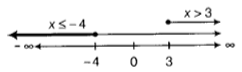
The solution set of inequalities $(i)$ and $(ii)$ are represented graphically on number line as given below:
Image
As no region is common, hence the given system has no solution.
View full question & answer
Question 45 Marks
Find the equation of the parabola whose focus is $(1, -1)$ and whose vertex is $(2, 1)$. Also find its axis and latus rectum.
Answer
Here, we are given the coordinates of the focus and vertex.
So, we require the equation of the directrix.
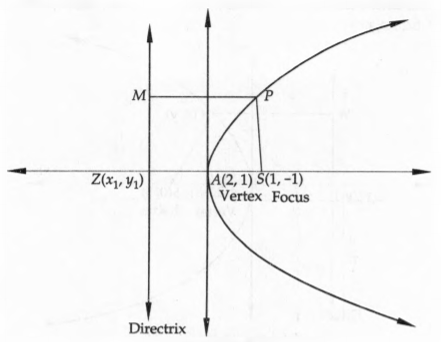
Let $Z \left( x _1, y _1\right)$ be the coordinates of the point of intersection of the axis and the directrix.
Then, the vertex $A(2,1)$ is the mid $-$ point of the line segment joining $Z\left(x_1, y_1\right)$ and the focus $S(1,-1)$
Image
$\therefore \frac{x_1+1}{2}=2 \text { and } \frac{y_1+(-1)}{2}=1 $
$\Rightarrow x_1=3, y_1=3$
Thus, the directrix meets the axis at $Z(3, 3)$
Let $m _1$ be the slope of the axis.
Then,
$m _1=\ ($ Slope of the line joining the focus $S$ and the vertex $A )=\frac{1+1}{2-1}=2 \ldots. (i)$
$\therefore$ Slope of the directrix $=-\frac{1}{2}\ [\because$ Directrix is perpendicular to the axis $]$
Thus, the directrix passes through $(3, 3)$ and has slope $- 1/2.$
So its equation is
$y-3=-\frac{1}{2}(x-3)$
$\text { or, } x+2 y-9=0$
Let $P (x, y)$ be a point on the parabola.
Then,
Distance of $P$ from the focus $=$ Distance of $P$ from the directrix
$\Rightarrow \sqrt{(x-1)^2+(y+1)^2}=\left|\frac{x+2 y-9}{\sqrt{1^2+2^2}}\right|$
$\Rightarrow(x-1)^2+(y+1)^2=\frac{(x+2 y-9)^2}{5}$
$\Rightarrow 5 x^2+5 y^2-10 x+10 y+10$
$=x^2+4 y^2+81+4 x y-18 x-36 y$
The axis passes through the focus $(1,-1)$, and its slope is $m_1=2$
Therefore, equation of the axis is $y+1=2(x,-1)$ or, $2 x-y-3=0$
Now,
Latus-rectum $= 2\ ($Length of the perpendicular from the focus on the directrix$)$
$=2$ Length of the perpendicular from $(1,-1)$ on $x+2 y-9=0$
$=2\left|\frac{1-2-9}{\sqrt{1+4}}\right|=2 \times \frac{10}{\sqrt{5}}=4 \sqrt{5}$
View full question & answer
Question 55 Marks
Draw the shape of the ellipse $4 x^2+9 y^2=36$ and find its major axis, minor axis, value of $c$, vertices, directrices, foci, eccentricity and length of latusrectum.
Answer
We have, equation of ellipse is $4 x^2+9 y^2=36$
$\text { or } \frac{x^2}{9}+\frac{y^2}{4}=1$
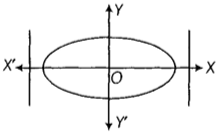
Since, the denominator of $\frac{x^2}{9}$ is greater than denominator of $\frac{y^2}{4}$ So, the major axis lies along X -axis.
Image

i. Shape is shown above.
ii. Major axis, $2 a =2 \times 3=6$
iii. Minor axis, $2 b=2 \times 2=4$
iv. Value of $c =\sqrt{a^2-b^2}=\sqrt{9-4}=\sqrt{5}$
v. Vertices $=(-a, 0)$ and $(a, 0)$ i.e., $(-3,0)$ and $(3,0)$
vi. Directrices, $x = \pm \frac{a^2}{c}= \pm \frac{9}{\sqrt{5}}$
vii. Foci $=(- c , 0)$ and $(c, 0)$ i.e., $(-\sqrt{5}, 0)$ and $(\sqrt{5}, 0)$
viii. Eccentricity, $e =\frac{c}{a}=\frac{\sqrt{5}}{3}$
ix. Length of latusrectum, $2 l=\frac{2 b^2}{a}=\frac{2 \times 4}{3}=\frac{8}{3}$
View full question & answer
Question 65 Marks
Calculate the mean, median and standard deviation of the following distribution:
Class$-$interval $31-35$ $36-40$ $41-45$ $46-50$ $51-55$ $56-60$ $61-65$ $66-70$
Frequency $2$ $3$ $8$ $12$ $16$ $5$ $2$ $3$
Answer
$1^{st}$ of all we will prepare the below table with the help of given information.
Class-interval $f_i$ Mid point $x_i$ $u _{ i }=\frac{x_i-53}{4}$ $u_i^2$ $f _{ i } u _{ i }$   $f _{ i } u_{ i }^2$
$31-35$ $2$ $33$ $-5$ $25$ $-10$ $50$
$36-40$ $3$ $38$ $-3.75$ $14.06$ $-11.25$ $42.18$
$41-45$ $8$ $43$ $-2.5$ $6.25$ $-20$ $50$
$46-50$ $12$ $48$ $-1.25$ $1.56$ $-15$ $18.72$
$51-55$ $16$ $53$ $0$ $0$ $0$ $0$
$56-60$ $5$ $58$ $1.25$ $1.56$ $6.25$ $7.8$
$61-65$ $2$ $63$ $2.5$ $6.25$ $5$ $12.5$
$66-70$ $3$ $68$ $3.75$ $14.06$ $11.25$ $42.18$
  $N = 51$         $\sum_{i=1}^n f_i u_i^2=223.38$
$ X = a + h \left(\frac{\sum_{i=1}^n f_i u_i}{N}\right)$
$=53+4\left(\frac{-33.75}{51}\right)$
$=50.36$
$\sigma^2=h^2\left(\frac{\sum_{i-1}^n f_i u_i^2}{N}\left(\frac{\sum_{i=1}^n f_i u_i}{N}\right)^2\right)$
$=16\left(\frac{223.38}{51}-\frac{1139.06}{2601}\right)$
$=63.07$
$\sigma=\sqrt{63.07}$
$=7.94$
$f_i$ Cumulative frequency
$2$ $2$
$3$ $5$
$8$ $13$
$12$ $25$
$16$ $41$
$5$ $46$
$2$ $48$
$3$ $51$
$\sum_N f_i=51=N$
$\frac{N}{2}=25.5$
Median class interval is $51 - 55$
$L = 51$
$F = 25$
$f = 16$
$h = 4$
$\text { Median }= L +\frac{\frac{N}{2}-F}{f} \times h$
$=51+\frac{25.5-25}{16} \times 4$
$=51+\frac{0.5}{4}$
$=51.125$
View full question & answer