Questions

5 Marks Questions

🎯

Test yourself on this topic

6 questions · timed · auto-graded

Question 15 Marks
Prove that: $\sin 5 x=5 \sin x-20 \sin ^3 x+16 \sin ^5 x$.
Answer
We have to prove that $\sin 5 x=5 \sin x-20 \sin ^3 x+16 \sin ^5 x$.
Let us consider $\text{LHS} = \sin 5x$
$\sin 5x = \sin(3x + 2x)$
But we know,
$\sin(x + y) = \sin x \cos y + \cos x \sin y ... (i)$
$\Rightarrow \sin 5 x=\sin 3 x \cos 2 x+\cos 3 x \sin 2 x$
$\Rightarrow \sin 5 x=\sin (2 x+x) \cos 2 x+\cos (2 x+x) \sin 2 x \ldots(ii)$
and
$\cos (x + y) = \cos(x)\cos(y) - \sin(x)\sin(y) ... (iii)$
Now substituting equation $(i)$ and $(iii)$ in equation $(ii),$ we get
$\Rightarrow \sin 5 x=(\sin 2 x \cos x +\cos 2 x \sin x ) \cos 2 x +(\cos 2 x \cos x -\sin 2 x \sin x ) \sin 2 x$
$\Rightarrow \sin 5 x =\sin 2 x$
$\Rightarrow \sin 5 x +\left(\sin 2 x \cos 2 x \cos x -\sin ^2 2 x \sin 2 x \right)$
Now $\sin 2 x =2 x \sin x \cos x +\cos ^2 2 x \sin x -\sin ^2 2 x \sin x \ldots \text { (iv) }$
And $\cos 2 x =\cos ^2 x -\sin ^2 x \ldots(vi)$
Substituting equation $(v)$ and $(vi)$ in equation $(iv),$ we get
$\Rightarrow \sin 5 x=2(2 \sin x \cos x)\left(\cos ^2 x-\sin ^2 x\right) \cos x+\left(\cos ^2 x-\sin ^2 x\right)^2 \sin x-(2 \sin x \cos x)^2 \sin x$
$\Rightarrow \sin 5 x=4\left(\sin x \cos ^2 x\right)\left(\left[1-\sin ^2 x\right]-\sin ^2 x\right)+\left(\left[1-\sin ^2 x\right]-\sin ^2 x\right)^2 \sin _x x$
$-\left(4 \sin ^2 x \cos ^2 x\right) \sin _x(\operatorname{as} \cos ^2 x+\sin ^2 x=1$
$\Rightarrow \cos ^2 x=.1-\sin ^2 x)$
$\Rightarrow \sin 5 x=4\left(\sin x\left[1-\sin ^2 x\right]\right)\left(1-2 \sin ^2 x\right)+\left(1-2 \sin ^2 x\right)^2 \sin x-4 \sin ^3 x\left[1-\sin ^2 x\right]$
$\Rightarrow \sin 5 x=4 \sin x\left(1-\sin ^2 x\right)\left(1-2 \sin ^2 x\right)+\left(1-4 \sin ^2 x+4 \sin ^4 x\right) \sin x-4 \sin ^3 x+4 \sin ^5 x$
$\Rightarrow \sin 5 x=\left(4 \sin x-4 \sin ^3 x\right)\left(1-2 \sin ^2 x\right)+\sin x-4 \sin ^3 x+4 \sin ^5 x-4 \sin ^3 x+4 \sin ^5 x$
$\Rightarrow \sin 5 x=4 \sin x-8 \sin ^3 x-4 \sin ^3 x+8 \sin ^5 x+\sin x-8 \sin ^3 x+8 \sin ^5 x$
$\Rightarrow \sin 5 x=5 \sin x-20 \sin ^3 x+16 \sin ^5 x$
Hence $\text{LHS = RHS}$
Hence proved.
View full question & answer
Question 25 Marks
Prove that $\cos 12^{\circ}+\cos 60^{\circ}+\cos 84^{\circ}=\cos 24^{\circ}+\cos 48^{\circ}$
Answer
$\text { LHS }=\cos 12^{\circ}+\cos 60^{\circ}+\cos 84^{\circ}$
$=\cos 12^{\circ}+\left(\cos 84^{\circ}+\cos 60^{\circ}\right)$
$=\cos 12^{\circ}+\left[2 \cos \left(\frac{84^{\circ}+60^{\circ}}{2}\right) \times \cos \left(\frac{84^{\circ}-60^{\circ}}{2}\right)\right]$
$\left[\because \cos x+\cos y=2 \cos \left(\frac{x+y}{2}\right) \cos \left(\frac{x-y}{2}\right)\right]$
$=\cos 12^{\circ}+\left[2 \cos \frac{144^{\circ}}{2} \times \cos \frac{24^{\circ}}{2}\right]$
$=\cos 12^{\circ}+\left[2 \cos 72^{\circ} \times \cos 12^{\circ}\right]=\cos 12^{\circ}\left[1+2 \cos 72^{\circ}\right]$
$=\cos 12^{\circ}\left[1+2 \cos \left(90^{\circ}-18^{\circ}\right)\right]$
$=\cos 12^{\circ}\left[1+2 \sin 18^{\circ}\right]\left[\because \cos \left(90^{\circ}-\theta\right)=\sin \theta\right]$
$=\cos 12^{\circ}\left[1+2\left(\frac{\sqrt{5}-1}{4}\right)\right]\left[\because \sin 18^{\circ}=\frac{\sqrt{5}-1}{4}\right]$
$=\left(1+\frac{\sqrt{5}-1}{2}\right) \cos 12^{\circ}=\left(\frac{\sqrt{5}+1}{2}\right) \cos 12^{\circ}$
$\text { RHS }=\cos 24^{\circ}+\cos 48^{\circ}$
$=2 \cos \left(\frac{24^{\circ}+48^{\circ}}{2}\right) \cos \left(\frac{24^{\circ}-48^{\circ}}{2}\right)\left[\because \cos x+\cos y=2 \cos \left(\frac{x+y}{2}\right) \cos \left(\frac{x-y}{2}\right)\right]$
$=2 \cos 36^{\circ} \cos \left(-12^{\circ}\right)$
$=2 \cos 36^{\circ} \times \cos 12^{\circ}[\because \cos (-\theta)=\cos \theta]$
$=2 \times \frac{\sqrt{5}+1}{4} \times \cos 12^{\circ}=\frac{\sqrt{5}+1}{2} \times \cos 12^{\circ}\left[\because \cos 36^{\circ}=\frac{\sqrt{5}+1}{4}\right]$
$\therefore \text { LHS }=\text { RHS }$
Hence proved.
View full question & answer
Question 35 Marks
Solve for $x , \frac{|x+3|+x}{x+2} > 1 zZ$
Answer
$\text { We have, } \frac{|x+3|+x}{x+2}>1$
$\Rightarrow \frac{|x+3|+x}{x+2}-1>0$
$\Rightarrow \frac{|x+3|+x-x-2}{x+2}>0$
$\Rightarrow \frac{|x+3|-2}{x+2}>0$
$\Rightarrow x =-3$
$\therefore x =-3 $ is a critical point.
So, here we have two intervals $(-\infty,-3)$ and $[-3, \infty)$
Case $I$ : When $- 3 \leq x<\infty$, then $|x+3|=(x+3)$
$\therefore \frac{|x+3|-2}{x+2}>0$
$\Rightarrow \frac{x+3-2}{x+2}>0$
$\Rightarrow \frac{x+1}{x+2}>0$
$\Rightarrow \frac{(x+1)(x+2)^2}{(x+2)}>0 \times(x+2)^2$
$\Rightarrow(x+1)(x+2)>0$
Product of $(x + 1)$ and $(x + 2)$ will be positive, if both are of same sign.
$\therefore(x+1)>0 $ and $(x+2)>0$
or $(x+1)<0 $ and $(x+2)<0$
$\Rightarrow x>-1 $ and $ x>-2$
or $ x<-1 \text { and } x<-2$
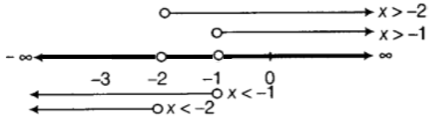
On number line, these inequalities can be represented as,
Image
Thus, $-1< x< \infty$ or $-\infty< x< -2$
But, here - $3 \leq x <\infty$
$\therefore-1< x <\infty$ or $-3 \leq x <-2$
Then, solution set in this case is
$x \in[-3,-2) \cup(-1, \infty)$
Case $II$ : When $x<-3$, then $|x+3|=-(x+3)$
$\therefore \frac{|x+3|-2}{x+2}>0$
$\Rightarrow \frac{-x-3-2}{x+2}>0$
$\Rightarrow \frac{-(x+5)}{x+2}>0$
$\Rightarrow \frac{x+5}{x+2}<0$
$\Rightarrow \frac{(x+5)(x+2)^2}{x+2}<0 \times( x +2)^2$
$\Rightarrow( x +5)( x +2)<0$
Product of $(x + 5)$ and $(x + 2)$ will be negative, if both are of opposite sign.
$\therefore(x+5)>0 $ and $(x+2)<0$
$\text { or }(x+5)<0 $ and $(x+2)>0$
$\Rightarrow x>-5 $ and $ x<-2$
$\text { or } x<-5 $ and $ x>-2$
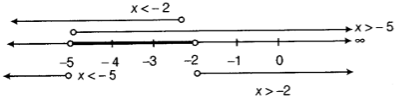
On number line, these inequalities can be represented as,
Image

Thus, $- 5 < x < - 2$ i.e., solution set in the case is $x\in (- 5, - 2).$
On combining cases $I$ and $II,$ we get the required solution set of given inequality, which is
$x \in(-5,-2) \cup(-1, \infty)$
View full question & answer
Question 45 Marks
Show that the equation $x^2-2 y^2-2 x+8 y-1=0$ represents a hyperbola. Find the coordinates of the centre, lengths of the axes, eccentricity, latusrectum, coordinates of foci and vertices and equations of directrices of the hyperbola.
Answer
We have,
$x^2-2 y^2-2 x+8 y-1=0$
$\Rightarrow\left(x^2-2 x\right)-2\left(y^2-4 y\right)=1$
$\Rightarrow\left(x^2-2 x+1\right)-2\left(y^2-4 y+4\right)=-6$
$\Rightarrow(1-x)^2-2(y-2)^2=-6$
$\Rightarrow \frac{(x-1)^2}{(\sqrt{6})^2}-\frac{(y-2)^2}{(\sqrt{3})}=-1 \ldots \text { (i) }$
Shifting the origin at $(1, 2)$ without rotating the coordinate axes and denoting the new coordinates with respect to these axes by $X$
and $Y,$ we obtain
$x = X + 1$ and $y = Y + 2 ... (ii)$
Using these relations, equation $(i)$ reduces to
$\frac{X^2}{(\sqrt{6})^2}-\frac{Y^2}{(\sqrt{3})^2}=-1 \ldots (iii)$
Comparing equation (iii) with standard form $\frac{x^2}{a^2}-\frac{y^2}{b^2}=-1$, we get
$a^2=(\sqrt{6})^2$ and $b^2=(\sqrt{3})^2$
$a=(\sqrt{6})$ and $ b=(\sqrt{3})$
Centre
The coordinates of the centre with respect to the new axes are $(X = 0, Y = 0)$.
So, the coordinates of the centre with respect to the old axes are
$(1,2)[$ Putting $X =0, Y =0$ in $(ii)]$
Lengths of the axes:
$\therefore$ Transverse axis $=2 b=2 \sqrt{3}$ and, Conjugate axis $=2 a =2 \sqrt{6}$.
Eccentricity:
$e=\sqrt{1+\frac{a^2}{b^2}}=\sqrt{1+\frac{6}{3}}=\sqrt{3}$
Latusrectum:
Foci:
The coordinates of foci with respect to the new axes are $ (X=0, Y= \pm$ be$)$
i.e. $(X=0, y= \pm 3 )$.
So, the coordinates of foci with respect to the old axes are
$(1,2 \pm 3)$ i.e. $(1,5)$ and $(1,-1)[$ Putting $X=0, y= \pm 3$ in $(ii)]$
Directrices:
The coordinates of the vertices with respect to the new axes are $X=0, Y= \pm b)$ i.e. $(x=0, y= \pm \sqrt{3})$
So, the coordinates of the vertices with respect to the old axes are $(1,2 \pm \sqrt{3})$ i.e. $(1,2+\sqrt{3})$ and $(1,2-\sqrt{3})$ [Putting $X=0, Y= \pm \sqrt{3}$ in $(ii)]$
Directrices:
The equations of the directrices with respect to the new axes are $Y = \pm \frac{b}{e}$ i.e. $y = \pm 1$.
So, the equations of the directrices with respect to the old axes are $y=2 \pm 1$ i.e. $y=1$ and $y=3$
$[$ Putting $Y= \pm 2$ in $(ii) ]$
View full question & answer
Question 55 Marks
Find the $(i)$ lengths of major and minor axes, $(ii)$ coordinate of the vertice, $(iii)$ coordinate of the foci, $(iv)$ eccentricity, and $(v)$ length of the latus rectum of ellipe: $16 x^2+25 y^2=400$.
Answer
Given: $16 x^2+25 y^2=400$
After dividing by $400$ to both the sides, we get
$\frac{16}{400} x^2+\frac{25}{400} y^2=1$
$\frac{x^2}{25}+\frac{y^2}{16}=1 \ldots \text { (i) }$
Now, above equation is of the form,
$\frac{x^2}{a^2}+\frac{y^2}{b^2}=1 \ldots (ii)$
Comparing eq. $(i)$ and $(ii),$ we get
$a^2=25$ and $b^2=16$
$\Rightarrow a=5$ and $b=4$
$i.$ Length of major axes
$\therefore$ Length of major axes $=2 a =2 \times 5=10$ units
$ii.$ Coordinates of the Vertices
$\therefore$ Coordinate of vertices $=(a, 0)$ and $(-a, 0)=(5,0)$ and $(-5,0)$
$iii.$ Coordinates of the foci
As we know that
Coordinates of foci $=( \pm c , 0)$
Now $c^2=a^2-b^2=25-16$
$\Rightarrow c^2=9$
$\Rightarrow c=\sqrt{9} \Rightarrow c=3...(iii)$
$\therefore$ Coordinates of foci $=( \pm 3,0)$
$iv.$ Eccentricity
As we know that, Eccentricity $=\frac{c}{a}$
$\Rightarrow e=\frac{3}{5} [$from $(iii)]$
$v.$ Length of the Latus Rectum
As we know, Length of Latus Rectum $=\frac{2 b^2}{a}=\frac{2 \times(4)^2}{5}=\frac{32}{5}$
View full question & answer
Question 65 Marks
From the frequency distribution consisting of $18$ observations, the mean and the standard deviation were found to be $7$ and $4,$ respectively. But on comparison with the original data, it was found that a figure $12$ was miscopied as $21$ in calculations. Calculate the correct mean and standard deviation.
Answer
Mean $= 7$
$\therefore \frac{\sum x_i}{18}=7[\because n =18]$
$\Rightarrow \sum x_i=18 \times 7=126$
Since, an observation $12$ was miscopied as $21.$
$\therefore$ Correct $\sum x_i=126-21+12=117$
Hence, true mean $=\frac{\operatorname{Correct} \sum x_i}{18}=\frac{117}{18}=6.5$
Also, given variance $=4^2=16$
$\therefore \frac{\sum x_i^2}{18}-(\text { Mean })^2=16$
$\Rightarrow \frac{\sum x_i^2}{18}=16+(\text { Mean })^2=16+(7)^2$
$\Rightarrow \frac{\sum x_i^2}{18}=16+49$
$\Rightarrow \sum x_i^2=18 \times 65=1170$
But one observation $12$ was miscopied as $21.$
Correct $\sum x_i^2=1170-21^2+12^2=1170-441+144=873$
Hence, correct variance $=\frac{\text { Carrect } \sum x_i^2}{18}-(\text { Correct mean })^2$
$=\frac{873}{18}-(6.5)^2=48.5-42.25=6.25$
$\therefore$ Correct standard deviation $=\sqrt{\text { Correct variance }}$
$=\sqrt{6.25}$
$=2.5$
View full question & answer