Questions

Case study (4 Marks)

🎯

Test yourself on this topic

3 questions · timed · auto-graded

Question 14 Marks
Two complex numbers $Z _1= a + ib$ and $Z _2= c + id$ are said to be equal, if $a = c$ and $b = d$.
$i.$ If $(x+i y)(2-3 i)=4+i$ then find the value of $(x, y)$.
$ii.$ If $\frac{(1+i)^2}{2-i}=x+i y$, then find the value of $x+y. (1)$
$iii.$ If $\left(\frac{1-i}{1+i}\right)^{100}=a+i b$, then find the values of $a$ and $b. (2)$
$OR$
If $(a-2,2 b+1)=(b-1, a+2)$, then find the real values of $a$ and $b. (2)$
Answer
Given, $(a - 2, 2b + 1) = (b - 1, a + 2)$
Comparing $x$ coordinates of both the sides, we get,
$a-2=b-1$
$\therefore a-b=1 \ldots(1)$
Comparing $y$ coordinates of both the sides, we get,
$2 b+1=a+2$
$\therefore a-2 b=-1 \ldots(2)$
Subtracting equation $(2)$ from $(1),$ we get,
$(a-a)+(-b-(-2 b))=1-(-1)$
$\therefore(-b+2 b)=1+1$
$\therefore b=2$
Put this value in equation $(1),$ we get,
$a-2=1$
$\therefore a=3$
View full question & answer
Question 24 Marks
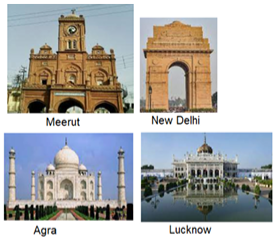
On her vacation, Priyanka visits four cities. Delhi, Lucknow, Agra, Meerut in a random order.
Image

$i$. What is the probability that she visits Delhi before Lucknow? $(1)$
$ii$. What is the probability she visit Delhi before Lucknow and Lucknow before Agra? $(1)$
$iii.$ What is the probability she visits Delhi first and Lucknow last? $(2)$
OR
What is the probability she visits Delhi either first or second? $(2)$
Answer
$\text { i. }(x+i y)(2-3 i)=4+i$
$ 2 x-(3 x) i+(2 y) i-3 y i^2=4+i$
$2 x+3 y+(2 y-3 x) i=4+i$
Comparing the real imaginary parts,
$2 x+3 y=4 \ldots \text { (i) }$
$2 y-3 x=1 \ldots \text { (ii) }$
Solving eq $(i)$ eq $(ii), \ 4x + 6y = 8$
$-9 x+6 y=3$
$13 x=5 $
$\Rightarrow x=\frac{5}{13}$
$y=\frac{14}{13}$
$\therefore(x, y)=\left(\frac{5}{13}, \frac{14}{13}\right)$
$\text { ii. } x+i y=\frac{(1+i)^2}{2-i}$
$x+i y=\frac{(1+i)^2}{2-i}$
$=\frac{1+2 i+i^2}{2-i}=\frac{2 i}{2-i}$
$=\frac{2 i(2+i)}{(2-i)(2+i)}=\frac{4 i+2 i^2}{4-i^2}$
$=\frac{4 i-2}{4+1}=\frac{-2}{5}+\frac{4 i}{5}$
$\Rightarrow x=\frac{-2}{5}, y=\frac{4}{5} $
$\Rightarrow x+y=\frac{-2}{5}+\frac{4}{5}=\frac{2}{5}$
$iii$. We have $\left(\frac{1-i}{1+i}\right)^{100}=a+b i$
$\Rightarrow\left(\frac{1-i}{1+i} \times \frac{1-i}{1-i}\right)^{100}=a+b i$
$\Rightarrow\left(\frac{1+i^2-2 i}{1-i^2}\right)^{100}=a+b i$
$\Rightarrow\left(\frac{1-1-2 i}{1+1}\right)^{100}=a+b i$
$\Rightarrow\left(\frac{-2 i}{2}\right)^{100}=a+b i$
$\Rightarrow(-i)^{100}=a+b i$
$\Rightarrow i^{100}=a+b i$
$\Rightarrow\left(i^4\right)^{25}=a+b i$
$\Rightarrow(1)^{25}=a+b i$
$\Rightarrow 1=a+b i$
$\Rightarrow 1+0 i=a+b i$
Comparing the real and imaginary parts,
We have $a = 1, b = 0$
Hence $(a, b) = (1, 0)$
View full question & answer
Question 34 Marks
Method to Find the Sets When Cartesian Product is Given
For finding these two sets, we write first element of each ordered pair in first set say $A$ and corresponding second element in second set $B\ ($say$)$.
Number of Elements in Cartesian Product of Two Sets
If there are $p$ elements in set $A$ and $q$ elements in set $B$, then there will be pq elements in $A \times B$ i.e. if $n(A)=p$ and $n(B)=q$, then $n(A \times B)=p q$.
$i$. The Cartesian product $A \times A$ has $9$ elements among which are found $(-1,0)$ and $(0,1)$. Find the set $A$ and the remaining elements of $A \times A. (1)$
$ii. A$ and $B$ are two sets given in such a way that $A \times B$ contains $6$ elements. If three elements of $A \times B$ are $(1, 3 ), (2,5)$ and $(3, 3),$ then find the remaining elements of $A \times B. (1)$
$iii$. If the set $A$ has $3$ elements and set $B$ has $4$ elements, then find the number of elements in $A \times B$. $(2)$
OR
If $A \times B=\{(a, 1),(b, 3),(a, 3),(b, 1),(a, 2),(b, 2)\}$. Find $A$ and $B .(2)$
Answer
$i.$ Let the Priyanka visits four cities Delhi, Lucknow, Agra, Meerut are respectively $A, B, C$ and $D$.
Number of way's in which Priyanka can visit four cities $A, B, C$ and $D$ is $4 !$ i.e. $24$
$\therefore A=\{a, b\}$ and $B=\{1,2,3\}$
$\therefore n ( S )=24$
Clearly, sample space for this experiment is
$S =\left\{\begin{array}{l}A B C D, A B D C, A C B D, A C D B, A D B C, A D C B \\ B A C D, B A D C, B C A D, B C D A, B D A C, B D C A \\ C A B D, C A D B, C B A D, C B D A, C D A B, C D B A, \\ D A B C, D A C B, D C A B, D C B A, D B A C, D B C A\end{array}\right\}$
Let $E _1$ be the event that Priyanka visits $A$ before $B$ .
Then,
$E_1=\{A B C D, A B D C, A C B D, A C D B, A D B C, A D C B,$
$ C A B D, C A D B, C D A B, D A B C, D A C B, D C A B\}$
$\Rightarrow n \left( E _1\right)=12$
$\therefore P ($ she visits $A$ before $B )= P \left( E _1\right)=\frac{n\left(E_1\right)}{n(S)}=\frac{12}{24}=\frac{1}{2}$
$ii$. Let the Priyanka visits four cities Delhi, Lucknow, Agra, Meerut are respectively $A, B, C$ and $D$.
Number of way's in which Priyanka can visit four cities $A, B, C$ and $D$ is $4!$ i.e. $24$
$\therefore n ( S )=24$
Clearly, sample space for this experiment is
$S =\left\{\begin{array}{l}A B C D, A B D C, A C B D, A C D B, A D B C, A D C B \\ B A C D, B A D C, B C A D, B C D A, B D A C, B D C A \\ C A B D, C A D B, C B A D, C B D A, C D A B, C D B A, \\ D A B C, D A C B, D C A B, D C B A, D B A C, D B C A\end{array}\right\}$
$ E _1=\{ ABCD , ABDC , ACBD , ACDB , ADBC , ADCB ,$
$ CABD , CADB , CDAB , DABC , DACB , DCAB \}$
$\Rightarrow n \left( E _1\right)=12$
$\therefore P ($she visits $A$ before $ B )=P\left(E_1\right)=\frac{n\left(E_1\right)}{n(S)}=\frac{12}{24}=\frac{1}{2}$
$iii$. Let the Priyanka visits four cities Delhi, Lucknow, Agra, Meerut are respectively $A, B, C$ and $D$.
Number of way's in which Priyanka can visit four cities $A, B, C$ and $D$ is $4!$ i.e. $24$
$\therefore n ( S )=24$
Clearly, sample space for this experiment is 
$S =\left\{\begin{array}{l}A B C D, A B D C, A C B D, A C D B, A D B C, A D C B \\ B A C D, B A D C, B C A D, B C D A, B D A C, B D C A \\ C A B D, C A D B, C B A D, C B D A, C D A B, C D B A, \\ D A B C, D A C B, D C A B, D C B A, D B A C, D B C A\end{array}\right\}$
Let $E _3$ be the event that she visits $A$ first and $B$ last.
Then,
$E_3=\{ ACDB , ADCB \}$
$n\left(E_3\right)=2$
$\because P($ she visits $A$ first and $B$ last $)=P\left(E_3\right)$
$=\frac{n\left(E_3\right)}{n(S)}=\frac{2}{24}=\frac{1}{12}$
OR
Let the Priyanka visits four cities Delhi, Lucknow, Agra, Meerut are respectively $A, B, C$ and $D$.
Number of way's in which Priyanka can visit four cities $A, B, C$ and $D$ is $4!$ i.e. $24$
$\therefore n ( S )=24$
Clearly, sample space for this experiment is
$S =\left\{\begin{array}{l}A B C D, A B D C, A C B D, A C D B, A D B C, A D C B \\ B A C D, B A D C, B C A D, B C D A, B D A C, B D C A \\ C A B D, C A D B, C B A D, C B D A, C D A B, C D B A, \\ D A B C, D A C B, D C A B, D C B A, D B A C, D B C A\end{array}\right\}$
Let $E _4$ be the event that she visits $A$ either first or second.
Then, $E_4=\{A B C D, A B D C, A C B D, A C D B, A D B C, A D C B,$
$ B A C D, B A D C, C A B D, C A D B, D A B C, D A C B\}$
$\Rightarrow n\left(E_4\right)=12$
Hence $, P ($she visits $A$ either first or second$)$
$=P\left(E_4\right)=\frac{n\left(E_4\right)}{n(S)}=\frac{12}{24}=\frac{1}{2}$
 
View full question & answer
Case study (4 Marks) - Maths STD 11 Science Questions - Vidyadip