Questions

3 Marks Question

🎯

Test yourself on this topic

9 questions · timed · auto-graded

Question 13 Marks
If $u=\{1,2,3,4,5,6,7,8,9,10,12,24\}$
$A=\{x: x$ is prime and $x \leq 10\}$
$B=\{x: x$ is a factor of $24\}$
Verify the following result
$i. A - B = A \cap B^{\prime}$
$ii. (A \cup B)^{\prime}=A^{\prime} \cap B^{\prime}$
$iii. (A \cap B)^{\prime}=A^{\prime} \cup B^{\prime}$
Answer
Given, $U = \{1,2,3,4,5,6,7,8,9,10,12,24\}$
$A = \{2,3,5,7\} B = \{1,2,3,4,5,6,8,12,24\}$
Now,$ A’ = \{1,4,6,8,9,10,12,24\} B’ = \{5,7,9,10\}$
$A \cup B=\{1,2,3,4,5,6,7,8,12,24\}$
$(A \cup B)^{\prime}=\{9,10\}$
$A \cap B=\{2,3\}(A \cup B)^{\prime}=\{1,4,5,6,7,8,9,10,12,24\}$
$\text { (i) } A-B=A \cap B^{\prime}$
$\text { L.H.S }=A-B=\{2,3,5,7\}-\{1,2,3,4,6,8,12,24\}=\{5,7\} $
$\text { R.H.S }=A \cap B^{\prime}=\{2,3,5,7\} \cap\{5,7,9,10\}=\{5,7\}$
$\therefore \text { L.H.S }=\text { R.H.S, }$
$\text { (ii) }(A \cup B)^{\prime}=A \cap B^{\prime}$
$\text { L.H.S }=(A \cup B)^{\prime}=\{9,10\}$
$\text { R.H.S }=A^{\prime} \cap B^{\prime}=\{1,4,6,8,9,10,12,24\} \cap\{5,7,9,10\}$
$=\{9,10\}$
$\therefore \text { L.H.S = R.H.S, }$
$\text { (iii) }(A \cap B)^{\prime}=A^{\prime} \cap B^{\prime}$
$\text { L.H.S = }(A \cap B)^{\prime}=\{1,4,5,6,7,8,9,10,12,24\}$
$\text { R.H.S }=A^{\prime} \cap B^{\prime}=\{1,4,6,8,9,10,12,24\} \cap\{5,7,9,10\}$
$=\{1,4,5,6,7,8,9,10,12,34\}$
$\therefore \text { L.H.S = R.H.S }$
View full question & answer
Question 23 Marks
Evaluate $\left[\frac{1}{1-4 i}-\frac{2}{1+i}\right]\left[\frac{3-4 i}{5+i}\right]$ to the standard form.
Answer
${\left[\frac{1}{1-4 i}-\frac{2}{1+i}\right]\left[\frac{3-4 i}{5+i}\right]=\left[\frac{1+i-2+8 i}{(1-4 i)(1+i)}\right]\left[\frac{3-4 i}{5+i}\right]}$
$=\left[\frac{-1+9 i}{1+i-4 i-4 i^2}\right]\left[\frac{3-4 i}{5+i}\right]=\left[\frac{-1+9 i}{5-3 i}\right]\left[\frac{3-4 i}{5+i}\right]$
$=\frac{-3+4 i+27 i-36 i^2}{25+5 i-15 i-3 i^2}=\frac{33+31 i}{28-10 i} \times \frac{28+10 i}{28+10 i}$
$=\frac{924+330 i+868 i+310 i^2}{(28)^2-(10 i)^2}=\frac{614+1198 i}{784+100}\left(\because i^2=-1\right)$
$=\frac{2(307+599 i)}{884}=\frac{307+599 i}{442}$
View full question & answer
Question 33 Marks
Express $(1-2 i)^{-3}$ in the form of $(a+i b)$.
Answer
Let $z=(1-2 i)^{-3}$
$=\frac{1}{(1-2 i)^3}=\frac{1}{1-8 i^3-6 i+12 i^2}\left[\because(a-b)^3=a^3-b^3-3 a^2 b+3 a b^2\right]$
$=\frac{1}{1-8 i^2 \cdot i-6 i+12(-1)}$
$=\frac{1}{1+8 i-6 i-12}\left[\because i^2=-1\right]$
$=\frac{1}{-11+2 i}=\frac{1}{-11+2 i} \times \frac{-11-2 i}{-11-2 i}[\text { multiplying numerator and denominator by }-11-2 i]$
$=\frac{-11-2 i}{(-11)^2-(2 i)^2}=\frac{-11-2 i}{121+4}\left[\because(a-b)(a+b)=a^2-b^2\right]$
$=\frac{-11-2 i}{125}=\frac{-11}{125}-\frac{2 i}{125}=a+i b[\text { say }]$
where, $a=\frac{-11}{125}$ and $b =\frac{-2}{125}$
View full question & answer
Question 43 Marks
Find the expansion of $\left(3 x^2-2 a x+3 a^2\right)^3$ using binomial theorem.
Answer
We have
$\left.\left(3 x^2-2 a x+3 a^2\right)^3=\left[\left(3 x^2-2 a x\right)+3 a^2\right)\right]^3$
$={ }^3 C_0\left(3 x^2-2 a x\right)^3+{ }^3 C_1\left(3 x^2-2 a x\right)^2\left(3 a^2\right)+{ }^3 C_2\left(3 x^2-2 a x\right)\left(3 a^2\right)^2+{ }^3 C_3\left(3 a^2\right)^3$
$=\left(3 x^2-2 a x\right)^3+3 \times 3 a^2\left(3 x^2-2 a x\right)^2+3 \times 9 a^4\left(3 x^2-2 a x\right)+27 a^6$
$=\left(27 x^6-8 a^3 x^3-54 a x^5+36 a^2 x^4\right)+9 a^2\left(9 x^4+4 a^2 x^2-12 a x^3\right)+27 a^4\left(3 x^2-2 a x\right)+27 a^6$
$=27 x^6-8 a^3 x^3-54 a x^5+36 a^2 x^4+81 a^2 x^4+36 a^4 x^2-108 a^3 x^3+81 a^4 x^2-54 a^5 x+27 a^6$
$=27 x^6-54 a x^5+117 a^2 x^4-116 a^3 x^3+117 a^4 x^2-54 a^5 x 27 a^6$
View full question & answer
Question 53 Marks
Find n , if the ratio of the fifth term from the beginning to the fifth term from the end in the expansion of $\left(\sqrt[4]{2}+\frac{1}{\sqrt[4]{3}}\right)^n$ is $\sqrt{6}: 1$
Answer
We have $\left(\sqrt[4]{2}+\frac{1}{\sqrt[4]{3}}\right)^n$
$5^{\text {th }}$ term from the beginning $={ }^n C_4(\sqrt[4]{2})^{n-4}\left(\frac{1}{\sqrt[4]{3}}\right)^4$
$5^{\text {th }}$ term from the end $=( n +1-5+1)^{ th }$ term from beginning
$=( n -3)^{ th } \text { term from beginning }$
$={ }^n C_{n-4}(\sqrt[4]{2})^4\left(\frac{1}{\sqrt[4]{3}}\right)^{n-4}$
Now $\frac{{ }^n C_4(\sqrt[4]{2})^{n-4}\left(\frac{1}{\sqrt[4]{3}}\right)^4}{{ }^n C_{n-4}(\sqrt[4]{2})^4\left(\frac{1}{4 / 5}\right)^{n-4}}=\frac{\sqrt{6}}{1}$
$\Rightarrow(2)^{\frac{n-8}{4}} \cdot(3)^{\frac{n-8}{4}}=2^{\frac{1}{2}} \times 3^{\frac{1}{2}}$
$\frac{n-8}{4}=\frac{1}{2}$
$\Rightarrow n-8=2$
$\Rightarrow n=10$
View full question & answer
Question 63 Marks
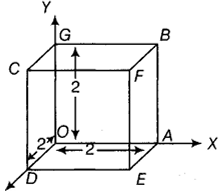
What are the coordinates of the vertices of a cube whose edge is 2 units, one of whose vertices coincides with the origin and three edges passing through the origin coincides with the positive direction of the axes through the origin?
Answer
Given, edge of a cube is 2 unit. It is clear that 
Image
coordinate of O = (0, 0, 0)
coordinate of A = (2, 0, 0)
coordinate of G = (0, 2, 0)
coordinate of D = (0, 0, 2)
coordinate of B = (2, 2, 0)
coordinate of F = (2, 2, 2)
coordinate of P = (2, 0, 2)
coordinate of C = (0, 2, 2)

View full question & answer
Question 73 Marks
Find the equation of the curve formed by the set of all points which are equidistant from the points $A (-1, 2, 3)$ and $B(3, 2, 1).$
Answer
Consider, $C(x, y, z)$ point equidistant from points $A(-1, 2, 3)$ and $B(3, 2, 1).$
$\therefore AC = BC$
$\sqrt{(x+1)^2+(y-2)^2+(z-3)^2}=\sqrt{(x-3)^2+(y-2)^2+(z-1)^2}$
Squaring both sides,
$\Rightarrow( x +1)^2+( y -2)^2+( z -3)^2=( x -3)^2+( y -2)^2+( z -1)^2$
$\Rightarrow x ^2+2 x +1+ y ^2-4 y +4+ z ^2-6 z +9= x ^2-6 x +9+ y ^2-4 y +4+ z ^2-2 z +1$
$\Rightarrow 8 x -4 z =0$
$\Rightarrow 2 x - z =0$
$\Rightarrow z =2 x $
Image
Equation of curve is $z = 2x$
View full question & answer
Question 83 Marks
Solve system of linear inequation: 1 < lx - 2l < 3
Answer
When,
$|x-2| \leq 1$
Then,
$x-2 \leq-1$ and $x-2 \geq 1$
Now when,
$x-2 \leq-1$
Adding 2 to both the sides in above equation
==>$x-2+2 \leq-1+2$
==>$x \leq 1$
Now when,
$x-2 \geq 1$
Adding 2 to both the sides in above equation
==>$x-2+2 \geq 1+2$
==>$x \geq 3$
For $|x-2| \geq 1$ <==> $x \leq 1$ or $x \geq 3$
When,
$|x-2| \leq 3$
Then,
$x-2 \geq-3$ and $x-2 \leq 3$
Now when,
$x-2 \geq-3$
Adding 2 to both the sides in above equation
==>$x-2+2 \geq-3+2$
==>$x \geq-1$
Now when,
$x-2 \leq 3$
Adding 2 to both the sides in above equation
==>$x-2+2 \leq 3+2$
==>$x \leq 5$
For $|x-2| \leq 3: x \geq-1$ or $x \leq 5$
Combining the intervals:
$x \leq 1$ or $x \geq 3$ and $x \geq-1$ or $x \leq 5$
Merging the overlapping intervals:
$-1 \leq x \leq 1 \text { and } 3 \leq x \leq 5$
Therefore,
$x \in[-1,1] \cup[3,5]$
View full question & answer
Question 93 Marks
Let $f=\left\{\left(x, \frac{x^2}{1+x^2}\right): x \in R\right\}$ be a function from R into R . Determine the range of f .
Answer
Here $f(x)=\frac{x^2}{1+x^2}$
Put $y=\frac{x^2}{1+x^2}$
$\Rightarrow y+y x^2=x^2$
$\Rightarrow x^2(1-y)=y$
$\Rightarrow x^2=\frac{y}{1-y}$
$\Rightarrow x= \pm \sqrt{\frac{y}{1-y}}$
$\frac{y}{1-y} \geq 0$
$\Rightarrow \frac{y}{y-1} \leq 0$
$\Rightarrow 0 \leq y<1$
$\Rightarrow y \in[0,1)$
$\therefore$ Range of $f(x)=[0,1)$
View full question & answer