MCQ 1011 Mark
Let $A$ and $B$ be subsets of a set $X$. Then
- A
$A - B = A \cup B$
- B
$A - B = A \cap B$
- C
$A - B = {A^c} \cap B$
- ✓
$A - B = A \cap {B^c}$
AnswerCorrect option: D. $A - B = A \cap {B^c}$
d
(d) $A - B = \{ x:x \in A$ and $x\not \in B\} $
$ = \{ x:x \in A $ and $x \in {B^c}\} = A \cap {B^c}$.
View full question & answer→MCQ 1021 Mark
Let $A$ and $B$ be two sets in the universal set. Then $A - B$ equals
- ✓
$A \cap {B^c}$
- B
${A^c} \cap B$
- C
$A \cap B$
- D
AnswerCorrect option: A. $A \cap {B^c}$
View full question & answer→MCQ 1031 Mark
If $A, B$ and $C$ are any three sets, then $A - (B \cap C)$ is equal to
- ✓
$(A - B) \cup (A - C)$
- B
$(A - B) \cap (A - C)$
- C
$(A - B) \cup C$
- D
$(A - B) \cap C$
AnswerCorrect option: A. $(A - B) \cup (A - C)$
a
(a) From De’ morgan’s law, $A - (B \cap C) = (A - B) \cup (A - C)$.
View full question & answer→MCQ 1041 Mark
If $A, B, C$ are three sets, then $A \cap (B \cup C)$ is equal to
- A
$(A \cup B) \cap (A - C)$
- ✓
$(A \cap B) \cup (A \cap C)$
- C
$(A \cup B) \cup (A \cup C)$
- D
AnswerCorrect option: B. $(A \cap B) \cup (A \cap C)$
b
(b) From Distributive law, $A \cap (B \cup C) = (A \cap B) \cup (A \cap C)$.
View full question & answer→MCQ 1051 Mark
If $A = \{1, 2, 3, 4, 5\}, B = \{2, 4, 6\}, C = \{3, 4, 6\},$ then $(A \cup B) \cap C$ is
- ✓
$\{3, 4, 6\}$
- B
$\{1, 2, 3\}$
- C
$\{1, 4, 3\}$
- D
AnswerCorrect option: A. $\{3, 4, 6\}$
a
(a) $A \cup B = \{ 1,\,2,\,3,\,4,\,5,\,6\} $
$\therefore (A \cup B) \cap C = \{ 3,\,4,\,6\} $.
View full question & answer→MCQ 1061 Mark
Consider the following relations :
$(1) \,\,\,A - B = A - (A \cap B)$
$(2) \,\,\,A = (A \cap B) \cup (A - B)$
$(3) \,\,\,A - (B \cup C) = (A - B) \cup (A - C)$
which of these is/are correct
- A
$1$ and $3$
- B
$2$ only
- C
$2$ and $3$
- ✓
$1$ and $2$
AnswerCorrect option: D. $1$ and $2$
d
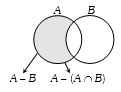
(d) $A - B = A - (A \cap B)$ is correct.
$A = (A \cap B) \cup (A - B)$ is correct.
$(3)$ is false.
$\therefore (1)$ and $(2)$ are true.
View full question & answer→MCQ 1071 Mark
If $n(A) = 3$ and $n(B) = 6$ and $A \subseteq B$. Then the number of elements in $A \cap B$ is equal to
Answera
(a) Since $A \subseteq B,$ $\therefore$ $A \cap B = A$
$\therefore$ $n\,(A \cap B) = n(A) = 3$.
View full question & answer→MCQ 1081 Mark
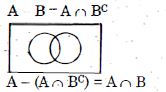
$A-(A-B)$ is
- A
$A \cup B$
- ✓
$A \cap B$
- C
$A \cap {B^c}$
- D
${A^c} \cap B$
AnswerCorrect option: B. $A \cap B$
b
View full question & answer→MCQ 1091 Mark
If $A$ and $B$ are two given sets, then $A \cap {(A \cap B)^c}$ is equal to
- A
$A$
- B
$B$
- C
$\phi $
- ✓
$A \cap {B^c}$
AnswerCorrect option: D. $A \cap {B^c}$
d
(d) $A \cap {(A \cap B)^c} = A \cap ({A^c} \cup {B^c})$
= $(A \cap {A^c}) \cup (A \cap {B^c})$ = $\phi \cup (A \cap {B^c}) = A \cap {B^c}$.
View full question & answer→MCQ 1101 Mark
Let $U = \{ 1,\,2,\,3,\,4,\,5,\,6,\,7,\,8,\,9,\,10\} $, $A = \{ 1,\,2,\,5\} ,\,B = \{ 6,\,7\} $, then $A \cap B'$ is
Answerb
(b) $B' = \{ 1,\,2,\,3,\,4,\,5,\,8\,,9,\,10\} $
$\therefore A \cap B' = \{ 1,\,2,\,5\} \cap \{ 1,\,2,\,3,\,4,\,5,\,8,\,9,\,10\} = \{ 1,\,2,\,5\} = A$
View full question & answer→MCQ 1111 Mark
If $A$ is any set, then
- A
$A \cup A' = \phi $
- ✓
$A \cup A' = U$
- C
$A \cap A' = U$
- D
AnswerCorrect option: B. $A \cup A' = U$
View full question & answer→MCQ 1121 Mark
If $A$ and $B$ be any two sets, then $(A \cap B)'$ is equal to
- A
$A' \cap {\rm B}'$
- ✓
$A' \cup B'$
- C
$A \cap B$
- D
$A \cup B$
AnswerCorrect option: B. $A' \cup B'$
b
(b) From De’ morgan’s law, $(A \cap B)' = A' \cup B'$.
View full question & answer→MCQ 1131 Mark
Given $n(U) = 20$, $n(A) = 12$, $n(B) = 9$, $n(A \cap B) = 4$, where $U$ is the universal set, $A$ and $B$ are subsets of $U$, then $n({(A \cup B)^C}) = $
Answerd
(d) $n(A \cup B) = n(A) + n(B) - n(A \cap B) = 12 + 9 - 4 = 17$
Now, $n({(A \cup B)^C}) = n(U) - n(A \cup B) = 20 - 17 = 3$.
View full question & answer→MCQ 1141 Mark
Which of the following statement is false (where $A$ $\&$ $B$ are two non empty sets)
- A
$A - B = A \cap B'$
- B
$A - B = A - (A \cap B)$
- ✓
$A - B = A - B'$
- D
$A - B = (A \cup B) - B$
AnswerCorrect option: C. $A - B = A - B'$
c
$A \cap B' = A - (A \cap B)$
$A \cap B' = (A \cup B) - B$
View full question & answer→MCQ 1151 Mark
If $A = \{x, y\}$ then the power set of $A$ is
- A
$\{ {x^x},\,{y^y}\} $
- B
$\{ \phi,x, y\}$
- C
$\{\phi, {x}, {2y}\}$
- ✓
$\{\phi, x, y, \{ x, y \} \}$
AnswerCorrect option: D. $\{\phi, x, y, \{ x, y \} \}$
d
The power set is all possible subsets of a set.
Thus power set of $A =\{ x , y \}$ is $\{\phi, x , y ,\{ x , y \}\}$
View full question & answer→MCQ 1161 Mark
In a city $20$ percent of the population travels by car, $50$ percent travels by bus and $10$ percent travels by both car and bus. Then persons travelling by car or bus is......$\%$
Answerc
(c) $n(C) = 20, n(B) = 50, n(C \cap B) = 10 $
Now $n(C \cup B) = n(C) + n(B) -n(C \cap B) $
$= 20 + 50 -10 = 60.$
Hence, required number of persons $= 60\%.$
View full question & answer→MCQ 1171 Mark
$20$ teachers of a school either teach mathematics or physics. $12$ of them teach mathematics while $4$ teach both the subjects. Then the number of teachers teaching physics is
Answera
(a) Let $n\,(P)$= Number of teachers in Physics.
$n\,(M)$= Number of teachers in Maths
$n\,(P \cup M) = n(P) + n\,(M) - n\,(P \cap M)$
$20 = n\,(P) + 12 - 4$ ==> $n\,(P) = 12$.
View full question & answer→MCQ 1181 Mark
In a class of $100$ students, $55$ students have passed in Mathematics and $67$ students have passed in Physics. Then the number of students who have passed in Physics only is
Answerd
(d) $n\,(M) = 55,n\,(P) = 67,n\,(M \cup P) = 100$
Now, $n\,(M \cup P) = n\,(M) + n\,(P) - n\,(M \cap P)$
$100 = 55 + 67 - n\,(M \cap P)$
$\therefore n\,(M \cap P) = 122 - 100 = 22$
Now $n$ ($P$ only) =$n\,(P) - n(M \cap P)$$ = 67 - 22 = 45$.
View full question & answer→MCQ 1191 Mark
The number of elements in the set $\{ (a,\,b):2{a^2} + 3{b^2} = 35,\;a,\,b \in Z\} $, where $Z$ is the set of all integers, is
Answerc
(c) Given set is $\{ (a,\,b):2{a^2} + 3{b^2} = 35,\;a,\,b \in Z\} $
We can see that, $2{( \pm 2)^2} + 3{( \pm 3)^2} = 35$ and $2{( \pm 4)^2} + 3{( \pm 1)^2} = 35$
$ \therefore (2, 3), (2, -3), (-2, -3), (-2, 3), (4, 1), (4, -1),$
$(-4, -1), (-4, 1)$ are $8$ elements of the set.
$ \therefore n = 8$.
View full question & answer→MCQ 1201 Mark
$A$ and $B$ are two subsets of set $S$ = $\{1,2,3,4\}$ such that $A\ \cup \ B$ = $S$ , then number of ordered pair of $(A, B)$ is
View full question & answer→MCQ 1211 Mark
Let $A = \{x:x \in R,\,|x|\, < 1\}\,;$ $B = \{x:x \in R,\,|x - 1| \ge 1\}$ and $A \cup B = R - D,$then the set $D$ is
- A
$\{x:1 < x \le 2\}$
- ✓
$\{x:1 \le x < 2\}$
- C
$\{x:1 \le x \le 2\}$
- D
AnswerCorrect option: B. $\{x:1 \le x < 2\}$
b
(b) $A = [x:x \in R,\, - 1 < x < 1]$
$B = [x:x \in R:x - 1 \le - 1$ or $x - 1 \ge 1]$
= $[x:x \in R:x \le 0{\rm{ or }}x \ge 2]$
$\therefore A \cup B = R - D$, where $D = [x:x \in R,\,1 \le x < 2]$.
View full question & answer→MCQ 1221 Mark
If $X = \{ {4^n} - 3n - 1:n \in N\} $ and $Y = \{ 9(n - 1):n \in N\} ,$ then $X \cup Y$ is equal to
Answerb
(b) Since, ${4^n} - 3n - 1 = {(3 + 1)^n} - 3n - 1$
$ = {3^n}{ + ^n}{C_1}{3^{n - 1}}{ + ^n}{C_2}{3^{n - 2}} + .....{ + ^n}{C_{n - 1}}3{ + ^n}{C_n} - 3n - 1$
(${ = ^n}{C_0}={ ^n}{C_n},{^n}{C_1}$ = ${^n}{C_{n - 1}}$ etc.)
$ = 9{[^n}{C_2}{ + ^n}{C_3}(3) + .....{ + ^n}{C_n}{3^{n - 1}}]$
${4^n} - 3n - 1$ is a multiple of $9$ for $n \ge 2$.
For $n = 1,$ ${4^n} - 3n - 1$ = $4 - 3 - 1 = 0$,
For $n = 2,$ ${4^n} - 3n - 1$= $16 - 6 - 1 = 9$
${4^n} - 3n - 1$ is a multiple of $9$ for all $n \in N$
$X$ contains elements, which are multiples of $9$, and clearly $Y$ contains all multiples of $9$.
$X \subseteq Y$ i.e., $X \cup Y = Y$.
View full question & answer→MCQ 1231 Mark
If $X = \{ {8^n} - 7n - 1:n \in N\} $ and $Y = \{ 49(n - 1):n \in N\} ,$ then
- ✓
$X \subseteq Y$
- B
$Y \subseteq X$
- C
$X = Y$
- D
AnswerCorrect option: A. $X \subseteq Y$
a
(a) Since ${8^n} - 7n - 1 = {(7 + 1)^n} - 7n - 1$
$ = {7^n}{ + ^n}{C_1}{7^{n - 1}}{ + ^n}{C_2}{7^{n - 2}} + .....{ + ^n}{C_{n - 1}}7{ + ^n}{C_n} - 7n - 1$
${ = ^n}{C_2}{7^2}{ + ^n}{C_3}{7^3} + ..{ + ^n}{C_n}{7^n}$,${(^n}{C_0}{ = ^n}{C_n},{\,^n}{C_1}{ = ^n}{C_{n - 1}}\,{\rm{etc}}{\rm{.)}}$
$ = 49{[^n}{C_2}{ + ^n}{C_3}(7) + ......{ + ^n}{C_n}{7^{n - 2}}]$
$\therefore$ ${8^n} - 7n - 1$ is a multiple of $49$ for $n \ge 2$
For $n = 1$, ${8^n} - 7n - 1 = 8 - 7 - 1 = 0$;
For $n = 2,$ ${8^n} - 7n - 1 = 64 - 14 - 1 = 49$
$\therefore$ ${8^n} - 7n - 1$ is a multiple of $49$ for all $n \in N.$
$\therefore $ $X$ contains elements which are multiples of $49$ and clearly $Y$ contains all multiplies of $49$. $X \subseteq Y$.
View full question & answer→MCQ 1241 Mark
Suppose ${A_1},\,{A_2},\,{A_3},........,{A_{30}}$ are thirty sets each having $5$ elements and ${B_1},\,{B_2}, ......., B_n$ are $n$ sets each with $3$ elements. Let $\bigcup\limits_{i = 1}^{30} {{A_i}} = \bigcup\limits_{j = 1}^n {{B_j}} = S$ and each elements of $S$ belongs to exactly $10$ of the $A_i's$ and exactly $9$ of the $B_j's$. Then $n$ is equal to
Answerc
(c) $O(S)$ = $O\left( {\bigcup\limits_{i = 1}^{30} {{A_i}} } \right) = \frac{1}{{10}}(5 \times 30) = 15$
Since, element in the union $S$ belongs to $10$ of $Ai$' s
Also, $O(S)$ = $O\left( {\bigcup\limits_{j\, = 1}^n {{B_j}} } \right) = \frac{{3n}}{9} = \frac{n}{3}$,
$\therefore$ $\frac{n}{3} = 15 \Rightarrow n = 45$.
View full question & answer→MCQ 1251 Mark
In a battle $70\%$ of the combatants lost one eye, $80\%$ an ear, $75\%$ an arm, $85\%$ a leg, $x\%$ lost all the four limbs. The minimum value of $x$ is
Answera
(a) Minimum value of $n=100-(30+20+25+15)$
$ = 100 - 90 = 10$.
View full question & answer→MCQ 1261 Mark
Out of $800$ boys in a school, $224$ played cricket, $240$ played hockey and $336$ played basketball. Of the total, $64$ played both basketball and hockey; $80$ played cricket and basketball and $40$ played cricket and hockey; $24$ played all the three games. The number of boys who did not play any game is
Answerd
(d) $n\,(C) = 224,\,n\,(H) = 240,n\,(B) = 336$
$n\,(H \cap B) = 64,\,\,n(B \cap C) = 80$
$n(H \cap C) = 40$, $n(C \cap H \cap B) = 24$
$n\,({C^c} \cap {H^c} \cap {B^C}) = n\,[{(C \cup H \cup B)^c}]$
$ = n( \cup ) - n(C \cup H \cup B)$
$ = 800 - [n(C) + n(H) + n(B) - n(H \cap C)$
$ - n(H \cap B) - n(C \cap B) + n(C \cap H \cap B)]$
$ = 800 - [224 + 240 + 336 - 64 - 80 - 40 + 24]$
$ = 800 - 640 = 160$.
View full question & answer→MCQ 1271 Mark
A survey shows that $63\%$ of the Americans like cheese whereas $76\%$ like apples. If $x\%$ of the Americans like both cheese and apples, then
- A
$x = 39$
- B
$x = 63$
- ✓
$39 \le x \le 63$
- D
AnswerCorrect option: C. $39 \le x \le 63$
c
(c) Let $A$ denote the set of Americans who like cheese and let $B$ denote the set of Americans who like apples.
Let Population of American be $100$.
Then $n\,(A) = 63,n\,(B) = 76$
Now, $n\,(A \cup B) = n(A) + n(B) - n(A \cap B)$
$ = 63 + 76 - n(A \cap B)$
$\therefore n\,(A \cup B) + n(A \cap B) = 139$
==> $n\,(A \cap B) = 139 - n(A \cup B)$
But $n\,(A \cup B) \le 100$
$\therefore - n\,(A \cup B) \ge - 100$
$\therefore 139 - n\,(A \cup B) \ge 139 - 100 = 39$
$\therefore n(A \cap B) \ge 39$ i.e., $39 \le n(A \cap B)$.....(i)
Again, $A \cap B \subseteq A,A \cap B \subseteq B$
$ \therefore n\,(A \cap B) \le n\,(A) = 63$ and $n\,(A \cap B) \le n\,(B) = 76$
$\therefore n(A \cap B) \le 63$…..(ii)
Then, $39 \le n\,(A \cap B) \le 63$ ==> $39 \le x \le 63$.
View full question & answer→MCQ 1281 Mark
In a certain town $25\%$ families own a phone and $15\%$ own a car, $65\%$ families own neither a phone nor a car. $2000$ families own both a car and a phone. Consider the following statements in this regard:
$1$. $10\%$ families own both a car and a phone
$2$. $35\%$ families own either a car or a phone
$3$. $40,000$ families live in the town
Which of the above statements are correct
- A
$1$ and $2$
- B
$1$ and $3$
- ✓
$2$ and $3$
- D
$1, 2$ and $3$
AnswerCorrect option: C. $2$ and $3$
c
(c) $n(P) = 25\% ,\,\,n(C) = 15\% $
$n\,({P^c} \cap {C^c}) = 65\% ,\,\,n(P \cap C) = 2000$
Since, $n\,({P^c} \cap {C^c}) = 65\% $
$\therefore$ $n\,{(P \cup C)^c} = 65\% $ and $n(P \cup C) = 35\% $
Now, $n(P \cup C) = n(P) + n(C) - n(P \cap C)$
$35 = 25 + 15 - n(P \cap C)$
$\therefore$ $n(P \cap C) = 40 - 35 = 5$. Thus $n\,(P \cap C) = 5\% $
But $n\,(P \cap C) = 2000$
$\therefore$ Total number of families $ = \frac{{2000 \times 100}}{5} = 40,000$
Since, $n(P \cup C) = 35\% $
and total number of families = $40,000$
and $n(P \cap C) = 5\% $. $\therefore$ $(2)$ and $(3)$ are correct.
View full question & answer→MCQ 1291 Mark
If $A, B$ and $C$ are three sets such that $A \cap B = A \cap C$ and $A \cup B = A \cup C$ then
AnswerCorrect option: B. $B = C$
b
$A \cup B=A \cup C$
$\Rightarrow n(A \cup B)=n(A \cup C)$
$\Rightarrow n(A)+n(B)-n(A \cap B)$
$=n(A)+n(C)-n(A \cap C)$
View full question & answer→MCQ 1301 Mark
If $A$ and $B$ are any two non empty sets and $A$ is proper subset of $B$. If $n(A) = 4$, then minimum possible value of $n(A \Delta B)$ is (where $\Delta$ denotes symmetric difference of set $A$ and set $B$)
Answerb
As $A \subset B \Rightarrow A-B=0$
$B-A \geq 1$
$n(A \Delta B)=n((A-B) \cup(B-A)) \geq 1$
minimum value $=1$
View full question & answer→MCQ 1311 Mark
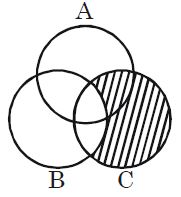
The shaded region in given figure is-
- A
$A \cap B\cup C$
- B
$C-(A \cap B)$
- ✓
$C-(B \cap C)$
- D
$C-(A \cup B)$
AnswerCorrect option: C. $C-(B \cap C)$
View full question & answer→MCQ 1321 Mark
$2n (A / B) = n (B / A)$ and $5n (A \cap B) = n (A) + 3n (B) $, where $P/Q = P \cap Q^C$ . If $n (A \cup B) \leq 10$ , then the value of $\frac{{n\ (A).n\ (B).n\ (A\ \cap\ B)}}{8}$ is
Answera
$2(\mathrm{n}(\mathrm{A})-\mathrm{n}(\mathrm{AB}))=\mathrm{n}(\mathrm{B})-\mathrm{n}(\mathrm{AB})$
$2 n(A)-n(B)=n(A B)$
$\mathrm{n}(\mathrm{A})+3 \mathrm{n}(\mathrm{B})=5 \mathrm{n}(\mathrm{AB})$
$\Rightarrow \mathrm{n}(\mathrm{A})+3 \mathrm{n}(\mathrm{B})=10 \mathrm{n}(\mathrm{A})-5 \mathrm{n}(\mathrm{B})$
$8 n(\mathrm{B})=9 \mathrm{n}(\mathrm{A})$
$\frac{\mathrm{n}(\mathrm{A})}{\mathrm{n}(\mathrm{B})}=\frac{8}{9}$
$\mathrm{n}(\mathrm{A})=8 \mathrm{k} ; \mathrm{n}(\mathrm{B})=9 \mathrm{k}$
$\Rightarrow \mathrm{n}(\mathrm{AB})=7 \mathrm{k}$
$\mathrm{n}(\mathrm{A} \cup \mathrm{B})=10 \mathrm{k} \leq 10$
$\mathrm{k}=1$
View full question & answer→