MCQ 11 Mark
The centre of the conic represented by the equation $2{x^2} - 72xy + 23{y^2} - 4x - 28y - 48 = 0$ is
- A
$\left( {\frac{{11}}{{15}},\;\frac{2}{{25}}} \right)$
- B
$\left( {\frac{2}{{25}},\;\frac{{11}}{{25}}} \right)$
- C
$\left( {\frac{{11}}{{15}},\; - \frac{2}{{25}}} \right)$
- ✓
$\left( { - \frac{{11}}{{25}},\; - \frac{2}{{25}}} \right)$
AnswerCorrect option: D. $\left( { - \frac{{11}}{{25}},\; - \frac{2}{{25}}} \right)$
d
(d) Centre of conic is $\left( {\frac{{hf - bg}}{{ab - {h^2}}},\,\frac{{gh - af}}{{ab - {h^2}}}} \right)$
$ = \frac{{( - 36)( - 14) - (23)( - 2)}}{{(2)(23) - {{(36)}^2}}},\;\frac{{( - 2)( - 36) - (2)( - 14)}}{{(2)(23) - {{( - 36)}^2}}}$
$ = \left( { - \frac{{11}}{{25}},\, - \frac{2}{{25}}} \right)$.
View full question & answer→MCQ 21 Mark
The centre of $14{x^2} - 4xy + 11{y^2} - 44x - 58y + 71 = 0$
- ✓
$(2, 3)$
- B
$(2, -3)$
- C
$(-2, 3)$
- D
$(-2, -3)$
AnswerCorrect option: A. $(2, 3)$
a
(a) Use formula of centre of conic
$i.e.$, $\left( {\frac{{hf - bg}}{{ab - {h^2}}},\,\frac{{gh - af}}{{ab - {h^2}}}} \right)$.
View full question & answer→MCQ 31 Mark
The equation of the conic with focus at $(1, -1)$, directrix along $x - y + 1 = 0$ and with eccentricity $\sqrt 2 $ is
- A
${x^2} - {y^2} = 1$
- B
$xy = 1$
- ✓
$2xy - 4x + 4y + 1 = 0$
- D
$2xy + 4x - 4y - 1 = 0$
AnswerCorrect option: C. $2xy - 4x + 4y + 1 = 0$
c
(c) Let $P (x, y)$ be any point on the conic.
Then $\sqrt {{{(x - 1)}^2} + {{(y + 1)}^2}} = \sqrt 2 \left( {\frac{{x - y + 1}}{{\sqrt 2 }}} \right)$,
[Using $SP = e.PM]$
$ \Rightarrow 2xy - 4x + 4y + 1 = 0$.
View full question & answer→MCQ 41 Mark
If a point $(x,\;y) \equiv (\tan \theta + \sin \theta ,\;\tan \theta - \sin \theta )$, then locus of $(x, y)$ is
AnswerCorrect option: C. ${({x^2} - {y^2})^2} = 16xy$
c
(c) Trick : Put the value of $(x, y)$ $ \equiv $ ($\tan \theta + \sin \theta ,\,\tan \theta - \sin \theta )$ in option $(c)$, which satisfies the equation.
View full question & answer→MCQ 51 Mark
Equation $\sqrt {{{(x - 2)}^2} + {y^2}} + \sqrt {{{(x + 2)}^2} + {y^2}} = 4$ represents
Answerd
(d) Given equation is , $\sqrt {{{(x - 2)}^2} + {y^2}} + \sqrt {{{(x + 2)}^2} + {y^2}} = 4$
$\sqrt {{{(x - 2)}^2} + {y^2}} = 4 - \sqrt {{{(x - 2)}^2} + {y^2}} $
Squaring both sides, we get $\sqrt {{{(x + 2)}^2} + {y^2}} = x + 2$
Again squaring both sides, we get ${y^2} = 0$, which is the equation of pair of straight lines.
View full question & answer→MCQ 61 Mark
The equation ${y^2} - {x^2} + 2x - 1 = 0$ represents
Answerc
(c) Given equation is ${y^2} - {x^2} + 2x - 1 = 0$
Comparing the given equation with
$a{x^2} + 2hxy + b{y^2} + 2gx + 2fy + c = 0$
We get, $a = 1$, $h = 0$, $b = 1$, $g = 1$, $f = 0$, $c = - 1$
$\therefore $ $\Delta = abc + 2fgh - a{f^2} - b{g^2} - c{h^2}$
$\Delta = 1 + 0 + 0 - 1 = 0$
Hence, the given equation represents two straight lines.
View full question & answer→MCQ 71 Mark
The equation ${x^2} - 2xy + {y^2} + 3x + 2 = 0$ represents
Answera
(a) $\Delta = (1)\,(1)\,(2) + 2\,\left( {\frac{3}{2}} \right)\,(0)( - 1) - (1)\,{(0)^2} - $$(1)\,{\left( {\frac{3}{2}} \right)^2} - 2{( - 1)^2}$
$ = 2 - \frac{9}{4} - 2 < 0$ and ${h^2} - ab = 1 - 1 = 0$.
i.e., ${h^2} = ab$ ==> a parabola.
View full question & answer→MCQ 81 Mark
Curve $16{x^2} + 8xy + {y^2} - 74x - 78y + 212 = 0$ represents
Answera
(a) $\Delta \ne 0,\,{h^2} = ab$ $i.e.$, parabola.
View full question & answer→MCQ 91 Mark
The points of intersection of the curves whose parametric equations are $x = {t^2} + 1,\;y = 2t$ and $x = 2s,\;y = \frac{2}{s}$ is given by
- A
$(1,\; - 3)$
- ✓
$(2, 2)$
- C
$(-2, 4)$
- D
$(1, 2)$
AnswerCorrect option: B. $(2, 2)$
b
(b) Eliminating $t$ from $x = {t^2} + 1,\,\,y = 2t,$ we obtain ${y^2} = 4x - 4$
Similarly eliminating s from $x = 2s,\,y = \frac{2}{s},$
we get $xy = 4.$
Hence point of intersection is $(2, 2).$
View full question & answer→MCQ 101 Mark
The equation $14{x^2} - 4xy + 11{y^2} - 44x - 58y + 71 = 0$ represents
Answerb
(b) Check $\Delta \ne 0$ and ${h^2} < ab$.
View full question & answer→MCQ 111 Mark
The eccentricity of the curve represented by the equation ${x^2} + 2{y^2} - 2x + 3y + 2 = 0$ is
- A
$0$
- B
$1/2$
- ✓
$1/\sqrt 2 $
- D
$\sqrt 2 $
AnswerCorrect option: C. $1/\sqrt 2 $
c
(c) Equation ${x^2} + 2{y^2} - 2x + 3y + 2 = 0$ can be written as
$\frac{{{{(x - 1)}^2}}}{2} + {\left( {y + \frac{3}{4}} \right)^2} = \frac{1}{{16}}$
==> $\frac{{{{(x - 1)}^2}}}{{(1/8)}} + \frac{{{{\left( {y + \frac{3}{4}} \right)}^2}}}{{(1/16)}} = 1$,
which is an ellipse with ${a^2} = \frac{1}{8}$ and ${b^2} = \frac{1}{{16}}$
$\therefore \frac{1}{{16}} = \frac{1}{8}(1 - {e^2})$
==>${e^2} = 1 - \frac{1}{2}$
==> $e = \frac{1}{{\sqrt 2 }}$.
View full question & answer→MCQ 121 Mark
The eccentricity of the conic $4{x^2} + 16{y^2} - 24x - 3y = 1$ is
- ✓
$\frac{{\sqrt 3 }}{2}$
- B
$\frac{1}{2}$
- C
$\frac{{\sqrt 3 }}{4}$
- D
$\sqrt 3 $
AnswerCorrect option: A. $\frac{{\sqrt 3 }}{2}$
a
(a) Given equation of conic is $4{x^2} + 16{y^2} - 24x - 3y = 1$
$ \Rightarrow $ ${(2x - 6)^2} + {(4y - 4)^2} = 53$
$ \Rightarrow $ $4\,{(x - 3)^2} + 16\,{(y - 1)^2} = 53$
$ \Rightarrow $ $\frac{{{{(x - 3)}^2}}}{{53/4}} + \frac{{{{(y - 1)}^2}}}{{53/16}} = 1$
$\therefore $ $e = \sqrt {1 - \frac{{{b^2}}}{{{a^2}}}} = \sqrt {1 - \frac{{53/16}}{{53/4}}}$
$= \sqrt {1 - \frac{1}{4}} = \frac{{\sqrt 3 }}{2}$.
View full question & answer→MCQ 131 Mark
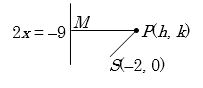
A point ratio of whose distance from a fixed point and line $x = 9/2$ is always $2 : 3$. Then locus of the point will be
Answerb
(b) In question, $PS = \frac{2}{3}PM$ (Given)
Focus $S( - 2,\,0)$,
Equation of directrix $2x - 9 = 0$
${(PS)^2} = \frac{4}{9}{(PM)^2}$
==> ${(h + 2)^2} + {(k)^2} = \frac{4}{9}{\left( {\frac{{2h - 9}}{2}} \right)^2}$
==> $9[{(h + 2)^2} + {(k)^2}] = \frac{{4{{(2h - 9)}^2}}}{4}$
==> $9{h^2} + 9{k^2} + 36h + 36 = 4{h^2} + 81 + 36h$
==> $\frac{{5{h^2}}}{{45}} + \frac{{9{k^2}}}{{45}} = 1$
==> $\frac{{{h^2}}}{9} + \frac{{{k^2}}}{5} = 1$
Locus of point $P(h, k)$ is $\frac{{{x^2}}}{9} + \frac{{{y^2}}}{5} = 1$, which is an ellipse
View full question & answer→MCQ 141 Mark
The equation $13[{(x - 1)^2} + {(y - 2)^2}] = 3{(2x + 3y - 2)^2}$ represents
Answerc
(c) Here coefficient of ${x^2}$ is $+ve$ and that of ${y^2}$ is $-ve$
$i.e.$, a hyperbola.
View full question & answer→MCQ 151 Mark
The equation ${x^2} + 4xy + {y^2} + 2x + 4y + 2 = 0$ represents
Answerc
(c) Obviously ${h^2} > ab$ and
$\Delta = (1)\,(1)\,(2) + 2(2)\,(1)\,(2) - (1)\,{(2)^2} - (1)\,{(1)^2} - 2{(2)^2} < 0$
Hence it is a hyperbola.
View full question & answer→MCQ 161 Mark
The equation of the directrices of the conic ${x^2} + 2x - {y^2} + 5 = 0$ are
- A
$x = \pm 1$
- B
$y = \pm 2$
- ✓
$y = \pm \sqrt 2 $
- D
$x = \pm \sqrt 3 $
AnswerCorrect option: C. $y = \pm \sqrt 2 $
c
(c) ${(x + 1)^2} - {y^2} - 1 + 5 = 0$
$⇒$ $ - \frac{{{{(x + 1)}^2}}}{4} + \frac{{{y^2}}}{4} = 1$
Equation of directrices of $\frac{{{y^2}}}{{{b^2}}} - \frac{{{x^2}}}{{{a^2}}} = 1$ are $y = \pm \frac{b}{e}$
Here $b = 2,\;e = \sqrt {1 + 1} = \sqrt 2 $
Hence $y = \pm \frac{2}{{\sqrt 2 }}$
$⇒$ $y = \pm \sqrt 2 $.
View full question & answer→MCQ 171 Mark
The equation ${x^2} - 16xy - 11{y^2} - 12x + 6y + 21 = 0$ represents
Answerc
(c) $\Delta \ne 0,\,{h^2} > ab$.
View full question & answer→MCQ 181 Mark
The equation of the hyperbola whose directrix is $2x + y = 1$, focus $(1, 1)$ and eccentricity $ = \sqrt 3 $, is
- ✓
$7{x^2} + 12xy - 2{y^2} - 2x + 4y - 7 = 0$
- B
$11{x^2} + 12xy + 2{y^2} - 10x - 4y + 1 = 0$
- C
$11{x^2} + 12xy + 2{y^2} - 14x - 14y + 1 = 0$
- D
AnswerCorrect option: A. $7{x^2} + 12xy - 2{y^2} - 2x + 4y - 7 = 0$
a
(a) $S\,(1,\,1)$, directrix is $2x + y = 1$ and $e = \sqrt 3 $.
Now let the various point be $(h,k)$,
then accordingly $\frac{{\sqrt {{{(h - 1)}^2} + {{(k - 1)}^2}} }}{{\frac{{2h + k - 1}}{{\sqrt 5 }}}} = \sqrt 3 $
Squaring both the sides, we get
$5[{(h - 1)^2} + {(k - 1)^2}] = 3{(2h + k - 1)^2}$
On simplification, the required locus is
$7{x^2} + 12xy - 2{y^2} - 2x + 4y - 7 = 0$.
View full question & answer→MCQ 191 Mark
${x^2} - 4{y^2} - 2x + 16y - 40 = 0$ represents
Answerc
(c) ${x^2} - 2x - 4{y^2} + 16y - 40 = 0$
==> $({x^2} - 2x) - 4({y^2} - 4y) - 40 = 0$
==> ${(x - 1)^2} - 1 - 4[{(y - 2)^2} - 4] - 40 = 0$
==> ${(x - 1)^2} - 4{(y - 2)^2} = 25$
==> $\frac{{{{(x - 1)}^2}}}{{25}} - \frac{{{{(y - 2)}^2}}}{{25/4}} = 1$, which is a hyperbola.
View full question & answer→MCQ 201 Mark
The locus of the intersection point of $x\cos \alpha - y\sin \alpha = a$ and $x\sin \alpha - y\cos \alpha = b$ is
Answerd
(d) $x\,\cos \alpha - y\sin \alpha = a,$ $x\,\sin \alpha - y\cos \alpha = b$ Intersection points are
$h = \frac{{a\,\cos \alpha - b\,\sin \alpha }}{{\cos 2\alpha }}$, $k = \,\frac{{a\,\sin \alpha - \,b\cos \alpha }}{{\cos 2\alpha }}$
Then the locus of point $(h,\,k)$ is ${x^4} + {y^4} - 2{x^2}{y^2}$ $ = ({a^2} + {b^2})$ $({x^2} + {y^2}) + 4abxy$, which is not a locus of any given curves.
View full question & answer→MCQ 211 Mark
${y^2} - 2x - 2y + 5 = 0$ represents
- A
A circle whose centre is $(1, 1)$
- B
A parabola whose focus is $(1, 2)$
- ✓
A parabola whose directrix is $x = \frac{3}{2}$
- D
A parabola whose directrix is $x = - \frac{1}{2}$
AnswerCorrect option: C. A parabola whose directrix is $x = \frac{3}{2}$
c
(c)The equation can be written as ${(y - 1)^2} = 2(x - 2)$.
Obviously, it is a parabola whose focus is $\left( {\frac{5}{2},1} \right)$ and directrix
is $x = \frac{3}{2}$.
View full question & answer→MCQ 221 Mark
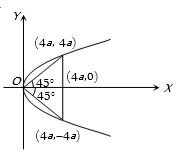
If a double ordinate of the parabola ${y^2} = 4ax$ be of length $8a$, then the angle between the lines joining the vertex of the parabola to the ends of this double ordinate is ............... $^\circ$
Answerc
(c) It is clear from figure.
View full question & answer→MCQ 231 Mark
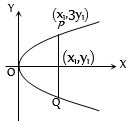
$PQ$ is a double ordinate of the parabola ${y^2} = 4ax$. The locus of the points of trisection of $PQ$ is
- ✓
$9{y^2} = 4ax$
- B
$9{x^2} = 4ay$
- C
$9{y^2} + 4ax = 0$
- D
$9{x^2} + 4ay = 0$
AnswerCorrect option: A. $9{y^2} = 4ax$
a
(a) Required locus is ${(3y)^2} = 4ax$
==> $9{y^2} = 4ax$.
View full question & answer→MCQ 241 Mark
Vertex of the parabola ${y^2} + 2y + x = 0$ lies in the quadrant
Answerd
(d) Given parabola can be written as ${(y + 1)^2} = - (x - 1)$.
Hence vertex is $(1, -1)$, which lies in $IV$ quadrant.
View full question & answer→MCQ 251 Mark
Vertex of the parabola $9{x^2} - 6x + 36y + 9 = 0$ is
- ✓
$(1/3,\; - 2/9)$
- B
$( - 1/3,\; - 1/2)$
- C
$( - 1/3,\;1/2)$
- D
$(1/3,\;1/2)$
AnswerCorrect option: A. $(1/3,\; - 2/9)$
a
(a) The equation can be written as ${(3x - 1)^2} = - 4(9y + 2)$.
Hence the vertex is $\left( {\frac{1}{3},\, - \frac{2}{9}} \right)$.
View full question & answer→MCQ 261 Mark
The equation of the parabola whose axis is vertical and passes through the points $(0, 0), (3, 0)$ and $(-1, 4)$ is
- ✓
${x^2} - 3x - y = 0$
- B
${x^2} + 3x + y = 0$
- C
${x^2} - 4x + 2y = 0$
- D
${x^2} - 4x - 2y = 0$
AnswerCorrect option: A. ${x^2} - 3x - y = 0$
a
(a) Check the equation of parabola for the given points.
View full question & answer→MCQ 271 Mark
The equation of the parabola whose vertex is $(-1, -2)$, axis is vertical and which passes through the point $(3, 6)$, is
AnswerCorrect option: A. ${x^2} + 2x - 2y - 3 = 0$
a
(a) ${(x + 1)^2} = 4a(y + 2)$
Passes through $(3, 6)$
==> $16 = 4a.8$
==> $a = \frac{1}{2}$
==> ${(x + 1)^2} = 2(y + 2)$
==> ${x^2} + 2x - 2y - 3 = 0$.
View full question & answer→MCQ 281 Mark
Axis of the parabola ${x^2} - 4x - 3y + 10 = 0$ is
- A
$y + 2 = 0$
- B
$x + 2 = 0$
- C
$y - 2 = 0$
- ✓
$x - 2 = 0$
AnswerCorrect option: D. $x - 2 = 0$
d
(d) The parabola is ${(x - 2)^2} = (3y - 6)$. Hence axis is $x - 2 = 0$.
View full question & answer→MCQ 291 Mark
Equation of the parabola whose directrix is $y = 2x - 9$ and focus $(-8, -2)$ is
- A
${x^2} + 4{y^2} + 4xy + 16x + 2y + 259 = 0$
- ✓
${x^2} + 4{y^2} + 4xy + 116x + 2y + 259 = 0$
- C
${x^2} + {y^2} + 4xy + 116x + 2y + 259 = 0$
- D
AnswerCorrect option: B. ${x^2} + 4{y^2} + 4xy + 116x + 2y + 259 = 0$
b
(b) Let any point on it be $(x, y)$, then from definition of parabola, we get
$\frac{{\sqrt {{{(x + 8)}^2} + {{(y + 2)}^2}} }}{{\left| {\frac{{2x - y - 9}}{{\sqrt 5 }}} \right|}} = 1$
Squaring and after simplification, we get
${x^2} + 4{y^2} + 4xy + 116x + 2y + 259 = 0$.
View full question & answer→MCQ 301 Mark
The equation of the parabola with $(-3, 0)$ as focus and $x + 5 = 0$ as directirx, is
- A
${x^2} = 4(y + 4)$
- B
${x^2} = 4(y - 4)$
- ✓
${y^2} = 4(x + 4)$
- D
${y^2} = 4(x - 4)$
AnswerCorrect option: C. ${y^2} = 4(x + 4)$
c
(c) Directrix $ = x + 5 = 0$
Focus is $(-3, 0)$
$⇒$ $2a = ( - 5 + 3) = 2$ $⇒$ $a = 1$
Vertex is $\left( {\frac{{ - 3 + ( - 5)}}{2},\,0} \right) = ( - 4,\,0)$
Therefore, equation is ${(y - 0)^2} = 4(x + 4)$.
View full question & answer→MCQ 311 Mark
The equation of the parabola whose vertex and focus lies on the $x$ - axis at distance $a$ and $a’$ from the origin, is
- ✓
${y^2} = 4(a' - a)(x - a)$
- B
${y^2} = 4(a' - a)(x + a)$
- C
${y^2} = 4(a' + a)(x - a)$
- D
${y^2} = 4(a' + a)(x + a)$
AnswerCorrect option: A. ${y^2} = 4(a' - a)(x - a)$
a
(a) Equation will be of the form ${y^2} = 4A(x - a)$,
where $A = (a' - a)$ or ${y^2} = 4(a' - a)(x - a)$.
View full question & answer→MCQ 321 Mark
The focus of the parabola ${y^2} = 4y - 4x$ is
- ✓
$(0, 2)$
- B
$(1, 2)$
- C
$(2, 0)$
- D
$(2, 1)$
AnswerCorrect option: A. $(0, 2)$
a
(a) ${(y - 2)^2} = - 4x + 4$
==> ${(y - 2)^2} = - 4(x - 1)$
Vertex is $(1,2)$ and focus = $(0,2)$.
View full question & answer→MCQ 331 Mark
Vertex of the parabola ${x^2} + 4x + 2y - 7 = 0$ is
- ✓
$(-2, 11/2)$
- B
$(-2, 2)$
- C
$(-2, 11)$
- D
$(2, 11)$
AnswerCorrect option: A. $(-2, 11/2)$
a
(a) ${(x + 2)^2} = - 2y + 7 + 4$
==> ${(x + 2)^2} = - 2\left( {y - \frac{{11}}{2}} \right)$
Hence vertex is $\left( { - 2,\frac{{11}}{2}} \right)$.
View full question & answer→MCQ 341 Mark
If the axis of a parabola is horizontal and it passes through the points $(0, 0), (0, -1)$ and $(6, 1)$, then its equation is
- A
${y^2} + 3y - x - 4 = 0$
- B
${y^2} - 3y + x - 4 = 0$
- C
${y^2} - 3y - x - 4 = 0$
- ✓
Answerd
(d) Trick : There will be no constant term in a curve which passes through $(0,0)$.
So none is correct.
View full question & answer→MCQ 351 Mark
The equation of the latus rectum of the parabola represented by equation ${y^2} + 2Ax + 2By + C = 0$ is
- A
$x = \frac{{{B^2} + {A^2} - C}}{{2A}}$
- B
$x = \frac{{{B^2} - {A^2} + C}}{{2A}}$
- ✓
$x = \frac{{{B^2} - {A^2} - C}}{{2A}}$
- D
$x = \frac{{{A^2} - {B^2} - C}}{{2A}}$
AnswerCorrect option: C. $x = \frac{{{B^2} - {A^2} - C}}{{2A}}$
c
(c) ${(y + B)^2} = - 2Ax - C + {B^2} = - 2A\left( {x + \frac{C}{{2A}} - \frac{{{B^2}}}{{2A}}} \right)$
Equation of latus rectum $x + \lambda = 0$
Vertex $ = \left( {\frac{{ - C + {B^2}}}{{2A}},B} \right)$, focus $ \equiv \left( {\frac{{ - C + {B^2}}}{{2A}} - \frac{A}{2},B} \right)$
Equation of $L.R.$ is $x = \frac{{ - C + {B^2}}}{{2A}} - \frac{A}{2} = \frac{{{B^2} - {A^2} - C}}{{2A}}$.
View full question & answer→MCQ 361 Mark
The equation of parabola whose vertex and focus are (0, 4) and (0, 2) respectively, is
- A
${y^2} - 8x = 32$
- B
${y^2} + 8x = 32$
- ✓
${x^2} + 8y = 32$
- D
${x^2} - 8y = 32$
AnswerCorrect option: C. ${x^2} + 8y = 32$
c
(c)Vertex $(0,4)$; focus $(0,2)$;
$\therefore $ $a = 2$
Hence parabola is ${(x - 0)^2} = - 4.2(y - 4)$
$i.e.$,${x^2} + 8y = 32$.
View full question & answer→MCQ 371 Mark
The length of the latus rectum of the parabola $9{x^2} - 6x + 36y + 19 = 0$
Answerd
(d) $9{x^2} - 6x + 19 = - 36y$
==> ${(3x - 1)^2} = - 36y - 18 = - 36\left( {y + \frac{1}{2}} \right)$
==> $9{\left( {x - \frac{1}{3}} \right)^2} = - 36\left( {y + \frac{1}{2}} \right)$
Hence length of latus rectum is $4$.
View full question & answer→MCQ 381 Mark
The axis of the parabola $9{y^2} - 16x - 12y - 57 = 0$ is
- ✓
$3y = 2$
- B
$x + 3y = 3$
- C
$2x = 3$
- D
$y = 3$
AnswerCorrect option: A. $3y = 2$
a
(a) Since $9{y^2} - 16x - 12y - 57 = 0$
==> ${\left( {y - \frac{2}{3}} \right)^2} = \frac{{16}}{9}\left( {x + \frac{{61}}{{16}}} \right)$
Put $y - \frac{2}{3} = Y$and $x + \frac{{61}}{{16}} = X$
==> ${Y^2} = 4\left( {\frac{4}{9}} \right)\,X$
Axis of this parabola is $Y = 0$
==> $y - \frac{2}{3} = 0$
==> $3y = 2$.
View full question & answer→MCQ 391 Mark
The vertex of a parabola is the point $(a, b)$ and latus rectum is of length $l$. If the axis of the parabola is along the positive direction of $y$ - axis, then its equation is
- A
${(x + a)^2} = \frac{l}{2}(2y - 2b)$
- ✓
${(x - a)^2} = \frac{l}{2}(2y - 2b)$
- C
${(x + a)^2} = \frac{l}{4}(2y - 2b)$
- D
${(x - a)^2} = \frac{l}{8}(2y - 2b)$
AnswerCorrect option: B. ${(x - a)^2} = \frac{l}{2}(2y - 2b)$
b
(b) The equation of the parabola referred to its vertex as the origin is ${X^2} = lY,$
where $x = X + a,\,\,y = Y + b$.
Therefore the equation of the parabola referred to the point $(a,b)$ as the vertex is
${(x - a)^2} = l(y - b)$ or ${(x - a)^2} = \frac{l}{2}(2y - 2b)$.
View full question & answer→MCQ 401 Mark
The latus rectum of the parabola ${y^2} = 5x + 4y + 1$ is
- A
$\frac{5}{4}$
- B
$10$
- ✓
$5$
- D
$\frac{5}{2}$
Answerc
(c) ${y^2} - 4y + 4 = 5x + 5$
${(y - 2)^2} = 5(x + 1)$
Obviously, latus rectum is $5$.
View full question & answer→MCQ 411 Mark
The focus of the parabola ${x^2} = 2x + 2y$ is
- A
$\left( {\frac{3}{2},\;\frac{{ - 1}}{2}} \right)$
- B
$\left( {1,\;\frac{{ - 1}}{2}} \right)$
- ✓
$(1, 0)$
- D
$(0, 1)$
AnswerCorrect option: C. $(1, 0)$
c
(c) The parabola is ${x^2} - 2x = 2y$
or ${x^2} - 2x + 1 = 2y + 1$
==> ${(x - 1)^2} = 2\left( {y + \frac{1}{2}} \right)$
Here $4a = 2 $
$\Rightarrow a = \frac{1}{2}$
Now focus is $\left( {x - 1 = 0,\,y + \frac{1}{2} = \frac{1}{2}} \right)\,\,i.e.,\,(1,\,0)$.
View full question & answer→MCQ 421 Mark
Latus rectum of the parabola ${y^2} - 4y - 2x - 8 = 0$ is
Answera
(a) Given equation,
${y^2} - 4y - 2x - 8 = 0$
==> ${(y - 2)^2} = 2(x + 6)$
$\therefore $Length of latus rectum = $2$.
View full question & answer→MCQ 431 Mark
The equation of the parabola with focus $(a, b)$ and directrix $\frac{x}{a} + \frac{y}{b} = 1$ is given by
- ✓
${(ax - by)^2} - 2{a^3}x - 2{b^3}y + {a^4} + {a^2}{b^2} + {b^4} = 0$
- B
${(ax + by)^2} - 2{a^3}x - 2{b^3}y - {a^4} + {a^2}{b^2} - {b^4} = 0$
- C
${(ax - by)^2} + {a^4} + {b^4} - 2{a^3}x = 0$
- D
${(ax - by)^2} - 2{a^3}x = 0$
AnswerCorrect option: A. ${(ax - by)^2} - 2{a^3}x - 2{b^3}y + {a^4} + {a^2}{b^2} + {b^4} = 0$
a
(a) ${(x - a)^2} + {(y - b)^2} = {\left( {\frac{{bx + ay - ab}}{{\sqrt {{a^2} + {b^2}} }}} \right)^2}$
On solving we get
${(ax - by)^2} - 2{a^3}x - 2{b^3}y + {a^4} + {a^2}{b^2} + {b^4} = 0$.
View full question & answer→MCQ 441 Mark
The length of latus rectum of the parabola $4{y^2} + 2x - 20y + 17 = 0$ is
Answerc
(c) $4{y^2} + 2x - 20y + 17 = 0$
$2{\left( {y - \frac{5}{2}} \right)^2} = - (x - 4)$
==> $4a = \frac{1}{2}$.
View full question & answer→MCQ 451 Mark
The vertex of the parabola $3x - 2{y^2} - 4y + 7 = 0$ is
- A
$(3, 1)$
- ✓
$(-3, -1)$
- C
$(-3, 1)$
- D
AnswerCorrect option: B. $(-3, -1)$
b
(b) Given equation can be written as,
${(y + 1)^2} = \frac{3}{2}(x + 3).$
So, vertex is $( - 3, - 1)$.
View full question & answer→MCQ 461 Mark
The focus of the parabola $4{y^2} - 6x - 4y = 5$ is
- A
$(-8/5, 2)$
- ✓
$(-5/8, 1/2)$
- C
$(1/2, 5/8)$
- D
$(5/8, -1/2)$
AnswerCorrect option: B. $(-5/8, 1/2)$
b
(b) Given equation of parabola written in standard form, we get
$4{\left( {y - \frac{1}{2}} \right)^2} = 6(x + 1)$
$\Rightarrow {\left( {y - \frac{1}{2}} \right)^2} = \frac{3}{2}(x + 1) $
$\Rightarrow {Y^2} = \frac{3}{2}X$
where, $Y = y - \frac{1}{2},\,\,X = x + 1$
$\therefore y = Y + \frac{1}{2},\,\,\,x = X - 1$…..$(i)$
For focus $X = a,\,\,Y = 0$
$\because 4a = \frac{3}{2} \Rightarrow a = \frac{3}{8} \Rightarrow x = \frac{3}{8} - 1 = - \frac{5}{8}$
$y = 0 + \frac{1}{2} = \frac{1}{2}$, Focus$ = \left( { - \frac{5}{8},\frac{1}{2}} \right)$.
View full question & answer→MCQ 471 Mark
The vertex of the parabola ${x^2} + 8x + 12y + 4 = 0$ is
- ✓
$(-4, 1)$
- B
$(4, -1)$
- C
$(-4, -1)$
- D
$(4, 1)$
AnswerCorrect option: A. $(-4, 1)$
a
(a) Given parabola is ${x^2} + 8x + 12y + 4 = 0$
It can be written as ${(x + 4)^2} = - 12y + 12$
$ \Rightarrow \,{(x + 4)^2} = - 12(y - 1)$, vertex is $( - \,4,\,1).$
View full question & answer→MCQ 481 Mark
Focus of the parabola ${(y - 2)^2} = 20(x + 3)$ is
- A
$(3, -2)$
- B
$(2, -3)$
- ✓
$(2, 2)$
- D
$(3, 3)$
AnswerCorrect option: C. $(2, 2)$
c
(c) We know that the standard equation of a parabola is ${(y - \beta )^2} = 4a(x - \alpha ).$
Comparing the given equation with the standard equation, we get vertex $(\alpha ,\,\beta ) = ( - 3,\,2)$ and $a = 5.$
Therefore focus of the parabola $(\alpha + a,\,\beta ) = (2,\,2)$.
View full question & answer→MCQ 491 Mark
The length of the latus rectum of the parabola ${x^2} - 4x - 8y + 12 = 0$ is
Answerc
(c) The given equation of parabola is ${x^2} - 4x - 8y + 12 = 0$
$ \Rightarrow $${x^2} - 4x = 8y - 12$
$ \Rightarrow $${(x - 2)^2} = 8(y - 1)$
Hence the length of latus rectum =$4a = 8$.
View full question & answer→MCQ 501 Mark
The focus of the parabola $y = 2{x^2} + x$ is
- A
$(0, 0)$
- B
$\left( {\frac{1}{2},\;\frac{1}{4}} \right)$
- ✓
$\left( { - \frac{1}{4},\;0} \right)$
- D
$\left( { - \frac{1}{4},\;\frac{1}{8}} \right)$
AnswerCorrect option: C. $\left( { - \frac{1}{4},\;0} \right)$
c
(c) The given equation of parabola is
$y = 2{x^2} + x$
$ \Rightarrow \,{x^2} + \frac{x}{2} = \frac{y}{2}$
$ \Rightarrow \,{\left( {x + \frac{1}{4}} \right)^2} = \frac{y}{2} + \frac{1}{{16}}$
$ \Rightarrow \,{\left( {x + \frac{1}{4}} \right)^2} = \frac{1}{2}\left( {y + \frac{1}{8}} \right)$
It can be written as, ${X^2} = \frac{1}{2}Y$.....$(i)$
Here $A = \frac{1}{8}$, focus of $(i)$ is $\left( {0,\frac{1}{8}} \right)$
$i.e.$ $X = 0$, $Y = \frac{1}{8}$
==> $x + \frac{1}{4} = 0$, $y + \frac{1}{8} = \frac{1}{8}$
$ \Rightarrow \,x = - \frac{1}{4},$ $y = 0$
$i.e.$ focus of given parabola is $\left( { - \frac{1}{4},\,0} \right)$.
View full question & answer→