MCQ 511 Mark
The value of ${( - i)^{1/3}}$ is
- A
$\frac{{1 + \sqrt 3 i}}{2}$
- B
$\frac{{\sqrt 3 - i}}{2}$
- C
$\frac{{ - \sqrt 3 - i}}{2}$
- ✓
$(b) $ and $ (c)$ both
AnswerCorrect option: D. $(b) $ and $ (c)$ both
d
(d) Since $\frac{{ - \sqrt 3 - i}}{2} = - \left( {\cos \frac{\pi }{6} + i\sin \frac{\pi }{6}} \right)$
==> ${\left( {\frac{{ - \sqrt 3 - i}}{2}} \right)^3} = - {\left( {\cos \frac{\pi }{6} + i\sin \frac{\pi }{6}} \right)^3} = - i$
and $\frac{{\sqrt 3 - i}}{2} = \cos \frac{\pi }{6} - i\sin \frac{\pi }{6}$
and ${\left( {\frac{{\sqrt 3 - i}}{2}} \right)^3} = \cos \frac{\pi }{2} - i\sin \frac{\pi }{2} = - i$.
Hence the result.
View full question & answer→MCQ 521 Mark
If ${(1 + i\sqrt 3 )^9} = a + ib,$ then $b$ is equal to
Answerc
(c) $1 + i\sqrt 3 = 2\left( {\frac{1}{2} + i\frac{{\sqrt 3 }}{2}} \right) = 2\left[ {\cos \frac{\pi }{3} + i\sin \frac{\pi }{3}} \right] = 2{e^{i\pi /3}}$
${(1 + i\sqrt 3 )^9} = {(2{e^{i\pi /3}})^9} = {2^9}.{e^{i(3\pi )}}$
$ = {2^9}(\cos 3\pi + i\sin 3\pi ) = - {2^9}$
$a + ib = {(1 + i\sqrt 3 )^9} = - {2^9}$;
$b = 0$.
View full question & answer→MCQ 531 Mark
${( - 1 + i\sqrt 3 )^{20}}$ is equal to
- A
${2^{20}}{( - 1 + i\sqrt 3 )^{20}}$
- B
${2^{20}}{(1 - i\sqrt 3 )^{20}}$
- C
${2^{20}}{( - 1 - i\sqrt 3 )^{20}}$
- ✓
Answerd
(d) Let $z = - 1 + i\sqrt 3 $, $r = \sqrt {1 + 3} = 2$
$\theta = {\tan ^{ - 1}}\left( {\frac{{\sqrt 3 }}{{ - 1}}} \right) = \frac{{2\pi }}{3}$
$\therefore \,z = 2\,\left( {\cos \frac{{2\pi }}{3} + i\sin \frac{{2\pi }}{3}} \right)$
$\therefore \,\,{(z)^{20}} = {\left[ {2\left( {\cos \frac{{2\pi }}{3} + i\sin \frac{{2\pi }}{3}} \right)} \right]^{20}}$
$ = {2^{20}}{\left( {\cos \frac{{2\pi }}{3} + i\sin \frac{{2\pi }}{3}} \right)^{20}}$$ = {2^{20}}{\left( { - \frac{1}{2} + i\frac{{\sqrt 3 }}{2}} \right)^{20}}$.
View full question & answer→MCQ 541 Mark
If ${e^{i\theta }} = \cos \theta + i\sin \theta $, then in $\Delta ABC$ value of ${e^{iA}}.{e^{iB}}.{e^{iC}}$ is
Answerc
(c) ${e^{iA}}.{e^{iB}}.{e^{iC}} = {e^{iA + iB + iC}} = {e^{i(A + B + C)}} = {e^{i\pi }}$
[ $\therefore \,A + B + C = \pi $ ]
$= \cos \pi + i\sin \pi = ( - 1) + i(0) = - 1$.
View full question & answer→MCQ 551 Mark
Which of the following is a fourth root of $\frac{1}{2} + \frac{{i\sqrt 3 }}{2}$
- A
$cis\left( {\frac{\pi }{2}} \right)$
- ✓
$cis\left( {\frac{\pi }{{12}}} \right)$
- C
$cis\left( {\frac{\pi }{6}} \right)$
- D
$cis\left( {\frac{\pi }{3}} \right)$
AnswerCorrect option: B. $cis\left( {\frac{\pi }{{12}}} \right)$
b
(b)$\frac{1}{2} + i\frac{{\sqrt 3 }}{2}$$ = \left( {\cos \frac{\pi }{3} + i\sin \frac{\pi }{3}} \right)$
Now ${\left( {\frac{1}{2} + i\frac{{\sqrt 3 }}{2}} \right)^{1/4}} = {\left( {\cos \frac{\pi }{3} + i\sin \frac{\pi }{3}} \right)^{1/4}}$
$ = \left( {\cos \frac{\pi }{{12}} + i\sin \frac{\pi }{{12}}} \right)$$ = cis\,\left( {\frac{\pi }{{12}}} \right)$.
View full question & answer→MCQ 561 Mark
In the Argand plane, the vector $z = 4 - 3i$ is turned in the clockwise sense through ${180^o}$and stretched three times. The complex number represented by the new vector is
- A
$12 + 9i$
- B
$12 - 9i$
- C
$ - 12 - 9i$
- ✓
$ - 12 + 9i$
AnswerCorrect option: D. $ - 12 + 9i$
d
(d) $|z| = \sqrt {{4^2} + {{( - 3)}^2}} = 5$
Let ${z_1}$ be the new vector obtained by rotating $z$ in the clockwise sense through ${180^o}$, therefore
${z_1} = {e^{ - i\pi }}z = (\cos \pi - i\sin \pi ),$i.e., $z = - 4 + 3i$
The unit vector in the direction of ${z_1}$is $ - \frac{4}{5} + \frac{3}{5}i$ .
Therefore required vector
$ = 3|z|\,\left( { - \frac{4}{5} + \frac{3}{5}i} \right) = 15\left( { - \frac{4}{5} + \frac{3}{5}i} \right) = - 12 + 9i$
View full question & answer→MCQ 571 Mark
The vector $z = 3 - 4i$ is turned anticlockwise through an angle of ${180^o}$ and stretched $2.5$ times. The complex number corresponding to the newly obtained vector is
AnswerCorrect option: B. $\frac{{ - 15}}{2} + 10i$
b
(b) $3 - 4i$ i.e., $(3, - 4)$lie in fourth quadrant in complex plane, after turned anticlockwise through ${180^o}$ this will lie in II quadrant, therefore, the number will be $ - 3 + 4i$, now after stretching it $2.5$ times
i.e., multiplying by $2.5$, the required complex number will be $\frac{{ - 15}}{2} + 10i$.
View full question & answer→MCQ 581 Mark
The complex numbers ${z_1},{z_2},{z_3}$ are the vertices of a triangle. Then the complex numbers $z$ which make the triangle into a parallelogram is
- A
${z_1} + {z_2} - {z_3}$
- B
${z_1} - {z_2} + {z_3}$
- C
${z_2} + {z_3} - {z_1}$
- ✓
Answerd
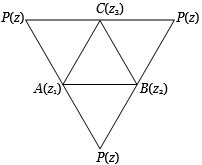
(d) Let $A,B,C$ be the points represented by the numbers ${z_1},{z_2},{z_3}$and $P$ be the point represented by $z$
Now the four points $A,B,C,P$ form a parallelogram in the following three orders.
$(i)$ $A,B,P,C$ $(ii) $ $B,C,P,A$and $(iii) $ $C,A,P,B$
In case $ (i)$ , the condition for $A,B,P,C$to form a parallelogram is $\overrightarrow {AB} = \overrightarrow {CP} $ i.e., ${z_2} - {z_1} = z - {z_3}$
or $z = {z_2} + {z_3} - {z_1}$
Similarly in case $ (ii) $ and $ (iii)$, the required points $\overrightarrow {BC} = \overrightarrow {AP} $or ${z_3} - {z_2} = z - {z_1}$i.e., $z = {z_3} + {z_1} - {z_2}$
and $\overrightarrow {CA} = \overrightarrow {BP} $or ${z_1} - {z_3} = z - {z_2}$i.e., $z = {z_1} + {z_2} - {z_3}$
View full question & answer→MCQ 591 Mark
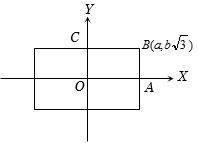
A rectangle is constructed in the complex plane with its sides parallel to the axes and its centre is situated at the origin. If one of the vertices of the rectangle is $a + ib\sqrt 3 $, then the area of the rectangle is
- A
$ab\sqrt 3 $
- B
$2ab\sqrt 3 $
- C
$3ab\sqrt 3 $
- ✓
$4ab\sqrt 3 $
AnswerCorrect option: D. $4ab\sqrt 3 $
d
(d) Area of required rectangle $= 4×$area of $OABC$
$ = 4 \times a \times b\sqrt 3 = 4ab\sqrt 3 $.
View full question & answer→MCQ 601 Mark
Let ${z_1},{z_2},{z_3}$ be three vertices of an equilateral triangle circumscribing the circle $|z|$=$\frac{1}{2}$. If ${z_1} = \frac{1}{2} + \frac{{\sqrt 3 \,i}}{2}$ and ${z_1},{z_2},{z_3}$ are in anticlockwise sense then ${z_2}$ is
- A
$1 + \sqrt 3 \,i$
- B
$1 - \sqrt 3 \,i$
- C
$1$
- ✓
$-1$
Answerd
(d) ${z_2} = \,{z_1}{e^{2i\pi /3}}$$ = \left( {\frac{1}{2} + \frac{{\sqrt 3 }}{2}i} \right)\,\,\left( {\cos \frac{{2\pi }}{3} + i\sin \frac{{2\pi }}{3}} \right)$
$ = \left( {\frac{1}{2} + \frac{{\sqrt 3 }}{2}i} \right)$ $\left( {\frac{{ - 1}}{2} + \frac{{\sqrt 3 }}{2}i} \right)$$ = - \frac{3}{4} - \frac{1}{4} = - 1$.
View full question & answer→MCQ 611 Mark
Let ${z_1}$ and ${z_2}$ be two complex numbers such that $\frac{{{z_1}}}{{{z_2}}} + \frac{{{z_2}}}{{{z_1}}} = 1$. Then
- A
${z_1},{z_2}$are collinear
- B
${z_1},{z_2}$and the origin form a right angled triangle
- ✓
${z_1},{z_2}$and the origin form an equilateral triangle
- D
AnswerCorrect option: C. ${z_1},{z_2}$and the origin form an equilateral triangle
c
(c) We have $\frac{{{z_1}}}{{{z_2}}} + \frac{{{z_2}}}{{{z_1}}} = 1 \Rightarrow z_1^2 + z_2^2 = {z_1}{z_2}$
==> $z_1^2 + z_2^2 + z_3^2 = {z_1}{z_2} + {z_1}{z_3} + {z_2}{z_3},$where ${z_3} = 0$
==> ${z_1},{z_2}$ and the origin form an equilateral triangle.
View full question & answer→MCQ 621 Mark
The region of the complex plane for which $\left| {\frac{{z - a}}{{z + \overline a }}} \right| = 1\,$ $\,[R(a) \ne 0]$ is
AnswerCorrect option: B. $y - $axis
b
(b) We have $\left| {\frac{{z - a}}{{z + \bar a}}} \right| = 1$
==> $|z - a|\, = \,|z + \overline a |$==> $|z - a{|^2} = |z + \overline a {|^2}$
==> $(z - a)(\overline {z - a} ) = (z + \overline a )(\overline {z + \overline a } )$
==> $(z - a)(\overline z - \overline a ) = (z + \overline a )(\overline z + a)$
==> $z\overline z - z\overline a - a\overline z + a\overline a = z\overline z + za + \overline a \overline z + \overline a a$
==> $za + z\overline a + \overline a \overline z + a\overline z = 0\,\,\,\, \Rightarrow (a + \overline a )(z + \overline z ) = 0$
==>$z + \overline z = 0\,\,(a + \overline a = 2{\mathop{\rm Re}\nolimits} (a) \ne 0)$
==> $2{\mathop{\rm Re}\nolimits} (z) = 0$==> $2x = 0$==>$x = 0$
Which is the equation of $y$-axis.
View full question & answer→MCQ 631 Mark
The locus of the points $z$ which satisfy the condition arg $\left( {\frac{{z - 1}}{{z + 1}}} \right)$ =$\frac{\pi }{3}$ is
Answerb
(b) Wehave $\frac{{z - 1}}{{z + 1}} = \frac{{x + iy - 1}}{{x + iy + 1}} = \frac{{({x^2} + {y^2} - 1) + 2iy}}{{{{(x + 1)}^2} + {y^2}}}$
Therefore $arg\frac{{z - 1}}{{z + 1}} = {\tan ^{ - 1}}\frac{{2y}}{{{x^2} + {y^2} - 1}}$
Hence ${\tan ^{ - 1}}\frac{{2y}}{{{x^2} + {y^2} - 1}} = \frac{\pi }{3}$
==> $\frac{{2y}}{{{x^2} + {y^2} - 1}} = \tan \frac{\pi }{3} = \sqrt 3 $
==> ${x^2} + {y^2} - 1 = \frac{2}{{\sqrt 3 }}y$
==> ${x^2} + {y^2} - \frac{2}{{\sqrt 3 }}y - 1 = 0$
Which is obviously a circle.
View full question & answer→MCQ 641 Mark
If the imaginary part of $\frac{{2z + 1}}{{iz + 1}}$is $-2$, then the locus of the point representing $z$in the complex plane is
Answerb
(b) We have $\frac{{2z + 1}}{{iz + 1}} = \frac{{2(x + iy) + 1}}{{i(x + iy) + 1}} = \frac{{(2x + 1) + 2iy}}{{(1 - y) + ix}}$
$ = \frac{{[(2x + 1)(1 - y) + 2xy] + i[2y(1 - y) - x(2x + 1)]}}{{{{(1 - y)}^2} + {x^2}}}$
But it is given that imaginary part of $\frac{{(2z + 1)}}{{(iz + 1)}}$is $-2$
==>$x + 2y - 2 = 0$. Which is a straight line.
View full question & answer→MCQ 651 Mark
If $z = (\lambda + 3) + i\sqrt {5 - {\lambda ^2},} $ then the locus of $z$ is a
Answera
(a) Let $z = x + iy$.Then $x = \lambda + 3$and $y = \sqrt {5 - {\lambda ^2}} $
==> ${(x - 3)^2} = {\lambda ^2}$ ......$(i)$
and ${y^2} = 5 - {\lambda ^2}$ ......$(ii)$
From $(i) $ and $(ii)$, ${(x - 3)^2} = 5 - {y^2}$==> ${(x - 3)^2} + {y^2} = 5$.
Obviously it is a circle.
View full question & answer→MCQ 661 Mark
If $arg\,(z - a) = \frac{\pi }{4}$, where $a \in R$, then the locus of $z \in C$ is a
Answerd
(d)$arg\left\{ {(x - a) + iy} \right\} = \frac{\pi }{4}$
==>${\tan ^{ - 1}}\left( {\frac{y}{{x - a}}} \right) = \frac{\pi }{4}$
==> $\frac{y}{{x - a}} = \tan \frac{\pi }{4} = 1\,\,\, \Rightarrow $$x - a = y$
View full question & answer→MCQ 671 Mark
Locus of the point $z$ satisfying the equation $|iz - 1|$+ $|z - i| = 2$ is
Answera
(a)$|iz - 1| + |z - i|\, = 2$
$ \Rightarrow $ $|i(x + iy) - 1|\, + |x + iy - i|\, = \,2$
$ \Rightarrow $ $| - (y + 1) + ix|\, + |x + i(y - 1)| = 2$
$ \Rightarrow $ $\sqrt {{{( - (y + 1))}^2} + {x^2}} + \sqrt {{x^2} + {{(y - 1)}^2}} = 2$
$ \Rightarrow $ $\sqrt {{{(y + 1)}^2} + {x^2}} = \,2 - \sqrt {{x^2} + {{(y - 1)}^2}} $
$ \Rightarrow $ ${y^2} + 1 + 2y + {x^2} = \,4 + {x^2} + {y^2} + 1 - 2y - 4\sqrt {{x^2} + {{(y - 1)}^2}} $
$ \Rightarrow $$4y = 4 - 4\sqrt {{x^2} + {{(y - 1)}^2}} $$ \Rightarrow $$y = 1 - \sqrt {{x^2} + {{(y - 1)}^2}} $
$ \Rightarrow $ ${x^2} + {(y - 1)^2} = {(1 - y)^2}$
$ \Rightarrow $ ${x^2} + {y^2} + 1 - 2y = \,1 + {y^2} - 2y$$ \Rightarrow $${x^2} = 0 \Rightarrow x = 0$
i.e. equation of straight line.
View full question & answer→MCQ 681 Mark
If $z = x + iy$ is a complex number satisfying ${\left| {z + \frac{i}{2}} \right|^2} = $ $\,\,{\left| {z - \frac{i}{2}} \right|^2},$ then the locus of $z$ is
- A
$2y = x$
- B
$y = x$
- C
$y$-axis
- ✓
$x$-axis
AnswerCorrect option: D. $x$-axis
d
(d)${\left| {\,z + \frac{i}{2}\,} \right|^2}\, = \,{\left| {\,z - \frac{i}{2}\,} \right|^2}$
==> ${\left| {\,x + iy + \frac{i}{2}\,} \right|^2} = {\left| {\,x + iy - \frac{i}{2}\,} \right|^2}$
==> ${\left| {\,x + i\left( {y + \frac{1}{2}} \right)\,} \right|^2} = {\left| {\,x + i\left( {y - \frac{1}{2}} \right)\,} \right|^2}$
$ \Rightarrow \,\,\,{x^2} + {\left( {y + \frac{1}{2}} \right)^2} = {x^2} + {\left( {y - \frac{1}{2}} \right)^2}$
==> $2y = 0$ i.e. $x$-axis.
View full question & answer→MCQ 691 Mark
If the amplitude of $z - 2 - 3i$ is $\pi /4$, then the locus of $z = x + iy$ is
- A
$x + y - 1 = 0$
- B
$x - y - 1 = 0$
- C
$x + y + 1 = 0$
- ✓
$x - y + 1 = 0$
AnswerCorrect option: D. $x - y + 1 = 0$
d
(d)$z - 2 - 3i = x + iy - 2 - 3i = (x - 2) + i(y - 3)$
${\tan ^{ - 1}}\left( {\frac{{y - 3}}{{x - 2}}} \right) = \frac{\pi }{4} \Rightarrow \,\frac{{y - 3}}{{x - 2}} = \tan \frac{\pi }{4} = 1$
==> $x - y + 1 = 0.$
View full question & answer→MCQ 701 Mark
The equation $|z - 5i| \div |z + 5i|\, = 12,$ where $z = x + iy,$ represents a/an
Answera
(a)$\frac{{|z - 5i|}}{{|z + 5i|}} = 12$==> $\frac{{{x^2} + {{(y - 5)}^2}}}{{{x^2} + {{(y + 5)}^2}}} = 12$
$ \Rightarrow \,\,\,{x^2} + {y^2} + 25 - 10y$$ = 12\,[{x^2} + {y^2} + 25 + 10y]$
$ \Rightarrow \,\,11{x^2} + 11{y^2} + 130y + 275 = 0.$
Which represents the equation of a circle.
View full question & answer→MCQ 711 Mark
If $z = x + iy$ and $arg\,\left( {\frac{{z - 2}}{{z + 2}}} \right) = \frac{\pi }{6}$, then locus of $z$ is
Answerb
(b) Put $z = x + iy$ in $arg\left( {\frac{{z - 2}}{{z + 2}}} \right) = \frac{\pi }{6}$
$arg\,\left( {\frac{{(x - 2) + iy}}{{(x + 2) + iy}}} \right) = \frac{\pi }{6}$
$arg((x - 2) + iy) - arg\,((x + 2) + iy) = \frac{\pi }{6}$
${\tan ^{ - 1}}\frac{y}{{x - 2}} - {\tan ^{ - 1}}\frac{y}{{x + 2}} = \frac{\pi }{6}$.
${\tan ^{ - 1}}\left( {\frac{{\frac{y}{{x - 2}} - \frac{y}{{x + 2}}}}{{1 + \frac{{{y^2}}}{{{x^2} - 4}}}}} \right) = \frac{\pi }{6}$$ \Rightarrow \frac{{xy + 2y - xy + 2y}}{{{x^2} + {y^2} - 4}} = \tan \frac{\pi }{6} = \frac{1}{{\sqrt 3 }}$
$ = {x^2} + {y^2} - 4\sqrt {3y} - 4 = 0$
Which is equation of a circle.
View full question & answer→MCQ 721 Mark
If $|8 + z| + |z - 8| = 16$ where $z$ is a complex number, then the point $z$ will lie on
Answerb
(b) Given $|8 + z| + |z - 8| = 16$.
Clearly locus of $z$ is an ellipse.
View full question & answer→MCQ 731 Mark
Which of the following equations can represent a triangle
AnswerCorrect option: B. $|z - 1| = |z - 2| = |z - i|$
b
(b)$|z - 1| = |z - 2| = |z - i|$
$(i)$ $|z - 1| = |z - i|$
represents a straight line through origin i.e., $y = x$
$(ii) $ $|z - 1| = |z - 2| \Rightarrow x = \frac{3}{2}$
which is a straight line
$(iii) $ $|z - 2| = |z - i| \Rightarrow 4x - 2y = 3$
which is a straight line
$|z - 1| = |z - 2| = |z - i|$ can represent a triangle.
View full question & answer→MCQ 741 Mark
A complex number $z$ is such that $arg\,\left( {\frac{{z - 2}}{{z + 2}}} \right)$ $ = \frac{\pi }{3}$. The points representing this complex number will lie on
Answerc
(c) $arg\,\,\,\left( {\frac{{z - 2}}{{z + 2}}} \right) = \frac{\pi }{3}$ $ \Rightarrow $${\tan ^{ - 1}}\left[ {\frac{{(x - 2) + iy}}{{(x + 2)\, + iy}}} \right] = \frac{\pi }{3}$
$ \Rightarrow $ $\sqrt {{{(x - 2)}^2} + {y^2}} = \tan (\pi /3)\,[\sqrt {{{(x + 2)}^2} + {y^2}} ]$
Squaring both sides,
$ \Rightarrow $ ${(x - 2)^2} + {y^2} = 3{[x + 2]^2} + {y^2}]$
$ \Rightarrow $ ${x^2} + {y^2} + 4 - 4x = 3{x^2} + 3{y^2} + 12x + 12$
$ \Rightarrow $ $2{x^2} + 2{y^2} + 16x + 8 = 0$
$ \Rightarrow $${x^2} + {y^2} + 8x + 4 = 0$
which is a equation of circle.
View full question & answer→MCQ 751 Mark
$\frac{{{{(\cos \theta + i\sin \theta )}^4}}}{{{{(\sin \theta + i\cos \theta )}^5}}}$ =
- A
$\cos \theta - i\sin \theta $
- B
$\cos 9\theta - i\sin 9\theta $
- C
$\sin \theta - i\cos \theta $
- ✓
$\sin 9\theta - i\cos 9\theta $
AnswerCorrect option: D. $\sin 9\theta - i\cos 9\theta $
d
(d)$\frac{{{{(\cos \theta + i\sin \theta )}^4}}}{{{{(\sin \theta + i\cos \theta )}^5}}} = \frac{{{{(\cos + i\sin \theta )}^4}}}{{{i^5}{{\left( {\frac{1}{i}\sin \theta + \cos \theta } \right)}^5}}}$
$ = \frac{{{{(\cos \theta + i\sin \theta )}^4}}}{{i\,{{(\cos \theta - i\sin \theta )}^5}}} = \frac{{{{(\cos \theta + i\sin \theta )}^4}}}{{i\,{{(\cos \theta + i\sin \theta )}^{ - 5}}}}$ (By property)
$ = \frac{1}{i}{(\cos \theta + i\sin \theta )^9} = \sin 9\theta - i\cos 9\theta $.
View full question & answer→MCQ 761 Mark
The following in the form of $A + iB$ ${(\cos 2\theta + i\sin 2\theta )^{ - 5}}$ ${(\cos 3\theta - i\sin 3\theta )^6}$${(\sin \theta - i\cos \theta )^3}$ in the form of $A + iB$ is
- A
$(\cos 25\theta + i\sin 25\theta )$
- B
$i(\cos 25\theta + i\sin 25\theta )$
- ✓
$i\,(\cos 25\theta - i\sin 25\theta )$
- D
$(\cos 25\theta - i\sin 25\theta )$
AnswerCorrect option: C. $i\,(\cos 25\theta - i\sin 25\theta )$
c
(c) $\sin \theta - i\cos \theta = - {i^2}\sin \theta - i\cos \theta = - i(\cos \theta + i\sin \theta )$
Given expression is
${( - i)^3}[\cos ( - 10\theta - 18\theta + 3\theta ) + i\sin ( - 25\theta )]$
= $i\,(\cos 25\theta - i\sin 25\theta )$.
View full question & answer→MCQ 771 Mark
If $a = \sqrt {2i} $ then which of the following is correct
- ✓
$a = 1 + i$
- B
$a = 1 - i$
- C
$a = - (\sqrt 2 )i$
- D
AnswerCorrect option: A. $a = 1 + i$
a
(a) We have $a = \sqrt {2i} = \sqrt {2\,} {i^{1/2}} = \sqrt 2 {\left( {\cos \frac{\pi }{2} + i\sin \frac{\pi }{2}} \right)^{1/2}}$
$ = \sqrt 2 \left( {\cos \frac{\pi }{4} + i\sin \frac{\pi }{4}} \right) = \sqrt 2 \left( {\frac{1}{{\sqrt 2 }} + \frac{1}{{\sqrt 2 }}i} \right) = 1 + i$
Trick : Check with options.
View full question & answer→MCQ 781 Mark
If $(\cos \theta + i\sin \theta )(\cos 2\theta + i\sin 2\theta )........$ $(\cos n\theta + i\sin n\theta ) = 1$, then the value of $\theta $ is
- A
$4m\pi $
- B
$\frac{{2m\pi }}{{n(n + 1)}}$
- ✓
$\frac{{4m\pi }}{{n(n + 1)}}$
- D
$\frac{{m\pi }}{{n(n + 1)}}$
AnswerCorrect option: C. $\frac{{4m\pi }}{{n(n + 1)}}$
c
(c) We have $(\cos \theta + i\sin \theta )(\cos 2\theta + i\sin 2\theta )$
......$(\cos n\theta + i\sin n\theta ) = 1$
==> $\cos (\theta + 2\theta + 3\theta + ... + n\theta ) + i\sin (\theta + 2\theta + . + n\theta ) = 1$
==> $\cos \left( {\frac{{n(n + 1)}}{2}\theta } \right) + i\sin \left( {\frac{{n(n + 1)}}{2}\theta } \right) = 1$
$\cos \left( {\frac{{n\,(n + 1)}}{2}\theta } \right)\, = \,1{\rm{ and }}\sin \left( {\frac{{n(n + 1)}}{2}\theta } \right)\, = 0$
==> $\frac{{n(n + 1)}}{2}\theta = 2m\pi \Rightarrow \theta = \frac{{4m\pi }}{{n(n + 1)}},$where $m \in I.$
View full question & answer→MCQ 791 Mark
${\left( {\frac{{1 + \cos \phi + i\sin \phi }}{{1 + \cos \phi - i\sin \phi }}} \right)^n} = $
- A
$\cos n\phi - i\sin n\phi $
- ✓
$\cos n\phi + i\sin n\phi $
- C
$\sin n\phi + i\cos n\phi $
- D
$\sin n\phi - i\cos n\phi $
AnswerCorrect option: B. $\cos n\phi + i\sin n\phi $
b
(b)$L.H.S.$ $ = {\left[ {\frac{{2{{\cos }^2}(\phi /2) + 2i\sin (\phi /2)\cos (\phi /2)}}{{2{{\cos }^2}\,(\phi /2) - 2i\sin (\phi /2)\cos (\phi /2)}}} \right]^n}$
$ = {\left[ {\frac{{\cos \,(\phi /2) + i\sin (\phi /2)}}{{\cos (\phi /2) - i\sin (\phi /2)}}} \right]^n}$
$ = {\left[ {\frac{{{e^{i(\phi /2)}}}}{{{e^{ - i(\phi /2)}}}}} \right]^n} = {({e^{i\phi }})^n}$
$ = \cos n\phi + i\sin n\phi $.
View full question & answer→MCQ 801 Mark
If ${\left( {\frac{{1 + \cos \theta + i\sin \theta }}{{i + \sin \theta + i\cos \theta }}} \right)^4} = \cos n\theta + i\sin n\theta $, then $n$ is equal to
Answerd
(d)${D^r} = i(1 + \cos \theta ) + \sin \theta = 2i{\cos ^2}\frac{\theta }{2} + 2\sin \frac{\theta }{2}\cos \frac{\theta }{2}$
$L.H.S$ $ = {\left[ {\frac{{\cos (\theta /2) + i\sin (\theta /2)}}{{i\cos (\theta /2) + \sin (\theta /2)}}} \right]^4}$
= $\frac{1}{{{i^4}}}{(\cos \theta + i\sin \theta )^4} = \cos 4\theta + i\sin 4\theta $.
View full question & answer→MCQ 811 Mark
${\left( {\frac{{\cos \theta + i\sin \theta }}{{\sin \theta + i\cos \theta }}} \right)^4}$equals
- A
$\sin 8\theta - i\cos 8\theta $
- B
$\cos 8\theta - i\sin 8\theta $
- C
$\sin 8\theta + i\cos 8\theta $
- ✓
$\cos 8\theta + i\sin 8\theta $
AnswerCorrect option: D. $\cos 8\theta + i\sin 8\theta $
d
(d) ${\left( {\frac{{\cos \,\theta + i\sin \theta }}{{\sin \,\theta + i\cos \,\,\theta }}} \right)^4} = \frac{{{{(\cos \,\,\theta + i\sin \,\theta )}^4}}}{{{i^4}\,{{(\cos \,\,\theta - i\sin \theta )}^4}}}$$ = \frac{{\cos \,\,4\theta + i\sin \,\,4\theta }}{{\cos \,\,4\theta - i\sin \,\,4\theta }}$
$ = \frac{{(\cos 4\theta + i\sin 4\theta )(\cos 4\theta + i\sin 4\theta )}}{{(\cos 4\theta - i\sin 4\theta )(\cos 4\theta + i\sin 4\theta )}}$
$\frac{{{{(\cos 4\theta + i\sin 4\theta )}^2}}}{{{{\cos }^2}4\theta + {{\sin }^2}4\theta }} = \cos 8\theta + i\sin 8\theta $
View full question & answer→MCQ 821 Mark
The value of ${\left[ {\frac{{1 - \cos \frac{\pi }{{10}} + i\sin \frac{\pi }{{10}}}}{{1 - \cos \frac{\pi }{{10}} - i\sin \frac{\pi }{{10}}}}} \right]^{10}} = $
Answerb
(b) Let$\cos \frac{\pi }{{10}} - i\sin \frac{\pi }{{10}} = z$ and $\cos \frac{\pi }{{10}} + i\sin \frac{\pi }{{10}} = \frac{1}{z}$
Therefore, ${\left( {\frac{{1 - z}}{{1 - \frac{1}{z}}}} \right)^{10}}$$ = {\left\{ {\frac{{ - (z - 1)z}}{{(z - 1)}}} \right\}^{10}} = {( - z)^{10}}$
$ = {z^{10}} = {\left( {\cos \frac{\pi }{{10}} - i\sin \frac{\pi }{{10}}} \right)^{10}}$$ = \cos \pi - i\sin \pi = - 1$.
View full question & answer→MCQ 831 Mark
If ${x_n} = \cos \,\left( {\frac{\pi }{{{4^n}}}} \right) + i\,\sin \,\left( {\frac{\pi }{{{4^n}}}} \right)\,,$ then ${x_1}.\,{x_2}.\,{x_3}....\infty = $
- ✓
$\frac{{1 + i\sqrt 3 }}{2}$
- B
$\frac{{ - 1 + i\sqrt 3 }}{2}$
- C
$\frac{{1 - i\sqrt 3 }}{2}$
- D
$\frac{{ - 1 - i\sqrt 3 }}{2}$
AnswerCorrect option: A. $\frac{{1 + i\sqrt 3 }}{2}$
a
(a) ${x_1}.\,{x_2}.\,{x_3}......\infty $
$ = \left[ {\cos \left( {\frac{\pi }{4}} \right) + i\sin \left( {\frac{\pi }{4}} \right)} \right]$
$\left[ {\cos \left( {\frac{\pi }{{{4^2}}}} \right) + i\sin \left( {\frac{\pi }{{{4^2}}}} \right)} \right]\,\left[ {\cos \left( {\frac{\pi }{{{4^3}}}} \right) + i\sin \left( {\frac{\pi }{{{4^3}}}} \right)} \right]\,.....\infty $
$ = \cos \left( {\frac{\pi }{4} + \frac{\pi }{{{4^2}}} + \frac{\pi }{{{4^3}}} + ....\infty } \right) + i\sin \left( {\frac{\pi }{4} + \frac{\pi }{{{4^2}}} + \frac{\pi }{{{4^3}}} + .....\infty } \right)$
= $\cos \,\left( {\frac{{\pi /4}}{{1 - 1/4}}} \right) + i\sin \,\left( {\frac{{\pi /4}}{{1 - 1/4}}} \right)$
= $\cos \left( {\pi /3} \right) + i\sin \,(\pi /3) = \frac{{1 + \sqrt 3 i}}{2}$.
View full question & answer→MCQ 841 Mark
$\frac{{{{(\cos \alpha + i\,\sin \alpha )}^4}}}{{{{(\sin \beta + i\,\cos \beta )}^5}}} = $
- A
$\cos (4\alpha + 5\beta ) + i\,\sin (4\alpha + 5\beta )$
- B
$\cos (4\alpha + 5\beta ) - i\,\sin (4\alpha + 5\beta )$
- ✓
$\sin (4\alpha + 5\beta ) - i\cos (4\alpha + 5\beta )$
- D
AnswerCorrect option: C. $\sin (4\alpha + 5\beta ) - i\cos (4\alpha + 5\beta )$
c
(c) $\frac{{{{(\cos \alpha + i\sin \alpha )}^4}}}{{{{(\sin \beta + i\cos \beta )}^5}}}$ $ = \frac{{\cos 4\alpha + i\sin 4\alpha }}{{{i^5}{{(\cos \beta - i\sin \beta )}^5}}}$
= $ - i\,(\cos 4\alpha + i\sin 4\alpha )\,{(\cos \beta - i\sin \beta )^{ - 5}}$
= $ - i\,[\cos 4\alpha + i\sin 4\alpha ]\,\,[\cos 5\beta + i\sin 5\beta ]$
= $ - i\,[\cos (4\alpha + 5\beta ) + i\sin (4\alpha + 5\beta )]$
= $\sin (4\alpha + 5\beta ) - i\,\cos (4\alpha + 5\beta )$.
View full question & answer→MCQ 851 Mark
Given $z = {(1 + i\sqrt 3 )^{100}},$ then $\frac{{{\mathop{\rm Re}\nolimits} (z)}}{{{\mathop{\rm Im}\nolimits} (z)}}$ equals
- A
$2^{100}$
- B
$2^{50}$
- ✓
$\frac{1}{{\sqrt 3 }}$
- D
$\sqrt 3 $
AnswerCorrect option: C. $\frac{1}{{\sqrt 3 }}$
c
(c) Let $z = (1 + i\sqrt 3 )$
$r = \sqrt {3 + 1} = 2$ ${\rm{and}}\,\,r\cos \theta = 1,\,\,r\sin \theta = \sqrt 3 $
$\tan \theta = \sqrt 3 = \tan \frac{\pi }{3}$$ \Rightarrow \,\theta = $$\frac{\pi }{3}.$
$z = \,2\,\left( {\cos \frac{\pi }{3} + i\sin \frac{\pi }{3}} \right)$
==> ${z^{100}} = {\left[ {2\,\left( {\cos \frac{\pi }{3} + i\sin \frac{\pi }{3}} \right)} \right]^{100}}$
$ = {2^{100}}\left( {\cos \frac{{100\,\pi }}{3} + i\sin \frac{{100\,\pi }}{3}} \right)$
$ = {2^{100}}\left( { - \cos \frac{\pi }{3} - i\sin \frac{\pi }{3}} \right)$$ = {2^{100}}\left( { - \frac{1}{2} - \frac{{i\sqrt 3 }}{2}} \right)$
$\therefore $ $\frac{{{\mathop{\rm Re}\nolimits} (z)}}{{{\mathop{\rm Im}\nolimits} \,(z)}} = \frac{{ - 1/2}}{{ - \sqrt 3 /2}} = \frac{1}{{\sqrt 3 }}$.
View full question & answer→MCQ 861 Mark
${\left( {\frac{{1 + \sin \theta + i\,\cos \theta }}{{1 + \sin \theta - i\,\cos \theta }}} \right)^n}$=
- ✓
$\cos \left( {\frac{{n\pi }}{2} - n\theta } \right) + i\,\sin \left( {\frac{{n\pi }}{2} - n\theta } \right)$
- B
$\cos \left( {\frac{{n\pi }}{2} + n\theta } \right) + i\,\sin \left( {\frac{{n\pi }}{2} + n\theta } \right)$
- C
$\sin \left( {\frac{{n\pi }}{2} - n\theta } \right) + i\,\cos \left( {\frac{{n\pi }}{2} - n\theta } \right)$
- D
$\cos \,n\left( {\frac{\pi }{2} + 2\theta } \right) + i\,\sin \,n\left( {\frac{\pi }{2} + 2\theta } \right)$
AnswerCorrect option: A. $\cos \left( {\frac{{n\pi }}{2} - n\theta } \right) + i\,\sin \left( {\frac{{n\pi }}{2} - n\theta } \right)$
a
(a)${\left( {\frac{{1 + \sin \theta + i\cos \theta }}{{1 + \sin \theta - i\cos \theta }}} \right)^n} = {\left( {\frac{{1 + \cos \alpha + i\sin \alpha }}{{1 + \cos \alpha - i\sin \alpha }}} \right)^n}$
$($where $\alpha = \frac{\pi }{2} - \theta )$
$ = {\left( {\frac{{2{{\cos }^2}\frac{\alpha }{2} + 2i\sin \frac{\alpha }{2}\cos \frac{\alpha }{2}}}{{2{{\cos }^2}\frac{\alpha }{2} - 2i\sin \frac{\alpha }{2}\cos \frac{\alpha }{2}}}} \right)^n}$$ = {\left( {\frac{{\cos \frac{\alpha }{2} + i\sin \frac{\alpha }{2}}}{{\cos \frac{\alpha }{2} - i\sin \frac{\alpha }{2}}}} \right)^n}$
$ = {\left( {\frac{{cos\,\left( {\frac{\alpha }{2}} \right)}}{{cos\,\left( { - \frac{\alpha }{2}} \right)}}} \right)^n}$$ = {\left\{ {cos\,\left( {\frac{\alpha }{2} + \frac{\alpha }{2}} \right)} \right\}^n} = cos(n\alpha )$
= $cos\,n\,\left( {\frac{\pi }{2} - \theta } \right) = cos\,\left( {\frac{{n\pi }}{2} - n\theta } \right)$
$ = \,\cos \left( {\frac{{n\pi }}{2} - n\theta } \right) + i\,\sin \,\left( {\frac{{n\pi }}{2} - n\theta } \right)$.
View full question & answer→MCQ 871 Mark
If $\frac{1}{x} + x = 2\cos \theta ,$ then ${x^n} + \frac{1}{{{x^n}}}$ is equal to
- ✓
$2\cos n\theta $
- B
$2\sin n\theta $
- C
$\cos n\,\theta $
- D
$\sin \,n\theta $
AnswerCorrect option: A. $2\cos n\theta $
a
(a) $x + \frac{1}{x} = 2\cos \theta $
==> ${x^2} - 2x\cos \theta + 1 = 0$
==>$x = \cos \theta \pm i\sin \theta $
==> ${x^n} = \cos n\theta \pm i\sin n\theta $
==>$\frac{1}{x} = \frac{1}{{\cos \theta \pm i\sin \theta }}$
==> $\frac{1}{x} = \cos \theta \mp i\sin \theta $
==>$\frac{1}{{{x^n}}} = \cos n\theta \mp i\sin n\theta $
Thus, ${x^n} + \frac{1}{{{x^n}}} = 2\cos n\theta $.
View full question & answer→MCQ 881 Mark
If $i{z^4} + 1 = 0$, then $z$ can take the value
AnswerCorrect option: B. $\cos \frac{\pi }{8} + i\,\sin \frac{\pi }{8}$
b
(b) $i{z^4} = - 1$
${z^4} = \frac{{ - 1}}{i} \Rightarrow {z^4} = i \Rightarrow z = {(i)^{1/4}}$
$z = {(0 + i)^{1/4}}$
$z = {\left( {\cos \frac{\pi }{2} + i\sin \frac{\pi }{2}} \right)^{1/4}}$
$z = \cos \frac{\pi }{8} + i\sin \frac{\pi }{8}$ (using De Moivre’s theorem)
View full question & answer→MCQ 891 Mark
Square of either of the two imaginary cube roots of unity will be
- A
- ✓
Other imaginary cube root of unity
- C
Sum of two imaginary roots of unity
- D
AnswerCorrect option: B. Other imaginary cube root of unity
b
(b) Since imaginary cube root of unity are square of each other.
View full question & answer→MCQ 901 Mark
The value of $\frac{{a + b\omega + c{\omega ^2}}}{{b + c\omega + a{\omega ^2}}} + \frac{{a + b\omega + c{\omega ^2}}}{{c + a\omega + b{\omega ^2}}}$ will be
Answerb
(b) Multiplying the numerator and denominator by $\omega $ and ${\omega ^2}$ respectively $I$ and $II$ expressions
$ = \frac{{a + b\omega + c{\omega ^2}}}{{b + c\omega + a{\omega ^2}}} + \frac{{a + b\omega + c{\omega ^2}}}{{c + a\omega + b{\omega ^2}}}$
$ = \frac{{\omega (a + b\omega + c{\omega ^2})}}{{(b\omega + c{\omega ^2} + a)}} + \frac{{{\omega ^2}(a + b\omega + c{\omega ^2})}}{{(c{\omega ^2} + a + a\omega )}} = \omega + {\omega ^2} = - 1$
View full question & answer→MCQ 911 Mark
If $z = \frac{{\sqrt 3 + i}}{2}$, then the value of ${z^{69}}$ is
AnswerCorrect option: A. $ - i$
a
(a) Given that $z = \frac{{\sqrt 3 + i}}{2} = \frac{{\sqrt 3 }}{2} + \frac{1}{2}i$
$ \Rightarrow \,\,\,iz = - \frac{1}{2} + i\frac{{\sqrt 3 }}{2} = \omega $
Now${z^{69}} = {z^{4(17)}}z = {(iz)^{4(17)}}z = {(\omega )^{68}}z,\,\,\,\,({i^{4n}} = 1)$
$ = \frac{{{\omega ^{69}}}}{i} = \frac{{{{({\omega ^3})}^{23}}}}{i} = \frac{1}{i} = - i$
Aliter : $z = \frac{{\sqrt 3 }}{2} + i\frac{1}{2} = \cos \frac{\pi }{6} + i\sin \frac{\pi }{6}$
==> ${z^{69}} = {\left( {\cos \frac{\pi }{6} + i\sin \frac{\pi }{6}} \right)^{69}} = \cos \frac{{69\pi }}{6} + i\sin \frac{{69\pi }}{6}$
$ = \cos \left( {11\pi + \frac{\pi }{2}} \right) + i\sin \left( {11\pi + \frac{\pi }{2}} \right) = 0 + i( - 1) = - i$.
View full question & answer→MCQ 921 Mark
If ${z_1},{z_2},{z_3}......{z_n}$ are nth, roots of unity, then for $k = 1,\,2,.....,n$
- A
$|{z_k}| = k|{z_{k + 1}}|$
- B
$|{z_{k + 1}}| = k|{z_k}|$
- C
$|{z_{k + 1}}|\, = \,|{z_k}| + |{z_{k + 1}}|$
- ✓
$|{z_k}| = |{z_{k + 1}}|$
AnswerCorrect option: D. $|{z_k}| = |{z_{k + 1}}|$
d
(d)The ${n^{{\rm{th}}}}$roots of unity are given by
${z_k} = {e^{\frac{{i2\pi (k - 1)}}{n}}},\,\,\,\,\,(k = 1,2....,n)$
$|{z_k}|\, = \,\left| {\,{e^{\frac{{i2\pi (k - 1)}}{n}}}\,} \right| = 1$for all $k = 1,2,.....,n$
==> $|{z_k}|\, = \,|{z_{k + 1}}|$for all $k = 1,2.....,n$
View full question & answer→MCQ 931 Mark
If $1,\omega ,{\omega ^2}$ are three cube roots of unity, then ${(a + b\omega + c{\omega ^2})^3}$ + ${(a + b{\omega ^2} + c\omega )^3}$ is equal to, if $a + b + c = 0$
AnswerCorrect option: A. $27\,abc$
a
(a)Trick : Put $a = 1,b = 1,c = - 2$, $a + b + c = 0$
$\therefore \,\,\,{(1 + \omega - 2{\omega ^2})^3} + {(1 + {\omega ^2} - 2\omega )^3}$
$ = {( - 3{\omega ^2})^3} + {( - 3\omega )^3} = - 27 - 27 = - 54$
Also option $(a)$ gives the value $i.e.,$$27 \times 1 \times 1( - 2) = - 54$
View full question & answer→MCQ 941 Mark
The common roots of the equations ${x^{12}} - 1 = 0$, ${x^4} + {x^2} + 1 = 0$ are
AnswerCorrect option: C. $ \pm \omega ,\, \pm {\omega ^2}$
c
(c) ${x^{12}} - 1 = ({x^6} + 1)({x^6} - 1) = ({x^6} + 1)({x^2} - 1)({x^4} + {x^2} + 1)$
Common roots are given by ${x^4} + {x^2} + 1 = 0$
$\therefore \,\,\,$${x^2} = \frac{{ - 1 \pm i\sqrt 3 }}{2} = \omega ,{\omega ^2}$or ${\omega ^4},{\omega ^2}$
$(\because {\omega ^3} = 1)$
or $x = \pm {\omega ^2}, \pm \omega $
View full question & answer→MCQ 951 Mark
If ${z_1},{z_2}{z_3},{z_4}$are the roots of the equation ${z^4} = 1$, then the value of $\sum\limits_{i = 1}^4 {z_i^3} $is
Answera
(a)${z_1} = 1,{z_2} = i,{z_3} = - 1,{z_4} = - i$
${1^3} + {(i)^3} + {( - 1)^3} + {( - i)^3} = 0$.
View full question & answer→MCQ 961 Mark
If $\alpha $ is an imaginary cube root of unity, then for $n \in N$, the value of ${\alpha ^{3n + 1}} + {\alpha ^{3n + 3}} + {\alpha ^{3n + 5}}$ is
Answerb
(b)Since $\alpha $ is an imaginary cube root of unity, let it be $\omega $then $ = {(\omega )^{3n + 1}} + {(\omega )^{3n + 3}} + {\omega ^{3n + 5}}$
$ = \omega + 1 + {\omega ^5},\,\,\,\,\,\{ {\omega ^{3n}} = 1$ and ${\omega ^3} = 1\} $$ = \omega + 1 + {\omega ^2} = 0$
View full question & answer→MCQ 971 Mark
${\left( {\frac{{ - 1 + i\sqrt 3 }}{2}} \right)^{20}} + {\left( {\frac{{ - 1 - i\sqrt 3 }}{2}} \right)^{20}} = $
- A
$20\sqrt 3 i$
- B
$1$
- C
$\frac{1}{{{2^{19}}}}$
- ✓
$ - 1$
AnswerCorrect option: D. $ - 1$
d
(d)As $\frac{{ - 1 + i\sqrt 3 }}{2} = \omega $ and $\frac{{ - 1 - i\sqrt 3 }}{2} = {\omega ^2}$
$\therefore \,\,\,{(\omega )^{20}} + {({\omega ^2})^{20}} = {\omega ^{18}}.{\omega ^2} + {\omega ^{39}}.\omega = {\omega ^2} + \omega = - 1$
View full question & answer→MCQ 981 Mark
If $\alpha $ and $\beta $ are imaginary cube roots of unity, then the value of ${\alpha ^4} + {\beta ^{28}} + \frac{1}{{\alpha \beta }}$,is
Answerc
(c)Since $\alpha $ and $\beta $ are complex roots of unity, we may write $\alpha = \omega ,\beta = {\omega ^2}$
Hence, ${\alpha ^4} + {\beta ^{28}} + \frac{1}{{\alpha \beta }} = {\omega ^4} + {({\omega ^2})^{28}} + \frac{1}{{\omega .{\omega ^2}}}$
$ = \omega + {\omega ^{56}} + 1 = \omega + {\omega ^2} + 1 = 0$
View full question & answer→MCQ 991 Mark
If $\omega $ is the cube root of unity, then ${(3 + 5\omega + 3{\omega ^2})^2}$ + ${(3 + 3\omega + 5{\omega ^2})^2}$ =
Answerc
(c)${(3 + 5\omega + 3{\omega ^2})^2} + {(3 + 3\omega + 5{\omega ^2})^2}$
$ = {(3 + 3\omega + 3{\omega ^2} + 2\omega )^2} + {(3 + 3\omega + 3{\omega ^2} + 2{\omega ^2})^2}$
$(1 + \omega + {\omega ^2} = 0,{\omega ^3} = 1)$
$ = {(2\omega )^2} + {(2{\omega ^2})^2} = 4{\omega ^2} + 4{\omega ^4} = 4( - 1) = - 4$.
View full question & answer→MCQ 1001 Mark
${\left( {\frac{{\sqrt 3 + i}}{2}} \right)^6} + {\left( {\frac{{i - \sqrt 3 }}{2}} \right)^6}$is equal to
Answera
(a) ${\left( {\frac{{\sqrt 3 + i}}{2}} \right)^6} + {\left( {\frac{{i - \sqrt 3 }}{2}} \right)^6} = {\left( {\frac{{ - 1 + \sqrt 3 i}}{{2i}}} \right)^6} + {\left( {\frac{{ - 1 - \sqrt 3 i}}{{2i}}} \right)^6}$
$ = \frac{1}{{{i^6}}}[{(\omega )^6} + {({\omega ^2})^6}] = - [{({\omega ^3})^2} + {({\omega ^3})^4}]$
$\left( {\because \,\,\,\omega = \frac{{ - 1 + \sqrt 3 i}}{2},{\omega ^2} = \frac{{ - 1 - \sqrt 3 i}}{2}} \right)$
$ = - (1 + 1) = - 2$.
View full question & answer→