MCQ 511 Mark
If $P(n,r) = 1680$ and $C(n,r) = 70$, then $69n + r! = $
Answerb
(b) $P(n,r) = 1680$$\frac{{n!}}{{(n - r)!}} = 1680$…..$(i)$
$C(n,r) = 70$ ==>$\frac{{n!}}{{r!\,(\,n - r)!}} = 70$…..$(ii)$ $\frac{{1680}}{{r!}} = 70$, [From $(i)$ and $(ii)$]
$r! = \frac{{1680}}{{70}} = 24$==> $r = 4$
$\because $ $p(n,4) = \,1680$
$\therefore$ $n(n - 1)(n - 2)(n - 3) = 1680$ ==> $n = 8$
$8 \times 7 \times 6 \times 5 = 1680$
Now $69n + r\,! = 69 \times 8 + 4!$
$ = 552 + 24$ $= 576$.
View full question & answer→MCQ 521 Mark
Ten persons, amongst whom are $A, B$ and $C$ to speak at a function. The number of ways in which it can be done if $A$ wants to speak before $B$ and $B$ wants to speak before $C$ is
- ✓
$\frac{{10\;!}}{6}$
- B
$3\;!\;7\;!$
- C
$^{10}{P_3}\;.\;7\;!$
- D
AnswerCorrect option: A. $\frac{{10\;!}}{6}$
a
(a) For $A, B, C$ to speak in order of alphabets, $3$ places out of $10$ may be chosen first in $^{10}{C_3}$ ways.
The remaining $7$ persons can speak in $7\;!$ ways.
Hence, the number of ways in which all the $10$ person can speak is $^{10}{C_3}\;.\;7\;!\; = \frac{{10\;!}}{{3\;!}}. = \frac{{10\;!}}{6}.$
View full question & answer→MCQ 531 Mark
There were two women participating in a chess tournament. Every participant played two games with the other participants. The number of games that the men played between themselves proved to exceed by $66$ the number of games that the men played with the women. The number of participants is
Answerc
(c) Let there be $n$ men participants. Then the number of games that the men play between themselves is $2\;.{\;^n}{C_2}$ and the number of games that the men played with the women is $2.\;(2n)$.
$\therefore $$2.{\;^n}{C_2} - 2\;.\;2n = 66$ (By hypothesis)
$ \Rightarrow $${n^2} - 5n - 66 = 0 \Rightarrow n = 11$
$\therefore $ Number of participants $ = 11\;{\rm{men}} + 2\;{\rm{women}} = 13$.
View full question & answer→MCQ 541 Mark
A father with $8$ children takes them $3$ at a time to the Zoological gardens, as often as he can without taking the same $3$ children together more than once. The number of times each child will go to the garden is
Answerb
(b) Each child will go as often as he (or she) can be accompanied by two others.
Therefore the required number is ${^7}{C_2} = 21$.
View full question & answer→MCQ 551 Mark
A car will hold $2$ in the front seat and $1$ in the rear seat. If among $6$ persons $2$ can drive, then the number of ways in which the car can be filled is
Answerb
(b) Since $2$ persons can drive the car, therefore we have to select $1$ from these two. This can be done in $^2{C_1}$ ways. Now from the remaining $5$ persons we have to select $2$ which can be done in $^5{C_2}$ ways.
Therefore the required number of ways in which the car can be filled is $^5{C_2}{ \times ^2}{C_1} = 20$.
View full question & answer→MCQ 561 Mark
How many numbers between $5000$ and $10,000$ can be formed using the digits $1, 2, 3, 4, 5, 6, 7, 8, 9$ each digit appearing not more than once in each number
AnswerCorrect option: A. $5{ \times ^8}{P_3}$
a
(a) A number between $5000$ and $10,000$ can have any of the digits $5, 6, 7, 8, 9$ at thousand's place.
So thousand's place can be filled in $5$ ways.
Remaining $3$ places can be filled by the remaining $8$ digits in $^8{P_3}$ ways
. Hence required number = $5{ \times ^8}{P_3}$.
View full question & answer→MCQ 571 Mark
A lady gives a dinner party for six guests. The number of ways in which they may be selected from among ten friends, if two of the friends will not attend the party together is
Answerb
(b) Either $6$ selected out of $8$ or one from $2$ and $5$ from $8$ $ = {\,^8}{C_6}\, + {\,^2}{C_1}\, + {\,^8}{C_5}\, = \,140$.
View full question & answer→MCQ 581 Mark
In how many ways a team of $10$ players out of $22$ players can be made if $6$ particular players are always to be included and $4$ particular players are always excluded
- A
$^{22}{C_{10}}$
- B
$^{18}{C_3}$
- ✓
$^{12}{C_4}$
- D
$^{18}{C_4}$
AnswerCorrect option: C. $^{12}{C_4}$
c
(c) $6$ particular players are always to be included and $4$ are always excluded so total no. of selection, now, $4$ players out of $12$,
hence number of ways = $^{12}{C_4}$.
View full question & answer→MCQ 591 Mark
A library has $a$ copies of one book, $b$ copies of each of two books, $c$ copies of each of three books and single copies of $d$ books. The total number of ways in which these books can be distributed is
- A
$\frac{{(a + b + c + d)\;!}}{{a\;!\;b\;!\;c\;!}}$
- ✓
$\frac{{(a + 2b + 3c + d)\;!}}{{a\;!\;{{(b\;!)}^2}{{(c\;!)}^3}}}$
- C
$\frac{{(a + 2b + 3c + d)\;!}}{{a\;!\;b\;!\;c\;!}}$
- D
AnswerCorrect option: B. $\frac{{(a + 2b + 3c + d)\;!}}{{a\;!\;{{(b\;!)}^2}{{(c\;!)}^3}}}$
b
(b) Total number of books $ = a + 2b + 3c + d$
Since there are $b$ copies of each of two books, $c$ copies of each of three books and single copies of $d$ books.
Therefore the total number of arrangements is $\frac{{(a + 2b + 3c + d)\;!}}{{a\;!\;{{(b\;!)}^2}{{(c\;!)}^3}}}$.
View full question & answer→MCQ 601 Mark
The number of triangles that can be formed by $5$ points in a line and $3$ points on a parallel line is
AnswerCorrect option: C. $^8{C_3}{ - ^5}{C_3} - 1$
c
The required number of ways =$^8{C_3}{ - ^5}{C_3}{ - ^3}{C_3}$.
{Since total points are $8$, but $5$ are collinear and other three are also collinear}.
View full question & answer→MCQ 611 Mark
The number of parallelograms that can be formed from a set of four parallel lines intersecting another set of three parallel lines is
Answerb
(b) Required number of ways ${ = ^4}{C_2}{ \times ^3}{C_2} = 18$.
View full question & answer→MCQ 621 Mark
A parallelogram is cut by two sets of $m$ lines parallel to its sides. The number of parallelograms thus formed is
AnswerCorrect option: C. ${\left( {^{m + 2}{C_2}} \right)^2}$
c
(c) Each set is having $m + 2$ parallel lines and each parallelogram is formed by choosing two straight lines from the first set and two straight lines from the second set.
Two straight lines from the first set can be chosen in $^{m + 2}{C_2}$ ways and two straight lines from the second set can be chosen in $^{m + 2}{C_2}$ ways.
Hence the total number of parallelograms formed ${ = ^{m + 2}}{C_2}\;.{\;^{m + 2}}{C_2} = {\left( {^{m + 2}{C_2}} \right)^2}$.
View full question & answer→MCQ 631 Mark
In a plane there are $37$ straight lines of which $13$ pass through the point $A$ and $11$ pass through the point $B$. Besides no three lines pass through one point, no line passes through both points $A$ and $B$ and no two are parallel. Then the number of intersection points the lines have is equal to
Answera
(a) The number of points of intersection of $37$ straight lines is $^{37}{C_2}$. But $13$ of them pass through the point $A$. Therefore instead of getting $^{13}{C_2}$ points we get merely one point.
Similarly $11$ straight lines out of the given $37$ straight lines intersect at $B$. Therefore instead of getting $^{11}{C_2}$ points, we get only one point. Hence the number of intersection points of the lines is $^{37}{C_2}{ - ^{13}}{C_2}{ - ^{11}}{C_2} + 2 = 535$.
View full question & answer→MCQ 641 Mark
Out of $18$ points in a plane, no three are in the same straight line except five points which are collinear. The number of $(i)$ straight lines, $(ii)$ triangles which can be formed by joining them is
- A
$(i )\,140 \,(ii) \,816$
- B
$(i) \,142,\,(ii)\,800$
- ✓
$(i) \,144,\,(ii)\, 806$
- D
$(i) \,146,\,(ii)\,750$
AnswerCorrect option: C. $(i) \,144,\,(ii)\, 806$
c
(c) $18$ points, $5 $ collinear :
$(i)$ Number of lines${ = ^{18}}{C_2}{ - ^5}{C_2} + 1 = 153 - 10 + 1 = 144$
$(ii)$ Number of $\Delta s{ = ^{18}}{C_3}{ - ^5}{C_3} = 816 - 10 = 806$
View full question & answer→MCQ 651 Mark
There are $n$ distinct points on the circumference of a circle. The number of pentagons that can be formed with these points as vertices is equal to the number of possible triangles. Then the value of $n$ is
Answerb
(b) $^n{C_5}\, = {\,^n}{C_3}\,\, \Rightarrow \,\,n\,\, = \,\,8$.
View full question & answer→MCQ 661 Mark
The number of numbers of $4$ digits which are not divisible by $5$ are
- ✓
$7200$
- B
$3600$
- C
$14400$
- D
$1800$
AnswerCorrect option: A. $7200$
a
(a) The total number of $4$ digits are $9999 - 999 = 9000$.
The numbers of $4$ digits number divisible by $5$ are $90 \times 20 = 1800$.
Hence required number of ways are $9000 - 1800 = 7200$.
{Since there are $20$ numbers in each hundred ($1$ to $100$) divisible by $5$ and from $999$ to $9999$ there are $90$ hundreds, hence the results}.
View full question & answer→MCQ 671 Mark
A set contains $(2n + 1)$ elements. The number of sub-sets of the set which contain at most $n$ elements is
- A
${2^n}$
- B
${2^{n + 1}}$
- C
${2^{n - 1}}$
- ✓
${2^{2n}}$
AnswerCorrect option: D. ${2^{2n}}$
d
(d) The number of sub-sets of the set which contain at most n elements is
$^{2n + 1}{C_0}{ + ^{2n + 1}}{C_1} + ..... + {\,^{2n + 1}}{C_n} = S$ (Say)
Then $2S = 2{(^{2n + 1}}{C_0} + {\,^{2n + 1}}{C_1} + ..... + {\,^{2n + 1}}{C_n})$
= ${(^{2n + 1}}{C_0} + {\,^{2n + 1}}{C_{2n + 1}}) + {(^{2n + 1}}{C_1} + {\,^{2n + 1}}{C_{2n}}) + ....$
$.... + {(^{2n + 1}}{C_n} + {\,^{2n + 1}}{C_{n + 1}})$
= $^{2n + 1}{C_0} + {\,^{2n + 1}}{C_1} + ....... + {\,^{2n + 1}}{C_{2n + 1}} = {2^{2n + 1}}$
$ \Rightarrow $ $S = {2^{2n}}$.
View full question & answer→MCQ 681 Mark
If $a,\;b,\;c,\;d,\;e$ are prime integers, then the number of divisors of $a{b^2}{c^2}de$ excluding $1$ as a factor, is
Answerd
(d) The numbers of divisors
$ = (1 + 1)(2 + 1)(2 + 1)(1 + 1)(1 + 1) - 1 = 71$.
View full question & answer→MCQ 691 Mark
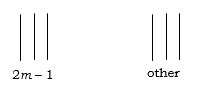
The number of way to sit $3$ men and $2 $ women in a bus such that total number of sitted men and women on each side is $3$
- A
$5!$
- ✓
$^6{C_5} \times 5!$
- C
$6!\,{ \times ^6}{P_5}$
- D
$5!\,{ + ^6}{C_5}$
AnswerCorrect option: B. $^6{C_5} \times 5!$
b
(b) $3$ men and $2$ women equal to $5$. A group of $5$ members make $5!$ permutation with each other.
The number of ways to sit $5$ members = $5!$
$6$ Places are filled by $5$ members by $^6{C_5}$ ways
The total number of ways to sit $5$ members on $6$ seats of a bus = $^6{C_5} \times 5!$.
View full question & answer→MCQ 701 Mark
How many numbers lying between $10$ and $1000$ can be formed from the digits $1, 2, 3, 4, 5, 6, 7, 8, 9$ (repetition is allowed)
Answerb
(b) The total number between $10$ and $1000$ are $989$ but we have to form the numbers by using numerals $1,\;2,........9,\;\; i.e.\,0$ is not occuring so the numbers containing any ‘$0$’ would be excluded i.e.,
Required number of ways
$= 989 - \left\{ \begin{array}{l}20,\;30,\;40,................100 = 9\\101,\;102,...................200 = 19\\201,........................300 = 19\\.............................................\\.............................................\\901,..........................990 = 18\end{array} \right\}$
$ = 989 - (9 + 18 + 19 \times 8) = 810$.
Aliter : Between $10$ and $1000$, the numbers are of $2$ digits and $3$ digits.
Since repetition is allowed, so each digit can be filled in $9$ ways.
Therefore number of $2$ digit numbers $ = 9 \times 9 = 81$
and number of $3$ digit numbers $9 \times 9 \times 9 = 729$
Hence total ways $ = 81 + 729 = 810$.
View full question & answer→MCQ 711 Mark
There are $10$ persons named $A,\;B,.......J$. We have the capacity to accommodate only $5$. In how many ways can we arrange them in a line if $A$ is must and $G$ and $H$ must not be included in the team of $5$
- A
$^8{P_5}$
- B
$^7{P_5}$
- C
$^7{C_3}(4\;!)$
- ✓
$^7{C_3}(5\;!)$
AnswerCorrect option: D. $^7{C_3}(5\;!)$
d
(d) Out of $10$ persons, $A$ is in and $G$ and $H$ are out of the team, so we have to select $4$ more from $7$ remaining.
This can be done in $^7{C_4}$ ways. These $5$ persons can be arranged in a line in $5\;!$ ways.
Hence the number of possible arrangements is $^7{C_4}.\;5\;!\;{ = ^7}{C_3}.\,(5\;!)$.
View full question & answer→MCQ 721 Mark
The total number of seven digit numbers the sum of whose digits is even is
- A
$9000000$
- ✓
$4500000$
- C
$8100000$
- D
AnswerCorrect option: B. $4500000$
b
(b) Suppose ${x_1}{x_2}{x_3}{x_4}{x_5}{x_6}{x_7}$ represents a seven digit number.
Then ${x_1}$ takes the value $1,\;2,\;3,\;........,9$ and ${x_2},\;{x_3},...{x_7}$ all take values $0, 1, 2, 3, ..., 9$.
If we keep ${x_1},\;{x_2},......,{x_6}$ fixed, then the sum ${x_1} + {x_2} + ..... + {x_6}$ is either even or odd.
Since ${x_7}$ takes $10$ values $0, 1, 2, ..., 9$, five of the numbers so formed will be even and $5$ odd.
Hence the required number of numbers
$ = 9\;.\;10\;.\;10.\;10\;.\;10.\;10\;.\;5 = 4500000$.
View full question & answer→MCQ 731 Mark
In a multiple- choice test consisting of $8$ questions, each question has four options. For each of the questions, exactly one of the four options is the right answer.$A$ student answers all the questions by choosing one option for each question. The number of ways in which the student can get exactly $5$ correct answers is
AnswerCorrect option: D. $1512$
d
(d)
Each question can be answered in 4 different ways
Required number of ways
$={ }^8 C _5 \times(1) \times(3)^3$
$=1512$
View full question & answer→MCQ 741 Mark
Let $A$ denote the set of all $2-$digit numbers in base $10$ that are equal to four times the sum of the factorial of their digits. The sum of the numbers in $A$ is
Answerc
(c)
$a b=(a !+b !)$
$\because ab \leq 99 \Rightarrow a !+ b ! \leq \frac{99}{4}$
$a, b \leq 4$
Check for $a=1,2,3,4$
$b =0,1,2,3,4$
We get $12,32$
Sum $=12+32=44$
View full question & answer→MCQ 751 Mark
In this question, all integers are represented in base $10$. Consider the set $E$ of positive integers $n$ having the property that when any nonzero digit $d$ is written to the right of $n$, the resulting number is divisible by $d$. Let $N$ be the smallest element of $E.$ The product of the digit of $N$ is
Answera
(a)
According to the condition $d / nd$
$\frac{10 n + d }{ d } \in I \Rightarrow \frac{10 n }{ d }+1 \in I$
$\frac{10 n }{ d } \in I \Rightarrow \frac{2 \times 5 \times n }{ d } \in I$
for smallest ' $n$ ', $2 \times 5 \times n$ is always divisible by $d \in\{1,2, \ldots, 9\}$
$n =3^2 \times 2^2 \times 7$
$n =252$
Product of digits of ' $n$ ' $=20$
View full question & answer→MCQ 761 Mark
There are $m$ books in black cover and $n$ books in blue cover, and all books are different. The number of ways these $(m+n)$ books can be arranged on a shelf so that all the books in black cover are put side by side is
- A
$m ! n !$
- ✓
$m !(n+1) !$
- C
$(n+1) !$
- D
$(m+n) !$
AnswerCorrect option: B. $m !(n+1) !$
b
(b)
Here, $m$ books will be considered one thing. So, total $(n+1)$ things to arrange.
View full question & answer→MCQ 771 Mark
The number of permutations of the letters $a_1, a_2, a_3, a_4, a_5$ in which the first letter $a_1$ does not occupy the first position (from the left) and the second letter $a_2$ does not occupy the second position (from the left) is
Answerb
(b)
Number of ways
$=5:\left(1-\frac{1}{1 !}+\frac{1}{2 !}-\frac{1}{3 !}+\frac{1}{4 !}-\frac{1}{5 !}\right)$ $+4 !^3 C_1\left(1-\frac{1}{1 !}+\frac{1}{2 !}-\frac{1}{3 !}+\frac{1}{4 !}\right)$
$+3 !^3 C_2\left(1-\frac{1}{1 !}+\frac{1}{2 !}-\frac{1}{3 !}\right)+{ }^3 C_3 \cdot 1$
$=44+27+6+1=78$
View full question & answer→MCQ 781 Mark
If the integers from $1$ to $2021$ are written as a single integer like $123 \ldots 91011 \ldots 20202021$, then the $2021st$ digit (counted from the left) in the resulting number is
Answerb
(b)
Total number of digits used till $99=9+90 \times 2=189$
The digits use in next 610 three digit numbers $=1830$
$\therefore$ Total digit used till the number
$710=189+1830=2019$
Next three digits are $711$
$\therefore 2021$ st digit is $1 .$
View full question & answer→MCQ 791 Mark
$A\,\,5$-digit number $\overline{a b c d e}$, when multiplied by $9$ , gives the $5-$digit number $edcba.$ The sum of the digits in the number is
Answerb
(b)
abcde $\times 9=a b c d e(10-1)=a b c d e 0$
$-0 a b c d e$
$(a-1)-0=0 \Rightarrow a=1$
$10-e=a \Rightarrow e=9$
$b-a=e \Rightarrow[{b=0}]$
$(e-1)-d=b \Rightarrow[d=8]$
$d-c =c \Rightarrow [c=4]$
$\overline{a b c d e} =10989$
$\therefore$ Sum of digits $=27$
View full question & answer→MCQ 801 Mark
The number of four-letter words that can be formed with letters $a, b, c$ such that all three letters occur is
Answerb
(b)
Out of given three letters $a, b, c$, we will repeat exactly one of the letter and we can do this in ${ }^3 C_1$ ways.
Now, we have four letters and out of these four letters two are identical, so number of ways to arrange these four letters is $\frac{4 !}{2 !}$.
So, the number of four letter words that can be formed with letters $a, b, c$ such that all three letters occur is
${ }^3 C_1 \times \frac{4 !}{2 !}=36$
View full question & answer→MCQ 811 Mark
Let $E$ denote the set of letters of the English alphabet, $V=\{a, e, i, o, u\}$ and $C$ be the complement of $V$ in $E$. Then, the number of four-letter words (where repetitions of letters are allowed) having at least one letter from $V$ and at least one letter from $C$ is
- ✓
$261870$
- B
$314160$
- C
$425880$
- D
$851760$
AnswerCorrect option: A. $261870$
a
(a)
The number of all four-letter words $=26^4$
The number of all four-letter words from set $V=\{a, e, i, o, u\}$ i.e vowels $=5^4$
Similarly, the number of all four-letter words from set of consonants $=21^5$
$\therefore$ Number of words which contains atleast one vowel and atleast one consonant
$=26^4-21^4-5^4$
$=\left(26^2+21^2\right)\left(26^2-21^2\right)-5^4$
$=(676+441)(5)(47)-5^4$
$=5[(1117 \times 47)-125]$
$=5 \times(52374)=261870$
View full question & answer→MCQ 821 Mark
A two-digit number $\overline{a b}$ is called almost prime if one obtains a two-digit prime number by changing at most one of its digits $a$ and $b$. (For example, $18$ is an almost prime number because $13$ is a prime number). Then the number of almost prime two-digit numbers is
Answerd
(d)
Since in the group of first $10$ two digit number $10-19$, has atleast $1$ prime number similarly in other groups of 10 two digits numbers
$20-29$, 30-39, 40-49, 50-59, 60-69, 70-79, $80-89$ and $90-99$ have almost $1$ prime numbers.
So, the number of almost prime two-digit number is $90 .$
View full question & answer→MCQ 831 Mark
The number of three digit numbers $\overline{a b c}$ such that the arithmetic mean of $b$ and $c$ and the square of their geometric mean are equal is
Answerb
(b)
It is given that, the number of three digit number $\overline{a b c}$, such that
$\frac{b+c}{2}=b c$
the above relation is true if $b=c=0$
And if neither $b$ nor $c$ is zero, then
$\frac{1}{b}+\frac{1}{c}=2$, and $b, c \in\{1,2,3,4,5,6,7,8,9\}$
Then $b=c=1$
and $a \in\{1,2,3,4,5,6,7,8,9\}$
So, total number of such three digit number are $2 \times 9=18$
View full question & answer→MCQ 841 Mark
A prime number $p$ is called special if there exist primes $p_1, p_2, p_3, p_4$ such that $p=p_1+p_2=p_3-p_4$. The number of special primes is
Answerb
(b)
It is given that for prime numbers $p_1, p_2, p_3, p_4$ the special prime number
$p=p_1+p_2=p_3-p_4$
Case $I$
If all $p_1, p_2, p_3, p_4$ are odd, then $\left(p_1+p_2\right)$ and $\left(p_3-p_4\right)$ are even, which is not possible.
Case $II$
If one of $p_1$ and $p_2$ is even, say $p_2$ is $2$ and $p_4$ must be $2$ .
So, $p=p_1+2=p_3-2$
the above equation is satisfied only if
$p=5, p_1=3 \text { and } p_3=7$
So, the number of special prime $p$ is $1$ .
View full question & answer→MCQ 851 Mark
Let $m$ (respectively, $n$ ) be the number of $5$ -digit integers obtained by using the digits $1,2,3,4,5$ with repetitions (respectively, without repetitions) such that the sum of any two adjacent digits is odd. Then $\frac{m}{n}$ is equal to
Answerc
(c)
We have, $m$ is 5 -digits number using digits $1,2,3,4,5$ with repetition such that sum of two adjacent digit is odd and $n$ is 5 -digits number using digits $1,2$ and other is odd.
Even $=2,4$,Odd $=1,3,5$
Case $I$ Digit is repeated.
Two possibilities
$(a)$ odd even odd even odd
$=3 \times 2 \times 3 \times 2 \times 3=108$
$(b)$ even odd even odd even
$=2 \times 3 \times 2 \times 3 \times 2=72$
$\therefore \quad m=108+72=180$
Case $II$ Digit is not repeated.
The possibility of arrangement is odd even odd even odd
$=3 \times 2 \times 2 \times 1 \times 1=12$
$n=12$
$\frac{m}{n}=\frac{80}{12}=15$
View full question & answer→MCQ 861 Mark
The least value of a natural number $n$ such that $\left(\frac{n-1}{5}\right)+\left(\frac{n-1}{6}\right) < \left(\frac{n}{7}\right)$, where $\left(\frac{n}{r}\right)=\frac{n !}{(n-r) ! r !}, i$
Answerc
(c)
Given,
$\frac{{ }^{n-1} C_5+{ }^{n-1} C_6 < { }^n C_7}{{ }^n C_6 < { }^n C_7}$
$\left[\because{ }^n C_{r-1}+{ }^n C_r={ }^{n+1} C_r\right]$
$\frac{n !}{(n-6) ! 6 !} < \frac{n !}{(n-7) ! 7 !}$
$n-6 > 7$
$n>13$
$\therefore$ Least value of $x=14$
View full question & answer→MCQ 871 Mark
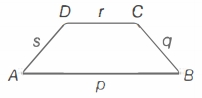
How many different (mutually non-congruent) trapeziums can be constructed using four distinct side lengths from the set $\{1,2,3,4,5,6\}$ ?
Answerb
(b)
Length of sides of trapezium from $\{1,2,3$, $4,5,6\}$.
From non-congruent trapezium
$|a-c| < b+d < a+c$
Possible combination are
$(r, p),(s, q) \equiv\{(5,6),(1,3)\},\{(5,6),(2,4)\}$
$\{(5,6),(1,4)\},\{(5,6),(3,4)\},\{(6,4),(1,3)\}$,
$\{(6,4),(1,5)\},\{(6,4),(2,3)\},\{(6,4),(3,5)\}$
$\{(4,5),(1,3)\}\{(4,5),(1,6)\}\{(4,5),(2,6)\}$
Total $11$ combination is possible.
View full question & answer→MCQ 881 Mark
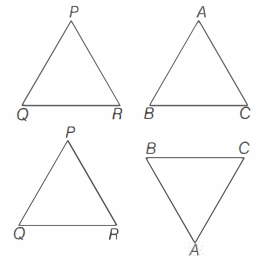
Suppose $B C$ is a given line segment in the plane and $T$ is a scalene triangle. The number of points $A$ in the plane such that the triangle with vertices $A, B, C$ (in same order) is similar to triangle $T$ is
Answerc
(c)
Let triangle $T$ is $P Q R$ and other triangle is $A B C$.
$A$ can taken position if $\triangle A B C \sim \triangle P Q R$.
We can arrange $A, B, C$ in $3 !$ ways $=6$ ways
Total position of $A$ can take $=3 ! \times 2=12$ ways
View full question & answer→MCQ 891 Mark
Let $S$ be the set of all permutations $a_1, a_2, \ldots, a_6$ of $1$ , $2, \ldots, 6$ such that $a_1, a_2, \ldots, a_k$ is not a permutation of $1,2, \ldots, k$ for any $k, 1 \leq k \leq 5 .$ Then the number of elements in $A$ is
Answerd
(d)
Let $S$ be the set of all permutation in $a_1, a_2, a_3, a_4, a_5, a_6$ of $1,2 , 3,4,5,6$
$\therefore \quad S=6 !=720$
Let $S^{\prime}$ be the set of all permutation containing $(2,3,4)$.
Total number $=(2 !+3 !+4 !) 3$ !
$=(2+6+24) \times 6$
$=32 \times 6=192$
Number of element in $A=$ Number of clement in $S$-Number of element in $S^{\prime}$
$=720-192=528$
View full question & answer→MCQ 901 Mark
The number of positive integers $n$ in the set $\{2,3, \ldots, 200\}$ such that $\frac{1}{n}$ has a terminating decimal expansion is
Answerb
(b)
We have, $n \in\{2,3,4,5,6, \ldots, 200\}$ $\frac{1}{n}$ has terminating decimal of $n=2^a \times 5^b$ $\therefore n=2,4,5,8,10,16,20,25,32,40,50$, $64,80,100,125,128,160,200$
$\therefore$ Total number of $n=18$
View full question & answer→MCQ 911 Mark
Let $S$ be the set of all ordered pairs $(x, y)$ of positive integers, with $HCF (x, y)=16$ and $\operatorname{LCM}(x, y)=48000$. The number of elements in $S$ is
Answerb
(b)
We have,
$HCF (x, y)=16$
$\operatorname{LCM}(x, y)=48000$
We know,
Product of two number $= HCF \times LCM$
$\therefore \quad x y=16 \times 48000$
$x y=16 \times 16 \times\left(3^1 \times 2^3 \times 5^3\right)$
As $\operatorname{HCF}$ of $(x, y)=16$
$2^3$ can be selected in 1 ways and $3^1$ and $5^3$ can be selected in $(1+1)(3+1)=8$ ways
$\therefore$ Number of ordered pairs $=8$
View full question & answer→MCQ 921 Mark
Consider the set $A$ of natural numbers $n$ whose units digit is non-zero, such that if this units digit is erased, then the resulting number divides $n$. If $K$ is the number of elements in the set $A$, then
AnswerCorrect option: D. $K < 25$
d
(d)
Let two digits number
if $b$ is erased.
Then, the resulting number is $a$.
$\therefore a b$ is divisible by $a$ if $a b$ is multiple of $c$.
$\therefore$ Such number are $11,12,13,14,15,16$,
$17,18,19,22,24,26,28,33,36,39,44$,
$48,55,66,77,88,99$.
$\therefore$ Total number are $23$.
Hence, $\quad K < 25$
View full question & answer→MCQ 931 Mark
There are exactly twelve Sundays in the period from January $1$ to March $31$ in a certain year. Then, the day corresponding to February $15$ in that year is
- A
- B
- ✓
- D
not possible to determine from the given data
Answerc
(c)
There are $90$ days from $1$ January to $31$ March (Non-leap year)
If year $13$ leap year, then total number of days $=91$ $(13$ weeks)
But we have $12$ Sunday
$\therefore 12$ weeks
$\therefore$ $1st$ Jan will be Monday as there will be 90 days January 1 to 31 March.
$\therefore 15$ th February will be Thursday.
View full question & answer→MCQ 941 Mark
The largest power of $2$ that divides $\frac{200 !}{100 !}$ is
Answerc
(c)
Exponent of $2$ in $200 !$.
$=\left[\begin{array}{c}200 \\ 2\end{array}\right]+\left[\begin{array}{c}200 \\ 2^2\end{array}\right]+\left[\begin{array}{c}200 \\ 2^3\end{array}\right]+\left[\begin{array}{c}200 \\ 2^4\end{array}\right]+\left[\begin{array}{c}200 \\ 2^5\end{array}\right] +\left[\frac{200}{2^8}\right]+\left[\begin{array}{c}200 \\ 2^7\end{array}\right]+\left[\begin{array}{c}200 \\ 2^8\end{array}\right]$
$=100+50+25+12+6+3+1=197$
Exponent of $2$ in $100!$
$=\left[\frac{100}{2}\right]+\left[\frac{100}{2^2}\right]+\left[\begin{array}{c}100 \\ 2^3\end{array}\right]+\left[\begin{array}{c}100 \\ 2^4\end{array}\right]+\left[\begin{array}{c}100 \\ 2^5\end{array}\right]+\left[\begin{array}{c}100 \\ 2^6\end{array}\right]+\left[\begin{array}{c}100 \\ 2^7\end{array}\right]$
$\operatorname{In} \frac{200 !}{100 !}=\frac{2^{197}}{2^{97}}=2^{100}$
$\therefore$ The largest power of $2$ is $100$.
View full question & answer→MCQ 951 Mark
Let $a_1, a_2, \ldots, a_n$ be $n$ non-zero real numbers, of which $p$ are positive and remaining are negative. The number of ordered pairs $(j, k), j < k$, for which $a_j a_k$ is positive, is $55$ . Similarly, the number of ordered pairs $(j, k), j < k$, for which $a_j a_k$ is negative, is $50$ . Then, the value of $p^2+(n-p)^2$ is
Answerc
(c)
Let $p$ are positive number from $a_1, a_2, a_3, \ldots, a_n$
$\therefore n-p$ are negative number.
Given $a_j, a_k$ is positive $j < k$ and $a_j a_k=55$ $a_j a_k$ is positive.
$\therefore a_j$ and $a_k$ are both positive or negative.
$\therefore \quad{ }^P C_2+{ }^{n-P} C_2=55$
and $a_j a_k$ is negative $j < k$
$a_j a_k=50$
any one of $a_j$ and $a_k$ are positive:
$\therefore \quad{ }^P C_1 \times{ }^{n-P} C_1=50 \Rightarrow P(n-P)=50$
$\Rightarrow \quad{ }^P C_2+{ }^{n-P} C_2=55$
$\Rightarrow P(P-1)+(n-P)(n-P-1)=110$
$\Rightarrow P^2-P+(n-P)^2-(n-P)=110$
$\Rightarrow P^2+(n-P)^2-n=110$
$\Rightarrow\{P+(n-P)\}^2-2 P(n-P)-n=110$
$\Rightarrow n^2-100-n-110=0[\because P(n-P)=50]$
$\therefore \quad n^2-n-210=0$
$\Rightarrow \quad(n-15)(n+14)=0$
$n=15, n \neq-14$
$\therefore \quad P(15-p) =50$
$\Rightarrow p^2-15 p+50 =0 $
$(P-10)(P-5) =0$
$p=5 \text { or } 10$
$\therefore \quad p^2+(n-P)^2 =5^2+10^2$
$=25+100=125$
View full question & answer→MCQ 961 Mark
It is given that the number $43361$ can be written as a product of $two$ distinct prime number $p_1, p_2$. Further, assume that there are $42900$ numbers which are less than $43361$ and are coprime to it. Then, $p_1+p_2$ is
Answera
(a)
The distinct prime factor of
$43361=131 \times 331$
where $p_1=131$ and $p_2=331$
$p_1+p_2=131+331=462$
View full question & answer→MCQ 971 Mark
Consider the set $A=\{1,2,3, \ldots, 30\}$. The number of ways in which one can choose three distinct number from $A$ so that the product of the chosen numbers is divisible by $9$ is
- ✓
$1590$
- B
$1505$
- C
$1110$
- D
$1025$
AnswerCorrect option: A. $1590$
a
(a)
Given, $A=\{1,2,3, \ldots, 30\}$
Case $I$ All three number are multiple of $3$ then product of three number are divisible by $9 .$
$\therefore \quad{ }^{10} C_3=120$
Case $II$ Two number are multiple of $3$ and other are not multiple of $9$ .
i.e. ${ }^{10} C_2 \times{ }^{20} C_1=900$
Case $III$ One are multiple of $9$ and other two are not multiple of $3$ .
${ }^3 C_1 \times{ }^{20} C_2=570$
$\therefore$ Total number of ways $=120+900+570$ $=1590$
View full question & answer→MCQ 981 Mark
Three schools send $2,4$ and $6$ students, respectively to a summer camp. The $12$ students must be accommodated in $6$ rooms numbered $1,2,3,4,5,6$ in such a way that each room has exactly $2$ students and both from the same school. The number of ways, the students can be accommodated in the rooms is
- A
$60$
- B
$45$
- ✓
$32400$
- D
$2700$
AnswerCorrect option: C. $32400$
c
(c)
We have $2,4,6$ students from three schools respectively.
$6$ rooms allotted for $1,2,3,4,5,6$ such that each room has exactly two students for same schools.
$\therefore$ Total number of ways student can be accommodated in the rooms
Total ways of arranging these groups in rooms $=45×6!=32400$
View full question & answer→MCQ 991 Mark
The number of non-congruent integer-sided triangles whose sides belong to the set $\{10,11,12, \ldots, 22\}$ is
Answerc
(c)
We have,
Set $\{10,11,12, \ldots, 22\}$
Number of scalene triangle
$={ }^{13} C_3-3=283$
Number of isosceles triangle
$=\left({ }^{13} C_2 \times 2\right)-4=152$
Number of equilateral triangle
$={ }^{13} C_1=13$
So, total number of triangle
$=283+152+13=448$
View full question & answer→MCQ 1001 Mark
The number of all $2-$digit numbers $n$, such that $n$ is equal to the sum of the square of digit in its tens place and the cube of the digit in units place is
Answerc
(c)
Let two-digits number be
$n=10 a+b$
$\text { Given, } n =a^2+b^3$
$\therefore 10 a+b =a^2+b^3$
$\Rightarrow \quad a^2-10 a+b^3-b=0$
$\Rightarrow a(a-10)+b(b+1)(b-1)=0$
$\Rightarrow \quad b(b+1)(b-1)=a(10-a)$
$b \neq 1$ if $b=1$ then $a=10$ not possible
if $b=2, a(10-a)=6$ no value of $a$
$b=3, a(10-a)=24, a=4,6$
Numbers are $43$ and $63 .$
If $b=4, a(10-a)=60$ no value of $a$
If $b=5, a(10-a)=120$ not possible
$\therefore$ Numbers are $43$ and $63 .$
View full question & answer→