MCQ 1511 Mark
The minimum value of $n$ for which $\frac{2^2+4^2+6^2+\ldots+(2 n)^2}{1^2+3^2+5^2+\ldots+(2 n-1)^2} < 1.01$ is
Answerc
(c)
We have,
$\frac{2^2+4^2+6^2+\ldots+(2 n)^2}{1^2+3^2+5^2+\ldots+(2 n-1)^2} < 1.01$
$=\frac{\Sigma 4 n^2}{\sum\left(4 n^2-4 n+1\right)} < 1.01$
$= \frac{4 \frac{n(n+1)(2 n+1)}{6}}{4 \frac{n(n+1)(2 n+1)}{6}-4 \frac{n(n)(n+1)}{2}+n}$
$= \frac{4 \frac{n(n+1)(2 n+1)}{6}}{\frac{n(2 n+1)(2 n-1)}{3}}<101=\frac{2(n+1)}{2 n-1} < \frac{101}{100}$
$= 200 n+200 < 202 n-101$
$\Rightarrow 2 n > 301 \Rightarrow n > \frac{301}{2}=150.5$
$\therefore n > 151$
View full question & answer→MCQ 1521 Mark
The sum of $\left(1^2-1+1\right)(1 !)+\left(2^2-2+1\right)(2 !)$ $+\ldots+\left(n^2-n+1\right)(n !)$ is
- A
$(n+2) !$
- ✓
$(n-1)((n+1) !)+1$
- C
$(n+2) !-1$
- D
$n((n+1) !)-1$
AnswerCorrect option: B. $(n-1)((n+1) !)+1$
b
(b)
Let
$S_n=\left(1^2-1+1\right)(1 !)+ \left(2^2-2+1\right)(2 !)$
$+\ldots+\left(n^2-n+1\right)(n !)$
Here, $T_r=\left(r^2-r+1\right)(r !)$
$T_r=\left(r^2-1-r+2\right)(r !)$
$T_r=\left(r^2-1\right) r !-(r-2) r !$
$T_r=(r-1)(r+1) !-(r-2) r !$
$S_n= T_1+T_2+T_3+\ldots+T_n$
$S_n= (1-0)+(3 !-0)+(2 \cdot 4 !-1 \cdot 3 !)$
$\quad\quad+(3 \cdot 5 !-2 \cdot 4 !)+(4 \cdot 6 !)-3 \cdot 5 ! \ldots$
$\quad\quad+[(n-1)(n+1) !-(n-2)(n !)]$
$S_n= 1+(n-1)(n+1) !$
$S_n=(n-1)(n+1) !+1$
View full question & answer→MCQ 1531 Mark
The number of positive integers $n$ in the set $\{1,2,3$, $\ldots \ldots . ., 100\}$ for which the number $\frac{1^2+2^2+3^2+\ldots .+n^2}{1+2+3+\ldots+n}$ is an integer is
Answerb
(b)
We have,
$\frac{1^2+2^2+3^2+4^2+\ldots+n^2}{1+2+3+4+\ldots+n}$
$=\frac{\frac{n(n+1)(2 n+1)}{6}}{n(n+1)}$
$=\frac{2 n+1}{2}=k(l \text { let })$
$\Rightarrow \quad n=\frac{3 k-1}{2}$
$\text { Now, } 1 \leq \frac{3 k-1}{2} \leq 100$
$\Rightarrow \quad 2 \leq 3 k-1 \leq 200$
$\Rightarrow \quad 2+1 \leq 3 k \leq 200+1$
$\Rightarrow \quad 3 \leq 3 k \leq 201$
$\Rightarrow \quad 1 \leq k \leq 201$
$\Rightarrow \quad 1 \leq k \leq 67$
Number of odd integer $=34$
View full question & answer→MCQ 1541 Mark
The number of natural number $n$ in the interval $[1005, 2010]$ for which the polynomial. $1+x+x^2+x^3+\ldots+x^{n-1}$ divides the polynomial $1+x^2+x^4+x^6+\ldots+x^{2010}$ is
Answerc
(c)
Let $P(x)=1+x^2+x^4+\ldots+x^{2010}$
${c}P(x)=\frac{1-x^{2012}}{1-x^2}$
$P(x)=\frac{\left(1-x^{1006}\right)\left(1+x^{1006}\right)}{(1-x)(1+x)}$$P(x)=\left(1+x^{1006}\right)\left(\frac{1-x^{503}}{1-x}\right)\left(\frac{1+x^{503}}{1+x}\right)$
$\left.P(x)=\left(1+x^{1006}\right) 1+x+x^2+x^3+\ldots+x^{502}\right)$
$\left(1-x+x^2-x^3+\ldots+x^{502}\right)$
Thus, $P(x)$ is divisible by $1+x+x^2+\ldots x^{n-1}$
If $n-1=502 \Rightarrow n=503$
View full question & answer→MCQ 1551 Mark
Suppose the sides of a triangle form a geometric progression with common ratio $r$. Then, $r$ lies in the interval
- A
$\left(0, \frac{-1+\sqrt{5}}{2}\right)$
- B
$\left(\frac{1+\sqrt{5}}{2}, \frac{2+\sqrt{5}}{2}\right)$
- ✓
$\left(\frac{1+\sqrt{5}}{2}, \frac{2+\sqrt{5}}{2}\right]$
- D
$\left(\frac{2+\sqrt{5}}{2}, \infty\right)$
AnswerCorrect option: C. $\left(\frac{1+\sqrt{5}}{2}, \frac{2+\sqrt{5}}{2}\right]$
c
(c)
Let the sides of triangle are
$a, a r, a r^2 . \quad[\because$ sides of triangle in $GP ]$
Case I $r > 1$
We know sum of two sides is greater than third side.
$\therefore a+a r>a r^2 \Rightarrow r^2-r-1<0$
$\begin{array}{ll} \Rightarrow & r=\frac{1 \pm \sqrt{5}}{2} \\\Rightarrow & 1 < r < \frac{\sqrt{5}+1}{2}, r > 1\end{array}$
Case $II$ $0 < r < 1$
$\therefore a r^2+a r > a \Rightarrow r^2+r-1 > 0$
$\Rightarrow \quad r=\frac{-1 \pm \sqrt{5}}{2}$
$\Rightarrow \quad 1 > r > \frac{\sqrt{5}-1}{2}, 0 < r < 1$
$\therefore \quad r \in\left(\frac{\sqrt{5}-1, \sqrt{5}+1}{2}, \frac{2}{2}\right)$
View full question & answer→MCQ 1561 Mark
Ten trucks, numbered $1$ to $10$ , are carrying packets of sugar. Each packet weights either $999\,g$ or $1000\,g$ and each truck carries only the packets equal weights. The combined weight of $1$ packet selected from the first truck,$2$ packets from the second,$4$ packets from the third, and so on, and $2^9$ packet from the tenth truck is $1022870\,g$. The trucks that have the lighter bags are
- A
$1,3,5$
- B
$2,4,5$
- C
$1,9$
- ✓
$2,8$
Answerd
(d)
If all trucks had packets of $1000\,g$, then total weight is
$1000(1+2 \left.+2^2+\ldots+2^9\right)$
$=1000\left(2^{10}-1\right)$
$=1000(1024-1)=1023000$
We have given total weight is $1022870$.
$\therefore 1022870 < 1023000$
Extra amount of weight
$=1023000-1022870$
$=130$
$130 =2^7+2^1=128+2$
$\therefore$ The trucks have the lighter bags are $2,8$
View full question & answer→MCQ 1571 Mark
Suppose the sequence $a_1, a_2, a_3, \ldots$ is a n arithmetic progression of distinct numbers such that the sequence $a_1, a_2, a_4, a_8, \ldots$ is a geometric progression. The common ratio of the geometric progression is
Answera
(a)
We have, $a_1, a_2, a_3, \ldots, a_n$ in an $AP$ and $a_1, a_2, a_4, a_8$ in GP.
Let $a_1=a, a_2=a+d, a _3=a+2 d$ and $a_1$, $a_2, a_4, a_8$ are in $GP$.
Let common ratio is $r$.
$\therefore \quad a_1=a, a_2=a r, a_4=a r^2, a_8=a r^3$
$\therefore a+ d =a r, a+3 d=a r^2, a+7 d=a r^3$
$\Rightarrow \quad 2 d =a r(r-1), 4 d=a r^2(r-1)$
$\Rightarrow \quad r=2$
View full question & answer→MCQ 1581 Mark
Let $S_n$ be the sum of all integers $k$ such that $2^n < k < 2^{n+1}$, for $n \geq 1$. Then,$9$ divides $S_n$ if and only if
AnswerCorrect option: C. $n$ is even
c
(c)
We have, $2^n < k < 2^{n+1}, k \in N$
Number of integer between $2^n$ and $2^{n+1}$ is i.e $k=2^{n+1}-2^n-1$
First term $=2^n+1$
Last term $=2^{n+1}-1$
$\therefore S_n=\frac{2^{n+1}-2^n-1}{2}\left[2^n+1+2^{n+1}-1\right]$
$S_n=\frac{2^{n+1}-2^n-1}{2}\left(2^n\right)(1+2)$
$S_n=\frac{\left(2^n-1\right)\left(2^n\right) \cdot 3}{2}$
But $S_n=9 m, m \in I$
$\therefore \quad \frac{\left(2^n-1\right) 2^n \cdot 3}{2}=9 m$
$\Rightarrow \quad\left(2^n-1\right) 2^{n-1}=3\,m$
$\Rightarrow \quad 2^n\left(2^n-1\right)=6\,m$
It is possible when, $n$ is even.
View full question & answer→MCQ 1591 Mark
Let $P(x)=1+x+x^2+x^3+x^4+x^5$. What is the remainder when $P\left(x^{12}\right)$ is divided by $P(x)$ ?
- A
$0$
- ✓
$6$
- C
$1+x$
- D
$1+x+x^2+x^3+x^4$
Answerb
(b)
We have,
$P(x)=1+x+x^2+x^3+x^4+x^5$
$P(x)=\frac{1-x^6}{1-x}$
${\left[\because a+a r+a r^2+\ldots+a r^n=\frac{a\left(-r^n\right)}{1-r}\right]}$
It has $5$ roots let $\alpha_1, \alpha_2, \alpha_3, \alpha_4, \alpha_5$ they are $6$ th roots of unity
Now,
$P\left(x^{12}\right)=1+x^{12}+x^{24}+x^{36}+x^{48}+x^{60}$
$\therefore P\left(x^{12}\right) =P(x) \cdot Q(x)+R(x)$
Here, $R(x)$ is a polynomial of maximum degree $4 .$
Put $x=\alpha_1, \alpha_2, \alpha_3, \alpha_4, \alpha_5$; we get
$R\left(\alpha_1\right)=6=R\left(\alpha_2\right) =R\left(\alpha_3\right)$
$=R\left(\alpha_4\right)=R\left(\alpha_5\right)$
$\therefore R(x)-6=0$ has 6 roots, which contradicts that $R(x)$ is maximum of degree $4 .$
$\therefore$ So it is an identity.
$\because \quad R(x)=6$
View full question & answer→MCQ 1601 Mark
Let $a, b, c$ be the sides of a triangle. If $t$ denotes the expression $\frac{\left(a^2+b^2+c^2\right)}{(a b+b c+c a)}$, the set of all possible values of $t$ is
- A
$\{x \in R \mid x>1\}$
- B
$\{x \in R \mid 1 < x < 2\}$
- ✓
$\{x \in R \mid 1 \leq x<2\}$
- D
$\{x \in R \mid 1 \leq x \leq 2\}$
AnswerCorrect option: C. $\{x \in R \mid 1 \leq x<2\}$
c
(c)
Let $a, b, c$ be the sides of a triangle.
$\therefore \quad a^2+b^2 \geq 2 a b \quad[\because AM \geq GM ]$
Similarly, $b^2+c^2 \geq 2 b c$
$c^2+a^2 \geq 2 a c$
$\Rightarrow 2\left(a^2+b^2+c^2\right) \geq 2(a b+b c+c a)$
$\Rightarrow \quad \frac{a^2+b^2+c^2}{a b+b c+a c} \geq 1$
$t \geq 1 \quad\left[\because \frac{a^2+b^2+c^2}{a b+b c+a c}=t\right]$
$\because a, b, c$ be the side of a triangle.
$\begin{aligned} a+b>c \\ & \quad|a|>|c-b| \\ a \end{aligned}$
$\Rightarrow \quad a^2 > (c-b)^2$
$\Rightarrow \quad a^2 > c^2+b^2-2 b c$
$\Rightarrow \quad b^2+c^2-a^2<2 b c$
Similarly, $a^2+b^2-c^2 < 2 a b$
and $\quad c^2+a^2-b^2 < 2 a c$
On adding Eqs.$(i), (ii)$ and $(iii)$, we get
$a^2+b^2+c^2 < 2(a b+b c+c a)$
$\Rightarrow \quad \frac{a^2+b^2+c^2}{a b+b c+c a} < 2$
$\therefore \quad t < 2$
$\therefore \quad\{x \in R \mid 1 \leq x < 2\}$
View full question & answer→MCQ 1611 Mark
The sum of all absolute values of the difference of the numbers $1,2,3, \ldots, n$, taken two at a time, i.e. $\sum \limits_{j \leq i \leq n}|i-j|$ equals:
- A
${ }^{n-1} C_3$
- B
${ }^{n} C_3$
- ✓
${ }^{n+1} C_3$
- D
${ }^{n+2} C_3$
AnswerCorrect option: C. ${ }^{n+1} C_3$
c
(c)
If we fix $j=1$, then $i$ range, we get $1+2+3+\ldots+(n-1)$
if we fix $j=2$, then $i$ range, we get $1+2+3+\ldots+(n-2)$
Similarly, we fix $j=n-1$, then $i$ range, We gret
if we put them all together we get a total of ( $n-1)$ numbers $1^{\prime}$ s,$(n-2)$ number of $2^{\prime} s . \ldots .1$ number of $(n-1)^{\prime}$ sthen sum equals
$\sum \limits_{k=1}^{n-1} k(n-k)=n \sum \limits_{k=1}^{n-1} k-\sum \limits_{k=1}^{n-1} k^2$
$=\frac{n(n)(n-1) \quad n(n-1)(2 n-1)}{2}$
$\left.=\frac{n(n-1)\left[n-\frac{2 n-1}{2}[n\right.}{3}\right]$
$=\frac{n(n-1)(n+1)}{2 \cdot 3}={ }^{n+1} C_3$
View full question & answer→MCQ 1621 Mark
Let $S_n$ denote the sum of first $n$ terms an arithmetic progression. If $S_{20}=790$ and $S_{10}=145$, then $S_{15}-$ $S_5$ is:
Answera
$\mathrm{S}_{20}=\frac{20}{2}[2 \mathrm{a}+19 \mathrm{~d}]=790 $
$ 2 \mathrm{a}+19 \mathrm{~d}=79$ $.............(1)$
$ \mathrm{~S}_{10}=\frac{10}{2}[2 \mathrm{a}+9 \mathrm{~d}]=145 $
$ 2 \mathrm{a}+9 \mathrm{~d}=29$ $................(2)$
From $(1)$ and $(2)$ a $=-8, d=5$
$ S_{15}-S_5=\frac{15}{2}[2 a+14 d]-\frac{5}{2}[2 a+4 d] $
$ =\frac{15}{2}[-16+70]-\frac{5}{2}[-16+20] $
$ =405-10 $
$ =395$
View full question & answer→MCQ 1631 Mark
Let $\alpha$ and $\beta$ be the roots of the equation $\mathrm{px}^2+\mathrm{qx}-$ $r=0$, where $p \neq 0$. If $p, q$ and $r$ be the consecutive terms of a non-constant G.P and $\frac{1}{\alpha}+\frac{1}{\beta}=\frac{3}{4}$, then the value of $(\alpha-\beta)^2$ is :
- ✓
$\frac{80}{9}$
- B
$9$
- C
$\frac{20}{3}$
- D
$8$
AnswerCorrect option: A. $\frac{80}{9}$
a
$ p x^2+q x-r=0 < \beta $
$ p=A, q=A R, r=A R^2$
$ A x^2+A R x-A R^2=0$
$ x^2+R x-R^2=0 < \beta $
$ \because \frac{1}{\alpha}+\frac{1}{\beta}=\frac{3}{4} $
$ \therefore \frac{\alpha+\beta}{\alpha \beta}=\frac{3}{4} \Rightarrow \frac{-R}{-R^2}=\frac{3}{4} \Rightarrow R=\frac{4}{3} $
$ (\alpha-\beta)^2=(\alpha+\beta)^2-4 \alpha \beta=R^2-4\left(-R^2\right)=5\left(\frac{16}{9}\right) $
$ =80 / 9$
View full question & answer→MCQ 1641 Mark
Let three real numbers $a, b, c$ be in arithmetic progression and $\mathrm{a}+1, \mathrm{~b}, \mathrm{c}+3$ be in geometric progression. If $\mathrm{a}>10$ and the arithmetic mean of $\mathrm{a}, \mathrm{b}$ and $\mathrm{c}$ is $8$ , then the cube of the geometric mean of $a, b$ and $c$ is
Answera
$ 2 b=a+c, b^2=(a+1)(c+3) $
$ \frac{a+b+c}{3}=8 \rightarrow b=8, a+c=16 $
$ 64=(a+1)(19-a)=19+18 a-a^2 $
$ a^2-18 a-45=0 \rightarrow(a-15)(a+3)=0,(a>10) $
$ a=15, c=1, b=8 $
$ \left((a b c)^{1 / 3}\right)^3=a b c=120$
View full question & answer→MCQ 1651 Mark
If $8=3+\frac{1}{4}(3+p)+\frac{1}{4^2}(3+2 p)+\frac{1}{4^3}(3+3 p)+\ldots \infty,$ then the value of $p$ is
Answera
$8=\frac{3}{1-\frac{1}{4}}+\frac{p \cdot \frac{1}{4}}{\left(1-\frac{1}{4}\right)^2}$
(sum of infinite terms of A.G.P $=\frac{\mathrm{a}}{1-\mathrm{r}}+\frac{\mathrm{dr}}{(1-\mathrm{r})^2}$ )
$\Rightarrow \frac{4 p}{9}=4 \Rightarrow p=9$
View full question & answer→MCQ 1661 Mark
A software company sets up $m$ number of computer systems to finish an assignment in $17$ days. If $4$ computer systems crashed on the start of the second day, $4$ more computer systems crashed on the start of the third day and so on, then it took $8$ more days to finish the assignment. The value of $m$ is equal to :
Answerb
$ 17 \mathrm{~m}=\mathrm{m}+(\mathrm{m}-4)+(\mathrm{m}-4 \times 2) \ldots+\ldots(\mathrm{m}-4 \times 24) $
$ 17 \mathrm{~m}=25 \mathrm{~m}-4(1+2 \ldots 24) $
$ 8 \mathrm{~m}=\frac{4 \cdot 24 \cdot 25}{2}=150$
View full question & answer→MCQ 1671 Mark
If in a $G.P.$ of $64$ terms, the sum of all the terms is $7$ times the sum of the odd terms of the $G.P,$ then the common ratio of the $G.P$. is equal to
Answerd
$ a+a r+a r^2+a r^3+\ldots+a r^{63} $
$=7\left(a+a r^2+a r^4 \ldots+a r^{62}\right) $
$\Rightarrow \frac{a\left(1-r^{64}\right)}{1-r}=\frac{7 a\left(1-r^{64}\right)}{1-r^2}$
$r=6$
View full question & answer→MCQ 1681 Mark
For $\mathrm{x} \geq 0$, the least value of $\mathrm{K}$, for which $4^{1+\mathrm{x}}+4^{1-\mathrm{x}}$, $\frac{\mathrm{K}}{2}, 16^{\mathrm{x}}+16^{-\mathrm{x}}$ are three consecutive terms of an $A.P.$ is equal to :
Answera
$ \mathrm{k}=4\left(4^{\mathrm{x}}+\frac{1}{4^{\mathrm{x}}}\right)+\left(4^{2 \mathrm{x}}+\frac{1}{4^{2 \mathrm{x}}}\right) $
$ \quad \geq 2 \quad \geq 2 $
$ \mathrm{k} \geq 10$
View full question & answer→MCQ 1691 Mark
Let $a_1, a_2, a_3, \ldots$ be in an arithmetic progression of positive terms.
Let $\mathrm{A}_{\mathrm{k}}=\mathrm{a}_1{ }^2-\mathrm{a}_2{ }^2+\mathrm{a}_3{ }^2-\mathrm{a}_4{ }^2+\ldots+\mathrm{a}_{2 \mathrm{k}-1}{ }^2-\mathrm{a}_{2 \mathrm{k}}{ }^2$.
If $\mathrm{A}_3=-153, \mathrm{~A}_5=-435$ and $\mathrm{a}_1{ }^2+\mathrm{a}_2{ }^2+\mathrm{a}_3{ }^2=66$, then $\mathrm{a}_{17}-\mathrm{A}_7$ is equal to....................
Answerc
$ \mathrm{d} \rightarrow \text { common diff. } $
$ \mathrm{A}_{\mathrm{k}}=-\mathrm{kd}[2 \mathrm{a}+(2 \mathrm{k}-1) \mathrm{d}] $
$ \mathrm{A}_3=-153 $
$ \Rightarrow 153=13 \mathrm{~d}[2 \mathrm{a}+5 \mathrm{~d}] $
$ 51=\mathrm{d}[2 \mathrm{a}+5 \mathrm{~d}] $
$ \mathrm{A}_5=-435 $
$ 435=5 \mathrm{~d}[2 \mathrm{a}+9 \mathrm{~d}] $
$ 87=\mathrm{d}[2 \mathrm{a}+9 \mathrm{~d}] $
$ (2)-(1) $
$ 36=4 \mathrm{~d}^2$
$ \mathrm{~d}=3, \mathrm{a}=1 $
$ \mathrm{a}_{17}-\mathrm{A}_7=49-[-7.3[2+39]]=910$
View full question & answer→MCQ 1701 Mark
Let $S_n$ denote the sum of the first $n$ terms of an arithmetic progression. If $\mathrm{S}_{10}=390$ and the ratio of the tenth and the fifth terms is $15: 7$, then $S_{15}-S_5$ is equal to:
Answerc
$ \mathrm{S}_{10}=390 $
$ \frac{10}{2}[2 \mathrm{a}+(10-1) \mathrm{d}]=390 $
$ \Rightarrow 2 \mathrm{a}+9 \mathrm{~d}=78 $ $......(1)$
$ \frac{\mathrm{t}_{10}}{\mathrm{t}_5}=\frac{15}{7} \Rightarrow \frac{\mathrm{a}+9 \mathrm{~d}}{\mathrm{a}+4 \mathrm{~d}}=\frac{15}{7} \Rightarrow 8 \mathrm{a}=3 \mathrm{~d} $ $......(2)$
$ \text { From }(1) \&(2) \quad \mathrm{a}=3 \& \mathrm{~d}=8 $
$ \mathrm{~S}_{15}-\mathrm{S}_5=\frac{15}{2}(6+14 \times 8)-\frac{5}{2}(6+4 \times 8) $
$ =\frac{15 \times 118-5 \times 38}{2}=790$
View full question & answer→MCQ 1711 Mark
Let $3,7,11,15, \ldots, 403$ and $2,5,8,11, \ldots, 404$ be two arithmetic progressions. Then the sum, of the common terms in them, is equal to.....................
- A
$6696$
- B
$6697$
- C
$668$
- ✓
$6699$
AnswerCorrect option: D. $6699$
d
$3,7,11,15, \ldots ., 403$
$2,5,8,11, \ldots ., 404$
$\operatorname{LCM}(4,3)=12$
$11,23,35, \ldots . \text { let }(403)$
$403=11+(n-1) \times 12$
$\frac{392}{12}=n-1$
$33 \cdot 66=n$
$n=33$
$\operatorname{Sum} \frac{33}{2}(22+32 \times 12)$
$=6699$
View full question & answer→MCQ 1721 Mark
Let $S_n$ be the sum to n-terms of an arithmetic progression $3,7,11, \ldots \ldots$. . If $40<\left(\frac{6}{\mathrm{n}(\mathrm{n}+1)} \sum_{\mathrm{k}=1}^{\mathrm{n}} \mathrm{S}_{\mathrm{k}}\right)<42$, then $\mathrm{n}$ equals
Answera
$S_n= 3+7+11+............ n $ terams
${n}{2}(6+(n-1) 4)=3 n+2 n^2-2 n $
$ =2 n^2+n $
$ \sum_{k=1}^n S_k=2 \sum_{k=1}^n K^2+\sum_{k=1}^n K $
$ =2 \cdot \frac{n(n+1)(2 n+1)}{6}+\frac{n(n+1)}{2} $
$=n(n+1)\left[\frac{2 n+1}{3}+\frac{1}{2}\right]$
$=\frac{n(n+1)(4 n+5)}{6} $
Rightarrow $40<\frac{6}{n(n+1)} \sum_{k=1}^n S_k<42 $
$ 40<4 n+5<42 $
$ 35<4 n<37 $
$ n=9$
View full question & answer→MCQ 1731 Mark
If $\log _e \mathrm{a}, \log _e \mathrm{~b}, \log _e \mathrm{c}$ are in an $A.P.$ and $\log _e \mathrm{a}-$ $\log _e 2 b, \log _e 2 b-\log _e 3 c, \log _e 3 c-\log _e a$ are also in an $A.P,$ then $a: b: c$ is equal to
- ✓
$9: 6: 4$
- B
$16: 4: 1$
- C
$25: 10: 4$
- D
$6: 3: 2$
AnswerCorrect option: A. $9: 6: 4$
a
$\log _e a, \log _e b, \log _e c$ are in $ A.P.$
$\therefore \mathrm{b}^2=\mathrm{ac}$
Also
$\log _{\circ}\left(\frac{a}{2 b}\right), \log _{\circ}\left(\frac{2 b}{3 c}\right), \log _{\circ}\left(\frac{3 c}{a}\right)$ are in $A.P.$
$\left(\frac{2 b}{3 \mathrm{c}}\right)^2=\frac{\mathrm{a}}{2 \mathrm{~b}} \times \frac{3 \mathrm{c}}{\mathrm{a}} $
$ \frac{\mathrm{b}}{\mathrm{c}}=\frac{3}{2}$
Putting in eq. $(i)$ $b^2=a \times \frac{2 b}{3}$
$ \frac{a}{b}=\frac{3}{2}$
$ a: b: c=9: 6: 4$
View full question & answer→MCQ 1741 Mark
The $20^{\text {th }}$ term from the end of the progression $20,19 \frac{1}{4}, 18 \frac{1}{2}, 17 \frac{3}{4}, \ldots .,-129 \frac{1}{4}$ is :-
- A
$-118$
- B
$-110$
- ✓
$-115$
- D
$-100$
AnswerCorrect option: C. $-115$
c
$20,19 \frac{1}{4}, 18 \frac{1}{2}, 17 \frac{3}{4}, \ldots \ldots,-129 \frac{1}{4}$
This is $A.P$. with common difference
$ d_1=-1+\frac{1}{4}=-\frac{3}{4} $
$ -129 \frac{1}{4}, \ldots \ldots \ldots . . ., 19 \frac{1}{4}, 20$
This is also $A.P.$ $a=-129 \frac{1}{4}$ and $d=\frac{3}{4}$
Required term $=$
$ -129 \frac{1}{4}+(20-1)\left(\frac{3}{4}\right)$
$ =-129-\frac{1}{4}+15-\frac{3}{4}=-115$
View full question & answer→MCQ 1751 Mark
The number of common terms in the progressions $4,9,14,19, \ldots \ldots$, up to $25^{\text {th }}$ term and $3,6,9,12$, up to $37^{\text {th }}$ term is :
Answerc
$4,9,14,19, \ldots$, up to $25^{\text {th }}$ term
$\mathrm{T}_{25}=4+(25-1) 5=4+120=124$
$3,6,9,12, \ldots$, up to $37^{\text {th }}$ term
$\mathrm{T}_{37}=3+(37-1) 3=3+108=111$
Common difference of $\mathrm{I}^{\text {st }}$ series $\mathrm{d}_{\mathrm{l}}=5$
Common difference of $\mathrm{In}^{\text {nd }}$ series $\mathrm{d}_2=3$
First common term $=9$, and
their common difference $=15\left(\mathrm{LCM}\right.$ of $\mathrm{d}_1$ and $\mathrm{d}_2$ )
then common terms are
$9,24,39,54,69,84,99$
View full question & answer→MCQ 1761 Mark
Let $a, a r, a r^2, \ldots . . .$. be an infinite $G.P.$ If $\sum_{n=0}^{\infty} a^n=57$ and $\sum_{n=0}^{\infty} a^3 r^{3 n}=9747$, then $a+18 r$ is equal to :
Answerd
$ \sum_{\mathrm{n}=0}^{\infty} \mathrm{ar}^{\mathrm{n}}=57 $
$ \mathrm{a}+\mathrm{ar}+\mathrm{ar}^2+\infty=57 $
$ \frac{\mathrm{a}}{1-\mathrm{r}}=57 \ldots \ldots \ldots \ldots .(\mathrm{I}) $
$ \sum_{\mathrm{n}=0}^{\infty} \mathrm{a}^3 \mathrm{r}^{3 \mathrm{n}}=9747 $
$ \mathrm{a}^3+\mathrm{a}^3 \cdot \mathrm{r}^3+\mathrm{a}^3 \cdot \mathrm{r}^6+\ldots \ldots \ldots \infty=9746 $
$ \frac{\mathrm{a}^3}{1-\mathrm{r}^3}=9746 \ldots \ldots \ldots \ldots(\mathrm{II}) $
$ \frac{(\mathrm{I})^3}{(\mathrm{II})} \Rightarrow \frac{\mathrm{a}^3}{\frac{(1-\mathrm{r})^3}{\mathrm{a}^3}}=\frac{57^3}{9717}=19 $
$ \text { On solving, } \mathrm{r}=\frac{2}{3} \text { and } \mathrm{r}=\frac{3}{2}(\text { rejected) } $
$ \mathrm{a}=19 $
$ \therefore \mathrm{a}+18 \mathrm{r}=19+18 \times \frac{2}{3}=31$
View full question & answer→MCQ 1771 Mark
In an increasing geometric progression ol positive terms, the sum of the second and sixth terms is $\frac{70}{3}$ and the product of the third and fifth terms is $49$. Then the sum of the $4^{\text {th }}, 6^{\text {th }}$ and $8^{\text {th }}$ terms is :-
Answerb
$ \mathrm{T}_2+\mathrm{T}_6=\frac{70}{3} $
$ \mathrm{ar}+\mathrm{ar}^5=\frac{70}{3} $
$ \mathrm{~T}_3 \cdot \mathrm{T}_5=49 $
$ \mathrm{ar}^2 \cdot \mathrm{ar}^4=49 $
$ \mathrm{a}^2 \mathrm{r}^6=49 $
$ \mathrm{ar}^3=+7, \mathrm{a}=\frac{7}{\mathrm{r}^3} $
$ \mathrm{ar}\left(1+\mathrm{r}^4\right)=\frac{70}{3} $
$ \frac{7}{\mathrm{r}^2}\left(1+\mathrm{r}^4\right)=\frac{70}{3}, \mathrm{r}^2=\mathrm{t} $
$ \frac{1}{\mathrm{t}}\left(1+\mathrm{t}^2\right)=\frac{10}{3} $
$ 3 \mathrm{t}^2-10 \mathrm{t}+3=0 $
$ \mathrm{t}=3, \frac{1}{3}$
Increasing $G.P$. $\mathrm{r}^2=3, \mathrm{r}=\sqrt{3}$
$ \mathrm{T}_4+\mathrm{T}_6+\mathrm{T}_8 $
$ =\mathrm{ar}^3+\mathrm{ar}^5+\mathrm{ar}^7 $
$ =\mathrm{ar}^3\left(1+\mathrm{r}^2+\mathrm{r}^4\right) $
$ =7(1+3+9)=91$
View full question & answer→MCQ 1781 Mark
If the range of $f(\theta)=\frac{\sin ^4 \theta+3 \cos ^2 \theta}{\sin ^4 \theta+\cos ^2 \theta}, \theta \in \mathbb{R}$ is $[\alpha, \beta]$, then the sum of the infinite $G.P.$, whose first term is $64$ and the common ratio is $\frac{\alpha}{\beta}$, is equal to...........
Answerb
$ f(\theta)=\frac{\sin ^4 \theta+3 \cos ^2 \theta}{\sin ^4 \theta+\cos ^2 \theta} $
$ f(\theta)=1+\frac{2 \cos ^2 \theta}{\sin ^4 \theta+\cos ^2 \theta} $
$ f(\theta)=\frac{2 \cos ^2 \theta}{\cos ^4 \theta-\cos ^2 \theta+1}+1 $
$ f(\theta)=\frac{2}{\cos ^2 \theta+\sec ^2 \theta-1}+1 $
$ \left.f(\theta)\right|_{\min .}=1 $
$ f(\theta)_{\max }=3 $
$ S=\frac{64}{1-1 / 3}=96$
View full question & answer→MCQ 1791 Mark
Let $\mathrm{ABC}$ be an equilateral triangle. A new triangle is formed by joining the middle points of all sides of the triangle $\mathrm{ABC}$ and the same process is repeated infinitely many times. If $\mathrm{P}$ is the sum of perimeters and $Q$ is be the sum of areas of all the triangles formed in this process, then:
- ✓
$\mathrm{P}^2=36 \sqrt{3} \mathrm{Q}$
- B
$\mathrm{P}^2=6 \sqrt{3} \mathrm{Q}$
- C
$P=36 \sqrt{3} Q^2$
- D
$\mathrm{P}^2=72 \sqrt{3} \mathrm{Q}$
AnswerCorrect option: A. $\mathrm{P}^2=36 \sqrt{3} \mathrm{Q}$
a
Area of first $\Delta=\frac{\sqrt{3} \mathrm{a}^2}{4}$
Area of second $\Delta=\frac{\sqrt{3} a^2}{4} \frac{a^2}{4}=\frac{\sqrt{3} a^2}{16}$
Area of third $\Delta=\frac{\sqrt{3} \mathrm{a}^2}{64}$
sum of area $=\frac{\sqrt{3} a^2}{4}\left(1+\frac{1}{4}+\frac{1}{16} \ldots\right)$
$\mathrm{Q}=\frac{\sqrt{3} \mathrm{a}^2}{4} \frac{1}{\frac{3}{4}}=\frac{\mathrm{a}^2}{\sqrt{3}}$
perimeter of $1^{\text {st }} \Delta=3 \mathrm{a}$
perimeter of $2^{\text {nd }} \Delta=\frac{3 a}{2}$
perimeter of $3^{\text {rd }} \Delta=\frac{3 \mathrm{a}}{4}$
$ \mathrm{P}=3 \mathrm{a}\left(1+\frac{1}{2}+\frac{1}{4}+\ldots\right) $
$ \mathrm{P}=3 \mathrm{a} \cdot 2=6 \mathrm{a} $
$ \mathrm{a}=\frac{\mathrm{P}}{6} $
$ \mathrm{Q}=\frac{1}{\sqrt{3}} \cdot \frac{\mathrm{P}^2}{36} $
$ \mathrm{P}^2=36 \sqrt{3} \mathrm{Q}$
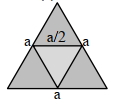
View full question & answer→MCQ 1801 Mark
If three successive terms of a$G.P.$ with common ratio $r(r>1)$ are the lengths of the sides of a triangle and $[\mathrm{r}]$ denotes the greatest integer less than or equal to $r$, then $3[r]+[-r]$ is equal to :
Answera
$\text { a, ar, } a r^2 \rightarrow \text { G.P. }$
Sum of any two sides $>$ third side
$ a+a r>a r^2, a+a r^2>a r, a r+a r^2>a $
$ r^2-r-1<0 $
$ r \in\left(\frac{1-\sqrt{5}}{2}, \frac{1+\sqrt{5}}{2}\right) $
$ r^2-r+1>0$ $............(1)$
always true
$ \mathrm{r}^2+\mathrm{r}-1>0 $
$ \mathrm{r} \in\left(-\infty,-\frac{1-\sqrt{5}}{2}\right) \cup\left(\frac{-1+\sqrt{5}}{2}, \infty\right)$ $...............(2)$
Taking intersection of $(1)$, $(2)$
$\mathrm{r} \in\left(\frac{-1+\sqrt{5}}{2}, \frac{1+\sqrt{5}}{2}\right)$
As $\mathrm{r}>1$
$ r \in\left(1, \frac{1+\sqrt{5}}{2}\right) $
$ {[r]=1[-r]=-2} $
$ 3[r]+[-r]=1$
View full question & answer→MCQ 1811 Mark
For $0<\mathrm{c}<\mathrm{b}<\mathrm{a}$, let $(\mathrm{a}+\mathrm{b}-2 \mathrm{c}) \mathrm{x}^2+(\mathrm{b}+\mathrm{c}-2 \mathrm{a}) \mathrm{x}$ $+(c+a-2 b)=0$ and $\alpha \neq 1$ be one of its root. Then, among the two statements
$(I)$ If $\alpha \in(-1,0)$, then $\mathrm{b}$ cannot be the geometric mean of $\mathrm{a}$ and $\mathrm{c}$
$(II)$ If $\alpha \in(0,1)$, then $\mathrm{b}$ may be the geometric mean of $a$ and $c$
AnswerCorrect option: A. Both $(I)$ and $(II) $are true
a
$\mathrm{f}(\mathrm{x})=(\mathrm{a}+\mathrm{b}-2 \mathrm{c}) \mathrm{x}^2+(\mathrm{b}+\mathrm{c}-2 \mathrm{a}) \mathrm{x}+(\mathrm{c}+\mathrm{a}-2 \mathrm{~b}) $
$ \mathrm{f}(\mathrm{x})=\mathrm{a}+\mathrm{b}-2 \mathrm{c}+\mathrm{b}+\mathrm{c}-2 \mathrm{a}+\mathrm{c}+\mathrm{a}-2 \mathrm{~b}=0$
$ \mathrm{f}(1)=0 $
$\therefore \alpha \cdot 1=\frac{\mathrm{c}+\mathrm{a}-2 \mathrm{~b}}{\mathrm{a}+\mathrm{b}-2 \mathrm{c}} $
$ \alpha=\frac{\mathrm{c}+\mathrm{a}-2 \mathrm{~b}}{\mathrm{a}+\mathrm{b}-2 \mathrm{c}} $
$ \text { If, }-1<\alpha<0 $
$ -1<\frac{\mathrm{c}+\mathrm{a}-2 \mathrm{~b}}{\mathrm{a}+\mathrm{b}-2 \mathrm{c}}<0$
$\mathrm{b}+\mathrm{c}<2 \mathrm{a} \text { and } \mathrm{b}>\frac{\mathrm{a}+\mathrm{c}}{2}$
therefore, $\mathrm{b}$ cannot be G.M. between $\mathrm{a}$ and $\mathrm{c}$.
If, $0<\alpha<1$
$0<\frac{\mathrm{c}+\mathrm{a}-2 \mathrm{~b}}{\mathrm{a}+\mathrm{b}-2 \mathrm{c}}<1$
$\mathrm{b}>\mathrm{c}$ and $\mathrm{b}<\frac{\mathrm{a}+\mathrm{c}}{2}$
Therefore, $\mathrm{b}$ may be the $G.M.$ between $\mathrm{a}$ and $\mathrm{c}$.
View full question & answer→MCQ 1821 Mark
Let $\mathrm{a}$ and $\mathrm{b}$ be be two distinct positive real numbers. Let $11^{\text {th }}$ term of a $GP$, whose first term is $a$ and third term is $b$, is equal to $p^{\text {th }}$ term of another $GP$, whose first term is $a$ and fifth term is $b$. Then $\mathrm{p}$ is equal to
Answerc
$ 1^{\text {st }} G P \Rightarrow t_1=a, t_3=b=a r^2 \Rightarrow r^2=\frac{b}{a} $
$ t_{11} =a r^{10}=a\left(r^2\right)^5=a \cdot\left(\frac{b}{a}\right)^5 $
$2^{\text {nd }} \text { G.P. } \Rightarrow T_1=a, T_5=a r^4=b $
$\Rightarrow r^4 =\left(\frac{b}{a}\right) \Rightarrow r=\left(\frac{b}{a}\right)^{1 / 4} $
$ T_p =a r^{p-1}=a\left(\frac{b}{a}\right)^{\frac{p-1}{4}} $
$ t_{11} =T_p \Rightarrow a\left(\frac{b}{a}\right)^5=a\left(\frac{b}{a}\right)^{\frac{p-1}{4}} $
$ \Rightarrow 5 =\frac{p-1}{4} \Rightarrow p=21$
View full question & answer→MCQ 1831 Mark
Let the range of the function
$f(x)=\frac{1}{2+\sin 3 x+\cos 3 x}, x \in \operatorname{IR} \text { be }[a, b] .$ If $\alpha$ and $\beta$ are respectively the $A.M.$ and the $G.M.$ of a and $b$, then $\frac{\alpha}{\beta}$ is equal to :
- ✓
$\sqrt{2}$
- B
$2$
- C
$\sqrt{\pi}$
- D
$\pi$
AnswerCorrect option: A. $\sqrt{2}$
a
$ f(x) \frac{1}{2+\sin 3 x+\cos 3 x} $
$ {\left[\frac{1}{2+\sqrt{2}}, \frac{1}{2-\sqrt{2}}\right]} $
$ \frac{\alpha}{\beta}=\frac{a+b}{2 \sqrt{a b}}=\frac{1}{2}\left(\sqrt{\frac{a}{b}}+\sqrt{\frac{b}{a}}\right) $
$ =\frac{1}{2}\left(\sqrt{\frac{2-\sqrt{2}}{2+\sqrt{2}}}+\sqrt{\frac{2+\sqrt{2}}{2-\sqrt{2}}}\right) $
$ =\frac{(2-\sqrt{2})+(2+\sqrt{2})}{2 \times \sqrt{2}}=\sqrt{2}$
View full question & answer→MCQ 1841 Mark
Let the first three terms $2, p$ and $q$, with $q \neq 2$, of a $G.P.$ be respectively the $7^{\text {th }}, 8^{\text {th }}$ and $13^{\text {th }}$ terms of an $A.P.$ If the $5^{\text {th }}$ term of the $G.P.$ is the $\mathrm{n}^{\text {th }}$ term of the $A.P.$, then $\mathrm{n}$ is equal to
Answerd
$ 2=a+6 d \quad \ldots(\text { i) } $
$ p=a+7 d \quad \ldots \text { (ii) } $
$ q=a+12 d \quad \ldots \text { (iii) } $
$ p-2=d $ $((ii)-(i))$
$ q-p=5 d $ $((iii)-(ii))$
$ q-p=5(p-2) $
$ q=6 p-10 $
$ p^2=2(6 p-10) $
$ p^2-12 p+20=0 $
$ p=10,2 $
$ p=10 ; q=50 $
$ d=8 $
$ a=-46 $
$ 2,10,50,250,1250 $
$ a^4=a+(n-1) d $
$ 1250=-46+(n-1) 8 $
$ n=163$
View full question & answer→MCQ 1851 Mark
Let $3, a, b, c$ be in $A.P.$ and $3, a-1, b+1, c+9$ be in $G.P.$ Then, the arithmetic mean of $a, b$ and $c$ is :
Answerd
$3, \mathrm{a}, \mathrm{b}, \mathrm{c} \rightarrow \mathrm{A} . \mathrm{P} \quad \Rightarrow 3,3+\mathrm{d}, 3+2 \mathrm{~d}, 3+3 \mathrm{~d}$
$3, \mathrm{a}-1, \mathrm{~b}+1, \mathrm{c}+9 \rightarrow \mathrm{G} . \mathrm{P} \Rightarrow 3,2+\mathrm{d}, 4+2 \mathrm{~d}, 12+3 \mathrm{~d}$
$\mathrm{a}=3+\mathrm{d}$ $(2+d)^2=3(4+2 d)$
$\mathrm{b}=3+2{~d}$ ${~d}=4,-2$
${c}=3+3{~d}$
$\text { If } \mathrm{d}=4 \quad \text { G.P } \Rightarrow 3,6,12,24$
$\mathrm{a}=7$
$\mathrm{~b}=11$
$\mathrm{c}=15$
$\frac{a+b+c}{3}=11$
View full question & answer→MCQ 1861 Mark
Let $2^{\text {nd }}, 8^{\text {th }}$ and $44^{\text {th }}$, terms of a non-constant $A.P.$ be respectively the $1^{\text {st }}, 2^{\text {nd }}$ and $3^{\text {rd }}$ terms of $G.P.$ If the first term of $A.P.$ is $1$ then the sum of first $20$ terms is equal to-
Answerd
$1+d, \quad 1+7 d, 1+43 d \text { are in GP } $
$ (1+7 d)^2=(1+d)(1+43 d) $
$ 1+49 d^2+14 d=1+44 d+43 d^2 $
$ 6 d^2-30 d=0 $
$ d=5 $
$ S_{20}=\frac{20}{2}[2 \times 1+(20-1) \times 5] $
$=10[2+95] $
$=970$
View full question & answer→MCQ 1871 Mark
If each term of a geometric progression $a_1, a_2, a_3, \ldots$ with $a_1=\frac{1}{8}$ and $a_2 \neq a_1$, is the arithmetic mean of the next two terms and $S_n=a_1+a_2+\ldots+a_n$, then $\mathrm{S}_{20}-\mathrm{S}_{18}$ is equal to
- A
$2^{ \mathrm{15}}$
- B
$-2^{18}$
- C
$2^{18}$
- ✓
$-2^{15}$
AnswerCorrect option: D. $-2^{15}$
d
Let $r^{\prime}$ th term of the GP be $a r^{n-1}$. Given,
$ 2 a_r=a_{r+1}+a_{r+2} $
$2 a r^{n-1}=a r^n+a r^{n-1} $
$ \frac{2}{r}=1+r $
$ r^2+r-2=0$
Hence, we get, $r=-2($ as $r \neq 1)$
So, $\mathrm{S}_{20}-\mathrm{S}_{18}=$ (Sum upto $20$ terms) - (Sum upto
$18$ terms )$=\mathrm{T}_{19}+\mathrm{T}_{20} $
$ \mathrm{~T}_{19}+\mathrm{T}_{20}=\mathrm{ar}^{18}(1+\mathrm{r})$
Putting the values $\mathrm{a}=\frac{1}{8}$ and $\mathrm{r}=-2$;
we get $T_{19}+T_{20}=-2^{15}$
View full question & answer→MCQ 1881 Mark
If $\left(\frac{1}{\alpha+1}+\frac{1}{\alpha+2}+\ldots+\frac{1}{\alpha+1012}\right) $ $ -\left(\frac{1}{2 \cdot 1}+\frac{1}{4 \cdot 3}+\frac{1}{6 \cdot 5}+\ldots+\frac{1}{2024 \cdot 2023}\right) $
$ =\frac{1}{2024}, $ then $\alpha$ is equal to-
- A
$1367$
- B
$1058$
- C
$1056$
- ✓
$1011$
AnswerCorrect option: D. $1011$
d
$ \left(\frac{1}{\alpha+1}+\frac{1}{\alpha+2}+\ldots+\frac{1}{\alpha+2012}\right) $ - $ \left\{\left(\frac{1}{1}-\frac{1}{2}\right)+\left(\frac{1}{3}-\frac{1}{4}\right)+\ldots+\left(\frac{1}{2023}-\frac{1}{2024}\right)\right\}=\frac{1}{2024} $
$\Rightarrow $ $ \left(\frac{1}{\alpha+1}+\frac{1}{\alpha+2}+\ldots+\frac{1}{\alpha+2012}\right) $ $ -\left\{\left(\frac{1}{1}+\frac{1}{2}+\frac{1}{3}+\frac{1}{4}\right)+\ldots+\frac{1}{2023}\right. $ $ \left.-\frac{1}{2024}-2\left(\frac{1}{2}+\frac{1}{4}+\ldots+\frac{1}{2022}\right)\right\}=\frac{1}{2024} $
$\Rightarrow $ $ \left(\frac{1}{\alpha+1}+\frac{1}{\alpha+2}+\ldots+\frac{1}{\alpha+2012}\right) $ $ -\left(\frac{1}{1}+\frac{1}{2}+\ldots+\frac{1}{2023}\right) $ $ \frac{1}{2024}+\left(\frac{1}{1}+\frac{1}{2}+\ldots+\frac{1}{1011}\right)=\frac{1}{2024} $
$\Rightarrow $ $ \frac{1}{\alpha+1}+\frac{1}{\alpha+2}+\ldots+\frac{1}{\alpha+2012} $ = $ \frac{1}{1012}+\frac{1}{1013}+\ldots+\frac{1}{2023} $
$\Rightarrow $ $ \alpha=1011$
View full question & answer→MCQ 1891 Mark
If the sum of series $\frac{1}{1 \cdot(1+d)}+\frac{1}{(1+d)(1+2 d)}+\ldots \ldots+\frac{1}{(1+9 d)(1+10 d)}$ is equal to $5$ , then $50 \mathrm{~d}$ is equal to :
Answerb
$ \frac{1}{1 \cdot(1+d)}+\frac{1}{(1+d)(1+2 d)}+\ldots \ldots $ $ \frac{1}{(1+9 d)(1+10 d)}=5$
$ \frac{1}{d}\left[\frac{(1+d)-1}{1 \cdot(1+d)}+\frac{(1+2 d)-(1-d)}{(1+d)(1+2 d)}\right]+\ldots . . . . $ $ \frac{(1+10 d)-(1+9 d)}{(1+9 d)(1+10 d)}=5 $
$ \frac{1}{d}\left[\left(1-\frac{1}{1+d}\right)+\left(\frac{1}{1+d}-\frac{1}{1+2 d}\right)+ . . .\right. $ $ \left.\left(\frac{1}{1+9 d}-\frac{1}{1+10 d}\right)\right]=5 $
$ \frac{1}{d}\left[1-\frac{1}{(1+10 d)}\right]=5 $
$ \frac{10 d}{1+10 d}=5 d $
$ 50 d=5$
View full question & answer→MCQ 1901 Mark
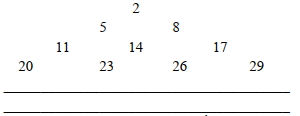
An arithmetic progression is written in the following way $Image$ The sum of all the terms of the $10^{\text {th }}$ row is..........
- ✓
$1505$
- B
$1078$
- C
$1045$
- D
$1548$
AnswerCorrect option: A. $1505$
a
$ 2,5,11,20, \ldots . . $
$ \text { General term }=\frac{3 n^2-3 n+4}{2} $
$ \mathrm{T}_{10}=\frac{3(100)-3(10)+4}{2} $
$=137 $
$ 10 \text { terms with c.d. }=3$
sum $ =\frac{10}{2}(2(137)+9(3))$
$ =1505$
View full question & answer→MCQ 1911 Mark
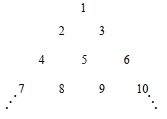
Let the positive integers be written in the form :
$Image$
If the $\mathrm{k}^{\text {th }}$ row contains exactly $\mathrm{k}$ numbers for every natural number $\mathrm{k}$, then the row in which the number $5310$ will be, is.........
Answera
$ \mathrm{S}=1+2+4+7+\ldots \ldots+\mathrm{T}_{\mathrm{n}} $
$ \mathrm{S}=1+2+4+\ldots \ldots $
$ \mathrm{Tn}=1+1+2+3+\ldots \ldots+\left(\mathrm{T}_{\mathrm{n}}-\mathrm{T}_{\mathrm{n}-1}\right) $
$ \mathrm{T}_{\mathrm{n}}=1+\left(\frac{\mathrm{n}-1}{2}\right)[2+(\mathrm{n}-2) \times 1] $
$ \mathrm{T}_{\mathrm{n}}=1+1+\frac{\mathrm{n}(\mathrm{n}-1)}{2} $
$ \mathrm{n}=100 \quad \mathrm{~T}_{\mathrm{n}}=1+\frac{100 \times 99}{2}=4950+1 $
$ \mathrm{n}=101 \quad \mathrm{~T}_{\mathrm{n}}=1+\frac{101 \times 100}{2}=5050+1=5051 $
$ \mathrm{n}=102 \quad \mathrm{~T}_{\mathrm{n}}=1+\frac{102 \times 101}{2}=5151+1=5152 $
$ \mathrm{n}=103 \quad \mathrm{~T}_{\mathrm{n}}=1+\frac{103 \times 102}{2}=5254 $
$ \mathrm{n}=104 \quad \mathrm{~T}_{\mathrm{n}}=1+\frac{104 \times 103}{2}=5357$
View full question & answer→MCQ 1921 Mark
$ \text { If } S(x)=(1+x)+2(1+x)^2+3(1+x)^3+\ldots . $
$ +60(1+x)^{60}, x \neq 0 \text {, and }(60)^2 S(60)=a(b)^b+b$ where $a, b N$, then $(a+b)$ equal to...............
- A
$3214$
- B
$1495$
- ✓
$3660$
- D
$3654$
AnswerCorrect option: C. $3660$
c
$ S(x)=(1+x)+2(1+x)^2+3(1+x)^3+. .+60(1+x)^{60} $
$(1+x) S=(1+x)^2+\ldots \ldots . . \quad 59(1+x)^{60}+60(1+x)^{61} $
$-x S=\frac{(1+x)(1+x)^{60}-1}{x}-60(1+x)^{61}$
Put $\mathrm{x}=60$
$-60 \mathrm{~S}=\frac{61\left((61)^{60}-1\right)}{60}-60(61)^{61}$
on solving $3660$
View full question & answer→MCQ 1931 Mark
Let the first term of a series be $T_1=6$ and its $\mathrm{r}^{\text {th }}$ term $T_r=3 T_{r-1}+6^r, r=2,3, \ldots . ., n$. If the sum of the first $\mathrm{n}$ terms of this series is $\frac{1}{5}\left(n^2-12 n+39\right)$ $\left(4.6^n-5.3^n+1\right)$. Then $n$ is equal to ...........
Answerc
$ \mathrm{T}_{\mathrm{r}}=3 \mathrm{~T}_{\mathrm{r}-1}+6^{\mathrm{r}}, \mathrm{r}=2,3,4, \ldots \mathrm{n} $
$ \mathrm{T}_2=3 \cdot \mathrm{T}_1+6^2 $
$ \mathrm{~T}_2=3 \cdot 6+6^2 $ ................($1$)
$ \mathrm{~T}_3=3 \mathrm{~T}_2+6^3 $
$ \mathrm{~T}_3=3 \mathrm{~T}_2+6^3 $
$ \mathrm{~T}_3=3\left(3 \cdot 6+6^2\right)+6^3 $
$ \mathrm{~T}_3=3^2 \cdot 6+3 \cdot 6^2+6^3 \quad \ldots(2) $ ...............($2$)
$ \mathrm{T}_{\mathrm{r}}=3^{\mathrm{r}-1} \cdot 6+3^{\mathrm{r}-2} \cdot 6^2+\ldots+6^{\mathrm{r}} $
$ \mathrm{T}_{\mathrm{r}}=3^{\mathrm{r}-1} \cdot 6\left[1+\frac{6}{3}+\left(\frac{6}{3}\right)^2+\ldots+\left(\frac{6}{3}\right)^{\mathrm{r}-1}\right] $
$ \mathrm{T}_{\mathrm{r}}=3^{\mathrm{r}-1} \cdot 6\left(1+2+2^2+\ldots+2^{\mathrm{r}-1}\right) $
$ \mathrm{T}_{\mathrm{r}}=6 \cdot 3^{\mathrm{r}-1} 1 \cdot \frac{\left(1-2^{\mathrm{r}}\right)}{(-1)} $
$ \mathrm{T}_{\mathrm{r}}=6 \cdot 3^{\mathrm{r}-1} \cdot\left(2^{\mathrm{r}}-1\right) $
$ \mathrm{T}_{\mathrm{r}}=\frac{6 \cdot 3^{\mathrm{r}}}{3} \cdot\left(2^{\mathrm{r}}-1\right)$
$ \mathrm{T}_{\mathrm{r}}=2 \cdot\left(6^{\mathrm{T}}-3^{\mathrm{r}}\right) $
$ \mathrm{S}_{\mathrm{n}}=2 \Sigma\left(6^{\mathrm{r}}-3^{\mathrm{r}}\right) $
$ \mathrm{S}_{\mathrm{n}}=2 \cdot\left[\frac{6 \cdot\left(6^{\mathrm{n}}-1\right)}{5}-\frac{3 \cdot\left(3^{\mathrm{n}}-1\right)}{2}\right] $
$ \mathrm{S}_{\mathrm{n}}=2\left[\frac{12\left(6^{\mathrm{n}}-1\right)-15\left(3^{\mathrm{n}}-1\right)}{10}\right] $
$ \mathrm{S}_{\mathrm{n}}=\frac{3}{5}\left[4 \cdot 6^4-5 \cdot 3^{\mathrm{n}}+1\right] $
$ \therefore \mathrm{n}^2-12 \mathrm{n}+39=3 $
$ \mathrm{n}^2-12 \mathrm{n}+36=0 $
$ \mathrm{n}=6$
View full question & answer→MCQ 1941 Mark
If $1+\frac{\sqrt{3}-\sqrt{2}}{2 \sqrt{3}}+\frac{5-2 \sqrt{6}}{18}+\frac{9 \sqrt{3}-11 \sqrt{2}}{36 \sqrt{3}}+\frac{49-20 \sqrt{6}}{180}+\ldots$
upto $\infty=2\left(\sqrt{\frac{b}{a}}+1\right) \log _e\left(\frac{a}{b}\right)$, where $a$ and $b$ are integers with $\operatorname{gcd}(a, b)=1$, then $11 a+18 b$ is equal to ...............
Answera
$ S=1+\frac{x}{2 \sqrt{3}}+\frac{x^2}{18}+\frac{x^3}{36 \sqrt{3}}+\frac{x^4}{180}+\ldots \infty $
$ \text { Put } \frac{x}{\sqrt{3}}=t \text {, where } x=\sqrt{3}-\sqrt{2} $
$ S=1+\frac{t}{2}+\frac{t^2}{6}+\frac{t^3}{12}+\frac{t^4}{20}+\ldots $
$ S=1+t\left(1-\frac{1}{2}\right)+t^2\left(\frac{1}{2}-\frac{1}{3}\right)+t^3\left(\frac{1}{3}-\frac{1}{4}\right)+t^4\left(\frac{1}{4}-\frac{1}{5}\right) $
$ S=\left(1+t+\frac{t^2}{2}+\frac{t^3}{3}+\frac{t^3}{4}+\ldots\right)-\left(\frac{t}{2}+\frac{t^2}{3}+\frac{t^3}{4}+\frac{t^4}{5}+\ldots\right) $
$ S=\left(t+\frac{t^2}{2}+\ldots\right)-\frac{1}{t}\left(t+\frac{t^2}{2}+\frac{t^3}{3}+\ldots\right)+2 $
$ S=2+\left(1-\frac{1}{t}\right)(-\log (1-t))=\left(\frac{1}{t}-1\right) \log (1-t)+2 $
$ S=2+\left(\frac{\sqrt{3}}{\sqrt{3}-\sqrt{2}}-1\right) \log \left(1-\frac{\sqrt{3}-\sqrt{2}}{\sqrt{3}}\right) $
$ S=2+\left(\frac{\sqrt{2}}{\sqrt{3}-\sqrt{2}}\right) \log e \frac{\sqrt{2}}{\sqrt{3}} $
$ S=2+\frac{(\sqrt{6}+2)}{2} \log e \frac{2}{3}=2+\left(\sqrt{\frac{3}{2}}+1\right) \log e \frac{2}{3} $
$ a=2, b=3 $
$ 11 a+18 b=11 \times 2+18 \times 3=76$
View full question & answer→MCQ 1951 Mark
The value of $\frac{1 \times 2^2+2 \times 3^2+\ldots+100 \times(101)^2}{1^2 \times 2+2^2 \times 3+\ldots+100^2 \times 101}$ is
- A
$\frac{306}{305}$
- ✓
$\frac{305}{301}$
- C
$\frac{32}{31}$
- D
$\frac{31}{30}$
AnswerCorrect option: B. $\frac{305}{301}$
b
$ \frac{1 \times 2^2+2 \times 3^2+\ldots+100 \times(101)^2}{1^2 \times 2+2^2 \times 3+\ldots+100^2 \times 101}=\frac{\sum_{\mathrm{r}=1}^{100} \mathrm{r}(\mathrm{r}+1)^2}{\sum_{\mathrm{r}=1}^{100} \mathrm{r}^2(\mathrm{r}+1)} $
$ =\frac{\sum_{\mathrm{r}=1}^{100}\left(\mathrm{r}^3+2 \mathrm{r}^2+\mathrm{r}\right)}{\sum_{\mathrm{r}=1}^{100}\left(\mathrm{r}^3+\mathrm{r}^2\right)}=\frac{\left(\frac{\mathrm{n}(\mathrm{n}+1)^2}{2}\right)+\frac{2 \mathrm{n}(\mathrm{n}+1)(2 \mathrm{n}+1)}{6}+\frac{\mathrm{n}(\mathrm{n}+1)}{2}}{\left(\frac{\mathrm{n}(\mathrm{n}+1)}{2}\right)^2+\frac{\mathrm{n}(\mathrm{n}+1)(2 \mathrm{n}+1)}{6}} $
$ =\frac{\frac{\mathrm{n}(\mathrm{n}+1)}{2}\left[\frac{\mathrm{n}(\mathrm{n}+1)}{2}+\frac{2}{3} \cdot(2 \mathrm{n}+1)+1\right]}{\frac{\mathrm{n}(\mathrm{n}+1)}{2}\left[\frac{\mathrm{n}(\mathrm{n}+1)}{2}+\frac{(2 \mathrm{n}+1)}{3}\right]} ; \text { Put } \mathrm{n}=100 $
$ \frac{\frac{100(101)}{2}+\frac{2}{3}(201)+1}{\frac{100 \times 101}{2}+\frac{201}{3}}=\frac{5185}{5117}=\frac{305}{301}$
View full question & answer→MCQ 1961 Mark
The sum of the series $\frac{1}{1-3 \cdot 1^2+1^4}+$ $\frac{2}{1-3 \cdot 2^2+2^4}+\frac{3}{1-3 \cdot 3^2+3^4}+\ldots$. up to $10$ terms is
- A
$\frac{45}{109}$
- B
$-\frac{45}{109}$
- C
$\frac{55}{109}$
- ✓
$-\frac{55}{109}$
AnswerCorrect option: D. $-\frac{55}{109}$
d
General term of the sequence,
$\mathrm{T}_{\mathrm{r}}=\frac{\mathrm{r}}{1-3 \mathrm{r}^2+\mathrm{r}^4}$
$\mathrm{~T}_{\mathrm{r}}=\frac{\mathrm{r}}{\mathrm{r}^4-2 \mathrm{r}^2+1-\mathrm{r}^2}$
$\mathrm{~T}_{\mathrm{r}}=\frac{\mathrm{r}}{\left(\mathrm{r}^2-1\right)^2-\mathrm{r}^2} $
$\mathrm{~T}_{\mathrm{r}}=\frac{\mathrm{r}}{\left(\mathrm{r}^2-\mathrm{r}-1\right)\left(\mathrm{r}^2+\mathrm{r}-1\right)}$
$\mathrm{T}_{\mathrm{r}}=\frac{\frac{1}{2}\left[\left(\mathrm{r}^2+\mathrm{r}-1\right)-\left(\mathrm{r}^2-\mathrm{r}-1\right)\right]}{\left(\mathrm{r}^2-\mathrm{r}-1\right)\left(\mathrm{r}^2+\mathrm{r}-1\right)}$
$=\frac{1}{2}\left[\frac{1}{\mathrm{r}^2-\mathrm{r}-1}-\frac{1}{\mathrm{r}^2+\mathrm{r}-1}\right]$
Sum of $10$ terms,
$\sum_{\mathrm{r}=1}^{10} \mathrm{~T}_{\mathrm{r}}=\frac{1}{2}\left[\frac{1}{-1}-\frac{1}{109}\right]=\frac{-55}{109}$
View full question & answer→MCQ 1971 Mark
Let $\alpha=1^2+4^2+8^2+13^2+19^2+26^2+\ldots \ldots$ upto 10 terms and $\beta=\sum_{n=1}^{10} n^4$. If $4 \alpha-\beta=55 k+40$, then $\mathrm{k}$ is equal to____________.
Answerb
$\alpha=1^2+4^2+8^2 \ldots . $
$t_n=a^2+b n+c$
$ 1=a+b+c$
$ 4=4 a+2 b+c $
$ 8=9 a+3 b+c$
On solving we get, $\mathrm{a}=\frac{1}{2}, \mathrm{~b}=\frac{3}{2}, \mathrm{c}=-1$
$ \alpha=\sum_{n=1}^{10}\left(\frac{n^2}{2}+\frac{3 n}{2}-1\right)^2 $
$ 4 \alpha=\sum_{n=1}^{10}\left(n^2+3 n-2\right)^2, \beta=\sum_{n=1}^{10} n^4 $
$ 4 \alpha-\beta=\sum_{n=1}^{10}\left(6 n^3+5 n^2-12 n+4\right)=55(353)+40$
View full question & answer→MCQ 1981 Mark
If a function $f$ satisfies $f(m+n)=f(m)+f(n)$ for all $\mathrm{m}, \mathrm{n} \in \mathrm{N}$ and $\mathrm{f}(1)=1$, then the largest natural number $\lambda$ such that $\sum_{\mathrm{k}=1}^{2022} \mathrm{f}(\lambda+\mathrm{k}) \leq(2022)^2$ is equal to ..........
- ✓
$1010$
- B
$1015$
- C
$1678$
- D
$1345$
AnswerCorrect option: A. $1010$
a
$ \mathrm{f}(\mathrm{m}+\mathrm{n})=\mathrm{f}(\mathrm{m})+\mathrm{f}(\mathrm{n}) $
$ \Rightarrow \mathrm{f}(\mathrm{x})=\mathrm{kx} $
$ \Rightarrow \mathrm{f}(1)=1 $
$ \Rightarrow \mathrm{k}=1 $
$ \mathrm{f}(\mathrm{x})=\mathrm{x}$
Now
$ \sum_{\mathrm{k}=1}^{2022} \mathrm{f}(\lambda+\mathrm{k}) \leq(2022)^2 $
$ \Rightarrow \sum_{\mathrm{k}=1}^{2022}(\lambda+\mathrm{k}) \leq(2022)^2 $
$ \Rightarrow 2022 \lambda+\frac{2022 \times 2023}{2} \leq(2022)^2$
$ \Rightarrow \lambda \leq 2022-\frac{2023}{2} $
$ \Rightarrow \lambda \leq 1010.5$
$\therefore$ largest natural no. $\lambda$ is $1010$ .
View full question & answer→MCQ 1991 Mark
If $\frac{1}{\sqrt{1}+\sqrt{2}}+\frac{1}{\sqrt{2}+\sqrt{3}}+\ldots+\frac{1}{\sqrt{99}+\sqrt{100}}=m$ and $\frac{1}{1 \cdot 2}+\frac{1}{2 \cdot 3}+\ldots+\frac{1}{99 \cdot 100}=\mathrm{n}$, then the point $(\mathrm{m}, \mathrm{n})$ lies on the line
- A
$11(x-1)-100(y-2)=0$
- B
$11(x-2)-100(y-1)=0$
- C
$11(x-1)-100 y=0$
- ✓
$11 x-100 y=0$
AnswerCorrect option: D. $11 x-100 y=0$
d
$ \frac{1}{\sqrt{1}+\sqrt{2}}+\frac{1}{\sqrt{2}+\sqrt{3}}+\ldots+\frac{1}{\sqrt{99}+\sqrt{100}}=\mathrm{m} $
$ \frac{\sqrt{1}-\sqrt{2}}{-1}+\frac{\sqrt{2}-\sqrt{3}}{-1} \ldots \frac{\sqrt{99}-\sqrt{100}}{-1}=\mathrm{m}$
$ \sqrt{100}-1=\mathrm{m} \Rightarrow \mathrm{m}=9 $
$ \frac{1}{1 \cdot 2}+\frac{1}{2 \cdot 3}+\ldots \frac{1}{99 \cdot 100}=\mathrm{n} $
$ \frac{1}{1}-\frac{1}{2}+\frac{1}{2}-\frac{1}{3} \ldots \frac{1}{99}-\frac{1}{100}=\mathrm{n} $
$ 1-\frac{1}{100}=\mathrm{n} $
$ \frac{99}{100}=\mathrm{n} $
$ (\mathrm{m}, \mathrm{n})=\left(9, \frac{99}{100}\right) $
$ \Rightarrow 11(9)-100\left(\frac{99}{100}\right) $
$ =99-99=0$
Ans. option ($4$) $11 x-100 y=0$
View full question & answer→MCQ 2001 Mark
If $2 \tan ^2 \theta-5 \sec \theta=1$ has exactly $7$ solutions in the interval $\left[0, \frac{n \pi}{2}\right]$, for the least value of $n \in N$ then $\sum_{\mathrm{k}=1}^{\mathrm{n}} \frac{\mathrm{k}}{2^{\mathrm{k}}}$ is equal to :
- A
$\frac{1}{2^{15}}\left(2^{14}-14\right)$
- B
$\frac{1}{2^{14}}\left(2^{15}-15\right)$
- C
$1-\frac{15}{2^{13}}$
- ✓
$\frac{1}{2^{13}}\left(2^{14}-15\right)$
AnswerCorrect option: D. $\frac{1}{2^{13}}\left(2^{14}-15\right)$
d
$2 \tan ^2 \theta-5 \sec \theta-1=0 $
$ \Rightarrow 2 \sec ^2 \theta-5 \sec \theta-3=0 $
$ \Rightarrow(2 \sec \theta+1)(\sec \theta-3)=0 $
$ \Rightarrow \sec \theta=-\frac{1}{2}, $
$ \Rightarrow \cos \theta=-2, \frac{1}{3} $
$ \Rightarrow \cos \theta=\frac{1}{3}$
For $7$ solutions $n=13$
$ \text { So, } \sum_{\mathrm{k}=1}^{13} \frac{\mathrm{k}}{2^{\mathrm{k}}}=\mathrm{S} \text { (say) } $
$ \mathrm{S}=\frac{1}{2}+\frac{2}{2^2}+\frac{3}{2^j}+\ldots .+\frac{13}{2^{13}} $
$ \frac{1}{2} \mathrm{~S}=\frac{1}{2^2}+\frac{1}{2^3}+\ldots . .+\frac{12}{2^{13}}+\frac{13}{2^{14}} $
$ \Rightarrow \frac{\mathrm{S}}{2}=\frac{1}{2} \cdot \frac{1-\frac{1}{2^{13}}}{1-\frac{1}{2}}-\frac{13}{2^{14}} \Rightarrow \mathrm{S}=2 \cdot\left(\frac{2^{13}-1}{2^{13}}\right)-\frac{13}{2^{13}}$
View full question & answer→