MCQ 11 Mark
The points $P$ is equidistant from $A(1,3), \,B (-3,5)$ and $C(5,-1)$. Then $PA =$
- A
$5$
- B
$5\sqrt 5 $
- C
$25$
- ✓
$5\sqrt {10} $
AnswerCorrect option: D. $5\sqrt {10} $
d
(d) Perpendicular bisector of $A\,(1,\,\,3)$ and $B\,( - 3,\,\,5)$ is $2x({x_1} - {x_2}) + 2y\,({y_1} - {y_2}) = (x_1^2 + y_1^2) - (x_2^2 + y_2^2)$
$ \Rightarrow \,\,2x(1 + 3) + 2y(3 - 5) = (1 + 9) - (9 + 25)$
$ \Rightarrow \,\,2x - y + 6 = 0$ .....$(i)$
Perpendicular bisector of $A\,(1,\,\,3)$ and $C\,(5,\,\, - 1)$ is
$2x\,(1 - 5) + 2y(3 + 1) = (1 + 9) - (25 + 1)$
$ \Rightarrow \,\,x - y - 2 = 0$ .....$(ii)$
Point of intersection of $(i)$ and $(ii)$ is $P = ( - 8,\,\, - 10)$
Then $PA = \sqrt {{{(1 + 8)}^2} + {{(3 + 10)}^2}} = \sqrt {81 + 169} $
$ = \sqrt {250} = 5\sqrt {10} $.
View full question & answer→MCQ 21 Mark
The points which trisect the line segment joining the points $(0, 0)$ and $(9, 12)$ are
- ✓
$(3,4),\, (6,8)$
- B
$(4,3),\, (6,8)$
- C
$(4,3),\, (8,6)$
- D
$(3,4),\, (8,6)$
AnswerCorrect option: A. $(3,4),\, (6,8)$
a
(a) Let the point be $(x, y)$
$(i)$ Point $B \,(x, y)$ divides $AD$ in $1 : 2$
$\therefore \,\,\,\,x = \frac{{0 + 9}}{3} = 3$ and $y = \frac{{0 + 12}}{3} = 4$
$(ii)$ Now point $C \,(x, y)$ divides $AD$ in $2 : 1$,
Then $x = \frac{{0 + 18}}{3} = 6$ and $y = \frac{{0 + 24}}{3} = 8$.

View full question & answer→MCQ 31 Mark
The mid-points of sides of a triangle are $(2, 1), \,(-1, -3)$ and $(4,5)$. Then the coordinates of its vertices are
- ✓
$(7,\,9),\,( - 3,\, - 7),\,(1,\,1)$
- B
$( - 3,\, - 7),\,(1,\,1),\,(2,\,3)$
- C
$(1,\,1),\,(2,\,3),\,( - 5,\,8),$
- D
AnswerCorrect option: A. $(7,\,9),\,( - 3,\, - 7),\,(1,\,1)$
a
(a) $\frac{{{x_1} + {x_2}}}{2} = 2,\,\,\frac{{{x_2} + {x_3}}}{2} = - 1,\,\,\frac{{{x_3} + {x_1}}}{2} = 4$
${x_1} = 7,\,\,{x_2} = - 3,\,\,{x_3} = 1$
Similarly ${y_1},\,\,{y_2},\,\,{y_3}$ can be found.
View full question & answer→MCQ 41 Mark
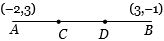
The coordinates of the join of trisection of the points $(-2, 3)$, $(3, -1)$ nearer to $(-2, 3)$, is
- ✓
$\left( { - \frac{1}{3},\,\frac{5}{3}} \right)$
- B
$\left( {\frac{4}{3},\frac{1}{3}} \right)$
- C
$\left( { - \frac{3}{4},\,2} \right)$
- D
$\left( {\frac{1}{3},\,\frac{5}{3}} \right)$
AnswerCorrect option: A. $\left( { - \frac{1}{3},\,\frac{5}{3}} \right)$
a
(a) $C$ divides the line in the ratio $1 : 2$,
so coordinates of $C$ will be $\left( { - \frac{1}{3},\,\frac{5}{3}} \right)$,
which is the required point.
View full question & answer→MCQ 51 Mark
The points of trisection of the line segment joining the points $(3, -2)$ and $(-3, -4)$ are
- A
$\left( {\frac{3}{2}, - \frac{5}{2}} \right)\,,\left( { - \frac{3}{2}, - \frac{{13}}{4}} \right)$
- B
$\left( { - \frac{3}{2},\frac{5}{2}} \right)\,,\left( {\frac{3}{2},\frac{{13}}{4}} \right)$
- ✓
$\left( {1, - \frac{8}{3}} \right)\,,\left( { - 1, - \frac{{10}}{3}} \right)$
- D
AnswerCorrect option: C. $\left( {1, - \frac{8}{3}} \right)\,,\left( { - 1, - \frac{{10}}{3}} \right)$
c
(c) Let $A(3,\, - 2)$,$B\,( - 3,\,\, - 4)$ and two points $C$ and $D$ are the trisection points of $AB$.
Obviously $C$ divides the line $AB$ in $1 : 2$, therefore coordinates of $C$ are
$\left( {\frac{{1( - 3) + 2(3)}}{{1 + 2}},\,\frac{{1( - 4) + 2( - 2)}}{{1 + 2}}} \right) = \left( {1,\,\, - \frac{8}{3}} \right)$.
Similarly $D$ divides the line $AB$ in $2 : 1$, hence coordinates of $D$ are
$\left( {\frac{{2( - 3) + 1(3)}}{{2 + 1}},\,\frac{{2( - 4) + 1( - 2)}}{{2 + 1}}} \right) = \left( { - 1,\,\, - \frac{{10}}{3}} \right)$.
View full question & answer→MCQ 61 Mark
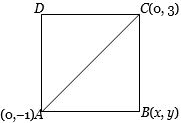
$(0, -1)$ and $(0, 3)$ are two opposite vertices of a square. The other two vertices are
- A
$(0, 1),\,(0, -3)$
- B
$(3, -1) \,(0, 0)$
- ✓
$(2, 1),\, (-2, 1)$
- D
$(2, 2), \,(1, 1)$
AnswerCorrect option: C. $(2, 1),\, (-2, 1)$
c
(c) Length of diagonal = $4$
Now, $A{C^2} = A{B^2} + B{C^2}$
$A{C^2} = 2A{B^2} \Rightarrow 8 = A{B^2}$
$AB = BC = 2\sqrt 2 $
Now, let $B\,(x,y)$; $\therefore A{B^2} = B{C^2}$
==>${(x - 0)^2} + {(y + 1)^2} = {(x - 0)^2} + {(y - 3)^2}$
${x^2} + {y^2} + 2y + 1 = {x^2} + {y^2} - 6y + 9$
==> $y = 1;\,\,\,\therefore {x^2} + {(2)^2} = 8; \Rightarrow {x^2} = 4 \Rightarrow x = \pm \,2$
$\therefore $ other vertices are $(2, 1)\,,(-2, 1)$.
View full question & answer→MCQ 71 Mark
The ratio in which point $(5, -2)$ divides the line segement joining points $(8, 4)$ and $(9, 6)$ is
- ✓
$3 : 4$ externally
- B
$7 : 9$ externally
- C
$3 : 4$ internally
- D
AnswerCorrect option: A. $3 : 4$ externally
View full question & answer→MCQ 81 Mark
The following points $A\, (2a,\, 4a),\, B(2a,\, 6a)$ and $C$ $(2a + \sqrt 3 a,\,5a)$, $(a > 0)$ are the vertices of
Answera
(a) $AB = \sqrt {{{(2a - 2a)}^2} + {{(4a - 6a)}^2}} = 2a$
$BC = \sqrt {{{(\sqrt 3 a)}^2} + {a^2}} = 2a$
$CA = \sqrt {{{(\sqrt 3 a)}^2} + {{( - a)}^2}} = 2a$
Since $AB = BC = CA,$ hence triangle is equilateral.
Therefore, it is an acute angled triangle.
View full question & answer→MCQ 91 Mark
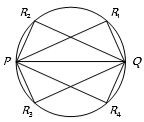
$P(3,1),\;Q(6,5)$ and $R(x,y)$ are three points such that the angle $PRQ$ is a right angle and the area of the $\Delta RPQ=5$, then the number of such points $R$ is
Answerd
(d) In the following figure, the four possible points are seen.
View full question & answer→MCQ 101 Mark
Circumcenter of the triangle formed by the line $y = x,\;\;y = 2x$ and $y = 3x + 4$ is
- A
$(6, 8)$
- ✓
$(6, -8)$
- C
$(3, 4)$
- D
$(-3, -4)$
AnswerCorrect option: B. $(6, -8)$
b
(b) ${x^2} + {y^2} = {(x + 4)^2} + {(y + 8)^2}\,\, \Rightarrow \,\,8x + 16y + 80 = 0$
and ${x^2} + {y^2} = {(x + 2)^2} + {(y + 2)^2}\,\, \Rightarrow \,\,4x + 4y + 8 = 0$
On simplification, we get $y = - 8$ and $x = 6$.
View full question & answer→MCQ 111 Mark
The incentre of the triangle formed by $(0, 0)$, $(5,12)$, $(16, 12)$ is
- ✓
$(7,9)$
- B
$(9,7)$
- C
$(-9, 7)$
- D
$(-7,9)$
AnswerCorrect option: A. $(7,9)$
a
(a) Obviously $a = 11,\,\,b = 20,\,\,c = 13.$
Hence incentre is
$\left( {\frac{{11 \times 0 + 20 \times 5 + 13 \times 16}}{{11 + 20 + 13}},\,\,\frac{{11 \times 0 + 20 \times 12 + 13 \times 12}}{{11 + 20 + 13}}} \right)$i.e. $(7, 9)$.
View full question & answer→MCQ 121 Mark
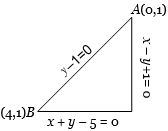
The equations of the sides of a triangle are $x + y - 5 = 0;\;$ $x - y + 1 = 0$ and $y - 1 = 0,$ then the coordinates of the circumcentre are
- ✓
$(2,1)$
- B
$(1,2)$
- C
$(2,-2)$
- D
$(1, -2)$
AnswerCorrect option: A. $(2,1)$
a
(a) Since the triangle is right angled so the circumcentre will be the middle point of hypotenuse i.e. $(2, 1)$.
View full question & answer→MCQ 131 Mark
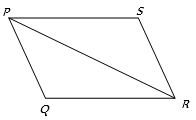
$P(2,1),\,Q(4, - 1),\,R(3,2)$ are the vertices of triangle and if through $P$ and $R$ lines parallel to opposite sides are drawn to intersect in $S$, then the area of $PQRS$ is
Answerb
(b) Since $PQRS$ is a parallelogram with an area which is twice the area of $\Delta PQR$.
Therefore, area $PQRS$ $ = 2.\frac{1}{2}\,\left| {\,\begin{array}{*{20}{c}}2&1&1\\4&{ - 1}&1\\3&2&1\end{array}\,} \right| = 4$.
View full question & answer→MCQ 141 Mark
If the points $(x + 1,\,2),\;(1,x + 2),\;\left( {\frac{1}{{x + 1}},\frac{2}{{x + 1}}} \right)$ are collinear, then x is
- A
$4$
- B
$0$
- C
$-4$
- ✓
$(b)$ and $(c)$ both
AnswerCorrect option: D. $(b)$ and $(c)$ both
d
(b) Let $A \equiv (x + 1,\,2),\,\,B \equiv (1,\,x + 2),\,\,C \equiv \left( {\frac{1}{{x + 1}},\,\,\frac{2}{{x + 1}}} \right)$
then $ A,\, B,\, C$ are collinear if area of $\Delta ABC = 0$
$ \Rightarrow \,\,\left| {\,\begin{array}{*{20}{c}}{x + 1}&2&1\\1&{x + 2}&1\\{\frac{1}{{x + 1}}}&{\frac{2}{{x + 1}}}&1\end{array}\,} \right| = 0$ $ \Rightarrow \,\,\left| {\,\begin{array}{*{20}{c}}x&{ - x}&0\\1&{x + 2}&1\\{\frac{1}{{x + 1}}}&{\frac{2}{{x + 1}}}&1\end{array}\,} \right| = 0$
$({R_1} \to {R_1} - {R_2})$
$ \Rightarrow \,\,\left| {\,\begin{array}{*{20}{c}}x&0&0\\1&{x + 3}&1\\{\frac{1}{{x + 1}}}&{\frac{3}{{x + 1}}}&1\end{array}\,} \right| = 0$ $({C_2} \to {C_2} + {C_1})$
$ \Rightarrow \,\,x\,\left( {x + 3 - \frac{3}{{x + 1}}} \right) = 0\,\, $
$\Rightarrow \,\,x({x^2} + 3 + 4x - 3) = 0$
$ \Rightarrow \,\,{x^2}(x + 4) = 0\,\, $
$\Rightarrow \,\,x = 0,\,\, - 4$.
View full question & answer→MCQ 151 Mark
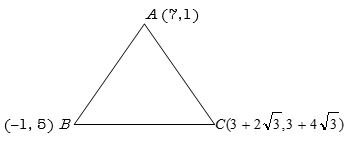
The incentre of a triangle with vertices $(7, 1) \,(-1, 5)$ and $(3 + 2\sqrt 3 ,\,3 + 4\sqrt 3 )$ is
- ✓
$\left( {3 + \frac{2}{{\sqrt 3 }},\,3 + \frac{4}{{\sqrt 3 }}} \right)$
- B
$\left( {1 + \frac{2}{{3\sqrt 3 }},\,1 + \frac{4}{{3\sqrt 3 }}} \right)$
- C
$(7, 1)$
- D
AnswerCorrect option: A. $\left( {3 + \frac{2}{{\sqrt 3 }},\,3 + \frac{4}{{\sqrt 3 }}} \right)$
a
(a) $AB=BC=CA=4 \sqrt 5$
i.e., given triangle is equilateral.
(In centre of a triangle are same as the centriod when triangle is equilateral)
.Hence, incentre = $\left( {\frac{{7 - 1 + 3 + 2\sqrt 3 }}{3},\frac{{1 + 5 + 3 + 4\sqrt 3 }}{3}} \right)$
$= \left( {3 + \frac{2}{{\sqrt 3 }},3 + \frac{4}{{\sqrt 3 }}} \right)$.
View full question & answer→MCQ 161 Mark
The orthocentre of the triangle with vertices $(-2, -6)$, $(-2, 4)$ and $(1, 3)$ is
- A
$(-3, 1)$
- B
$(-1,1/3)$
- ✓
$(1, 3)$
- D
AnswerCorrect option: C. $(1, 3)$
c
(c) Let $A( - 2, - 6),B( - 2,\,4)\,C(1,\,3)$ be the vertices of the triangle.
Slope of $BC = \frac{{3 - 4}}{{1 + 2}} = \frac{{ - 1}}{3}$
Slope of $ \bot $ to $BC = 3$
Equation of altitude through $A$ is
$y + 6 = 3(x + 2)$ ==> $y + 6 = 3x + 6$ ==> $y = 3x$ .....$(i)$
Slope of $CA = \frac{{3 + 6}}{{1 + 2}} = \frac{9}{3} = 3$
Slope of $ \bot $ to $CA = \frac{{ - 1}}{3}$
Equation of altitude through $B$ is
$y - 4 = \frac{{ - 1}}{3}(x + 2)$ ==> $3y - 12 = - x - 2$
==> $x + 3y - 10 = 0$ .....$(ii)$
Solving $(i)$ and $(ii)$ $x = 1,y = 3$
Hence, orthocentre $(1, 3).$
View full question & answer→MCQ 171 Mark
Orthocentre of the triangle whose vertices are $(0, 0) \,(3, 0)$ and $(0, 4)$ is
- ✓
$(0, 0)$
- B
$(1, 1)$
- C
$(2, 2)$
- D
$(3, 3)$
AnswerCorrect option: A. $(0, 0)$
a
(a) This is a right angled (at origin) triangle therefore orthocentre = $(0, 0).$
View full question & answer→MCQ 181 Mark
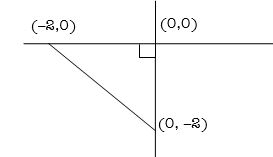
The circumcentre of a triangle formed by the line $xy + 2x + 2y + 4 = 0$ and $x + y + 2 = 0$ is
- ✓
$(-1, -1)$
- B
$(0, -1)$
- C
$(1, 1)$
- D
$(-1, 0)$
AnswerCorrect option: A. $(-1, -1)$
a
(a) $xy + 2x + 2y + 4 = 0$....$.(i)$
and $x + y + 2 = 0$.....$.(ii)$
from $(i)$ and $(ii)$, $xy = 0 \Rightarrow x = y = 0$
Vertices of triangle are $( - 2,0)\,\,(0,0)\,\,(0, - 2)$
(In a right angled triangle circumcentre is mid point of hypotenuse)
$( - 1, - 1)$ is the circumcircle.
View full question & answer→MCQ 191 Mark
If equation of three sides of a triangle are $x = 2,$ $y + 1 = 0$ and $x + 2y = 4$ then co-ordinates of circumcentre of this triangle are
- ✓
$(4, 0)$
- B
$(2, -1)$
- C
$(0, 4)$
- D
$ (-1, 2)$
AnswerCorrect option: A. $(4, 0)$
a
(a) Equations of three sides of a triangle are $x = 2,\,\,y + 1 = 0$and $x + 2y = 4$
Co-ordinates of point of intersection of the $x = 2$ and $y + 1 = 0$ is $(2, -1)$
Co-ordinates of point of intersection of $x = 2$ and $x + 2y = 4$ is $(2, 1)$
Co-ordinates of point of intersection of $y + 1 = 0$ and $x + 2y = 4$ is $(6, -1)$
Let Co-ordinates of circumcentre is $(x, y)$
${(x - 2)^2} + {(y + 1)^2} = {(x - 2)^2} + {(y - 1)^2}$
${(y + 1)^2} = {(y - 1)^2}$; ${y^2} + 2y + 1 = {y^2} - 2y + 1$
$4y = 0$, $y = 0$ and ${(x - 2)^2} + {(y - 1)^2} = {(x - 6)^2} + {(y + 1)^2}$
In this equation put $y = 0$
${(x - 2)^2} + {(0 - 1)^2} = {(x - 6)^2} + {(0 + 1)^2}$
${(x - 2)^2} + 1 = {(x - 6)^2} + 1$; ${(x - 2)^2} - {(x - 6)^2} = 0$
$(x - 2 + x - 6)(x - 2 - x + 6) = 0$
$4(2x - 8) = 0$==> $8(x - 4) = 0$; $x - 4 = 0$ ==> $x = 4$
Co-ordinates of circumcentre is $(4, 0)$.
View full question & answer→MCQ 201 Mark
The orthocentre of the triangle formed by $(0, 0),\, (8, 0), \,(4 6)$ is
AnswerCorrect option: A. $\left( {4,\,\frac{8}{3}} \right)$
a
(a) Let the vertices of the triangle be $O(0, 0)$ $A(8,0),$ $B(4,6)$. The equation of an altitude through $O$ and perpendicular to $AB$ is $y = \frac{2}{3}x$ and the equation of an altitude through $A(8,0)$ and perpendicular to $OB$ is $3y = - 2x + 16$. The two altitudes intersect at $\left( {4,\frac{8}{3}} \right)$.
View full question & answer→MCQ 211 Mark
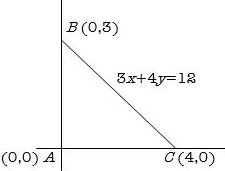
The incentre of triangle formed by the lines $x = 0,$ $y = 0$ and $3x + 4y = 12$ is
- A
$\left( {\frac{1}{2},\,\frac{1}{2}} \right)$
- ✓
$(1, 1)$
- C
$\left( {1,\,\frac{1}{2}} \right)$
- D
$\left( {\frac{{11}}{2},\,1} \right)$
AnswerCorrect option: B. $(1, 1)$
b
(b)Here $a = BC = 5,\,\,b = AC = 4,\,\,\,c = AB = 3$
Hence incentre is $\left( {\frac{{0 + 0 + 3 \times 4}}{{5 + 4 + 3}},\frac{{0 + 4 \times 3 + 0}}{{5 + 4 + 3}}} \right)$= $(1, 1)$.
View full question & answer→MCQ 221 Mark
Coordinates of the orthocentre of the triangle whose sides are $x = 3,\,y = 4$ and $3x + 4y = 6$ is
- A
$(0, 0)$
- B
$(3, 0)$
- C
$(0, 4)$
- ✓
$(3, 4)$
AnswerCorrect option: D. $(3, 4)$
d
(d) Obviously it is a right angled at $(3, 4)$. Hence the orthocentre is $(3, 4)$
View full question & answer→MCQ 231 Mark
If the vertices of a triangle be $(0,0)$, $(6,0)$ and $(6,8)$ then its incentre will be
- A
$(2,1)$
- B
$(1,2)$
- ✓
$(4,2)$
- D
$(2,4)$
AnswerCorrect option: C. $(4,2)$
c
(c) Let $A\,(0,\,\,0),\,\,B\,(6,\,\,0)$ and $C\,(6,\,8)$
Thus $c = AB = 6,\,\,a = BC = 8$ and $b = AC = 10$
Hence incentre
$ = \left( {\frac{{8 \times 0 + 10 \times 6 + 6 \times 6}}{{8 + 10 + 6}},\,\frac{{8 \times 0 + 10 \times 0 + 6 \times 8}}{{8 + 10 + 6}}} \right) = (4,\,\,2)$.
View full question & answer→MCQ 241 Mark
Area of the triangle formed by points $(102,-4), (105,-2)$ and $(103,-3)$ -
Answerc
Shift origin at $(102,-4)$
View full question & answer→MCQ 251 Mark
Number of values of $\lambda$ for which the points given by $(\lambda + 1, 1), (2\lambda +1, 3)$ $ \&$ $(2\lambda + 2, 2\lambda )$ are collinear, is-
Answerc
$A(2+1,1) \quad B(2 \lambda+1,3) \quad c(2 \lambda+2$
ase said to be cerlineas if Area $(\Delta A B C)=0$
$=\frac{S}{2}\left|\begin{array}{lll}2 & y & 1 \\ x_{2} & y_{2} & 1 \\ x_{3} & y_{3} & 1\end{array}\right|=0$
$\therefore \quad\left|\begin{array}{lll}\lambda+1 & 1 & 1 \\ 2 \lambda+1 & 3 & 1 \\ 2 \lambda+2 & 2 \lambda & 1\end{array}\right|=0$
$\Rightarrow(\dot{x}+1)(3-2 \lambda)-1(82+1-2 \lambda-2)$
$+1\left(4 x^{2}+2 x-6 x-6\right)=0$
$\Rightarrow 3 \lambda+3-2\left(\lambda^{2}-2 \lambda+1+4 x^{2}-4 \lambda-6=0\right.$
$\Rightarrow 2 \lambda^{2}-3 \lambda-2=0$
$\Rightarrow 2 \lambda^{2}-4 \lambda+\lambda-2=0$
a) $2 x(x-2)+1(x-2)=0$
$\Rightarrow \lambda=-1 / 2$ or 2
" polsible values of
$\lambda \operatorname{are} 2$
View full question & answer→MCQ 261 Mark
The mid points of three sides of a triangle are $(1,2)$; $(-1,1)$ and $(0,3)$. Area of this triangle will be (in sq. units)$^-$
Answerd
Area $ = 4 \times \frac{1}{2}|\left| {\begin{array}{*{20}{c}}
1&2&1\\
{ - 1}&1&1\\
0&3&1
\end{array}} \right|| = 6$
View full question & answer→MCQ 271 Mark
Without changing the direction of coordinate axes, origin is transferred to $(h,k)$, so that the linear (one degree) terms in the equation ${x^2} + {y^2} - 4x + 6y - 7$=$0$ are eliminated. Then the point $(h,k)$ is
- A
$(3, 2)$
- B
$(-3,2)$
- ✓
$(2, -3)$
- D
AnswerCorrect option: C. $(2, -3)$
c
(c) Putting $x = x' + h,\,\,y = y' + k,$ the given equation transforms to
${x'^2} + {y'^2} + x'(2h - 4) + y'(2k + 6) + {h^2} + {k^2} - 7 = 0$
To eliminate linear terms, we should have
$2h - 4 = 0,\,\,2k + 6 = 0\,\,\, \Rightarrow \,\,h = 2,\,\,k = - 3$
i.e., $(h,\,\,k) = (2,\,\, - 3)$.
View full question & answer→MCQ 281 Mark
The equation of the locus of a point whose distance from $(a, 0)$ is equal to its distance from y-axis, is
AnswerCorrect option: B. ${y^2} - 2ax + {a^2} = 0$
b
(b) Let the point be $(h,\,\,k),\,$
So,${(h - a)^2} + {(k - 0)^2} = {h^2}$$ \Rightarrow \,\,\,{h^2} + {a^2} - 2ah + {k^2} = {h^2}$
Hence locus is ${y^2} - 2ax + {a^2} = 0$.
View full question & answer→MCQ 291 Mark
Two points $A$ and $B$ have coordinates $(1, 0)$ and $(-1, 0)$ respectively and $Q$ is a point which satisfies the relation $AQ - BQ = $ $ \pm 1.$The locus of $Q$ is
AnswerCorrect option: B. $12{x^2} - 4{y^2} = 3$
b
(b) According to the given condition
$\sqrt {{{(x - 1)}^2} + {y^2}} - \sqrt {{{(x + 1)}^2} + {y^2}} = \pm 1$
On squaring both sides, we get
$2{x^2} + 2{y^2} + 1 = 2\sqrt {{{(x - 1)}^2} + {y^2}} .\sqrt {{{(x + 1)}^2} + {y^2}} $
Again on squaring, we get $12{x^2} - 4{y^2} = 3$.
View full question & answer→MCQ 301 Mark
The equation to the locus of a point which moves so that its distance from $x$-axis is always one half its distance from the origin, is
- A
${x^2} + 3{y^2} = 0$
- ✓
${x^2} - 3{y^2} = 0$
- C
$3{x^2} + {y^2} = 0$
- D
$3{x^2} - {y^2} = 0$
AnswerCorrect option: B. ${x^2} - 3{y^2} = 0$
b
(b) Let the moving point be $(x, y)$ and its distance from x-axis is $y$. Therefore, according to given condition $\frac{1}{2}\sqrt {{x^2} + {y^2}} = y\,\,\, \Rightarrow \,\,{x^2} - 3{y^2} = 0$
This is required locus of the point $(x, y)$.
View full question & answer→MCQ 311 Mark
The coordinates of the point $A$ and $B$ are $(ak,0)$ and $\left( {\frac{a}{k},0} \right),\,\,(k = \pm 1)$. If a point $P$ moves so that $PA = kPB,$ then the equation to the locus of $P$ is
- A
${k^2}({x^2} + {y^2}) - {a^2} = 0$
- B
${x^2} + {y^2} - {k^2}{a^2} = 0$
- C
${x^2} + {y^2} + {a^2} = 0$
- ✓
${x^2} + {y^2} - {a^2} = 0$
AnswerCorrect option: D. ${x^2} + {y^2} - {a^2} = 0$
d
(d) ${(x - ak)^2} + {y^2} = {k^2}\,\left[ {{{\left( {x - \frac{a}{k}} \right)}^2} + {y^2}} \right]$
$ \Rightarrow \,\,(1 - {k^2})\,({x^2} + {y^2}) - 2akx + 2akx + {a^2}{k^2} - {a^2} = 0$
$ \Rightarrow \,\,{x^2} + {y^2} - {a^2} = 0$.
View full question & answer→MCQ 321 Mark
The position of a moving point in the $XY$ -plane at time $t$ is given by $\left( {(u\cos \alpha )t,(u\sin \alpha )t - \frac{1}{2}g{t^2}} \right),$ where $u,\,\alpha ,\,g$ are constants. The locus of the moving point is
Answerb
(b) Let $h = u\,\cos \,\alpha \,.\,t,\,\,k = u\,\sin \alpha \,.\,t - \frac{1}{2}g{t^2},$ then $t = \frac{h}{{u\,\cos \alpha }}$.
Putting the value of t in $k = u\,\sin \alpha \,.\,t - \frac{1}{2}g{t^2},$ we get $k = h\,\tan \alpha - \frac{1}{2}g\frac{{{h^2}}}{{{u^2}{{\cos }^2}\alpha }}$
$\therefore \,\,$Locus of (h, k) is $y = x\tan \alpha - \frac{1}{2}g\frac{{{x^2}}}{{{u^2}\,{{\cos }^2}\alpha }}$, which is a parabola.
View full question & answer→MCQ 331 Mark
If $A(\cos \alpha ,\sin \alpha ),\;B(\sin \alpha , - \cos \alpha ),\,C(1,{\rm{ }}2)$ are the vertices of a $\Delta ABC$, then as $\alpha $ varies, the locus of its centroid is
- A
${x^2} + {y^2} - 2x - 4y + 1 = 0$
- ✓
$3({x^2} + {y^2}) - 2x - 4y + 1 = 0$
- C
${x^2} + {y^2} - 2x - 4y + 3 = 0$
- D
AnswerCorrect option: B. $3({x^2} + {y^2}) - 2x - 4y + 1 = 0$
b
(b) Let $(h,\,\,k)$ be the centroid of the triangle, then
$h = \frac{{\cos \alpha + \sin \alpha + 1}}{3}$ and $k = \frac{{\sin \alpha - \cos \alpha + 2}}{3}$
$ \Rightarrow \,\,3h - 1 = \cos \alpha + \sin \alpha $ and $3k - 2 = \sin \alpha - \cos \alpha $
$ \Rightarrow \,\,{(3h - 1)^2} + {(3k - 2)^2} = 2$, (squaring and adding)
$ \Rightarrow \,9\,({h^2} + {k^2}) - 6h - 12k + 3 = 0$
$ \Rightarrow \,\,3\,({h^2} + {k^2}) - 2h - 4k + 1 = 0$
$\therefore $ Locus of $(h,\,\,k)$ is $3\,({x^2} + {y^2}) - 2x - 4y + 1 = 0$.
View full question & answer→MCQ 341 Mark
The locus of a point whose difference of distance from points $(3, 0)$ and $(-3,0)$ is $4$, is
- ✓
$\frac{{{x^2}}}{4} - \frac{{{y^2}}}{5} = 1$
- B
$\frac{{{x^2}}}{5} - \frac{{{y^2}}}{4} = 1$
- C
$\frac{{{x^2}}}{2} - \frac{{{y^2}}}{3} = 1$
- D
$\frac{{{x^2}}}{3} - \frac{{{y^2}}}{2} = 1$
AnswerCorrect option: A. $\frac{{{x^2}}}{4} - \frac{{{y^2}}}{5} = 1$
a
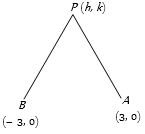
(a) Let the point be $P\,(h,\,\,k).$
Given that $PA - PB = 4$
$\sqrt {{{(h - 3)}^2} + {k^2}} - \sqrt {{{(h + 3)}^2} + {k^2}} = 4$
$ \Rightarrow \,\,\sqrt {{{(h - 3)}^2} + {k^2}} = 4 + \sqrt {{{(h + 3)}^2} + {k^2}} $
Squaring both sides, we get
${(h - 3)^2} + {k^2} = 16 + {(h + 3)^2} + {k^2} + 8\sqrt {{{(h + 3)}^2} + {k^2}} $
$ \Rightarrow \,\,\,{h^2} + 9 - 6h + {k^2} = 16 + {h^2} + 9 + 6h + {k^2}$
$ + \,8\sqrt {{{(h + 3)}^2} + {k^2}} $
$ \Rightarrow \,\, - 6h = 16 + 6h + 8\sqrt {{{(h + 3)}^2} + {k^2}} $
$ \Rightarrow \,\, - 8\,\sqrt {{{(h + 3)}^2} + {k^2}} = 12h + 16$
Again, squaring both sides, we get
$64\,({h^2} + 9 + 6h + {k^2}) = 144{h^2} + 256 + 2.16.12h$
$ \Rightarrow \,\,4\,({h^2} + 9 + 6h + {k^2}) = 9{h^2} + 16 + 24h$
$ \Rightarrow \,\,4{h^2} + 36 + 24h + 4{k^2} = 9{h^2} + 16 + 24h$
$ \Rightarrow \,\,5{h^2} - 4{k^2} = 20\,\, \Rightarrow \,\,\frac{{{h^2}}}{4} - \frac{{{k^2}}}{5} = 1$
Hence, the locus of point $P$ is $\frac{{{x^2}}}{4} - \frac{{{y^2}}}{5} = 1$.
View full question & answer→MCQ 351 Mark
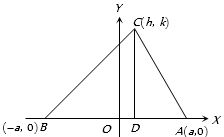
Two fixed points are $A(a,0)$ and $B( - a,0)$. If $\angle A - \angle B = \theta $, then the locus of point $C$ of triangle $ABC$ will be
- A
${x^2} + {y^2} + 2xy\tan \theta = {a^2}$
- B
${x^2} - {y^2} + 2xy\tan \theta = {a^2}$
- C
${x^2} + {y^2} + 2xy\cot \theta = {a^2}$
- ✓
${x^2} - {y^2} + 2xy\cot \theta = {a^2}$
AnswerCorrect option: D. ${x^2} - {y^2} + 2xy\cot \theta = {a^2}$
d
(d) Given $\angle A - \angle B = \theta $ $ \Rightarrow \,\,\tan \,(A - B) = \tan \theta $ .....$(i)$
In right angled triangle $CDA,\,\,\,\tan A = \frac{k}{{a - h}}$
and similarly in triangle $CDB,\,\,\tan B = \frac{k}{{a + h}}$
Also from $(i)$, $\frac{{\tan A - \tan B}}{{1 + \tan A\,.\,\tan B}} = \tan \theta $
Substituting the values of $\tan A$ and $\tan B,$ we get
${h^2} - {k^2} + 2hk\cot \theta = {a^2}$
Hence the locus is ${x^2} - {y^2} + 2xy\cot \theta = {a^2}$.
View full question & answer→MCQ 361 Mark
The co-ordinates axes are rotated through an angle $135^o$. If the coordinates of a point $P$ in the new system are known to be $(4, -3)$, then the coordinates of $P$ in the original system are
- A
$\left( {\frac{1}{{\sqrt 2 }},\frac{7}{{\sqrt 2 }}} \right)$
- B
$\left( {\frac{1}{{\sqrt 2 }},\frac{{ - 7}}{{\sqrt 2 }}} \right)$
- C
$\left( {\frac{{ - 1}}{{\sqrt 2 }},\frac{{ - 7}}{{\sqrt 2 }}} \right)$
- ✓
$\left( {\frac{{ - 1}}{{\sqrt 2 }},\frac{7}{{\sqrt 2 }}} \right)$
AnswerCorrect option: D. $\left( {\frac{{ - 1}}{{\sqrt 2 }},\frac{7}{{\sqrt 2 }}} \right)$
d
(d) $P = (x\cos \theta - y\sin \theta ,\,x\sin \theta + y\cos \theta )$
$ = \left( {4.\frac{{ - 1}}{{\sqrt 2 }} + 3.\frac{1}{{\sqrt 2 }},\,4.\frac{1}{{\sqrt 2 }} + 3.\frac{1}{{\sqrt 2 }}} \right) = \left( {\frac{{ - 1}}{{\sqrt 2 }},\,\frac{7}{{\sqrt 2 }}} \right)$
View full question & answer→MCQ 371 Mark
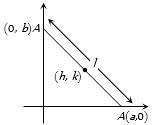
A stick of length l rests against the floor and a wall of a room. If the stick begins to slide on the floor, then the locus of its middle point is
Answerb
(b) Let middle point of stick $AB$ is $(h, k)$ therefore
$\left( {\frac{{a + 0}}{2},\,\frac{{0 + b}}{2}} \right)\, \equiv \,(h,\,\,k)\,\, \Rightarrow \,\,h = \frac{a}{2},\,\,k = \frac{b}{2}$
$ \Rightarrow \,\,a = 2h,\,\,b = 2k$
But we know from figure that
${a^2} + {b^2} = {l^2}\,\, \Rightarrow \,\,4{h^2} + 4{k^2} = {l^2}$
Hence the locus is ${x^2} + {y^2} = \frac{{{l^2}}}{4}$
which is obviously a circle.
View full question & answer→MCQ 381 Mark
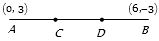
The point of trisection of the line joining the points $(0, 3) $ and $(6, -3)$ are
- A
$(2,\,0)$ and $(4,\, - 1)$
- B
$(2,\, - 1)$ and $(4,1)$
- C
$(3,1)$ and $(4, - 1)$
- ✓
$(2,1)$ and $(4, - 1)$
AnswerCorrect option: D. $(2,1)$ and $(4, - 1)$
d
(d) $C\,\left( {\frac{{6 + 0}}{3},\,\,\frac{{ - 3 + 6}}{3}} \right) \equiv (2,\,\,1)$
$D\,\left( {\frac{{2 \times 6 + 0}}{3},\,\frac{{ - 6 + 3}}{3}} \right)\, \equiv \,(4,\, - 1)$.
View full question & answer→MCQ 391 Mark
Area of the triangle with vertices $(a,b),\;({x_1},{y_1})$ and $({x_2},{y_2})$, where $a,\;{x_1}$ and ${x_2}$ are in $G.P.$ with common ratio r and b, ${y_1}$ and ${y_2}$ are in $G.P.$ with common ratio $s$, is given by
- A
$ab(r - 1)(s - 1)(s - r)$
- B
$\frac{1}{2}ab(r + 1)(s + 1)(s - r)$
- ✓
$\frac{1}{2}ab(r - 1)(s - 1)(s - r)$
- D
$ab(r + 1)(s + 1)(r - s)$
AnswerCorrect option: C. $\frac{1}{2}ab(r - 1)(s - 1)(s - r)$
c
(c) We have ${x_1} = ar,\,\,{x_2} = a{r^2},\,\,{y_1} = bs,\,\,{y_2} = b{s^2}$
The area of the triangle is given by
$\Delta = \frac{1}{2}\,\left| {\,\begin{array}{*{20}{c}}a&b&1\\{{x_1}}&{{y_1}}&1\\{{x_2}}&{{y_2}}&1\end{array}\,} \right| = \frac{1}{2}\,\left| {\,\begin{array}{*{20}{c}}a&b&1\\{ar}&{bs}&1\\{a{r^2}}&{b{s^2}}&1\end{array}\,} \right|$
$ = \frac{1}{2}ab\,\left| {\,\begin{array}{*{20}{c}}1&1&1\\r&s&1\\{{r^2}}&{{s^2}}&1\end{array}\,} \right|$$ = \frac{1}{2}ab\,\left| {\,\begin{array}{*{20}{c}}1&1&1\\{r - 1}&{s - 1}&0\\{{r^2} - 1}&{{s^2} - 1}&0\end{array}\,} \right|$
(Applying ${R_2} - {R_1},\,\,{R_3} - {R_1})$
$ = \frac{1}{2}ab\,(r - 1)\,(s - 1)\,(s - r)$.
View full question & answer→MCQ 401 Mark
Suppose $A B C D(A B \| C D)$ is a trapezium such that the diagonals $AC , BD$ bisect the angles $\angle DAB , \angle CBA$, respectively. Then
- A
no two side of the trapezium are equal
- B
exactly two sides of the trapezium are equal
- ✓
exactly three sides of the trapezium are equal
- D
none of the options above can be concluded
AnswerCorrect option: C. exactly three sides of the trapezium are equal
c
(c)
$AC$ is bisector of $\angle DAB$
$\therefore \angle DAC =\angle CAB$
and $DC \| AB$
$\therefore \angle CAB =\angle ACD \quad \ldots(2)$
$\therefore \angle DAC =\angle ACD$
Hence $AD = DC$
similarly $BC = DC$
Hence Exactly three sides are equal.

View full question & answer→MCQ 411 Mark
Let $A B C D$ be a convex quadrilateral in which $AC = BD . \quad AB = CD , \quad \angle BAC =70^{\circ}$ and $\angle BCD =60^{\circ}$. The acute angle between $AC$ and $BD$ is
- A
$70^{\circ}$
- B
$75^{\circ}$
- ✓
$80^{\circ}$
- D
$85^{\circ}$
AnswerCorrect option: C. $80^{\circ}$
c
(c)
In $\triangle ABC$ and $\triangle DCB$
$AB = DC$
$BC = CB$
$AC = DB$
$\triangle ABC \cong \triangle DCB$
$\therefore \angle BAC =\angle CDB =70^{\circ}$
$\angle ABC =\angle DCB =60^{\circ}$
$\angle ACB =180^{\circ}-\angle BAC -\angle ABC$
$=180^{\circ}-70^{\circ}-60^{\circ}$
$=50^{\circ}$
$\angle DCO =60^{\circ}-\angle ACB$
$=60^{\circ}-50^{\circ}=10^{\circ}$
$\angle DOC =180^{\circ}-70^{\circ}-10^{\circ}=100^{\circ}$
Acute angle $\angle DOC =80^{\circ}$

View full question & answer→MCQ 421 Mark
Suppose $A B C$ is triangle and $D, E$ are points on the sides $AB$ and $AC$ respectively. If $AD : AB =3: 5$ and $AE : AC =2: 3$, then the ratio of the areas of the triangles $ABC$ and $ADE$ lies in the interval.
- A
$(1,2]$
- ✓
$\left(2, \frac{5}{2}\right]$
- C
$\left(\frac{5}{2}, 3\right]$
- D
$\left(3, \frac{7}{2}\right]$
AnswerCorrect option: B. $\left(2, \frac{5}{2}\right]$
b
(b)
$\frac{\operatorname{ar} \triangle ABC }{\operatorname{ar} \triangle ADE }=\frac{\frac{1}{2} \cdot AB \cdot AC \sin \theta}{\frac{1}{2} \cdot AD \cdot AE \sin \theta}$
$=\frac{ AB }{ AD } \times \frac{ AC }{ AE }$
$=\frac{5}{3} \times \frac{3}{2}=\frac{5}{2}$
correct option is $\frac{5}{2}$

View full question & answer→MCQ 431 Mark
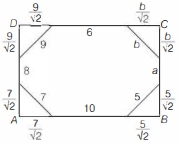
Six consecutive sides of an equiangular octagon are $6$ , $9,8,7,10,5$ in that order. The integer nearest to the sum of the remaining two sides is
Answerb
(b)
Let the remaining two sides be $a$ and $b$, then
.Since, $A B C D$ is a rectangle, then
$\frac{9}{\sqrt{2}}+6+\frac{b}{\sqrt{2}}=\frac{7}{\sqrt{2}}+10+\frac{5}{\sqrt{2}}$
$\quad \frac{b}{\sqrt{2}}=4+\frac{3}{\sqrt{2}}$
$\text { Similarly, } \frac{9}{\sqrt{2}}+8+\frac{7}{\sqrt{2}}=\frac{b}{\frac{\sqrt{2}}{}}+a+\frac{5}{\sqrt{2}}$
$\quad a=4+\frac{8}{\sqrt{2}}$
$\therefore \quad a+b=7+8 \sqrt{2}=18.3$
View full question & answer→MCQ 441 Mark
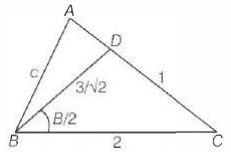
In a $\triangle A B C$, the angle bisector $B D$ of $\angle B$ intersects $A C$ in $D$. Suppose $B C=2, C D=1$ and $B D=\frac{3}{\sqrt{2}}$. The perimeter of the $\triangle A B C$ is
- A
$\frac{17}{2}$
- ✓
$\frac{15}{2}$
- C
$\frac{17}{4}$
- D
$\frac{15}{4}$
AnswerCorrect option: B. $\frac{15}{2}$
b
(b)
We have, $\cos \frac{B}{2}=\frac{\frac{9}{2}+4-1}{6 \sqrt{2}}=\frac{5}{4 \sqrt{2}}$
$\therefore$ Length of angle bisector,
$B D=\frac{2 a c}{a+c} \cos \frac{B}{2}$
$\frac{3}{\sqrt{2}} =\left(\frac{4 c}{e+2}\right) \cdot \frac{5}{4 \sqrt{2}}$
$c =3$
We know that, $\frac{A B}{B C}=\frac{A D}{C D}$
$A D=\frac{3}{2}$
$\therefore$ Perimeter of $\triangle A B C=1+\frac{3}{2}+3+2=\frac{15}{2}$
View full question & answer→MCQ 451 Mark
Let $a=B C, b=C A, c=A B$ be the side lengths of a $\triangle A B C$ and $m$ be the length of the median through $A$. If $a=8, b-c=2, m =6$, then the nearest integer to $b$ is
Answerb
(b)
If in a $\triangle A B C, A D$ is median, then by Apollonius Theorem
$A B^2+A C^2=2\left(A D^2+B D^2\right)$
Here, by using Apollonius theorem, we get
$x^2+(x-2)^2=2\left[6^2+4^2\right]$
$2 x^2-4 x+4=104$
$x^2-2 x-50=0 \Rightarrow x=1+\sqrt{51}$
The nearest integer to $b$ is $8$ .

View full question & answer→MCQ 461 Mark
Among all the parallelograms whose diagonals are $10$ and $4$,the one having maximum area has its perimeter lying in the interval
- A
$(19,20]$
- B
$(20,21]$
- ✓
$(21,22]$
- D
$(22,23]$
AnswerCorrect option: C. $(21,22]$
c
(c)
Area of parallelogram whose diagonals are 10 and 4 and if angle between adjacent side is $\theta$ is
$A=\frac{10 \times 4}{\sin \theta}$
The area will be maximum if $\theta=\frac{\pi}{2}$, so the parallelogram must be rhombus
Perimeter of rhombus
$=4 \sqrt{2} \overline{9}=\sqrt{46} \overline{4} \text { and } \sqrt{46} \overline{4} \in(21,22]$
View full question & answer→MCQ 471 Mark
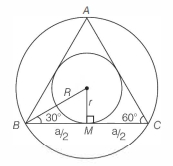
Let $A B C$ be an equilateral triangle with side length $a$. Let $R$ and $r$ denote the radii of the circumcircle and the incircle of triangle $A B C$ respectively. Then, as a function of $a$, the ratio $\frac{R}{r}$
Answerc
(c)
For an equilateral triangle $A B C$ having side length $a$. If $R$ and $r$ are radii of the circumcircle and the incircle of triangle $A B C$ respectively, then
$R=\frac{a}{2} \sec 30^{\circ}=\frac{a}{2}\left(\frac{2}{\sqrt{3}}\right)=\frac{a}{\sqrt{3}}$
and $r=\frac{a}{2} \tan 30^{\circ}=\frac{a}{2} \times \frac{1}{\sqrt{3}}=\frac{a}{2 \sqrt{3}}$
$\therefore \frac{R}{r}=\frac{\frac{a}{\sqrt{3}}}{\frac{a}{2 \sqrt{3}}}=2$, which is independent of $a$ and it is constant.
View full question & answer→MCQ 481 Mark
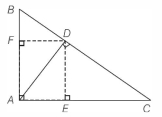
In a triangle $A B C, \angle B A C=90^{\circ} ; A D$ is the altitude from $A$ on to $B C$. Draw $D E$ perpendicular to $A C$ and $D F$ perpendicular to $A B$. Suppose $A B=15$ and $B C=25$. Then the length of $E F$ is
- ✓
$12$
- B
$10$
- C
$5 \sqrt{3}$
- D
$5 \sqrt{5}$
Answera
(a)
It is given that in triangle $A B C$, $\angle B A C=90^{\circ}, A D$ is the altitude from $A$ on to $B C$.
Since, $A B=15$ and $B C=25$
$\therefore \quad A C=\sqrt{B C^2-A B^2}=\sqrt{625-225}$
$=\sqrt{400}=20$
Now, since area of $\triangle A B C=\frac{1}{2}(B C)(A D)$
$=\frac{1}{2}(A B)(A C)$
$\Rightarrow \frac{1}{2}(B C)(A D)=\frac{1}{2} \times 15 \times 20$
$\Rightarrow \quad 25 \times A D=300$
$\Rightarrow \quad A D=12$
$\because A E D F$ is a rectangle, then
$E F=A D=12$
View full question & answer→MCQ 491 Mark
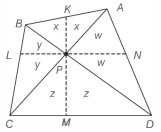
Let $P$ be an interior point of a convex quadrilateral $A B C D$ and $K, L, M, N$ be the mid-points of $A B, B C$, $C D, D A$ respectively. If Area $(P K A N)=25$, Area $(P L B K)=36$, and Area $(P M D N)=41$ then Area $(P L C M)$ is
Answerc
(c)
Let a convex quadrilateral $A B C D$ and $K, L, M, N$ be the mid-point of $A B$, $B C, C D, D A$ respectively.
Now, as area $\Delta A K P=$ area $\Delta B K P=x$ (let) Similarly
$\triangle B L P =\Delta C L P=y$
$\Delta C P M =\triangle D P M=z$
And $\Delta D N P =\triangle A N P=w$
It is given that Area $(P K A N)=x+w=25$ area $(P L B K)=x+y=36$
and area $(P M D N)=z+w=41$
So $\operatorname{area}(P L C M)=y+z$
$=(x+y)+(z+w)-(x+w)$
$=\operatorname{area}(P L B K)+$ area $(P M D N)-$ area $(P K A N)$
$=36+41-25=77-25=52$
View full question & answer→MCQ 501 Mark
Let $l > 0$ be a real number, $C$ denote a circle with circumference $l$ and $T$ denote a triangle with perimeter $l$. Then
- ✓
given any positive real number $\alpha$, we can choose $C$ and
- B
given any positive real number $\alpha$, we can choose $C$ and $T$ as above such that ratio $\frac{\operatorname{Area}(C)}{\operatorname{Area}(T)}$ is less than $\alpha$
- C
give any $C$ and $T$ as above, the ratio $\frac{\text { Area }(C)}{\text { Area }(T)}$ is independent of $C$ and $T$
- D
there exist real numbers $a$ and $b$ such that for any circle $C$ and triangle $T$ as above, we must have $a < \frac{\text { Area }(C)}{\text { Area }(T)} < b$
AnswerCorrect option: A. given any positive real number $\alpha$, we can choose $C$ and
a
(a)
It is given that circumference of circle $C$ is $l$ and the perimeter of triangle $T$ is $l$.
Now, let the radius of circle $C$ is $r$, so
$2 \pi r=l \Rightarrow r=\frac{l}{2 \pi}$
$\therefore$ area of circle $C$ is $A_1=\pi r^2=\frac{l^2}{4 \pi}$
Now, as we know that area of triangle will be maximum for given perimeter if it is an equilateral triangle, let the length of side of equilateral triangle is ' $a$ ', then
$3 a=l \Rightarrow a=\frac{l}{3}$
and area of equilateral triangle is
$A_2=\frac{\sqrt{3}}{4} a^2$
So, $A_2=\frac{\sqrt{3}}{4}\left(\frac{l^2}{9}\right)=\frac{l^2}{12 \sqrt{3}}$
Since, as we took an equilateral triangle, which has maximum area. But we can take a triangle $T$ such that the ratio area $(C)$ is greater than any positive real area $(T)$ number $\alpha$.
View full question & answer→