Question 15 Marks
Two identical ball bearings in contact with each other and resting on a frictionless table are hit head-on by another ball bearing of the same mass moving initially with a speed V. If the collision is elastic, which of the following is a possible result after collision?
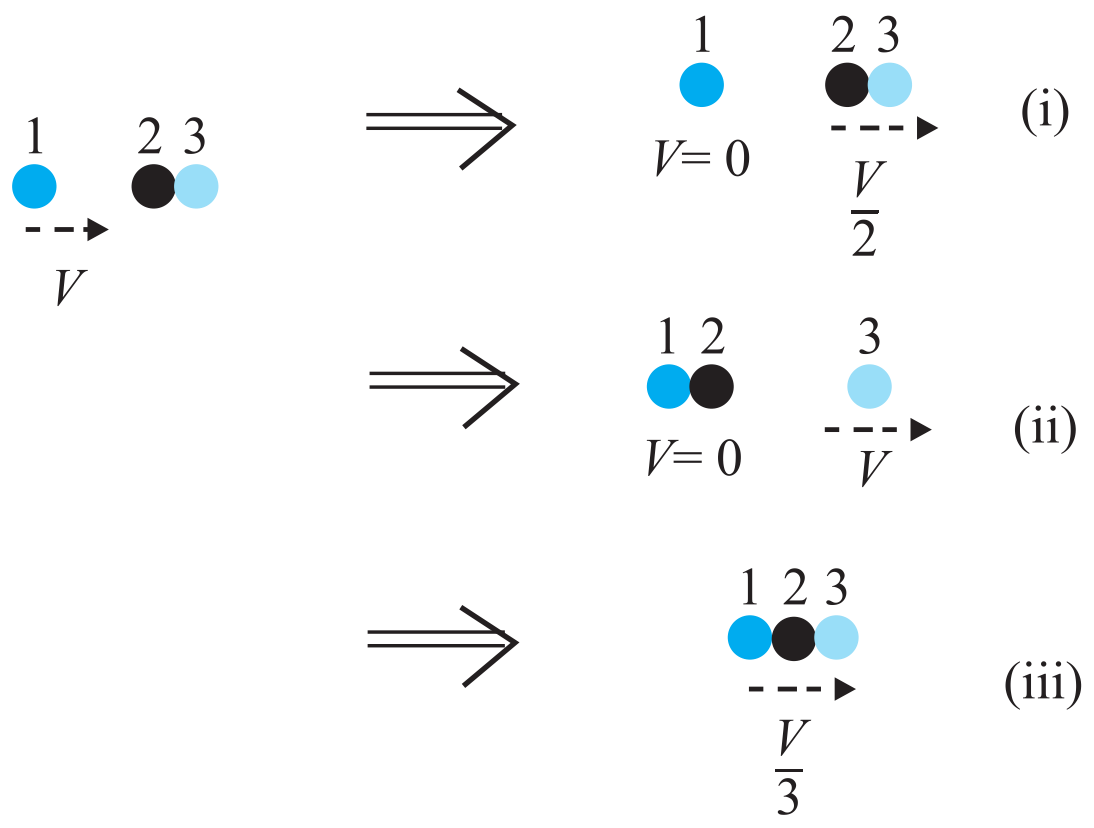
AnswerSuppose, m = mass of each ball bearing Before collision, total K.E. of the system $=\frac{1}{2}\text{mv}^2+0=\frac{1}{2}\text{mv}^2\ ....(1)$ After collision, K.E. of the system is given by Case (i): $\text{E}_1=\frac{1}{2}2\text{m}\Big(\frac{\text{V}}{2}\Big)^2=\frac{1}{4}\text{mv}^2\ ....(2)$ Case (ii): $\text{E}_2=\frac{1}{2}\text{mv}^2\ ...(3)$ Case (iii): $\text{E}_3=\frac{1}{2}(3\text{m})\Big(\frac{\text{v}}{3}\Big)^2=\frac{1}{6}\text{mv}^2\ ....(4)$ Hence form above equations, we see that the k.E. is conserved in case (ii), so, case (ii) is the only possible result after collision.
View full question & answer→Question 25 Marks
A person trying to lose weight (dieter) lifts a $10kg$ mass, one thousand times, to a height of $0.5m$ each time. Assume that the potential energy lost each time she lowers the mass is dissipated.
- How much work does she do against the gravitational force?
- Fat supplies $3.8 \times 107J$ of energy per kilogram which is converted to mechanical energy with a $20\%$ efficiency rate. How much fat will the dieter use up?
AnswerMass of the weight, m = 10kg Height to which the person lifts the weight, h = 0.5m Number of times the weight is lifted, n = 1000 Work done against gravitational force, = n(mgh) = 1000 × 10 × 9.8 × 0.5 = 49kJ Energy equivalent of 1kg of fat $= 3.8 \times 10^7J$ Efficiency rate = 20% Mechanical energy supplied by the person’s body, $=\frac{20}{100} × 3.8 × 10⁷\text{J}$
$=\frac{1}{5} × 3.8 × 10⁷\text{J}$ Equivalent mass of fat lost by the dieter, $=\Bigg[\frac{1}{\frac{1}{5}}× 3.8 × 10^7\Bigg]× 49 × 10^3$ $=\frac{245}{3.8}×10-4 = 6.45 × 10^{-3}\text{kg}$
View full question & answer→Question 35 Marks
Answer the following: In the man walks $2m$ carrying a mass of $15kg$ on his hands. In he walks the same distance pulling the rope behind him. The rope goes over a pulley, and a mass of $15kg$ hangs at its other end. In which case is the work done greater?
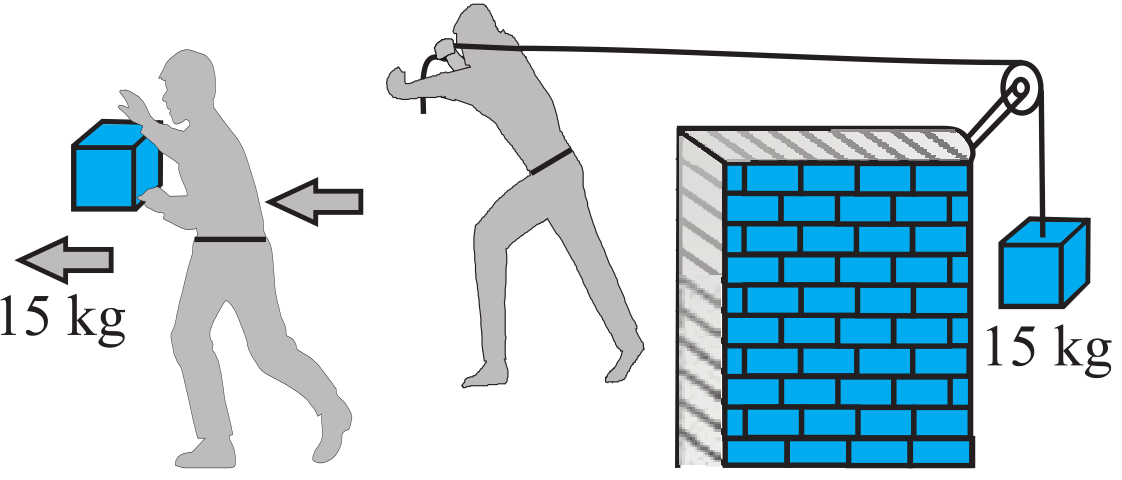
AnswerThe man carries the mass of 15 kg on his hands and walks 2 m . In this case, he is actually doing work against the friction force. Friction force contribution by mass $\mathrm{f}=\mu \mathrm{N}=\mu \mathrm{mg} \times 15 \times 9.8 \mathrm{~N}$ and work done against friction $\mathrm{W}_1=\mathrm{f}_{\mathrm{s}}=\mu \times 15 \times 9.8 \times 2=294 \mu \mathrm{~J}$ The tension in string, $\mathrm{T}=\mathrm{mg}=15 \times 9.8 \mathrm{~N}$ Hence, force applied by man for pulling the rope $\mathrm{F}=\mathrm{T}=15 \times 9.8 \mathrm{~N} \therefore$ Work done by man, $\mathrm{W}_2=\mathrm{F}_{\mathrm{S}}=15 \times 9.8 \times 2=294 \mathrm{~J}$ and additional work has to be done against friction also. Thus, it is clear that $W_2>W_1$
View full question & answer→Question 45 Marks
A pump on the ground floor of a building can pump up water to fill a tank of volume $30m^3$ in $15min$. If the tank is $40m$ above the ground, and the efficiency of the pump is $30\%$, how much electric power is consumed by the pump?
AnswerGiven, Volume of the tank, $V = 30m^3$ Time of operation, t = 15min = 15 × 60 = 900s Height of the tank, h = 40m Efficiency of the pump, $\eta= 30\%$ Density of water, $\rho= 103\text{kg/m}^3$ Mass of water, $\text{m} =\rho\text{V} = 30 × 10^3\text{kg}$ Output power can be obtained as, $\text{P}_0=\frac{\text{Work done}}{\text{Time}}=\frac{\text{mgh}}{\text{t}}$ $=30\times10^3\times9.8\times\frac{40}{900}$ $=13.067\times10^3\text{W}$ For input power $P_i$, efficiency $\eta,$ is given by the relation, $\eta=\frac{\text{P}_0}{\text{P}_{\text{i}}}=30\%$ $\text{P}_{\text{i}}=\frac{13.067\times100\times10^3}{30}$ $=0.436\times10^5\text{W}$ = 43.6kW, is the electric power consumed by the pump.
View full question & answer→Question 55 Marks
A family uses $8kW$ of power.
- Direct solar energy is incident on the horizontal surface at an average rate of $200W$ per square meter. If $20\%$ of this energy can be converted to useful electrical energy, how large an area is needed to supply $8kW$?
- Compare this area to that of the roof of a typical house.
Answer
- Power used by the family, $P = 8kW = 8 \times 10^3W$
Solar energy received per square metre = 200W
Efficiency of conversion from solar to electricity energy = 20%
Area required to generate the desired electricity = A
$(8 \times 10^3) = (20\%) \times (A \times 200)$
$=\Big(\frac{20}{100}\Big)\times\text{A}\times200$
Therefore $\text{A}=\Big(\frac{8\times10^3}{40}\Big)$
$=200\text{m}^2$
- The area of a solar plate required to generate 8kW of electricity is almost equivalent to the area of the roof of a building having dimensions 14m × 14m.
View full question & answer→Question 65 Marks
A bullet of mass 0.012 kg and horizontal speed $70 \mathrm{~ms}^{-1}$ strikes a block of wood of mass 0.4 kg and instantly comes to rest with respect to the block. The block is suspended from the ceiling by means of thin wires. Calculate the height to which the block rises. Also, estimate the amount of heat produced in the block.
AnswerMass of the bullet, $\mathrm{m}=0.012 \mathrm{~kg}$ Initial speed of the bullet, $\mathrm{u}_{\mathrm{b}}=70 \mathrm{~m} / \mathrm{s}$ Mass of the wooden block, $\mathrm{M}=0.4 \mathrm{~kg}$ Initial speed of the wooden block, $\mathrm{u}_{\mathrm{B}}=0$ Final speed of the system of the bullet and the block $=\mathrm{v}$ Applying the law of conservation of momentum, $\mathrm{mu}_{\mathrm{b}}+\mathrm{mu}_{\mathrm{B}}=(\mathrm{m}+\mathrm{M}) \mathrm{v} 0.012 \times 70+0.4 \times 0=(0.012+0.4) \mathrm{v} \therefore \mathrm{v}=\frac{0.84}{0.412}=2.04 \mathrm{~m} / \mathrm{s}$
For the system of the bullet and the wooden block: Mass of the system, $\mathrm{m}^{\prime}=0.412 \mathrm{~kg}$ Velocity of the system $=$ $2.04 \mathrm{~m} / \mathrm{s}$ Height up to which the system rises $=\mathrm{h}$ Applying the law of conservation of energy to this system: Potential energy at the highest point $=$ Kinetic energy at the lowest point $\mathrm{m}^{\prime} \mathrm{gh}=\frac{1}{2} \mathrm{~m}^{\prime} \mathrm{v}^2 \therefore \mathrm{~h}=\frac{1}{2} \mathrm{v}^2 / \mathrm{g}=\frac{1}{2}(2.04)^2 / 9.8$ $=0.2123 \mathrm{~m}$ The wooden block will rise to a height of 0.2123 m . Heat produced $=$ Kinetic energy of the bullet Kinetic energy of the system $\frac{1}{2} \mathrm{mu}^2-\frac{1}{2} \mathrm{~m}^{\prime} \mathrm{v}^2=29.4-0.857=28.54 \mathrm{~J}$
View full question & answer→Question 75 Marks
Given in are examples of some potential energy functions in one dimension. The total energy of the particle is indicated by a cross on the ordinate axis. In each case, specify the regions, if any, in which the particle cannot be found for the given energy. Also, indicate the minimum total energy the particle must have in each case. Think of simple physical contexts for which these potential energy shapes are relevan.
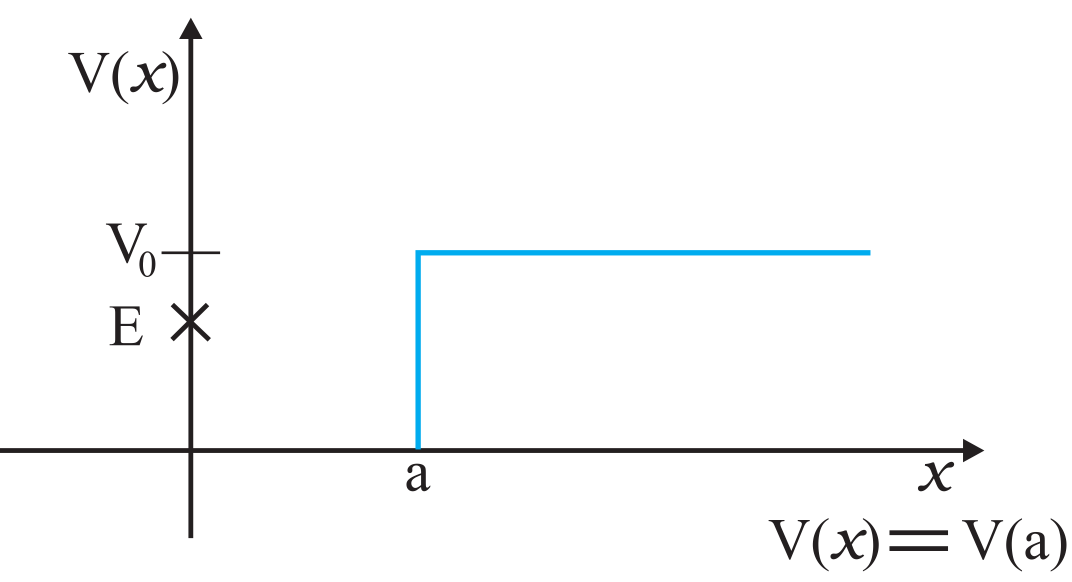
AnswerTotal energy of a system is given by the relation, $E = P.E. + K. E$. $\therefore K.E. = E - P.E$. Kinetic energy of a body is a positive quantity. It cannot be negative. Therefore, the particle will not exist in a region where K.E. becomes negative. For $x > a, P.E. (V_0) > E$ $\therefore$ K.E. becomes negative. Hence the object cannot be present in the region $x < a$ and $x > b. x > a$ and $x < b; -V_1$ In the given case, the condition regarding the positivity of K.E. is satisfied only in the region between $x > a$ and $x < b$. The minimum potential energy in this case is -$V_1$. Therfore, $K.E. = E - (-V_1) = E + V_1$.
Therefore, for the positivity of the kinetic energy, the total energy of the particle must be greater than $-V_1$. So, the minimum total energy the particle must have is $–V_1$. $\frac{\text{b}}{2}<\text{x}<\frac{\text{a}}{2} ; \frac{\text{a}}{2}<\text{x}<\frac{\text{b}}{2} ; -\text{V}_1$ In the given case, the potential energy (V_0) of the particle becomes greater than the total energy (E) for $\frac{\text{b}}{2} < \text{x} < \frac{\text{b}}{2 }$ and $-\frac{\text{a}}{2}< \text{x} < \frac{\text{a}}{2}.$ Therefore, the particle will not exist in these regions. The minimum potential energy in this case is $-V_1$. Therfore, $K.E. = E - (-V_1) = E +_{V1}$. Therefore, for the positivity of the kinetic energy, the totaol energy of the particle must be greater than $-V_1$. So, the minimum total energy the particle must have is $-V_1$.
View full question & answer→Question 85 Marks
Two inclined frictionless tracks, one gradual and the other steep meet at A from where two stones are allowed to slide down from rest, one on each track. Will the stones reach the bottom at the same time? Will they reach there with the same speed? Explain. Given $\theta_1= 300,\theta_2= 600 ,$ and h = 10m, what are the speeds and times taken by the two stones? 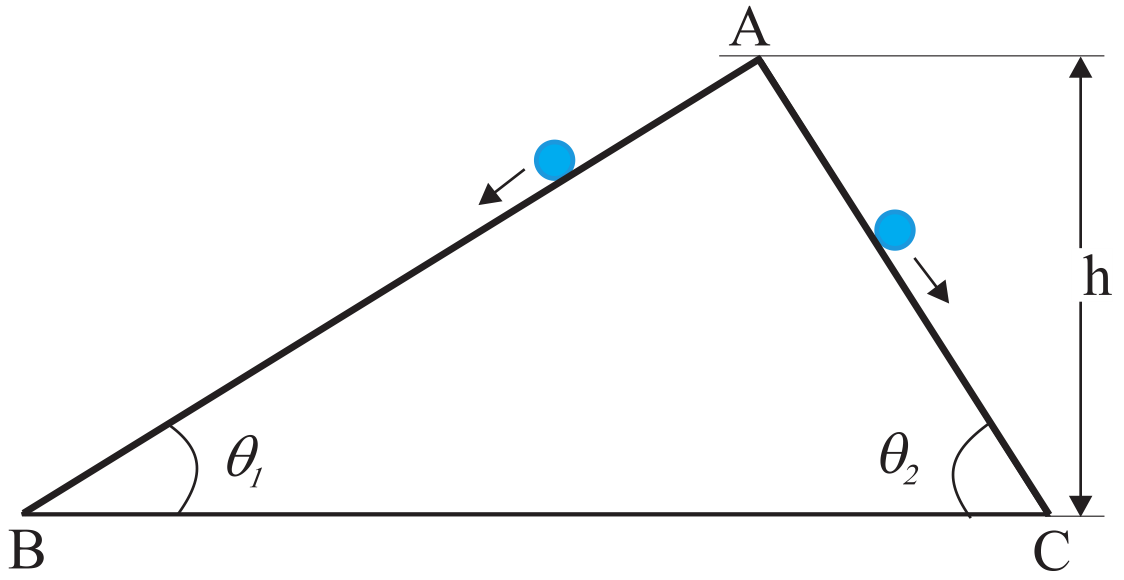
AnswerThe given situation can be shown as in the following figure: 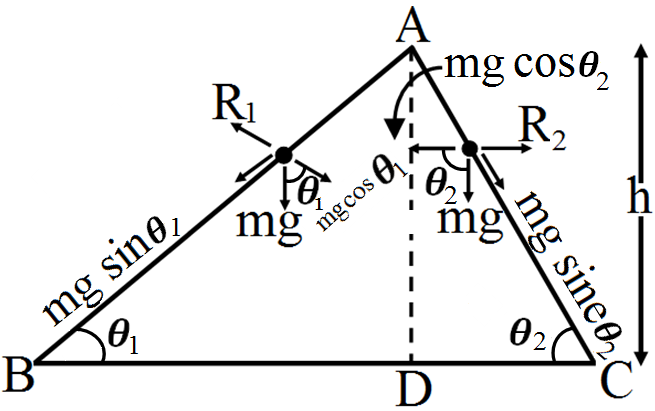 AB and AC are two smooth planes inclined to the horizontal at $\angle\theta_1 $ and $\angle\theta_2$ respectively. As height of both the planes is the same, therefore, noth the stones will reach the bottom with same speed. As P.E. at O = K.E. at A = K.E. at B $\therefore\text{ mgh} = \frac{1}{2}\text{mv}_1^2 =\frac{1}{2}\text{mv}^2_2$ $\therefore\text{v}_1=\text{v}_2$ As it is clear from fig. above, accleration of the two blocks are $\text{a}_1=\text{g}\sin\theta_1$ and $\text{a}_2=\text{g}\sin\theta_2$ As $\theta_2>\theta_1$ $\therefore\text{ a}_2>\text{a}_1$ From $\text{v}=\text{u}+\text{at}=0+\text{at}$ or, $\text{t}=\frac{\text{v}}{\text{a}}$ As $\text{t}\propto\frac{1}{\text{a}},$ and $\text{a}_2>\text{a}_1$ $\therefore\text{ t}_2<\text{t}_1$ i.e., Second stone will take lesser time and reach the bottom earlier than the first stone.
 View full question & answer→Question 95 Marks
A trolley of mass $200kg$ moves with a uniform speed of $36km/h$ on a frictionless track. A child of mass $20kg$ runs on the trolley from one end to the other ($10m$ away) with a speed of $4ms^{-1}$ relative to the trolley in a direction opposite to the its motion, and jumps out of the trolley. What is the final speed of the trolley? How much has the trolley moved from the time the child begins to run?
AnswerMass of the trolley, $M=200 \mathrm{~kg}$ Speed of the trolley, $v=36 \mathrm{~km} / \mathrm{h}=10 \mathrm{~m} / \mathrm{s}$ Mass of the boy, $\mathrm{m}=20 \mathrm{~kg}$ Initial momentum of the system of the boy and the trolley $=(M+m) v=(200+20) \times 10=2200 \mathrm{kgm} / \mathrm{s}$ Let $\mathrm{v}^{\prime}$ be the final velocity of the trolley with respect to the ground. Final velocity of the boy with respect to the ground $=\mathrm{v}^{\prime}-4$ Final momentum $=M v^{\prime}+m\left(v^{\prime}-4\right)=200 v^{\prime}+20 v^{\prime}-80=220 v^{\prime}-80$ As per the law of conservation of momentum, Initial momentum = Final momentum $2200=220 \mathrm{v}^{\prime}-80 \therefore \mathrm{v}^{\prime}=\frac{2280}{220}=10.36 \mathrm{~m} / \mathrm{s}$ Length of the trolley, $\mathrm{I}=10 \mathrm{~m}$ Speed of the boy, $\mathrm{v}^{\prime \prime}=4 \mathrm{~m} / \mathrm{s}$ Time taken by the boy to run, $\mathrm{t}=\frac{10}{4}=2.5 \mathrm{~s}$ Distance moved by the trolley $=\mathrm{v}^{\prime \prime} \times \mathrm{t}=10.36 \times$ $2.5=25.9 \mathrm{~m}$
View full question & answer→Question 105 Marks
An electron and a proton are detected in a cosmic ray experiment, the first with kinetic energy 10keV, and the second with 100keV. Which is faster, the electron or the proton? Obtain the ratio of their speeds. (electron mass = $9.11 \times 10^{-31}kg$, proton mass = $1.67 \times 10^{-27}kg, 1eV = 1.60 \times 10^{-19}J$).
AnswerElectron is faster, Ratio of speeds is $13.54: 1$ Mass of the electron, $m_e=9.11 \times 10^{-31} \mathrm{~kg}$ Mass of the proton, $m_p=1.67 \times 10^{-27} \mathrm{~kg}$ Kinetic energy of the electron, $\mathrm{E}_{\mathrm{Ke}}=10 \mathrm{keV}=10^4 \mathrm{eV}=10^4 \times 1.60 \times 10^{-19}=1.60 \times 10^{-15} \mathrm{~J}$ Kinetic energy of the proton, $\mathrm{E}_{\mathrm{Kp}}=$
$100 \mathrm{keV}=10^5 \mathrm{eV}=1.60 \times 10^{-14} \mathrm{~J}$ For the velocity of an electron $\mathrm{v}_{\mathrm{e}}$ its kinetic energy is given by the relation,
$\text{E}_{\text{ke}}=\frac{1}{2}\text{mv}^2_{\text{e}}$
$\therefore\ \text{v}_{\text{e}}=\sqrt{\frac{2\times\text{E}_{\text{ke}}}{\text{m}}}$
$=\sqrt{\frac{2\times1.60\times10^{-10}}{9.11\times10^{-31}}}$
$=5.93\times10^{7}\text{m/s}$ For the velocity of a proton $v_p$_ its kinetic energy is given by the relation, $\text{E}_{\text{kp}}=\frac{1}{2}\text{mv}^2_{\text{p}}$
$\text{v}_{\text{p}}=\sqrt{\frac{2\times\text{E}_{\text{kp}}}{\text{m}}}$
$\therefore\text{ v}_{\text{p}}=\sqrt{\frac{2\times1.6\times10^{-14}}{1.67\times10^{-27}}}$
$=4.38\times10^{6}\text{m/s}$ Hence, the electron is moving faster than the proton. The ratio of their speeds, $\frac{\text{v}_{\text{e}}}{\text{v}_{\text{p}}}=\frac{5.93\times10^7}{4.38\times10^6}=13.54:1$
View full question & answer→Question 115 Marks
A rain drop of radius $2mm$ falls from a height of $500m$ above the ground. It falls with decreasing acceleration (due to viscous resistance of the air) until at half its original height, it attains its maximum (terminal) speed, and moves with uniform speed thereafter. What is the work done by the gravitational force on the drop in the first and second half of its journey? What is the work done by the resistive force in the entire journey if its speed on reaching the ground is $10 m s^{-1}$?
AnswerRadius of the rain drop, $r = 2mm = 2 \times 10^{–3}m$ Volume of the rain drop, $\text{V}=\frac{4}{3}π\text{r}^3$ $= \frac{4}{3}×3.14 × (2 × 10-3)3\text{m}^{-3}$ Density of water, $\rho= 103 \text{kgm}^{-3 }$ Mass of the rain drop, $\text{m}=\rho\text{V}$ $=\frac{4}{3}×3.14 × (2 × 10^{-3})^3 × 10^3\text{kg}$ Gravitational force, F = mg $=\frac{4}{3}×3.14 × (2 × 10^{-3})^3 × 10^3\times9.8\text{N}$ The work done by the gravitational force on the drop in the first half of its journey, $W_I = Fs =\frac{4}{3}×3.14 × (2 × 10^{-3})^3 × 10^3\times9.8\times250=0.082\text{J}$ This amount of work is equal to the work done by the gravitational force on the drop in the second half of its journey, i.e., $W_{II} = 0.082 J$. As per the law of conservation of energy, if no resistive force is present, then the total energy of the rain drop will remain the same.
$\therefore$ Total energy at the top, $E_T = mgh + 0 =\frac{4}{3}×3.14 × (2 × 10^{-3})^3 × 10^3\times9.8\times500\times10^{-5}$ = 0.164J Due to the presence of a resistive force, the drop hits the ground with a velocity of 10m/s.
$\therefore$ Total energy at the ground, $\text{E}_{\text{G}} = \frac{1}{2}\text{mv}^2 + 0$ $=\frac{1}{2} × \frac{4}{3} × 3.14 × (2 × 10^{-3})^3 × 10^3 × 9.8 × (10)^2$
$= 1.675\times10-3\text{J}$
$\therefore$ Resistive force $= E_G– E_T = –0.162J$
View full question & answer→Question 125 Marks
The blades of a windmill sweep out a circle of area A.
- If the wind flows at a velocity v perpendicular to the circle, what is the mass of the air passing through it in time t?
- What is the kinetic energy of the air?
- Assume that the windmill converts $25\%$ of the wind’s energy into electrical energy, and that $A = 30 m^2, v = 36km/h$ and the density of air is $1.2kgm^{-3}$. What is the electrical power produced?
AnswerArea of the circle swept by the windmill = A Velocity of the wind = v Density of air $=\rho$ Volume of the wind flowing through the windmill per $\sec=\text{Av}$ Mass of the wind flowing through the windmill per $\sec=\rho\text{AV}$ Mass m, of the wind flowing through the windmill in time $\text{t}=\rho\text{Avt}$ Kinetic energy of air $=\Big(\frac{1}{2}\Big)\text{mv}^2$ $=\Big(\frac{1}{2}\Big)\big(\rho\text{Avt}\big)\text{v}^2=\Big(\frac{1}{2}\Big)\rho\text{Av}^3\text{t}$ Area of the circle swept by the windmill = $A = 30m^2$ Velocity of the wind = v = 36km/h Density of air, $\rho=1.2\text{kgm}^{-3}$ Electric energy produced = 25% of the wingnergy $=\Big(\frac{25}{100}\Big)\times\text{kinetic energy of air}$ $=\Big(\frac{1}{8}\Big)\rho\text{Av}^3\text{t}$ $=\Big(\frac{1}{8}\Big)\times1.2\times30\times(10)^3$ $=4.5\text{kW}$
View full question & answer→Question 135 Marks
The bob of a pendulum is released from a horizontal position. If the length of the pendulum is $1.5m$, what is the speed with which the bob arrives at the lowermost point, given that it dissipated $5\%$ of its initial energy against air resistance?
AnswerLength of the pendulum, l = 1.5m Mass of the bob = m Energy dissipated = 5% According to the law of conservation of energy, the total energy of The system remains constant. At the horizontal position: Potential energy of the bob, $E_P = mgl$ Kinetic energy of the bob, $E_K = 0$ Total energy = mgl …(i) At the lowermost point (mean position): Potential energy of the bob, $E_P = 0$ Kinetic energy of the bob, $\text{EK}= \frac{1}{2}\text{mv}^2$ Total energy $\text{E}_{\text{x}}=\Big(\frac{1}{2}\Big)\text{mv}^2\ ...(\text{ii})$ As the bob moves from the horizontal position to the lowermost point, 5% of its energy gets dissipated. The total energy at the lowermost point is equal to 95% of the total energy at the horizontal point, i.e. $\frac{1}{2}\text{mv}^2 =\frac{95}{100}\text{mgl}$
$\therefore\text{ v}=\Big(2 × 95 × 1.5 ×\frac{9.8 }{100}\Big)^{\frac{1}{2}}$ $= 5.28 \text{m/s}$
View full question & answer→Question 145 Marks
A billard ball A moving with an initial speed of $1ms^{-1}$ undergoes a perfectly elastic collision with another identical ball B at rest. A is scattered through an angle of $30°$. What is the angle of recoil of B? What is the speed of ball A after the collision?
AnswerMasses of the two balls are same and the collision is perfectly elastic $\therefore\theta+\phi=\frac{\pi}{2}$
$30^\circ+\phi=90^\circ$
$\therefore\phi=90^\circ-30^\circ=60^\circ$ Hence, the angle of recoil is $60^\circ$ Now according to the law of conservation of momentaum, for x-component, $\text{u}=\upsilon_1\cos30^\circ+\upsilon_2\cos60^\circ$
$1=\frac{\sqrt{3}}{2}\upsilon_1+\frac{1}{2}\upsilon_2$
$\therefore\sqrt{3}\upsilon_1+\upsilon_2=2$ For yromponent, $0=\upsilon_1\sin30^\circ-\upsilon_2\sin60^\circ$
$0=\frac{1}{2}\upsilon_1-\frac{\sqrt{3}}{2}\upsilon_2$
$\therefore\upsilon_1=\sqrt{3}\upsilon_2$
$\upsilon_2=\frac{\upsilon_1}{\sqrt{3}}$ Form eq. (i) and (ii) we get $\sqrt{3}\upsilon_1+\frac{\upsilon_1}{\sqrt{3}}=2$
$\frac{4}{\sqrt{3}}\upsilon_1=2$
$\therefore\upsilon_1=2\times\frac{\sqrt{3}}{4}=\frac{\sqrt{3}}{2}\text{ ms}^{-1}$ Hence the speed of A after the collision is $\frac{\sqrt{3}}{2}\text{ ms}^{-1}$.
View full question & answer→Question 155 Marks
Prove that the total mechanical energy remains constant for a ball of mass m dropped from a towe of height h.
AnswerAt A P.E. mgh K.E. = 0 Total energy = mgh 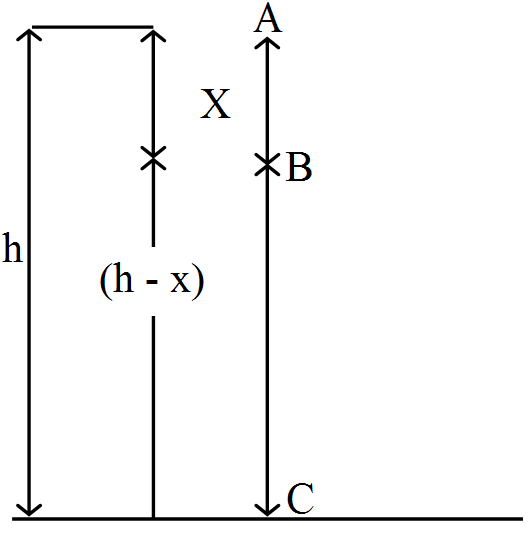 At B Velocity, $\text{v}=\sqrt{2\text{gh}}$ K.E. $=\frac{1}{2}\text{mv}^2=\frac{1}{2}\text{m.2gx}=\text{mgx}$ P.E. $=\text{mg}(\text{h}-\text{x})$ Total energy = mgh. At C Velocity, $\text{v}=\sqrt{2gh}$. K.E $=\frac{1}{2}\text{mv}^2=\frac{1}{2}\text{m.2gh}=\text{mgh}$ P.E. = 0 $\therefore$ total energy = mgh. Total mechanical energy is therefore mgh at all states as a body is dropped.
 View full question & answer→Question 165 Marks
A metre stick weighing 240g is pivoted at its upper end in such a way that it can freely rotate in a vertical plane through this end (figure). A particle of mass 100g is attached to the upper end of the stick through a light string of length 1m. Initially, the rod is kept vertical and the string horizontal when the system is released from rest. The particle collides with the lower end of the stick and sticks there. Find the maximum angle through which the stick will rise.
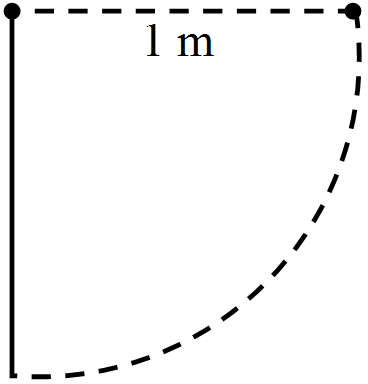
Answer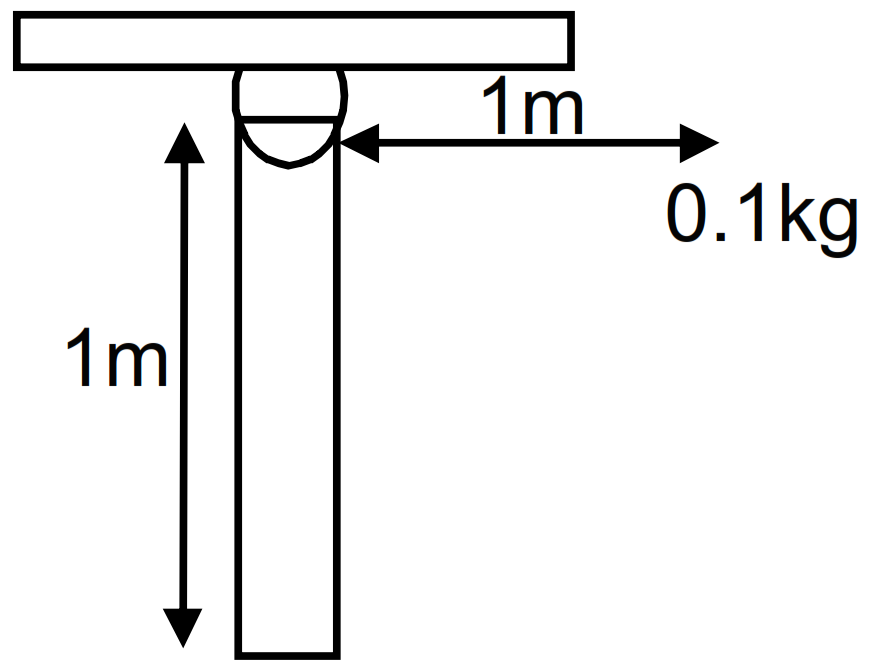 $\frac{1}{2}\text{l}\omega^2-0=0.1\times10\times1$ $\Rightarrow\omega=\sqrt{20}$ For collision $0.1\times1^2\times\sqrt{20}+0=\Big[\Big(\frac{0.24}{3}\Big)\times1^2+(0.1)^21^2\Big]\omega'$ $\Rightarrow\omega'=\frac{\sqrt{20}}{10.(0.18)}$ $\Rightarrow0-\frac{1}{2}\omega'^2=-\text{m}_1\text{gl}(1-\cos\theta)-\text{m}_2\text{g}\frac{\text{l}}2{}(1-\cos\theta)$ $=0.1\times10(1-\cos\theta)=0.24\times10\times0.5(1-\cos\theta)$ $\Rightarrow\frac{1}{2}\times0.18\times\Big(\frac{20}{3.24}\Big)=2.2(1-\cos\theta)$ $\Rightarrow(1-\cos\theta)=\frac{1}{(2.2\times1.8)}$ $\Rightarrow1-\cos\theta=0.252$ $\Rightarrow\cos\theta=1-0.252=0.748$ $\Rightarrow\omega=\cos^{-1}(0.748)=41^\circ$
 View full question & answer→Question 175 Marks
A 250g block slides on a rough horizontal table. Find the work done by the frictional force in bringing the block to rest if it is initially moving at a speed of 40cm/s. If the friction coefficient between the table and the block is 0.1, how far does the block move before coming to rest?
AnswerGiven, m = 250g = 0.250kg, u = 40cm/sec = 0.4m/sec $\mu=0.1,\ \text{v}=0$ Here, $\mu\text{R}=\text{ma}$ {where, a = deceleration} $\text{a}=\frac{\mu\text{R}}{\text{m}}=\frac{\mu\text{mg}}{\text{m}}=\mu\text{g}$ $=0.1\times9.8=0.98\text{m}/\text{sec}^2$ $\text{S}=\frac{\text{v}^2-\text{u}^2}{2\text{a}}$ $=0.082\text{m}=8.2\text{cm}$ Again, work done against friction is given by, $\text{w}=\mu\text{RS}\cos\theta$ $=0.1\times2.5\times0.082\times1(\theta=0^\circ)=0.02\text{J}$ $\Rightarrow\text{W}=-0.02\text{J}$
View full question & answer→Question 185 Marks
Prove that when a particle suffers an oblique elastic collision with another particle of equal mass and initially at rest, the two particles would move in mutually perpendicular directions after collisions.
AnswerLet a particle A of mass m and having velocity u collides with particle B of equal mass but at rest. Let the collision be oblique elastic collision and after collision the balls A and B move with velocities $v_1$ and $v_2$ respectively inclined at an angle $\theta$ from each other.
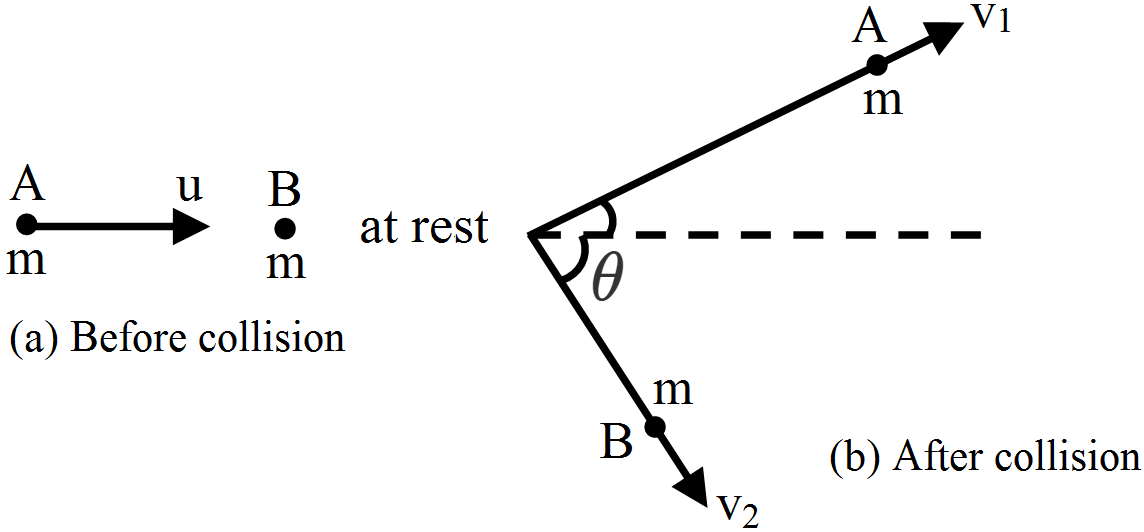
Applying principle of conservation of liner momentum, we get $mu = mv_1 + mv_2 u = v_1 + v_2$
$=\text{v}_1^2+\text{v}_2^2+2\text{v}_1\text{v}_2\cos\theta\cdots\text{(i)}$ Again as total KE before Collision = Total KE after collision
$\therefore\frac{1}{2}\text{mu}=\frac{1}{2}\text{mv}_1^2+\frac{1}{2}\text{mv}_2^2$
$\Rightarrow\text{u}^2=\text{v}_1^2+\text{v}_2^2\cdots\text{(ii)}$ Comparing Eqs.(i) and (ii) we get
$2\text{v}_1\text{v}_2\cos\theta=0$ as in oblique collision both $v_1$ and $v_2$ are finite hence $cos\theta=0$
$\Rightarrow\theta=\cos^{-1}(0)=\frac{\pi}{2}$ Thus, pariticles A and B are moving in mutually perpendicular direction after the collision. View full question & answer→Question 195 Marks
The bob of a stationary pendulum is given a sharp hit to impart it a horizontal speed of $\sqrt{3\text{gl}}.$ Find the angle rotated by the string before it becomes slack.
Answer
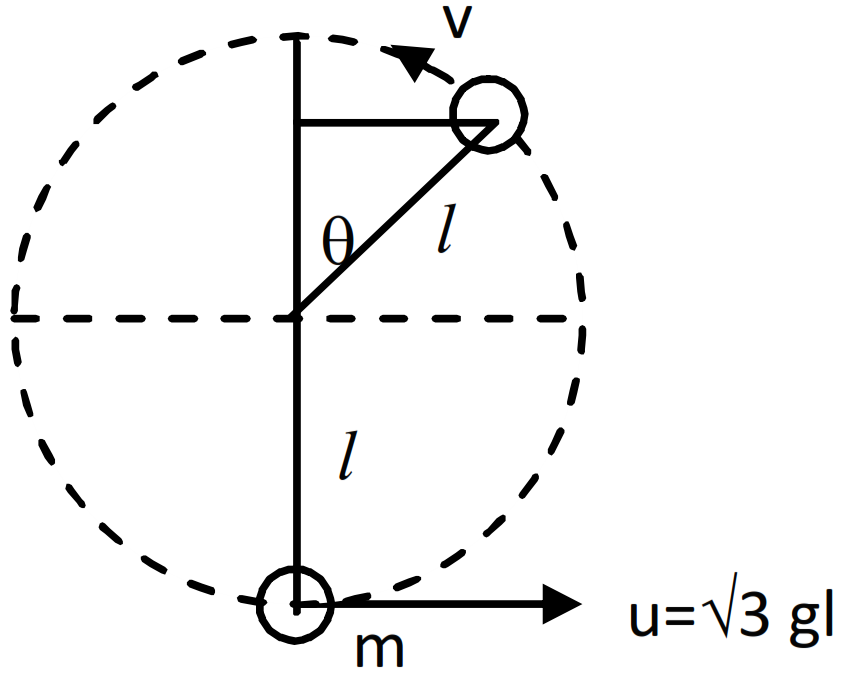
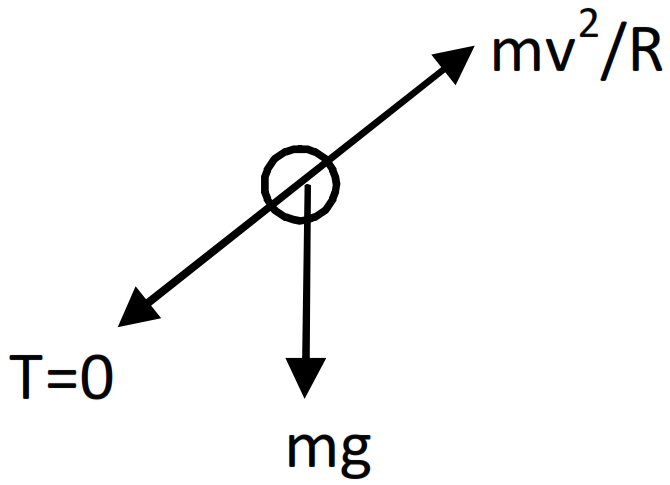 $\text{v}=\sqrt{3\text{gl}}$
$\frac{1}{2}\text{m}\text{v}^2-\frac{1}{2}\text{m}\text{v}_2^2=-\text{mgh}$
$\text{v}^2=\text{u}^2-2\text{g}(\text{l}+\cos\theta)$
$\text{v}^2=3\text{gl}-2\text{gl}(\text{l}+\cos\theta)\ \dots(1)$
Again,
$\frac{\text{mv}^2}{\text{l}}=\text{mg}\cos\theta$
$\text{v}^2=\text{lg}\cos\theta\ \dots(2)$
From equation (1) and (2), we get
$3\text{gl}-2\text{gl}-2\text{gl}\cos\theta=\text{gl}\cos\theta$
$3\cos\theta=1$
$\cos\theta=\frac{1}{3}$
$\theta=\cos^{-1}\Big(\frac{1}{3}\Big)$
So, angle rotated before the string becomes slack,
$\Rightarrow180^\circ-\cos^{-1}\Big(\frac{1}{3}\Big)=\cos^{-1}\Big(\frac{-1}{3}\Big)$ View full question & answer→Question 205 Marks
Two 22.7kg ice sleds A and B are placed a short distance apart, one directly behind the other, as shown in Fig. A 3.63kg cat, standing on one sled, jumps across to the other and immediately back to the first. Both jumps are made at a speed of 3.05ms-1 relative to the ice. Find the final speeds of the two sleds.
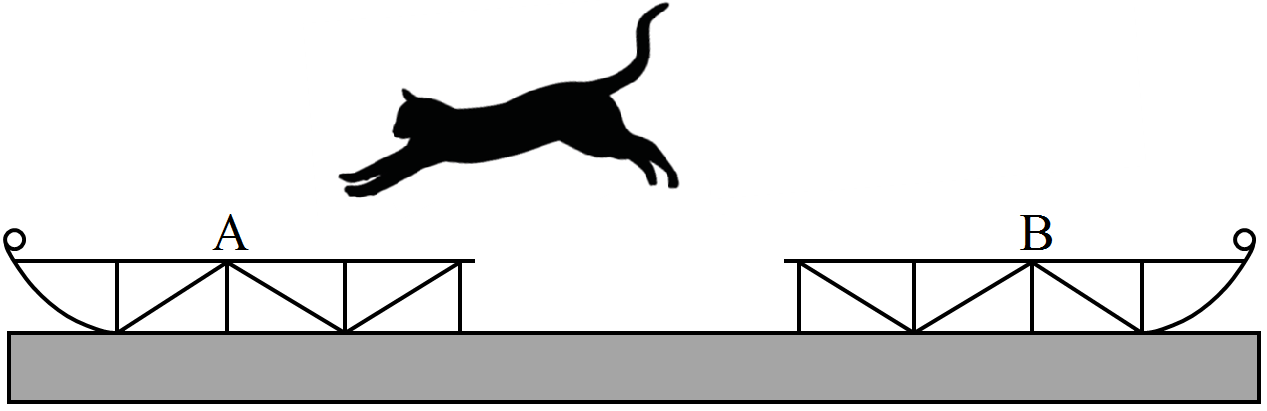
AnswerTotal momentum imparted to B $=2\times3.63\times3.05\text{kg}\text{ ms}^{-1}$ Velocity of B $=\frac{2\times3.36\times3.05}{22.7}\text{ms}^{-1}$ $=0.975\text{ms}^{-1}$ Velocity of A when the cat jumps away from A $=\frac{63\times3.05}{22.7}\text{ms}^{-1}$ $=0.4877\text{ms}^{-1}$ When the cat comes back to A Velocity of A $=\frac{22.7\times0.4877+3.36\times3.05}{22.7+3.63}\text{ms}^{-1}$ $=0.841\text{ms}^{-1}$
View full question & answer→Question 215 Marks
Two identical ball bearings in contact with each other and resting on a frictionless table are hit head-on by another ball bearing of the same mass moving initially with a speed V. If the collision is elastic, which of the following is a possible result after collision?
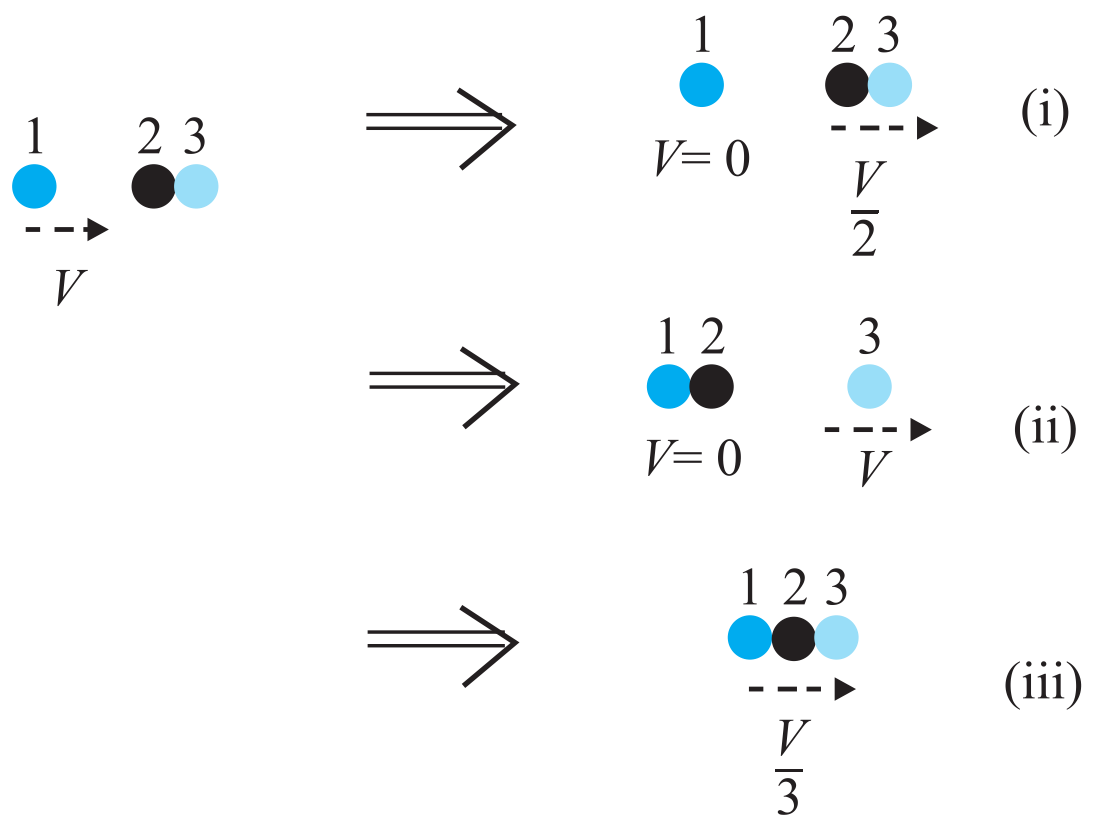
AnswerSuppose, m = mass of each ball bearing Before collision, total K.E. of the system $=\frac{1}{2}\text{mv}^2+0=\frac{1}{2}\text{mv}^2\ ....(1)$ After collision, K.E. of the system is given by Case (i): $\text{E}_1=\frac{1}{2}2\text{m}\Big(\frac{\text{V}}{2}\Big)^2=\frac{1}{4}\text{mv}^2\ ....(2)$ Case (ii): $\text{E}_2=\frac{1}{2}\text{mv}^2\ ...(3)$ Case (iii): $\text{E}_3=\frac{1}{2}(3\text{m})\Big(\frac{\text{v}}{3}\Big)^2=\frac{1}{6}\text{mv}^2\ ....(4)$ Hence form above equations, we see that the k.E. is conserved in case (ii), so, case (ii) is the only possible result after collision.
View full question & answer→Question 225 Marks
Two identical masses, one at rest and the other moving, undergo elastic oblique collision. Prove that they will move at right angles to each other after collision.
AnswerLet the identical masses be m. Let the velocity at their motion initially be u and zero. Since momentum is a vector, we have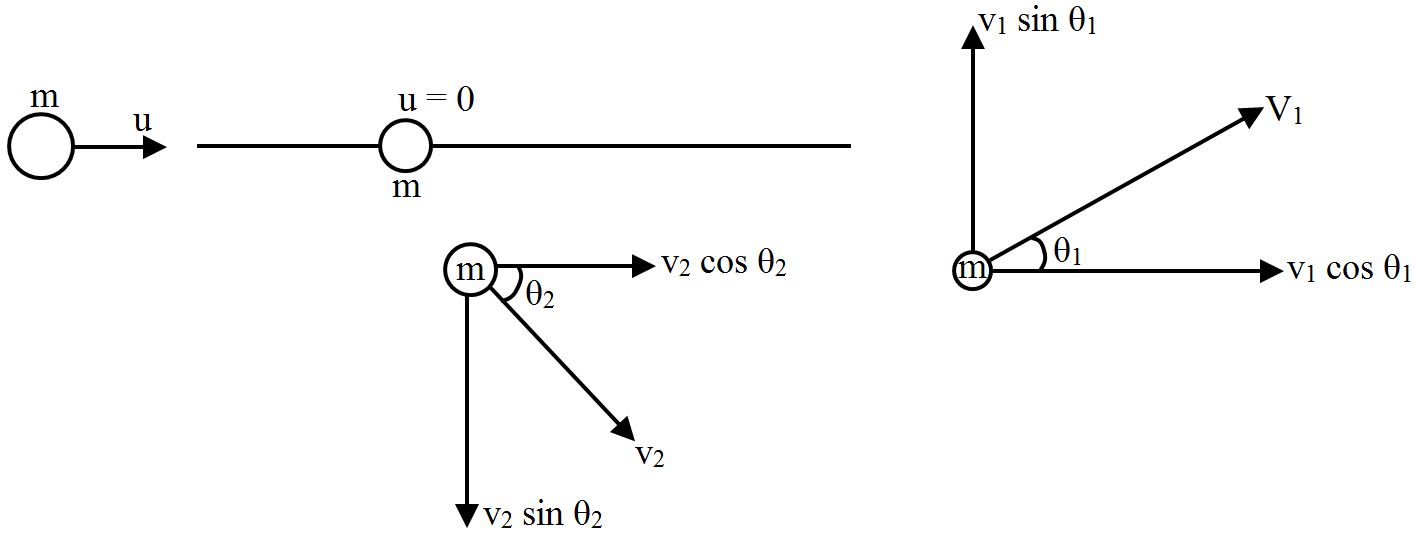
$\text{mu}=\text{m}\upsilon_1\cos\theta_1+\text{m}\upsilon_2\cos\theta_2$ i.e., $\text{u}=\upsilon_1\cos\theta_1+\upsilon_2\cos\theta_2\cdots\text{(i)}$ and $0=\upsilon_1\sin\theta_1-\upsilon_2\sin\theta_2\cdots\text{(ii)}$ Squaring and adding (i) and (ii), we have, $\text{u}^2=\upsilon_1^2+\upsilon_2^2+2\upsilon_1\upsilon_2$ $(\cos\theta_1\cos\theta_2-\sin\theta_1\sin\theta_2)$ $\text{u}^2=\upsilon_1^2+\upsilon_2^2+2\upsilon_1\upsilon_2\cos(\theta_1+\theta_2)$ Using equation (iii), we have $2\upsilon_1\upsilon_2\cos(\theta_1+\theta_2)=0$ $\therefore\cos(\theta_1+\theta_2)=0$ $\theta_1+\theta_2=\frac{\pi}{2}$ i.e., The masses move at right angles after the collision. View full question & answer→Question 235 Marks
A particle of mass $0.1kg$ has an initial speed of $4ms^{-1}$ at a point A on a rough horizontal road. The coefficient of friction, between the object and the road is $0.15$. The particle moves to a point B at a distance of $2m$ from A. What is the speed of the particle B? (Take $g = 10ms^{-2}$)
AnswerSpeed of the particle at A
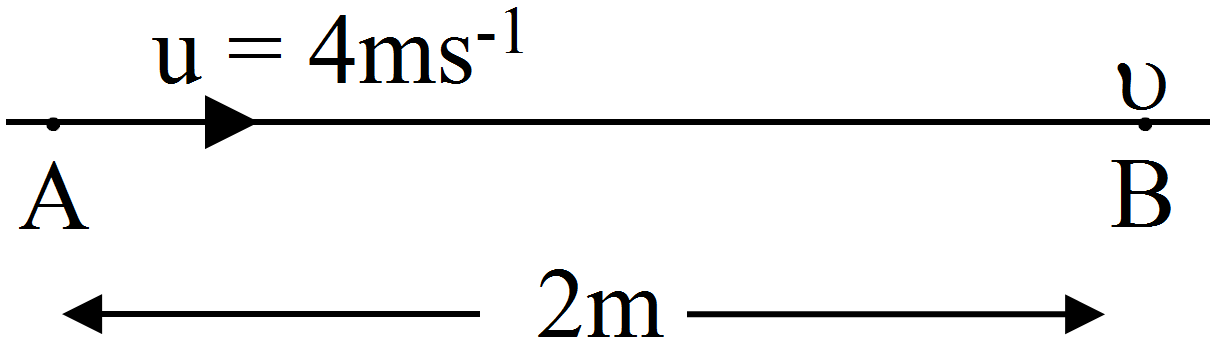
Let the speed of the particle at B be $\vec{\text{v}}\text{ ms}^{-1}$. The particle has to do the work against the force of friction.
$\therefore$ The force is non-conservative. So the work done W = force distance travelled $=\mu\text{ mg}\times\text{s}=0.15\times0.1\times10\times2=0.3\text{J}$ $=\frac{1}{2}\text{m}[(\text{u}^2)-\text{V}^2]=\frac{1}{2}\times0.1[(\text{u}^2)-\text{V}^2]$
$\therefore\frac{1}{2}\times0.1[(\text{u})^2-\text{V}^2]=0.3$ $\Rightarrow0.05[16-\text{V}^2]=0.3$ $\Rightarrow16-\text{V}^2=6$ $\Rightarrow\text{V}^2=16-6=10$
$\therefore\text{V}=\sqrt{10}=3.16\text{ms}^{-1}$ View full question & answer→Question 245 Marks
Two ball bearings of mass m each moving in opposite directions with equal speed v collide head-on with each other. Predict the outcome of the collision, assuming it to be perfectly elastic.
AnswerHere, $M_1 = M_2 = m. u_1 = v$ and $u_2 = - v$
Now, $\text{v}_1=\frac{\text{(M}_1-\text{M}_2)\text{u}_1+2\text{M}_2\text{u}_2}{\text{M}_1+\text{M}_2}$
$=\frac{(\text{m}-\text{m})\text{v}+2\text{m}(-\text{v})}{\text{m}+\text{m}}=-\text{v}$
$\text{v}_2=\frac{(\text{M}_2-\text{M}_1)\text{u}_2+2\text{M}_1\text{u}_1}{\text{M}_1+\text{M}_2}$
$=\frac{(\text{m}-\text{m})(-\text{v})+2\text{mv}}{\text{m}+\text{m}}=\text{v}$ After collision, the two ball bearings will move with same speed but their direction of motion will be reversed.
View full question & answer→Question 255 Marks
A body of mass $2kg$ is resting on a rough horizontal surface. A force of $20N$ is now applied to it for $10$ seconds parallel to the surface. If the coefficient of kinetic friction between the surfaces in contact is $0.2$, calculate.
- Work done by the applied force in $10$ seconds.
- Change in kinetic energy of the object in $10$ seconds.
Take $g = 10 m/ s^2$ AnswerForces of kinetic friction $\text{F}_\text{k}=\mu\text{ mg} = (0.2)(2kg)(10m/ s^2) = 4.0N$ Net external force on the body $F_{net} = 20 N - 4 N = 16N$ Displacement of the body in 10sec. $S = at^2 = \frac{1}{2}\times(8)(10)^2=400\text{m}$
- Work done by applied force
$W = F × S = 20 × 400 = 8000J$
- Change in K.E.
= Work done by net force
$= F_{net} \times S = 16 \times 400 = 6400J$ View full question & answer→Question 265 Marks
A long spring of spring constant $500N/ m$ is attached to a wall horizontally and surface below the spring is rough with coefficient of friction $0.75$.
A $100kg$ mass block moving with a speed $10\sqrt{2}\text{ms}^{-2}$ strikes the spring. Find the maximum compression of the spring. $(g = 10ms^{-2})$
AnswerWhen the block strikes the spring it carry some kinetic energy and all of that is spent against friction and stores in the compressed spring as potential energy.
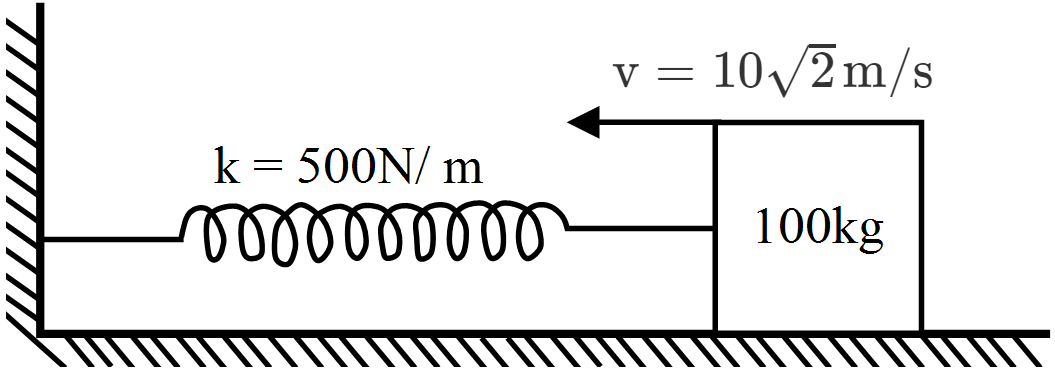
Let the spring compresses by x. Loss in kinetic energy of block = Gain in potential energy of the spring + Work done against friction. $\frac{1}{2}\text{mv}^2=\frac{1}{2}\text{kx}^2+\mu\text{mg}\text{x}$
$\frac{1}{2}\times100\times200$
$=\frac{1}{2}500\text{x}^2+0.75\times100\times100\times10\times\text{x}$
$=50\times200=250\text{x}+750\text{x}$
$\Rightarrow200=5\text{x}^2+15\text{x}$
$=5\text{x}^2+15\text{x}-200=0$
$=\text{x}^2+3\text{x}-40=0$
$\text{x}^2+8\text{x}-5\text{x}-40=0$
$\Rightarrow\text{x}(\text{x}+8)-5(\text{x}+8)=0$
$=\text{x}=5\text{m}=-8\text{m}$
$=\text{x}=5\text{m}$ View full question & answer→Question 275 Marks
A particle moves along the x-axis from $x = 0$ to $x = 5m$ under the influence of a force given by $f(x) = 7 - 2x + 3x^2$. Calculate the work done.
AnswerAs work done, dW = Fdx $\text{W}=\int_\limits{0}^{5}\text{F}.\text{dx}=\int_\limits{0}^{5}(7-2\text{x}+3\text{x}^2)\text{dx}$
$=\bigg[7\text{x}-\frac{2\text{x}^2}{2}+\frac{3\text{x}^3}{3}\bigg]^5_0$ $=7(5-0)-(5^2-0)+(5^3-0)$ $=135\text{J}$
View full question & answer→Question 285 Marks
A block of mass m moving at speed 'v' collides with another block of mass $2 m$ at rest. The lighter block comes to rest after the collision. Find the coefficient of restitution.
Answer$V_{2f}$ = Velocity of second block just after collision. Applying principle of conservation of momentum. $2\text{ mv}_\text{2f}+\text{m}\times0=\text{mv}+2\text{ m}\times0$
$\text{v}_\text{2f}=\frac{\text{v}}{2}$ Velocity of separation =$\frac{\text{V}}{2}$ and Velocity of approach = v Coefficient of restitution = $\frac{\frac{V}{2}}{\text{V}}=\frac{1}{2}=0.5$
View full question & answer→Question 295 Marks
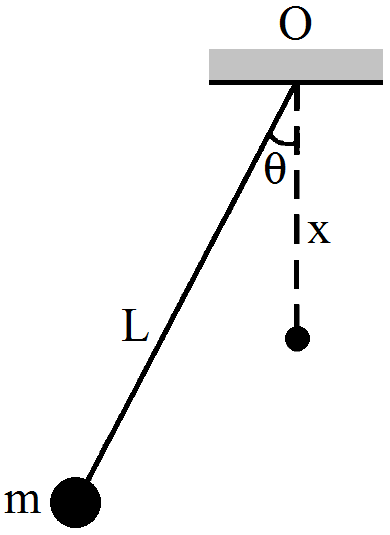
A simple pendulum of length L having a bob of mass m is deflected from its rest position by an angle $\theta$ and released (figure). The string hits a peg which is fixed at a distance x below the point of suspension and the bob starts going in a circle centred at the peg.
- Assuming that initially the bob has a height less than the peg, show that the maximum height reached by the bob equals its initial height.
- If the pendulum is released with $\theta=90^\circ$ and $\text{x}=\frac{\text{L}}{2}$ find the maximum height reached by the bob above its lowest position before the string becomes slack.
- Find the minimum value of $\frac{\text{x}}{\text{L}}$ for which the bob goes in a complete circle about the peg when the pendulum is released from $\theta=90^\circ.$
Answer
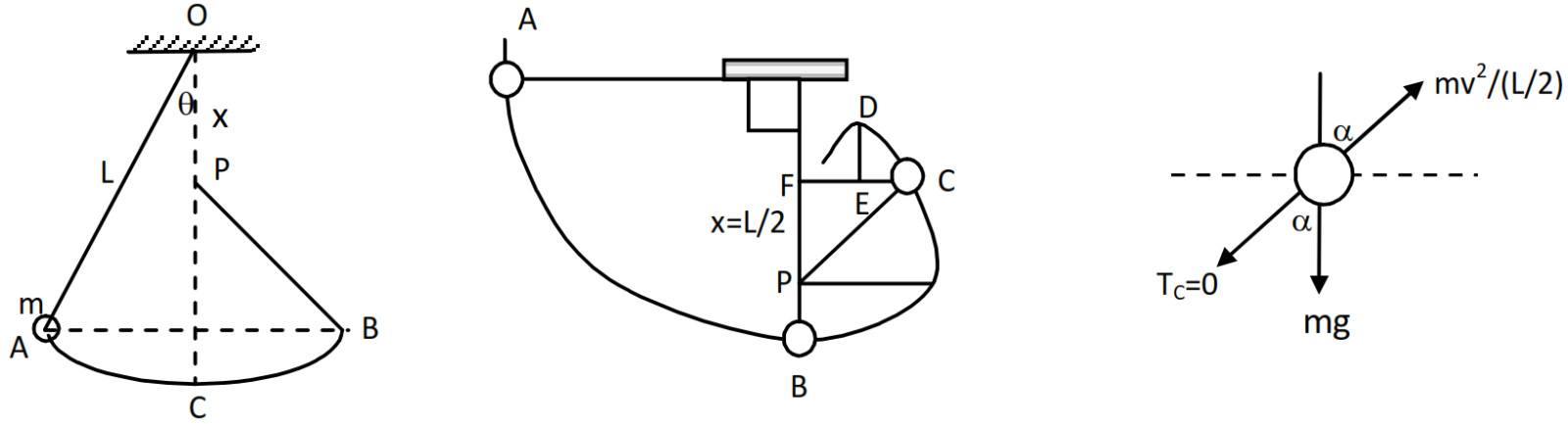
- When the bob has an initial height less than the peg and then released from rest (figure), let body travels from A to B.
Since, Total energy at A = Total energy at B
$\therefore (K.E)_A = (PE)_A = (KE)_B + (PE)_B$
$\Rightarrow (PE)_A = (PE)_B$ [because, $(KE)_A = (KE)_B = 0]$
So, the maximum height reached by the bob is equal to initial height.
- When the pendulum is released with $\theta=90^\circ$ and $\text{x}=\frac{\text{L}}{2},$ (figure) the path of the particle is shown in the figure.
At point C, the string will become slack and so the particle will start making projectile motion.
$\Rightarrow\Big(\frac{1}{2}\Big)\text{mv}_\text{c}^2-0=\text{mg}\Big(\frac{\text{L}}{2}\Big)(1-\cos\alpha)$
Because, distance between A nd C in the vertical direction is $\frac{\text{L}}{2}(1-\cos\alpha)$
$\Rightarrow\text{v}_\text{c}^2=\text{gl}(1-\cos\alpha)\ \dots(1)$
Again, form the freebody diagram,
$\frac{\text{mv}_\text{c}^2}{\frac{\text{L}}{2}}=\text{mg}\cos\alpha$ [because $T_c = 0$]
So, $\Rightarrow\text{v}_\text{c}^2=\frac{\text{gl}}{2}\cos\alpha\ \dots(2)$
From Eqn.(1) and equn (2),
$\text{gl}(1-\cos\alpha)=\frac{9\text{L}}{2}\cos\alpha$
$\Rightarrow(1-\cos\alpha)=\frac{1}{2}\cos\alpha$
$\Rightarrow\frac{3}{2}\cos\alpha=1$
$\Rightarrow\cos\alpha=\frac{2}{3}\ \dots(3)$
To find highest position C, before the string becomes slack.
$\text{BF}=\frac{\text{L}}{2}+\frac{\text{L}}{2}\cos\theta$
$\text{BF}=\frac{\text{L}}{2}+\frac{\text{L}}{2}\times\frac{2}{3}=\text{L}\Big(\frac{1}{2}+\frac{1}{3}\Big)$
So, $\text{BF}=\frac{5\text{L}}{6}$
- If the particle has to complete a vertical circle, at the point C.
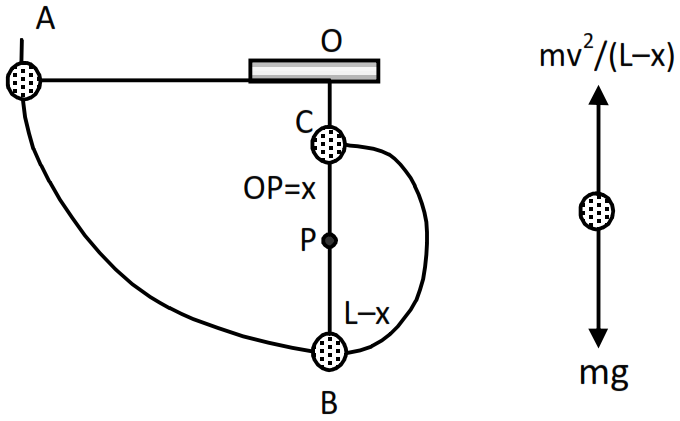
$\frac{\text{mv}_\text{c}^2}{(\text{L}-\text{x})}=\text{mg}$
$\Rightarrow\text{v}_\text{c}^2=\text{g}(\text{L}-\text{x})\ \dots(4)$
Again, applying energy principle between A and C,
$\frac{1}{2}\text{mv}_\text{c}^2-0=\text{mg}(\text{OC})$
$\Rightarrow\frac{1}{2}\text{v}_\text{c}^2-0=\text{mg}[\text{L}-2(\text{L}-\text{x})]$
$\Rightarrow\text{mg}(2\text{x}-\text{L})$
$\Rightarrow\text{v}_\text{c}^2=2\text{g}(2\text{x}-\text{L})\ \dots(5)$
From equn. (4) and equn (5),
$\text{g}(\text{L}-\text{x})=2\text{g}(2\text{x}-\text{L})$
$\Rightarrow\text{L}-\text{x}=4\text{x}-2\text{L}$
$\Rightarrow5\text{x}=3\text{L}$
$\therefore\ \frac{\text{x}}{\text{L}}=\frac{3}{5}=0.6$
So, the rates $\Big(\frac{\text{x}}{\text{L}}\Big)$ should be 0.6 View full question & answer→Question 305 Marks
A particle of mass m moving with an initial velocity u collides in elastically with a particle of mass M initially at rest. If the collision is completely inelastic, then find expressions for:
- Final velocity of combined entity and
- Loss in kinetic energy during collision.
Answer
- Let a particle of mass m moving with an initial velocity u collides in elastically with another particle of mass M initially at rest. Let after collision, the combined entity moves with a velocity v. Then, from the conservation of linear momentum, we have
mu + 0 = (m + M) v
$\Rightarrow\text{v}=\frac{\text{mu}}{\text{m}+\text{M}}$
- Initial kinetic energy of system before collision
$\text{K}=\frac{1}{2}\text{mu}^2$
Final energy of system after collision
$\text{K}'=\frac{1}{2}(\text{m}+\text{M})\text{v}^2=\frac{1}{2}(\text{m}+\text{M}).\Big(\frac{\text{mu}}{\text{m}+\text{M}}\Big)^2$
$\therefore$ Loss in kinetic energy during collision
$=\frac{1}{2}\frac{\text{m}^2\text{u}^2}{(\text{m}+\text{M})}=\frac{1}{2}\frac{\text{m}^2\text{u}^2}{(\text{m}+\text{M})}$
$=\Delta\text{K}=\text{K}-\text{K}$
$\frac{1}{2}\text{mu}^2-\frac{1}{2}\frac{\text{m}^2\text{u}^2}{(\text{m}+\text{M})}$
$=\frac{1}{2}\text{mu}^2\Big[1-\frac{\text{m}}{\text{M}+\text{m}}\Big]$
$=\frac{1}{2}\text{mu}^2\Big(\frac{\text{M}}{\text{M}+\text{m}}\Big)$
Fractional loss in kinetic energy during collision
$\frac{\Delta\text{K}}{\text{K}}=\frac{\text{M}}{\text{M}+\text{m}}$ View full question & answer→Question 315 Marks
A particle of mass $1kg$ moving with a velocity $\text{V}_1=(3\hat{\text{i}}-2\hat{\text{J})}\text{m/ s}$ experience a perfectly inelastic collision with another particle of mass 2kg having velocity $\text{v}_2=4\hat{\text{j}}-6\hat{\text{k}}\text{m/ s}$. Find the velocity and speed of the particle formed.
AnswerGiven, $m_1 = 1kg, \text{v}_1=(3\hat{\text{i}}-2\hat{\text{j}})\text{m/ s}$
$m_2 = 2kg$, $\text{v}_2=(4\hat{\text{i}}-6\hat{\text{k}})\text{m/ s}$ When two particles experience a perfecdy inelasti collision. They stick together and move with a common velocity v given by $\text{v}=\frac{\text{m}_1\text{v}_1+\text{m}_2\text{v}_2}{\text{m}_1+\text{m}_2} $
$=\frac{1(3\hat{\text{i}}-2\hat{\text{j}})+2(4\hat{\text{j}}-6\hat{\text{k}})}{1+2}$ Speed of combined particle $\text{v}=\sqrt{1^2+(2)^2+(-4)^2}$
$=\sqrt{21}\text{m/ s}$
View full question & answer→Question 325 Marks
Two identical steel cubes (masses $50g$, side $1cm$) collide head-on face to face with a speed of $10cm/ s$ each. Find the maximum compression of each. Young’s modulus for steel = $Y = 2 \times 1011 N/ m^2$.
AnswerWhen two indentical cubes collide head-on collision. Then KE of cubes converts into PE and compresses the faces of cube by $\Delta\text{l}.$ By Hooks Law stress $\alpha$ strain. Or $\text{Y}=\frac{\text{stress}}{\text{strain}}$
$\text{Y}=\frac{\text{F}\cdot\text{L}}{\text{A}\Delta\text{L}}$ Or $\text{F}=\text{AY}\frac{\Delta\text{L}}{\text{L}}$ Or $\text{F}=\text{L}^2\text{Y}\frac{\Delta\text{L}}{\text{L}}=\text{LY}\Delta\text{L}$
$\text{WD}=\text{F}\cdot\Delta\text{L}=\text{LY}\Delta\text{L}^2$ KE of both cubes $=2\Big(\frac{1}{2}\text{mv}^2\Big)=0.05\times0.1\times0.1=5\times10^{-4}\text{J}$
$\text{W.D.}=\text{K.E.}$
$\text{LY}\Delta\text{L}^2=5\times10^{-4} $
$\Delta\text{L}^2=\frac{5\times10^{-4}}{0.01\times2\times10^{11}}=\frac{5}{2}\times10^{-4-11+2}$
$\Delta\text{L}=\sqrt{25\times10^{-14}}=5\times10^{-7}\text{m}$
View full question & answer→Question 335 Marks
A bullet of mass $20g$ is moving with a speed of $150ms^{-1}$. It strikes a target and is brought to rest after piercing $10cm$ into it. Calculate the average force of resistance offered by the target.
AnswerHere $\mathrm{m}=20 \mathrm{~g}=0.02 \mathrm{~kg} \mathrm{u}=150 \mathrm{~ms}^{-1}, \mathrm{v}=0$ and $\mathrm{s}=10 \mathrm{~cm}=0.1 \mathrm{~m}$ According to work-kinetic energy theorem, we have $\mathrm{K}-\mathrm{K}^{\prime}=\mathrm{W}=\mathrm{Fs}$
$\therefore\frac{1}{2}\text{mu}^2-0=\text{Fs}$
$\Rightarrow\text{F}=\frac{\text{mu}^2}{2\text{s}}=\frac{0.02\times(150)^2}{2\times0.1}=2250\text{ N}$
View full question & answer→Question 345 Marks
A small block of mass $200g$ is kept at the top of a frictionless incline which is $10m$ long and $3.2m$ high. How much work was required.
- To lift the block from the ground and put it at the top.
- To slide the block up the incline? What will be the speed of the block when it reaches the ground.
- It falls off the incline and drops vertically on the ground.
- It slides down the incline? Take $g = 10m/s^2$.
Answer$m = 200g = 0.2kg, s = 10m, h = 3.2m, g = 10m/sec^2$
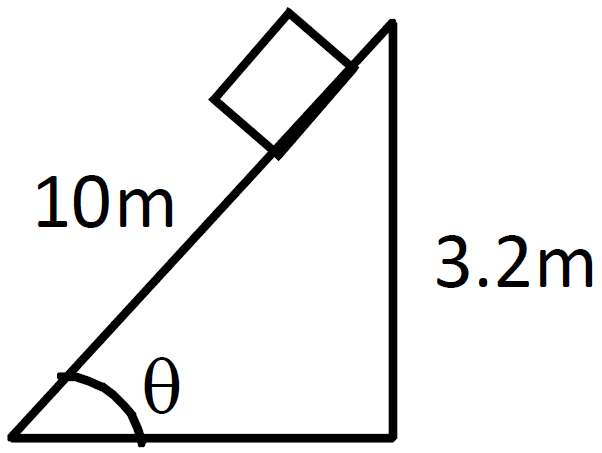
- Work done W = mgh = 0.2 × 10 × 3.2 = 6.4J
- Work done to slide the block up the incline,
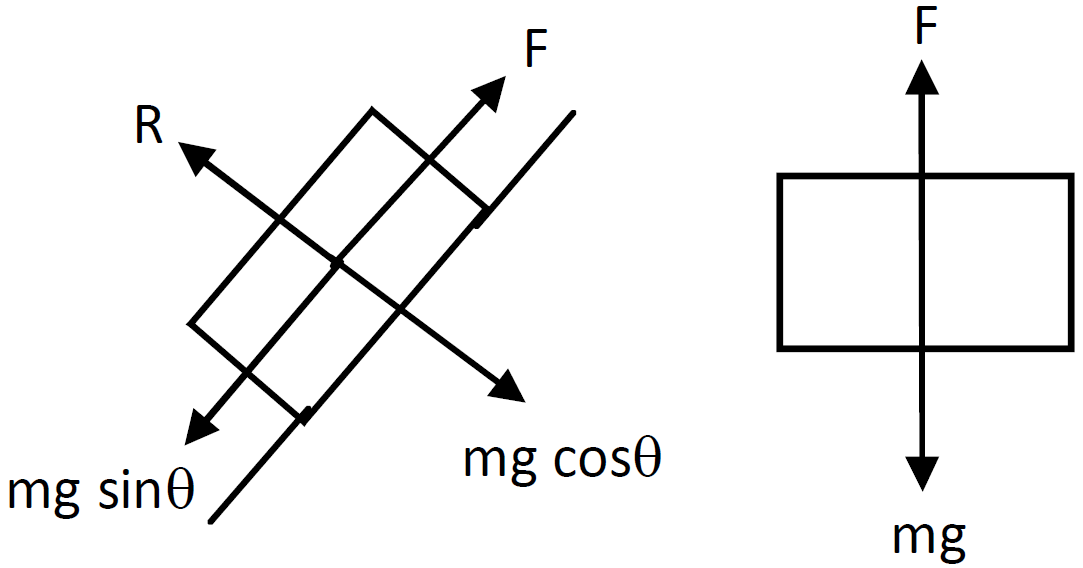
$\text{w}=(\text{mg}\sin\theta)\times\text{s}$
$=(0.2)\times10\times\frac{3.2}{10}\times10=6.4\text{J}$
- Let, the velocity be v when falls on the ground vertically,
$=\frac{1}{2}\text{mv} -0=6.4\text{J}$
$\Rightarrow\text{v}=8\text{m}/\text{s}$
- Let V be the velocity when reaches the ground by liding,
$=\frac{1}{2}\text{mV}^2-0=6.4\text{J}$
$\Rightarrow\text{v}=8\text{m}/\text{s}$ View full question & answer→Question 355 Marks
A block of mass $200g$ is released from P which slides down without friction till it reaches a point Q of a circular path of radius $2.0m$. Find.
- The velocity of the block at point Q and.
- The coefficient of friction if the block comes to rest $2.0m$ from Q, assuming the horizontal part of the path is rough. Take $g = 10ms^{-2}$.
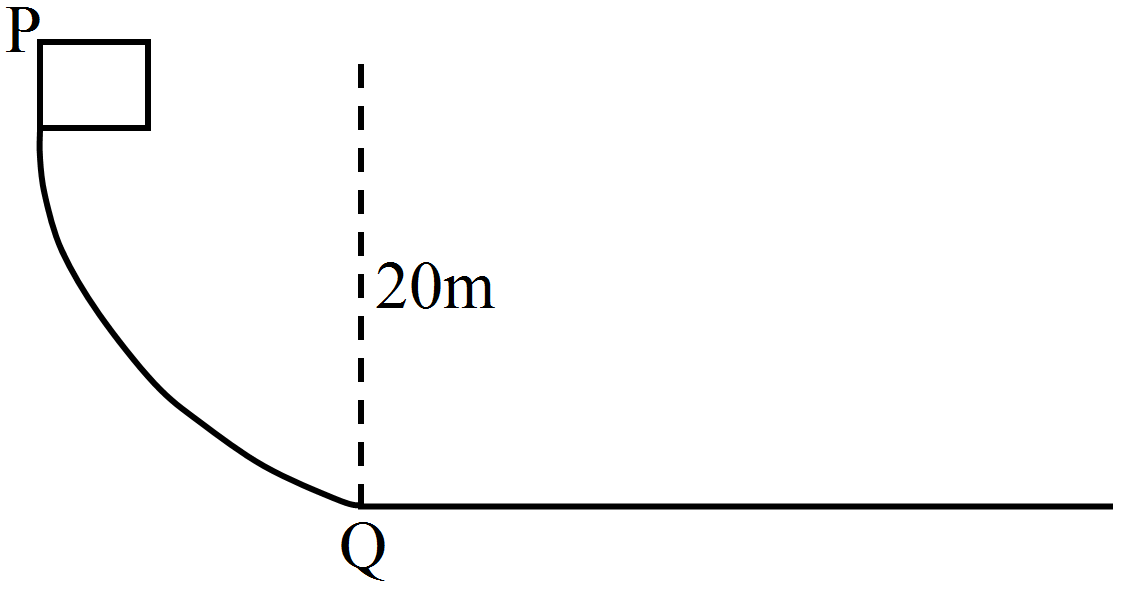
Answer
- P.E. of block at P is converted into K.E. of the block at Q.
$\therefore\text{mgh}=\frac{1}{2}\text{m}\upsilon^2$
$\upsilon=\sqrt{2\text{gh}}=\sqrt{2\times10\times2}$
$=\sqrt{40}=6.32\text{ms}^{-1}$
- When the block comes to rest after travelling a distance, s = 2.0m from Q, then according to work - energy theorem.
Work done against friction = change in K.E.
i.e, $\mu\text{mgs}=\frac{1}{2}\text{m}\upsilon^2$
$\mu=\frac{\upsilon^2}{2\text{gs}}=\frac{40}{2\times10\times2}=1$ View full question & answer→Question 365 Marks
The displacement x of a particle moving in one dimension under the action of a constant force is related to time by the equation$\text{t}=\sqrt{\text{x}}+3$ where x is in meter and t in second. Calculate the work done by the force in the first $6$ second.
AnswerWe have $\text{t}=\sqrt{\text{x}}+3$ $\sqrt{\text{x}}=\text{t}-3$
$\therefore\text{x}=(\text{t}-3)^2$ The velocity of the particle is givm by $\upsilon=\frac{\text{dx}}{\text{dt}}=2(\text{t}-3)\text{ ms}^{-1}$
$\therefore$The acceleration of the particle is grven by $\text{a}=\frac{\text{d}\upsilon}{\text{dt}}=2\text{ms}^{-2}$ Force required to produce this acceleration is given by F = m × a = m × 2 = 2m where m is the mass of the particle. Distance travelled by the particle in first 6 seconds $x = (6 – 3)^2 = 9m$
Hence work done =$ Fx = (2m × 9) = 18m\ Joule$
View full question & answer→Question 375 Marks
A $0.5kg$ block slides from the point A on a horizontal track with an initial speed $4\sqrt{5}\text{ms}^{-1}$ towards a weightless horizontal spring of length $10m$ and spring constant 2 N/ m.
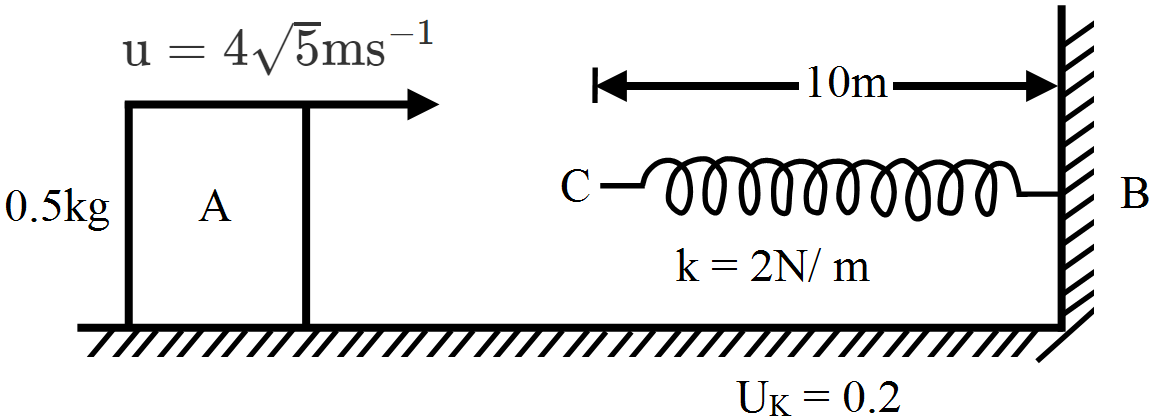
The initial track is frictionless and part BC under the unstretched length of spring has coefficient of kinetic friction $\mu_\text{k}=0.2$ Calculate total distance by which the block move before coming finally to rest. $(g = 10ms^{-1})$. AnswerLet the block compresses the spring by x before finally coming to rest on the rough part. 
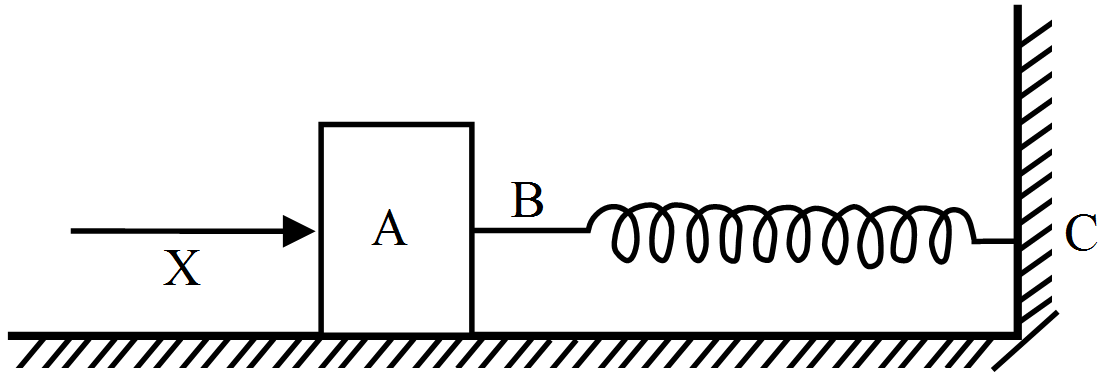
Total energy of the block on friction surface = Work done against friction + Potential energy stored in spring. $\frac{1}{2}\times0.5\times16\times5=\mu_\text{k}\text{mgs}+\frac{1}{2}\text{kx}^2$ $20=0.2\times0.5\times10\times\text{x}+\frac{1}{2}\times2\times\text{x}^2$
$20 = x + x^2 x^2 + x - 20 = 0 x^2 + 5x - 4x - 200 = 0 x ( x + 5) - 4 (x + 5 ) = 0 x (x + 5) - 4 (x + 5) = 0 x = 4, x = -5$ Hence the compression of spring is 4m. View full question & answer→Question 385 Marks
A and B are two particles having the same mass 'm'. A is moving along x-axis with a speed of $10ms^{-1}$ and B is at rest. After undergoing a perfectly elastic collision with B, particle A get scattered through an angle of $30°$. What is the direction of the motion of B and the speeds of A and B after the collision?
Answer
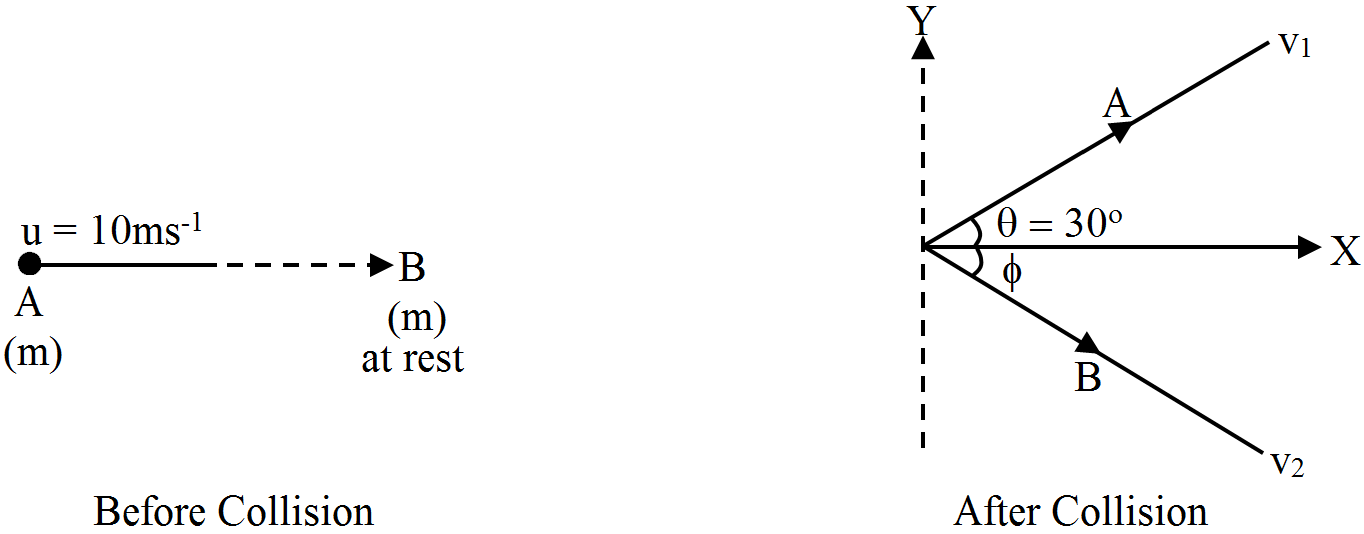 The masses of two bodies are same and the collision is perfectly elastic.
$\therefore\theta+\phi=90^\circ$
$30^\circ+\phi=90^\circ$
$\phi=90^\circ-30^\circ=60^\circ$
According to law of conservation of momentaum, for x-component
$\text{u}=\text{v}_1\cos30^\circ+\text{v}_2\cos60^\circ$
$10=\frac{\sqrt{3}}{2}\text{v}_1+\frac{1}{2}\text{v}_2$
$\therefore\sqrt{3}\upsilon_1+\upsilon_2=20$
For y-Component, we get
$0=\text{V}_1\sin30^\circ-\text{V}_2\sin60^\circ$
$0=\text{V}_1\times\frac{1}{2}-\text{V}_2\times\frac{\sqrt{3}}{2}$
$\text{V}_1=\sqrt{3}\text{V}_2$
Solving Eq. (i) and (ii) we get
$\sqrt{3}\times\sqrt{3}\text{V}_2+\text{V}_2=20$
$3\text{V}_2+\text{V}_2=20$
$4\text{V}_2=20$
$\text{V}_2=5\text{m/s}$
and $\text{V}_1=\sqrt{3}\times5$
$\text{V}_1=5\times1.732$
$\text{V}_18.66\text{m/s}$ View full question & answer→Question 395 Marks
A particle of mass $0.2kg$, has an initial speed of $5ms^{-1}$ at the bottom of a rough inclined plane of inclination $30°$ and vertical height $0.5m$. What is the speed of the particle as it reaches the top of the inclived plane?
Answerimage$\sin30^\circ=\frac{\text{h}}{\text{AB}}$
$\frac{1}{2}=\frac{0.5}{\text{AB}}$
$\text{AB}=1\text{m}$
Force of friction between the particle and the inclined plane
$=\mu\text{N}$
$=\mu\times\text{mg}\cos\theta$
$=\frac{1}{\sqrt{3}}\times0.2\times10\times\cos30^\circ$
$\therefore$ The work done by the particle in moving from A to B against the force of friction
$=\mu\text{ mg}\cos\theta\times\text{AB}$
$=1\text{N}\times1\text{m}=1\text{J}$
Let $\vec{\upsilon}$ be the velocity of the Particle at B
$\therefore\omega$ = change in energy from A to B
$1\text{J}=\big[\frac{1}{2}\times0.2\times(5)^2+0\big]-\big[\frac{1}{2}\times0.2\times\text{V}^2+0.2\times10\times0.5\big]$
$\Rightarrow1=2.5-[0.1\text{V}^2+1\big]$
$\Rightarrow0.1\text{V}^2=1.5-1$
$\Rightarrow0.1\text{V}^2=0.5$
$\Rightarrow\text{V}^2=5$
$\Rightarrow\text{V}=\sqrt{5}=2.24\text{ms}^{-1}$
View full question & answer→Question 405 Marks
Can static friction do nonzero work on an object? If yes, give an example. If no, give reason.
AnswerYes. Let us consider a block A which is resting on another block B. Block B is resting on a smooth horizontal surface. Let the coefficient of kinetic friction between the blocks be $\mu\text{k}.$ 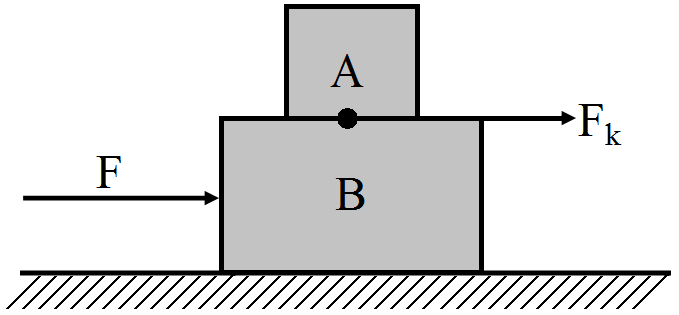 When a force F is applied on block B in the forward direction as shown in the above figure, block A moves with block B in the direction of the applied force. The friction force on block A and the displacement will be in the forward direction. Therefore, work done by the friction force is positive. In this case, block A will remain in contact with block B. This shows that static friction is doing a nonzero work on an object.
 View full question & answer→Question 415 Marks
Two identical balls A and B undergo a perfectly elastic two dimensional collision. Initially A is moving with a speed of $10ms^{-1}$ and B is at rest. Due to collision A is scattered through angle of $30°$. What are the speed of A and B after the collision?
AnswerThe balls A and B are identical $\therefore$ masses are same, $\theta=30^\circ$
$\therefore\phi=90^\circ-30^\circ=60^\circ$ Initially $\text{v}_1=10\text{ms}^{-1}$ and $\text{v}_2=0$
$\therefore$ According to Law of conservation of momentum for x- component'. $\text{u}=\text{v}_1\cos30^\circ+\text{v}_2\cos60^\circ$
$10=\text{v}_1\times\frac{\sqrt{3}}{2}+\text{v}_2\times\frac{1}{2}$
$\therefore\sqrt{3}\text{v}_1+\text{v}_2=20$ For y-component,
$0=\text{v}_1\sin30^\circ-\text{v}_2\sin60^\circ$
$0=\text{v}_1\times\frac{1}{2}-\text{v}_2\times\frac{\sqrt{3}}{2}$
$\text{v}_1=\sqrt{3}\text{v}_2$ Form eq. (i) and (ii) we get $\sqrt{3}\times\sqrt{3}\text{v}+\text{v}_2=20$
$\Rightarrow3\text{v}_2+\text{v}_2=20$
$\Rightarrow4\text{v}_2=20$
$\therefore\text{v}_2=5\text{ ms}^{-1}$ From eq. (iii) $\text{v}_1=\sqrt{3}\times5=5\sqrt{3}\text{ ms}^{-1}$ Here, the velocities of A and B are $5\sqrt{3}\text{ ms}^{-1}$ and $5ms^{-1}$ respectively.
View full question & answer→Question 425 Marks
A helicopter lifts a $72kg$ astronaut $15m$ vertically from the ocean by means of a cable. The acceleration of the astronaut is $\frac{\text{g}}{10}$.
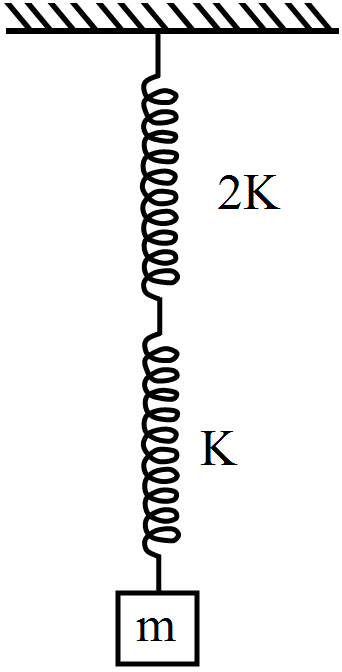
How much work is done on the astronaut by:
- The force from the helicopter and
- The gravitational force on him?
- What are the kinetic energy and
- The speed of the astronaut just before he reaches the helicopter?(Take, $g = 10ms^{‑2}$)
AnswerHere, mass of astronaut m = 72kg, vertical distance
h = 15m and acceleration of astronaut $\text{a}=\frac{\text{g}}{10}$
- Force ftom the helicopte
$\text{F}=\text{mg}+\text{ma}$
$=\text{mg}+\frac{\text{mg}}{10}=\frac{11\text{mg}}{10}$
$\therefore$ Work done by force from the helicopter
$\text{W}=\text{F}\times\text{h}=\frac{11\text{mg}}{10}\times\text{h}$
$\text{W}=\frac{11\times72\times10\times15}{10}$
$=11880\text{J}$
- Work done by gavitational force
$\text{W}'=\text{(mg)}(\text{h})(\cos180^\circ)$
$\text{W}'=-\text{mgh}=-72\times10\times15$
$=-10800\text{J}$
- KE of astronaut K = network done on him
= W + W'
= (11880 - 10800)J
= +1080J
- As $\text{KE}=\frac{1}{2}\text{mv}^2$, Hence
$\text{v}=\sqrt{\frac{2\text{K}}{\text{m}}}$
$=\sqrt{\frac{2\times1080}{72}}$
$=5.48\text{ms}^{-1}$ View full question & answer→Question 435 Marks
A bullet of mass $20g$ travelling horizontally with a speed of 500m/s passes through a wooden block of mass $10.0kg$ initially at rest on a level surface. The bullet emerges with a speed of $100m/s$ and the block slides $20cm$ on the surface before coming to rest. Find the friction coefficient between the block and the surface.
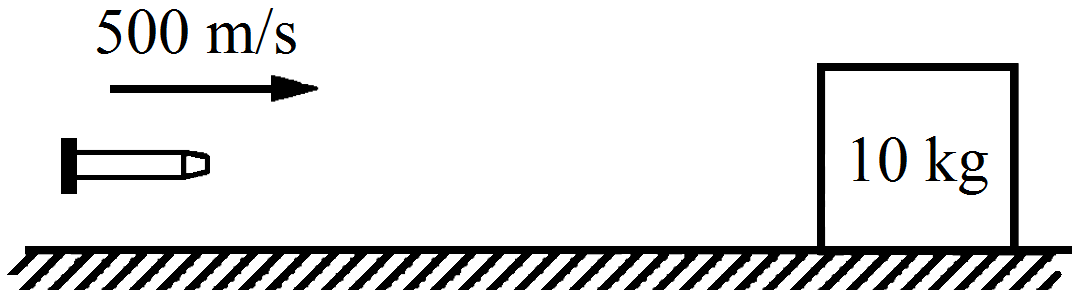
AnswerMass of bullet m = 0.02kg. Initial velocity of bullet $V_1 = 500m/s$ Mass of block, $M = 10kg$. Initial velocity of block $u_2 = 0$. Final velocity of bullet = $100m/s = v$.
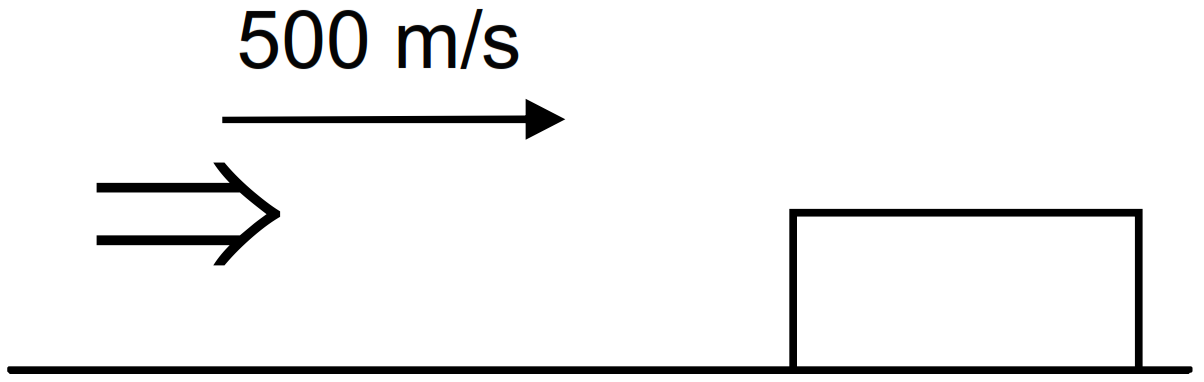
Let the final velocity of block when the bullet emerges out, if block = $v'. mv_1 + Mu_2 = mv + Mv' \Rightarrow 0.02 \times 500 = 0.02 \times 100 + 10 \times v' ⇒ v' = 0.8m/s$ After moving a distance 0.2m it stops. ⇒ change in K.E. = Work done $\Rightarrow0-\Big(\frac{1}{2}\Big)\times10\times(0.8)^2$ $=-\mu\times10\times10\times0.2$ $\Rightarrow\mu=0.16$ View full question & answer→Question 445 Marks
The heavier block in an Atwood machine has a mass twice that of the lighter one. The tension in the string is 16.0N when the system is set into motion. Find the decrease in the gravitational potential energy during the first second after the system is released from rest.
AnswerGiven, T = 16N From the freebody diagrams,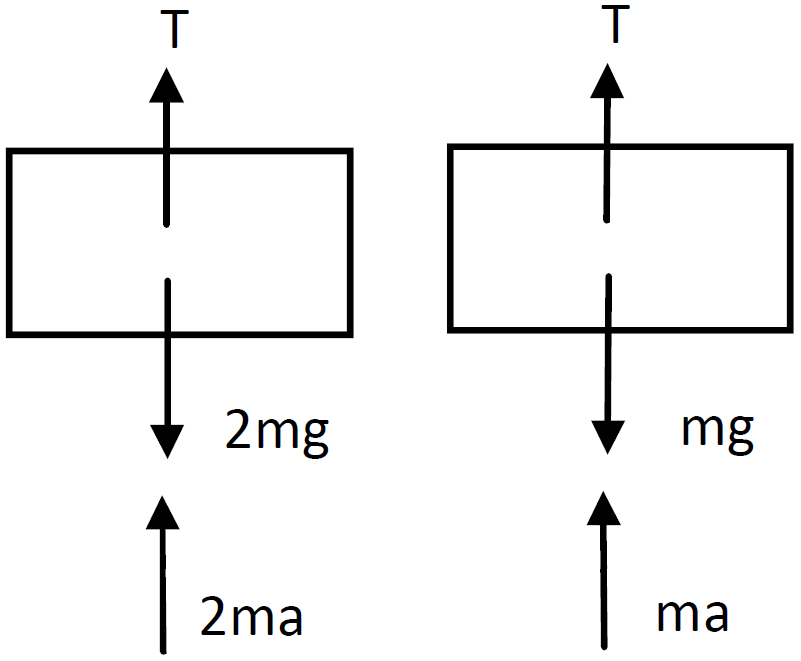
T - 2mg + 2ma = 0 …(i) T - mg - ma = 0 …(ii) From, Equation (i) & (ii) T = 4ma $\Rightarrow\text{a}=\frac{\text{T}}{4\text{m}}$ $\Rightarrow\text{A}=\frac{16}{4\text{m}}=\frac{4}{\text{m}}\text{m}/\text{s}^2$ Now, $\text{s}=\text{ut}+\frac{1}{2}\text{at}^2$ $\Rightarrow\text{S}=\frac{1}{2}\times\frac{4}{\text{m}}\times1$ $\Rightarrow\text{S}=\frac{2}{\text{m}}$ [because u=0] Net mass = 2m - m = m Decrease in P.E. = mgh $\Rightarrow\text{P.E.}=\text{m}\times\text{g}\times\frac{2}{\text{m}}$ $\Rightarrow\text{P.E.}=9.8\times2$ $\Rightarrow\text{P.E.}=19.6\text{J}$
View full question & answer→Question 455 Marks
A person trying to lose weight (dieter) lifts a $10kg$ mass, one thousand times, to a height of $0.5m$ each time. Assume that the potential energy lost each time she lowers the mass is dissipated.
- How much work does she do against the gravitational force?
- Fat supplies $3.8 \times 107J$ of energy per kilogram which is converted to mechanical energy with a $20\%$ efficiency rate. How much fat will the dieter use up?
AnswerMass of the weight, m = 10kg Height to which the person lifts the weight, h = 0.5m Number of times the weight is lifted, n = 1000 Work done against gravitational force, = n(mgh) = 1000 × 10 × 9.8 × 0.5 = 49kJ Energy equivalent of 1kg of fat = $3.8 \times 10^7J$ Efficiency rate = 20% Mechanical energy supplied by the person’s body, $=\frac{20}{100} × 3.8 × 10⁷\text{J}$ $=\frac{1}{5} × 3.8 × 10⁷\text{J}$ Equivalent mass of fat lost by the dieter, $=\Bigg[\frac{1}{\frac{1}{5}}× 3.8 × 10^7\Bigg]× 49 × 10^3$ $=\frac{245}{3.8}×10-4 = 6.45 × 10^{-3}\text{kg}$
View full question & answer→Question 465 Marks
A body of mass 3kg is under a constant force, which causes a displacement S in metre in it, given by the relation $\text{S}=\frac{1}{2}\text{t}^2$, where t is in second. Find the work done by the force in 2s.
AnswerWork done by the Force = Force × Displacement W = F × s …..(i) But from Newton's 2nd law, we have Force = mass × acceleration i.e. F = ma ...(ii) Hence, from Eqs.(i) and (ii), we get $\text{W}=\text{m}\bigg(\frac{\text{d}^2s}{\text{dt}^2}\bigg)\text{S}$ $\bigg[\therefore\text{a}=\frac{\text{d}^2s}{\text{dt}^2}\bigg]\cdots\text{(ii)}$ Now, we have $\text{S}=\frac{1}{3}\text{t}^2$ $\therefore\frac{\text{d}^2s}{\text{dt}^2}=\frac{\text{d}}{\text{dt}}\bigg[\frac{\text{d}}{\text{dt}}\big(\frac{1}{3}\text{t}^2\bigg)\bigg]$ $=\frac{\text{d}}{\text{dt}}\times\bigg(\frac{2}{3}\text{t}\bigg)$ $=\frac{2}{3}\frac{\text{dt}}{\text{dt}}=\frac{2}{3}$ Hennce Eq. (iii) becomes $\text{W}=\frac{2}{3}\text{ms}=\frac{2}{3}\times\text{m}\times\frac{1}{3}\text{t}^2$ $=\frac{2}{9}\text{mt}^2$ We have, m = 3kg, t = 2s $\text{W}=\frac{2}{9}\times3\times(2)^2$ $=\frac{8}{3}\text{J}$
View full question & answer→Question 475 Marks
A ball moves along a curved path of radius 5m as shown in figure. It starts from point A and reaches point B. If there is no force of friction between the ball and surface of the path, then find the normal force that acts on the ball at the bottom (B) of the curved path.
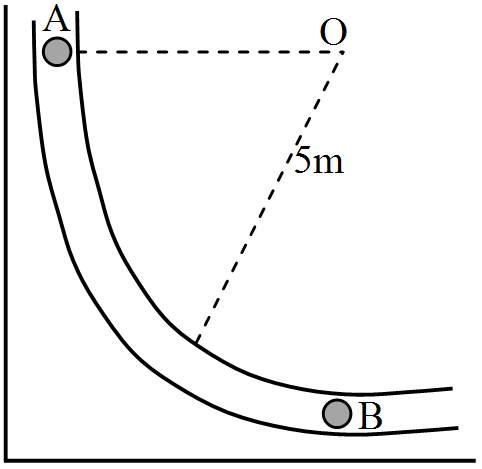
AnswerK.E. of ball at A = P.E. of ball at B i.e., $\frac{1}{2}\text{m}\upsilon^2=\text{mgh}$ $\upsilon^2=2\text{gR}$ Centripetal acceleration of the ball, $\text{a}=\frac{\upsilon^2}{\text{R}}$ $=\frac{2\text{gR}}{\text{R}}$$=2\text{g}$ $\therefore$ Centripetal force on the ball, $\text{f}=\text{ma}$ $=2\text{mg}$ Now, Let W = mg be the mass of the ball acting vertically downward at point B and R is the normal reaction or force acting on the ball in the upward direction. f = R – W R = f + W = 2mg + mg = 3mg
View full question & answer→Question 485 Marks
A mass m is placed on a platform from a height 'h'. The platform is attached to a spring whose other end is fixed to the ground. Find the compression in the spring, if the spring constant is k.
Answer
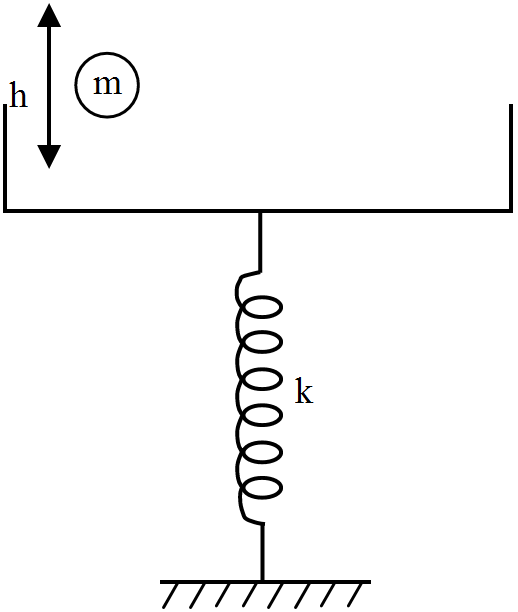
Drop in potential energy = Energy stored in spring
$\text{mg}(\text{h}+\text{x})=\frac{1}{2}\text{kx}^2$
$2 mgh + 2 mgh = kx^2$
$kx^2 – 2 mgh – 2 mgh = 0$
$\text{x}=\frac{2\text{mg}\pm\sqrt{4\text{m}^2\text{g}^2-4\text{k}.2\text{mgh}}}{2\text{k}}$
$\Rightarrow\text{x}=\frac{\text{mg}}{\text{k}}\pm\frac{\text{mg}}{\text{k}}\sqrt{1-\frac{2\text{kh}}{\text{mg}}}$. View full question & answer→Question 495 Marks
Consider a one-dimensional motion of a particle with total energy E. There are four regions A, B, C and D in which the relation between potential energy V, kinetic energy (K) and total energy E is as given below: Region A : V > E Region B : V < E Region C : K > E Region D : V > K State with reason in each case whether a particle can be found in the given region or not.
AnswerFor region A : V > E ⇒ E = V + K ⇒ K = E - V
; background:rgba(220,220,220,0.5))
V > E. So, K < 0 or KE is negative, Which is not possible. In region B : V < E ⇒ K= E - V ⇒ K > 0 This case is possible. Both energies are greater than zero. Region C : K > E ⇒ V = E - K ⇒ v < 0 PE is negative. This is laso possible because PE can be negative. Region D : V > K K = E - V This is also possible as PE for a system can be greater than KE.
View full question & answer→Question 505 Marks
If momentum of a body increased by 300%, then what will be percentage increase in momentum of a body?
AnswerConsider a particle of mass m moving with a velocity v So, that its $\text{KE}=\frac{1}{2}\text{mv}^2$ and momentum, p = mv. Thus, $\text{KE}=\frac{\text{P}^2}{2\text{m}}$ $\text{P}=\sqrt{2\text{mKE}}$ When KE is increased by 300%, then new KE KE' = KE + 300% of E = KE + 3KE = 4KE New momentum, $\text{P}'=\sqrt{2\text{mKE}'}$ $=\sqrt{2\text{m}\times4KE}$ $\therefore$ Percentage increase in momentu $=\frac{\text{P}'-\text{P}}{\text{P}}\times100$ $=\frac{2\text{P}-\text{P}}{\text{P}}\times100$ $=100\%$
View full question & answer→