Questions

4 Marks Question

🎯

Test yourself on this topic

28 questions · timed · auto-graded

Question 14 Marks
State giving reasons, which of the following transactions would improve, reduce or not change the Current Ratio, if Current Ratio of a company is 0.8 : 1:
  1. Cash paid to Trade Payables.
  2. Purchase of Stock-in-Trade on credit.
  3. Purchase of Stock-in-Trade for cash.
  4. Payment of Dividend payable.
  5. Bills Payable discharged.
  6. Bills Receivable endorsed to a creditor.
  7. Bills Receivable endorsed to a creditor dishonoured.
Answer
  1. Let’s assume Current Assets as ₹ 80,000 and Current Liabilities as ₹ 1,00,000
Current Ratio $=\frac{\text{Current Assets}}{\text{Current Liabilities}}$

Current Ratio $=\frac{80,000}{1,00,000}=0.8:1$
  1. Cash paid to Trade Payables (say ₹ 50,000)
Current Ratio $=\frac{80,000-50,000}{1,00,000-50,000}=0.6:1\text{ Reduce}$
  1. Purchase of Stock-in-Trade for cash (say ₹ 50,000)
Current Ratio $=\frac{80,000+50,000}{1,00,000+50,000}=0.87:1\text{ Improve}$
  1. Purchase of Stock-in-Trade for cash (say ₹ 50,000)
Current Ratio $=\frac{80,000+50,000-50,000}{1,00,000}=0.8:1\text{ No Change}$
  1. Payment of Dividend (say ₹ 50,000)
Current Ratio $=\frac{80,000-50,000}{1,00,000-50,000}=0.6:1\text{ Reduce}$
  1. Bills Payable discharged (say ₹ 50,000)
Current Ratio $=\frac{80,000-50,000}{1,00,000-50,000}=0.6:1\text{ Reduce}$
  1. Bills Receivable endorsed to a Creditor (say ₹ 50,000)
Current Ratio $=\frac{80,000-50,000}{1,00,000-50,000}=0.6:1\text{ Reduce}$
  1. Bills Receivable endorsed to a Creditor dishonoured (say ₹ 50,000)
Current Ratio $=\frac{80,000+50,000}{1,00,000+50,000}=0.87:1\text{ Improve}$
View full question & answer
Question 24 Marks
From the following information, calculate Gross Profit Ratio:
 
 
Credit Sales
5,00,000
Decrease in Inventory
10,000
Purchases
3,00,000
Returns Outward Wages
10,000
Carriage Inwards
10,000
Rate of Credit Sale to Cash Sale.
4 : 1
Answer
Credit Sales = 5,00,000
Rate of Credit Sale to Cash Sale = 4 : 1
$\text{Case Sales}=\frac{1}{4}\times5,00,000=₹\ 1,25,000$
Total Sales = Cash Sales + Credit Sales = ₹ 1,25,000 + ₹ 5,00,000 = ₹ 6,25,000
Cost of Goods Sold = Purchases – Return Outward + Carriage Inwards + Wages + Decrease in Inventory
= ₹ 3,00,000 - ₹ 10,000 + ₹ 10,000 + ₹ 50,000 + ₹ 10,000
= ₹ 3,60,000
Gross Profit = Total Sales - Cost of Goods Sold
= ₹ 6,25,000 - ₹ 3,60,000 = ₹ 2,65,000
Gross Profit Ratio $=\frac{\text{Gross Profit}}{\text{Net Sales}}\times100$
$=\frac{2,65,000}{6,25,000}\times100=42.40\%$
View full question & answer
Question 34 Marks
Calculate Return on Investment (ROI) from the following details: Net Profit after Tax ₹ 6,50,000; Rate of Income Tax 50%; 10% Debentures of ₹ 100 each ₹ 10,00,000; Fixed Assets at cost ₹ 22,50,000; Accumulated Depreciation on Fixed Assets up to date ₹ 2,50,000; Current Assets ₹ 12.00,000: Current Liabilities ₹ 4,00,000.
Answer
Net Fixed Assets = Fixed Assets (at cost) - Accumulated Depreciation
= 22,50,000 - 2,50,000 = 20,00,000
Capital Employed = Net Fixed Assets + Current Assets - Current Liabilities
= 20,00,000 + 12,00,000 - 4,00,000
= 28,00,000
Interest on 10% Debentures = 10% of 10,00,000 = 1,00,000
Let Profit before Tax be = x
Profit after Tax = Profit Before Tax - Tax
Tax Rate = 50%
$\therefore$ Tax = 0.5x
x - 0.5x = 6,50,000
x = 13,00,000
Net Profit before Tax = x = 13,00,000
Profit before Interest and Tax = Profit before Tax + Interest on Long-term Debt
= 13,00,000 + 1,00,000
= 14,00,000
Return on Investment = $\frac{\text{Net Profit before Interest and Tax}}{\text{Capital Employed}}\times100$
$=\frac{14,00,000}{28,00,000}\times100=50\%$
View full question & answer
Question 44 Marks
The Quick Ratio of a company is 0.8 : 1. State with reason, whether the following transactions will increase, decrease or not change the Quick Ratio:
  1. Purchase of loose tools for ₹ 2,000
  2. Insurance premium paid in advance ₹ 500
  3. Sale of goods on credit ₹ 3,000
  4. Honoured a bills payable of ₹ 5,000 on maturity.
Answer
  Transaction Impact
(i) Purchase of loose tools ₹ 2,000 As cash is going out, quick assets are decreasing by ₹ 2,000. So, quick ratio will decrease.
(ii) Insurance premium paid in advance ₹ 500 As cash is going out, quick assets are decreasing by ₹ 500. So, quick ratio will decrease.
(iii) Sale of goods on credit ₹ 3,000 As debtors increase, quick assets also increase by ₹ 3,000. So, quick ratio will increase.
(iv) Honoured a bills payable ₹ 5,000 on maturity As cash is going out, quick assets are decreasing by ₹ 5,000 and since bill is honoured current liabilities are decreasing. Thus, quick ratio will decrease.
View full question & answer
Question 54 Marks
From the following calculate:
  1. Current Ratio.
  2. Quick Ratio.
 
 
Total Debt.
6,00,000
Long-term Borrowings.
2,00,000
Total Assets.
8,00,000
Long-term Provisions.
2,00,000
Fixed Assets (Tangible).
3,00,000
Inventories
95,000
Non-current Investment.
50,000
Prepaid Expenses.
5,000
Long-term Loans and Advances.
50,000
 
 
Answer
  1. Current Ratio:
Current Assets = Total Assets - Fixed Assets - Non-Current Investment - Long term Loans and Advances.

= 8,00,000 - 3,00,000 - 50,000 - 50,000 = ₹ 4,00,000

Current Liabilities = Total Debt - Non-Current Liabilities.

= 6,00,000 - 2,00,000 - 2,00,000 = ₹ 2,00,000.

$\text{Current Ratio}=\frac{\text{Current Assets}}{\text{Current Liabilities}}$

$=\frac{4,00,000}{2,00,000}=2:1$
  1. QuickRatio:
Quick Assets = Current Assets - Stock-Prepaid Expenses

= 4,00,000 - 95,000 - 5,000 = ₹ 3,00,000

$\text{Quick Ratio}=\frac{\text{Quick Assets}}{\text{Current Liabilities}}$

$=\frac{3,00,000}{2,00,000}=1.5:1$
View full question & answer
Question 64 Marks
Debt to Equity Ratio of a company is 0.5 : 1. Which of the following suggestions would increase, decrease or not change it:
  1. Issue of Equity Shares.
  2. Cash received from debtors.
  3. Redemption of debentures.
  4. Purchased goods on credit?
Answer
Debt Equity Ratio = 0.5 : 1
Let Long- term Loan be = ₹ 5,00,000
Shareholders’ Funds = ₹ 10,00,000
$\text{Debt to Equity Ratio}=\frac{\text{Debt}}{\text{Equity}}$
$=\frac{5,00,000}{1,00,000}=\frac{0.5}{1}$
  1. Issue of Equity shares - Decrease
Reason: Issue of equity shares results in increase in Shareholders’ Funds in the form of equity shares but there will be no change in Long-term Loan.

Example: Issue of equity share ₹ 5,00,000

Shareholders’ Funds after issue of equity shares = 10,00,000 + 15,00,000 = ₹ 15,00,000

$\text{Debt to Equity Ratio}=\frac{\text{Debt}}{\text{Equity}}$

$=\frac{5,00,000}{15,00,000}=\frac{0.33}{1}$
  1. Cash received from Debtors - No Change
Reason: Cash received from debtors will increase one current asset in the form of cash and decrease other asset in the form of debtors. This transaction will have no effect on Long-term Loan and Shareholders’ Funds.
  1. Redemption of Debentures- Decrease
Reason: This transaction will result decrease in Long-term Loans in the form of reduction in debtors and no change in Shareholders’ Funds.

Example: Redemption of Debentures ₹ 2,00,000

Long-term Loan = 5,00,000 - 2,00,000 = 3,00,000

Debt to Equity Ratio after redempition of Debentures $=\frac{3,00,000}{10,00,000}=0.3:1$
  1. Purchased of goods on Credit - No Change
Reason: Neither Long-term loan nor share holders’ funds will be affected by this transaction because purchase of goods results no change in Long-term Loan and Shareholders’ Funds.
View full question & answer
Question 74 Marks
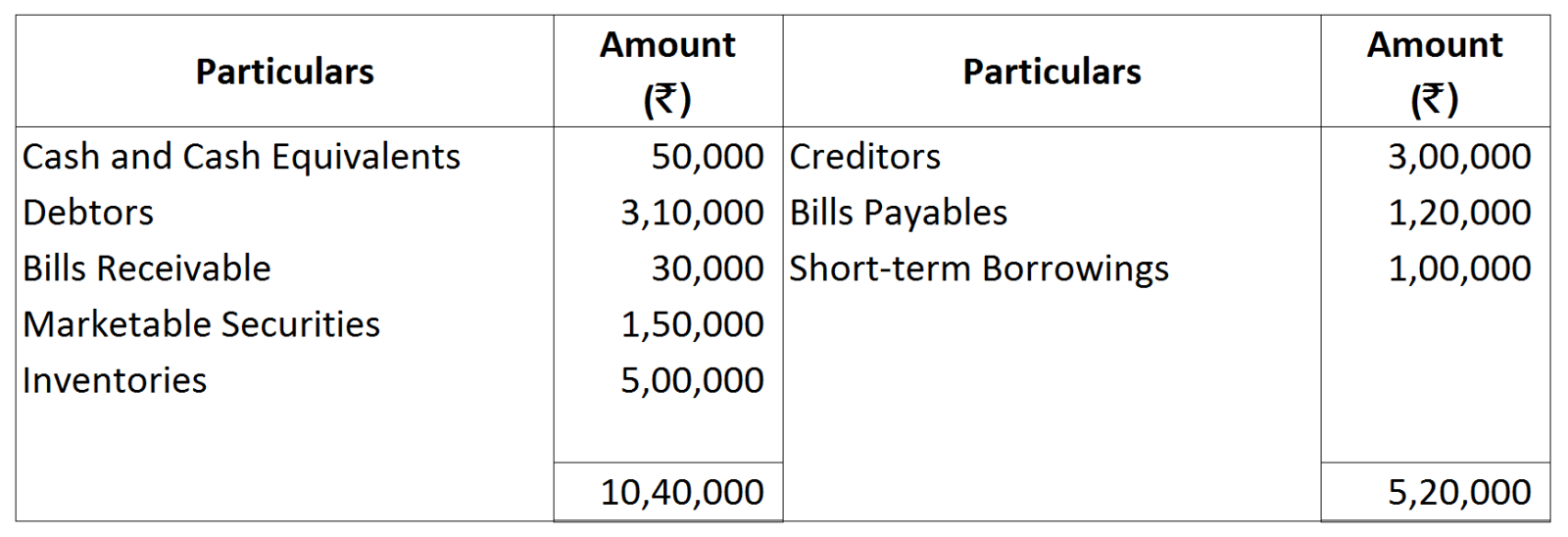
Current Assets and Current Liabilities of Times Ltd. are as follows:
Calculate Current Ratio and Liquid Ratio.
Answer
  1. Current Ratio
Current Assets = Inventories + Cash and Cash Equivalents + Debtors + Bills Receivable + Marketable Securities.

= ₹ 5,00,000 + ₹ 50,000 + ₹ 3,10,000 + ₹ 30,000 + ₹ 1,50,000 = ₹ 10,40,000

Current Liabilities = Short-Term Borrowings + Creditors + Bills Payable

= ₹ 1,00,000 + ₹ 3,00,000 + ₹ 1,20,000 = ₹ 5,20,000

$\text{Current Ratio}=\frac{\text{Current Assets}}{\text{Current Liabilities}}$

$=\frac{10,40,000}{5,20,000}=2:1$
  1. Liquid Ratio
Quick Assets = Currents Assets - Inventories

= ₹ 10,40,000 - ₹ 5,00,000 = ₹ 5,40,000

Or

Quick Assets = Cash and Cash Equivalents + Debtors + Bills Receivable + Marketable Securities

= ₹ 50,000 + ₹ 3,10,000 + ₹ 30,000 + ₹ 1,50,000 = ₹ 5,40,000

Current Liabilities = As calculated in (i) = ₹ 5,20,000.

$\text{Liquid Ratio}=\frac{\text{Liquid Assets or Quick Assets}}{\text{Current Liabilities}}$

$=\frac{₹\ 5,40,000}{₹\ 5,20,000}=1.04:1$
View full question & answer
Question 84 Marks
Calculate Operating Profit Ratio in the following:
Cost of Goods Sold, i.e., Cost of Revenue from Operations ₹ 8,00,000; Gross Profit 20% on Sales; Operating Expenses ₹ 50,000.
Answer
Gross Profit = 20% On Sales
Let Sales = x
$\therefore\text{Gross Profit}=\text{x}\times\frac{20}{100}$
$=\frac{20\text{x}}{100}$
Sales = Cost Goods Sold + Gross Profit
x = 8,00,000 + $\frac{20\text{x}}{100}$
or, $\frac{80\text{x}}{100}=8,00,000$
or. x = 10,00,000
$\therefore$ Sales = 10,00,000
Operating Cost = Cost of Goods Sold + Operating Expenses
= 8,00,000 + 50,000 = 8,50,000
Operating Profit = Net Sales - Cost of Goods Sold - Operating Expenses
= 10,00,000 - 8,00,000 - 50,000 = 1,50,000
Operating Profit Ratio = $\frac{\text{Operating Profit}}{\text{Net Sales}}\times100$
$=\frac{1,50,000}{1,00,000}\times100=15\%$
View full question & answer
Question 94 Marks
Ratio of Current Assets ₹ (8,75,000) to Current Liabilities (₹ 3,50,000) is 2.5 : 1. The firm wants to maintain Current Ratio of 2 : 1 by purchasing goods on credit. Compute amount of goods that should be purchased on credit.
Answer
Current Assets = ₹ 8,75,000
Current Liabilities = ₹ 3,50,000
Current Ratio = 2.5 : 1
The business is interested to maintain its Current Ratio at 2 : 1 by purchasing goods on credit.
Let the amount of goods purchased on credit be ‘x’
Current Liabilities = ₹ 3,50,000 + x
Current Assets = ₹ 8,75,000 + x
$\text{Current Ratio}=\frac{\text{Current Assets}}{\text{Current Liabilities}}$
$=\frac{8,75,000+\text{x}}{3,50,000+\text{x}}=\frac{2}{1}$
8,75,000 + x = 7,00,000 + 2x
8,75,000 – 7,00,000 = 2x - x
1,75,000 = x
$\therefore$ goods worth ₹ 1,75,000 must be purchased on credit to maintain the current ratio at 2 : 1.
View full question & answer
Question 104 Marks
From the following information, calculate value of Opening Inventory:
 
 
Car Closing Inventory.
=
68,000
Total Sales
=
4,80,000 (including Cash Sales ₹ 1,20,000)
Purchases.
=
3,60,000 (including Credit Purchases ₹ 2,39,200)
Goods are sold at a profit of 25% on cost.
Answer
Let Cost of Goods Sold be = x
$\text{Gross Profit}=\text{x}\times\frac{25}{100}=\frac{25\text{x}}{100}$
Cost of Good Sold = Sales - Gross Profit
or, $\text{x}=4,80,000-\frac{25\text{x}}{100}$
or, $\text{x}+\frac{25}{100}=4,80,000$
or, $\frac{125\text{x}}{100}=4,80,000$
or, $\text{x}=\frac{4,80,000\times100}{125}=3,84,000$
Cost of Goods Sold = x = ₹ 3,84,000
Cost of Goods Sold = Opening Inventory (Stock) + Purchases - Closing Inventory (Stock)
3,84,000 = Opening Inventory + 3,60,000 - 68,000
Opening Inventory = 3,84,000 - 2,92,000 = ₹ 92,000.
View full question & answer
Question 114 Marks
Following figures have been extracted from Shivalika Mills Ltd:
  • Inventory in the beginning of the year ₹ 60,000.
  • Inventory at the end of the year ₹ 1,00,000.
  • Inventory Turnover Ratio 8 times.
  • Selling price 25% above cost.
Compute amount of Gross Profit and Revenue from Operations (Net Sales).
Answer
Average Inventory $=\frac{\text{Opening Inventory+Closing Inventory}}{2}$
$=\frac{60,000+1,00,000}{2}=80,000$
Inventory Turnover Ratio $=\frac{\text{Cost of Goods Sold}}{\text{Average Inventory}}$
$8=\frac{\text{Cost of Goods Sold}}{80,000}$
Cost of Goods sold = ₹ 6,40,000
Gross Profit = 25% on Cost.
$\therefore\text{Gross Profit}=6,40,000\times\frac{25}{100}$
= 1,60,000
Sales = Cost of Goods Sold + Gross Profit
= 6,40,000 + 1,60,000 = 8,00,000.
View full question & answer
Question 124 Marks
State giving reason, whether the Current Ratio will improve or decline or will have no effect in each of the following transactions if Current Ratio is 2 : 1.
  1. Cash paid to Trade Payables.
  2. Bills Payable discharged.
  3. Bills Receivable endorsed to a creditor.
  4. Payment of final Dividend already declared.
  5. Purchase of Stock-in-Trade on credit.
  6. Bills Receivable endorsed to a Creditor dishonoured.
  7. Purchase of Stock-in-Trade for cash.
  8. Sale of Fixed Assets (Book Value of ₹ 50,000) for ₹ 45,000.
  9. Sale of Fixed Assets (Book Value of ₹ 50,000) for ₹ 60,000.
Answer
Let’s assume Current Assets as ₹ 2,00,000 and Current Liabilities as ₹ 1,00,000
$\text{Current Ratio}=\frac{\text{Current Assets}}{\text{Current Liabilities}}$
$\text{Current Ratio}=\frac{2,00,000}{1,00,000}=2:1$
  1. Cash paid to Trade Payables (say ₹ 50,000)
Current Ratio $=\frac{2,00,000-50,000}{1,00,000-50,000}=3:1$ (Improve)
  1. Bills Payable discharged (say ₹ 50,000)
Current Ratio $=\frac{2,00,000-50,000}{1,00,000-50,000}=3:1$ (Improve)
  1. Bills Receivable endorsed to a creditor (say ₹ 50,000)
Current Ratio $=\frac{2,00,000-50,000}{1,00,000-50,000}=3:1$
  1. Payment of final Dividend already declared (say ₹ 50,000)
Current Ratio $=\frac{2,00,000-50,000}{1,00,000-50,000}=3:1$ (Improve)
  1. Purchase of Stock-in-Trade on credit (say ₹ 50,000)
Current Ratio $=\frac{2,00,000+50,000}{1,00,000+50,000}=1.67:1$ (Decline)
  1. Bills Receivable endorsed to a Creditor dishonoured (say ₹ 50,000)
Current Ratio $=\frac{2,00,000+50,000}{1,00,000+50,000}=1.67:1$ (Decline)
  1. Purchase of Stock-in-Trade for cash (say ₹ 50,000)
Current Ratio $=\frac{2,00,000+50,000-50,000}{1,00,000}=2:1$ (No effect)
  1. Sale of Fixed Assets (Book value of ₹ 50,000) for ₹ 45,000
Current Ratio $=\frac{2,00,000+45,000}{1,00,000}=2.45:1$ (Improve)
  1. Sale of Fixed Assets (Book value of ₹ 50,000) for ₹ 60,000
Current Ratio $=\frac{2,00,000+60,000}{1,00,000}=2.6:1$ (Improve)
View full question & answer
Question 134 Marks
From the following information, calculate Opening and Closing Trade Receivables, if Trade Receivables Turnover Ratio is 3 Times:
  1. Cash Revenue from Operations is $\frac{1}{3}$rd of Credit Revenue from Operations.
  2. Cost of Revenue from Operations is ₹ 3,00,000.
  3. Gross Profit is 25% of the Revenue from Operations.
  4. Trade Receivables at the end are 3 Times more than that of in the beginning.
Answer
Trade Receivable Turnover Ratio $=\frac{\text{Credit Revenue from Operations}}{\text{Average Trade Receivables}}$
$3=\frac{3,00,000}{\text{Average Trade Receivables}}$
Average Trade Receivables $=\frac{3,00,000}{3}=₹\ 1,00,000$
Average Trade Receivables $=\frac{\text{Opening Trade Receivables + Closing Trade Receivables}}{2}$
$1,00,000=\frac{\text{x}+4\text{x}}{2}$
So, x would be ₹ 40,000
$\therefore$ Opening receivables would be ₹ 40,000 and, Closing Receivables would be ₹ 1,60,000 (40,000 × 4)
Revenue from Operations $=3,00,000+\frac{25}{75}\times3,00,000=₹\ 4,00,000$
Credit Revenue from Operations = Total Revenue from Operations - Cash Revenue from Opening.
$\text{x}=4,00,000-\frac{1}{3}\text{x}$
Credit Revenue from Operations = ₹ 3,00,000.
View full question & answer
Question 144 Marks
Inventory Turnover Ratio 5 times; Cost of Revenue from Operations (Cost of Goods Sold) ₹ 18,90,000. Calculate Opening Inventory and Closing Inventory if Inventory at the end is 2.5 times more than that in the beginning.
Answer
Inventory Turnover Ratio $=\frac{\text{Cost of Goods Sold}}{\text{Avarage Inventory}}$
$5=\frac{18,90,000}{\text{Average Inventory}}$
Let Opening Inventory = x
Closing Inventory = 2.5x + x = 3.5x
Average Inventory $=\frac{\text{Opning Inventory+Closing Inventory}}{2}$
$3,78,000=\frac{\text{x}+3.5\text{x}}{2}$
or, 4.5x = 7,56,000
or, x = 1,68,000
Opening Inventory = x = ₹ 1,68,000
Closing Inventory = 3.5x = 3.5 × 1,68,000 = ₹ 5,88,000.
View full question & answer
Question 154 Marks
Calculate Inventory Turnover Ratio in each of the following alternative case.
Case: Cash Sales 25% of Credit Sales; Credit Sales ₹ 3,00,000; Gross Profit 20% on Revenue from Operations, i.e., Net Sales; Closing Inventory ₹ 1,60,000; Opening Inventory ₹ 40,000.
Answer
Case:
Credit Sales = 3,00,000
Cash sales = 25% of Credit Sales
$\therefore \text{Case Sale}=3,00,000\times\frac{25}{100}$
= 75,000
Total Sales = Cash Sales + Credit Sales
= 3,00,000 + 75,000 = 3,75,000
Gross Profit = 20% on Sales
$\therefore\text{Gross Profit}=3,75,000\times\frac{20}{100}$
= 75,000
Cost of Goods Sold = Total Sales - Gross Profit
= 3,75,000 - 75,000 = 3,00,000
Average Stock $=\frac{\text{Opening Stock+Closing Stock}}{2}$
$=\frac{40,000+1,60,000}{2}=1,00,000$
Inventory Turnover Ratio $=\frac{\text{Cost of Goods Sold}}{\text{Average Inventory}}$
$=\frac{3,00,000}{1,00,000}=3\text{ Times}$
View full question & answer
Question 164 Marks
From the following information, determine Opening and Closing Inventories:
Inventory Turnover Ratio 5 Times, Total Sales ₹ 2,00,000, Gross Profit Ratio 25%. Closing Inventory is more by ₹ 4,000 than the Opening Inventory.
Answer
Sales = 2,00,000
Gross Profit = 25% on Sales
$\therefore\text{Gross Profit}=2,00,000\times\frac{25}{100}$
= 50,000
Cost of Goods Sold = Total Sales - Gross Profit
= 2,00,000 - 50,000 = 1,50,000
Inventory Turnover Ratio $=\frac{\text{Cost of Goods Sold}}{\text{Average Inventory}}$
$5=\frac{1,50,000}{\text{Average Inventory}}$
Average Inventory = 30,000
Let Opening Inventory = x
Closing Inventory = x + 4,000
Average Inventory $=\frac{\text{Opning Inventory+Closing Inventory}}{2}$
$30,000=\frac{\text{x+x}+4,000}{2}$
or, 60,000 = 2x + 4,000
or, x = 28,000
Opening Inventory = x = ₹ 28,000
Closing Inventory = x + 4,000 = 28,000 + 4,000 = ₹ 32,000.
View full question & answer
Question 174 Marks
Calculate Gross Profit Ratio from the following data:
Cash Sales are 20% of Total Sales; Credit Sales are ₹ 5,00,000; Purchases are ₹ 4,00,000; Excess of Closing Inventory over Opening Inventory ₹ 25,000.
Answer
Credit Sales = 5,00,000
Cash sales = 20% of Total Sales
Let Total Sales be ‘x’
Therefore, Cash Sales = 20% of x
Total Sales = Cash Sales + Credit Sales
$\text{x}=\frac{20}{100}\text{x}+5,00,000$
$\text{x}-\frac{20}{100}\text{x}=5,00,000$
$\frac{80}{100}\text{x}=5,00,000$
$\text{x}=\frac{5,00,000\times100}{80}=6,25,000$
Cost of Goods Sold = Purchases - Excess of Closing Stock over Opening Stock
= ₹ 4,00,000 - ₹ 25,000 = ₹ 3,75,000
Gross Profit = Total Sales - Cost of Goods Sold
= ₹ 6,25,000 – 3,75,000 = ₹ 2,50,000
Gross Profit Ratio $=\frac{\text{Gross Profit}}{\text{Net Sales}}\times100$
$=\frac{2,50,000}{6,25,000}\times100=40\%$
View full question & answer
Question 184 Marks
Calculate Gross Profit Ratio from the following data:
Average Inventory ₹ 3,20,000; Inventory Turnover Ratio 8 Times; Average Trade Receivables ₹ 4,00,000; Trade Receivables Turnover Ratio 6 Times; Cash Sales 25% of Net Sales.
Answer
Inventory Turnover Ratio = 8 times
Average Inventory = ₹ 3,20,000
Stock Turnover Ratio $=\frac{\text{Cost of Goods Sold}}{\text{Average Stock}}=\frac{\text{Cost of goods Sold}}{3,20,000}=8 \ \text{times}$
Cost of Goods sold = 25,60,000
Trade Receivables Turnover Ratio = 6 times
Average Trade Receivables = Rs 4,00,000
Trade Receivables Turnover Ratio $=\frac{\text{Net Credit Sales}}{\text{Average Trade Receivables}}$
$6=\frac{\text{Net Credit Sales}}{4,00,000}$
Net Credit Sales = 24,00,000
Total Sales = Cash Sales + Credit Sales
Total Sales = 25% of Total Sales + Credit Sales
75% of Total Sales = 24,00,000
Total Sales $=\frac{24,00,000}{75\%}=32,00,000$
Gross Profit = Total Sales - Cost of Goods Sold
= 32,00,000 - 25,60,000 = 6,40,000
Gross Profit Ratio $=\frac{\text{Gross Profit}}{\text{Net Sales}}\times100$
$=\frac{6,40,000}{32,00,000}\times100=20\%$
View full question & answer
Question 194 Marks
Calculate Trade Receivables Turnover Ratio in the following:
Case: Cost of Revenue from Operations or Cost of Goods Sold ₹ 3,00,000; Gross Profit on Cost 25%; Cash Sales 20% of Total Sales; Opening Trade Receivables ₹ 50,000; Closing Trade Receivables ₹ 1,00,000.
Answer
Case:
Cost of Goods Sold = 3,00,000
Gross Profit = 25% on Cost
$\therefore\text{Gross Profit}=\frac{25}{100}\times3,00,000=75,000$
Total Sales = Cost of Goods Sold + Gross Profit
= 3,00,000 + 75,000 = 3,75,000
Cash Sales = 20% of Total Sales
$\therefore\text{Case sales}=3,75,000\times\frac{25}{100}=75,000$
Credit Sales = Total Sales - Cash Sales
= 3,75,000 - 75,000 = 3,00,000
Avarage Trade Receivable $=\frac{\text{Opening Trade Receivable+Closing Trade Receivable}}2{}$
Avarage Trade Receivable $=\frac{50,000+1,00,000}{2}=75,000$
Trade Receivable Turnover Ratio $=\frac{\text{Net Credit Sale}}{\text{Average Trade Receivables}}$
Trade Receivable Turnover Ratio $=\frac{3,00,000}{75,000}=4\text{ Times}$
View full question & answer
Question 204 Marks
Gross Profit at 25% on cost; Gross Profit ₹ 5,00,000; Equity Share Capital ₹ 10,00,000; Reserves and Surplus ₹ 2,00,000; Long-term Loan ₹ 13,00,000; Fixed Assets (Net) ₹ 10,00,000. Calculate Working Capital-Turnover-Ratio:
[Hint: Working Capital = ₹ 5,00,000; Total Sales = ₹ 25,00,000.]
Answer
Gross Profit = 25% on Cost
Let Cost be = ₹ x
$\text{Gross Profit}=\text{x}\times\frac{25}{100}=\frac{25\text{x}}{100}$
or, $5,00,000=\frac{25\text{x}}{100}$
or, $\text{x}=\frac{5,00,000}{25}\times100 =20,00,000$
$\therefore$ Cost of Goods Sold = 20,00,000
Net Sales = Cost of Goods Sold + Gross Profit
= 20,00,000 + 5,00,000 = 25,00,000
Capital Employed = Equity Share Capital = Reserves and Surplus + Long-term Loan
= 10,00,000 + 2,00,000 + 3,00,000 + 15,00,00
Working Capital Turnover Ratio $=\frac{\text{Net Sales}}{\text{Working Capital}}$
$=\frac{25,00,000}{5,00,000}=5\text{ Times}$
View full question & answer
Question 214 Marks
₹ 3,00,000 is the cost of Revenue from Operations (Cost of Goods Sold).
Inventory Turnover Ratio 8 times; inventory in the beginning is 2 times more than the Inventory at the end. Calculate value of Opening and Closing Inventories.
Answer
Inventory Turnover Ratio $=\frac{\text{Cost of Goods Sold}}{\text{Avarage Inventory}}$
$8=\frac{3,00,000}{\text{Average Inventory}}$
Average Inventory = ₹ 37,500
Let Closing Inventory = x
Opening Inventory = 2x + x = 3x
Average Inventory $=\frac{\text{Opning Inventory+Closing Inventory}}{2}$
$37,500=\frac{3\text{x}+\text{x}}{2}$
or, 4x = 75,000
or, x = 18,750
Closing Inventory = x = ₹ 18,750
Opening Inventory = 3x = 3 × 18,750 = ₹ 56,250.
View full question & answer
Question 224 Marks
Closing Trade Receivables ₹ 4,00,000; Cash Sales being 25% of Credit Sales; Excess of Closing Trade Receivables over Opening Trade Receivables ₹ 2,00,000; Revenue from Operations, i.e., Net Sales ₹ 15,00,000. Calculate Trade Receivables Turnover Ratio.
Hints:
  1. Net Credit Sales = Total Sales - Cash Sales = ₹ 15,00,000 - 20% of ₹ 15,00,000 = ₹ 12,00,000.
  2. Opening Trade Receivables = Closing Trade Receivables - Excess of Closing Trade Receivables over Opening Trade Receivables.
Answer
Let Credit Sales be = x
Case Sale = 25% of Credit Sales
$\text{Case Sale}=\text{x}\times\frac{25}{100}=\frac{25\text{x}}{100}$
Total Sales = Cash Sales + Credit Sales
$15,00,000=\frac{25\text{x}}{100}+\text{x}$
or, $\frac{125\text{x}}{100}=15,00,000$
or, $\text{x}=\frac{15,00,000\times100}{125}=12,00,000$
Credit Sale = x = ₹ 12,00,000
Opening Trade Receivables = Closing Trade Receivables - 2,00,000
= 4,00,000 - 2,00,000 = 2,00,000.
Average Trade Receivable $=\frac{\text{Opning Trade Receivable+Closing Trade Receivables}}{2}$
Average Trade Receivable $=\frac{2,00,000+4,00,000}{2}=₹ \ 3,00,000$
Trade Receivable Turnover Ratio $=\frac{\text{Net Credit Sales}}{\text{Average Trade Receivables}}$
Trade Receivable Turnover Ratio $=\frac{12,00,000}{3,00,000}=4\text{ Times}$
Therefore, Trades Receivable Turnover Ratio is 4 Times.
View full question & answer
Question 234 Marks
₹ 1,75,000 is the Credit Revenue from Operations, i.e., Net Credit Sales of an enterprise. If Trade Receivables Turnover Ratio is 8 times, calculate Trade Receivables in the beginning and at the end of the year. Trade Receivables at the end is ₹ 7,000 more than that in the beginning.
Answer
Trade Receivable Turnover Ratio $=\frac{\text{Net Credit Sales}}{\text{Average Trade Receivables}}$
$8=\frac{1,75,000}{\text{Average Trade Receivables}}$
Average Trade Receivables = ₹ 21,875
Let Opening Trade Receivables = x
$\therefore$ Closing Trade Receivables = x + 7,000
Average Trade Recevables $=\frac{\text{Opening Trade Receivable+Closing Trade Receivable}}{2}$
$21,875=\frac{\text{x+x}+7,000}{2}$
or, 43,750 = 2x + 7,000
or, 2x = 36,750
or, x = ₹ 18,375
$\therefore$ Opening Trade Receivables = x = 18,375
Closing Trade Receivables = x + 7,000 = 25,375.
View full question & answer
Question 244 Marks
A firm had Current Assets of ₹ 5,00,000. It paid Current Liabilities of ₹ 1,00,000 and the Current Ratio became 2 : 1. Determine Current Liabilities and Working Capital before and after the payment was made.
Answer
Firm disposed off liabilities of ₹ 1,00,000 which results in decrease in current liabilities and current assets by the same amount.
After disposing liabilities:
Current Assets = ₹ 4,00,000 (₹ 5,00,000 - ₹ 1,00,000) And, Let Current Liabilities be (x - ₹ 1,00,000)
$\text{Current Ratio}=\frac{\text{Current Assets}}{\text{Current Liabilities}}$
$=\frac{4,00,000}{\text{x}-1,00,000}=\frac{2}{1}$
4,00,000 = 2x - 2,00,000
6,00,000 = 2x
Therefore, x = 3,00,000
Current Liabilities after payment = x - ₹ 1,00,000 = ₹ 2,00,000
Working Capital after Payment = Current Assets - Current Liabilities
= ₹ 4,00,000 - ₹ 2,00,000 = ₹ 2,00,000
Current Assets before payment = ₹ 5,00,000
Current Liabilities before Payment = ₹ 3,00,000
Therefore, Working Capital Before Payment = Current Assets - Current Liabilities
= ₹ 5,00,000 – ₹ 3,00,000 = ₹ 2,00,000.
View full question & answer
Question 254 Marks
Calculate Inventory Turnover Ratio in each of the following alternative case.
Case: Sales 20% of Total Sales; Credit Sales ₹ 4,50,000; Gross Profit 25% on Cost; Opening Inventory ₹ 37,500; Closing Inventory ₹ 1,12,500.
Answer
Case:
Let Total Sales = x
$\text{Case Sale}=\text{Total Sales}\times\frac{20}{100}$
$\text{Case Sales}=\text{x}\times\frac{20}{100}=\frac{20\text{x}}{100}$
Total Sales = Cash Sales + Credit Sales
$\text{x}=\frac{20\text{x}}{100}+4,50,000$
or, $\text{x}-\frac{20\text{x}}{100}+4,50,000$
or, $\frac{80\text{x}}{100}=4,50,000$
Or, x = 5, 62,500
Let Cost of Goods Sold = a.
Gross profit $=\text{a}\times\frac{25}{100}=\frac{25\text{a}}{100}$
Gross Profit = Sales - Cost of Goods Sold
$\frac{25\text{a}}{100}=5,62,500-\text{a}$
or, $\text{a}+\frac{25\text{a}}{100}=5,62,500$
or, $\frac{125\text{a}}{100}=5,62,500$
or, $\text{a} = 4,50,000$
Cost of Good Sold = a = 4,50,000
Average Stock $=\frac{\text{Opening Stock+Closing Stock}}{2}$
$=\frac{37,500+1,12,5000}{2}=75,000$
Stock Turnover Ratio $=\frac{\text{Cost of Goods Sold}}{\text{Average Stock}}$
$=\frac{4,50,000}{75,000}=6\text{ Times}$
View full question & answer
Question 264 Marks
Calculate Working Capital Turnover Ratio from the following information:
Revenue from Operations ₹ 30,00,000; Current Assets ₹ 12,50,000; Total Assets ₹ 20,00,000; Non-current Liabilities ₹ 10,00,000, Shareholders' Funds ₹ 5,00,000.
Answer
Working Capital Turnover Ratio $=\frac{\text{Net Sales}}{\text{Working Capital}}$
Revenue from Operations (Net Sales) = ₹ 30,00,000 (Given)
Working Capital = Current Assets - Current Liabilities
Current Assets = 12,50,000 (Given)
Current Liabilities = ?
Total Assets = Total Liabilities = ₹ 20,00,000 (Given)
Total Liabilities = Shareholders' Funds + Non-Current Liabilities + Current Liabilities
20,00,000 = 5,00,000 + 10,00,000 + Current Liabilities
Current Liabilities = ₹ 5,00,000
Working Capital = 12,50,000 - 5,00,000 = ₹ 7,50,000
Working Capital Turnover Ratio $=\frac{30,00,000}{7,50,000}=4\text{ Times}$
View full question & answer
Question 274 Marks
State giving reasons, which of the following transactions would improve, reduce or not change the Current Ratio, if Current Ratio of a company is 1 : 1.
  1. Cash paid to Trade Payables.
  2. Purchase of Stock-in-Trade on credit.
  3. Purchase of Stock-in-Trade for cash.
  4. Payment of Dividend payable.
  5. Bills Payable discharged.
  6. Bills Receivable endorsed to a creditor.
  7. Bills Receivable endorsed to a creditor dishonoured.
Answer
  1. Let’s assume Current Assets as ₹ 1,00,000 and Current Liabilities as ₹ 1,00,000
Current Ratio $=\frac{\text{Current Assets}}{\text{Current Liabilities}}$

Current Ratio $=\frac{1,00,000}{1,00,000}=1:1$
  1. Cash paid to Trade Payables (say ₹ 50,000)
Current Ratio $=\frac{1,00,000-50,000}{1,00,000-50,000}=1:1\text{ No Change}$
  1. Purchase of Stock-in-Trade on credit (say ₹ 50,000)
Current Ratio $=\frac{1,00,000+50,000}{1,00,000+50,000}=1:1\text{ No Change}$
  1. Purchase of Stock-in-Trade for cash (say ₹ 50,000)
Current Ratio $=\frac{1,00,000+50,000-50,000}{1,00,000}=1:1\text{ No Change}$
  1. Payment of Dividend (say ₹ 50,000)
Current Ratio $=\frac{1,00,000-50,000}{1,00,000-50,000}=1:1\text{ No Change}$
  1. Bills Payable discharged (say ₹ 50,000)
Current Ratio $=\frac{1,00,000-50,000}{1,00,000-50,000}=1:1\text{ No Change}$
  1. Bills Receivable endorsed to a Creditor (say ₹ 50,000)
Current Ratio $=\frac{1,00,000-50,000}{1,00,000-50,000}=1:1\text{ No Change}$
  1. Bills Receivable endorsed to a Creditor dishonoured (say ₹ 50,000)
Current Ratio $=\frac{1,00,000+50,000}{1,00,000+50,000}=1:1\text{ No Change}$
View full question & answer
Question 284 Marks
Compute Gross Profit Ratio from the following information:
Revenue from Operations, i.e., Net Sales = ₹ 4,00,000; Gross Profit 25% on Cost.
Answer
Gross Profit = 25% On Cost
Let Cost = x
$\therefore\text{Gross Profit}=\text{x}\times\frac{25}{100}=\frac{25\text{x}}{100}$
Sales = Cost + Gross Profit
$4,00,000=\text{x}+\frac{25\text{x}}{100}$
or, $4,00,000=\frac{125\text{x}}{100}$
or, $\text{x}=\frac{4,00,000\times100}{125}=3,20,000$
Cost = x = ₹ 3,20,000
Gross Profit = Sales - Cost
= 4,00,000 - 3,20,000 = 80,000
Gross Profit Ratio $=\frac{\text{Gross Profit}}{\text{Net Sales}}\times100$
$=\frac{80,000}{4,00,000}\times100=20\%$
View full question & answer
4 Marks Question - Accountancy STD 12 Commerce Questions - Vidyadip