Questions · Page 1 of 3

4 Marks Question

🎯

Test yourself on this topic

50 questions · timed · auto-graded

Question 14 Marks
  1. What is meant by activity Ratios'?
  2. From the following information calculate inventory turnover ratio; Revenue from operations ₹ 16,00,000; Average Inventory ₹ 2,20,000; Gross Loss Ratio 5%.
Answer
  1. Activity ratios refers to the ratios that are calculated for measuring the efficiency of operations of business based on effective utilisation of resources.
  2. Calculation of Inventory Turnover Ratio
$\text{Inventory Turnover Ratio}=\frac{\text{Cost of Revenue from Operations}}{\text{Average Inventory}}$
Cost of Revenue from Operations = Revenue from Operations + Gross Loss

= ₹ 16,00,000 + ₹ 80,000 = ₹ 16,80,000

Average Inventory = ₹ 2,20,000
$\text{Inventory Turnover Ratio}=\frac{\text{₹ 16,80,000}}{\text{₹ 2,20,000}}$

= 7.64 times
View full question & answer
Question 24 Marks
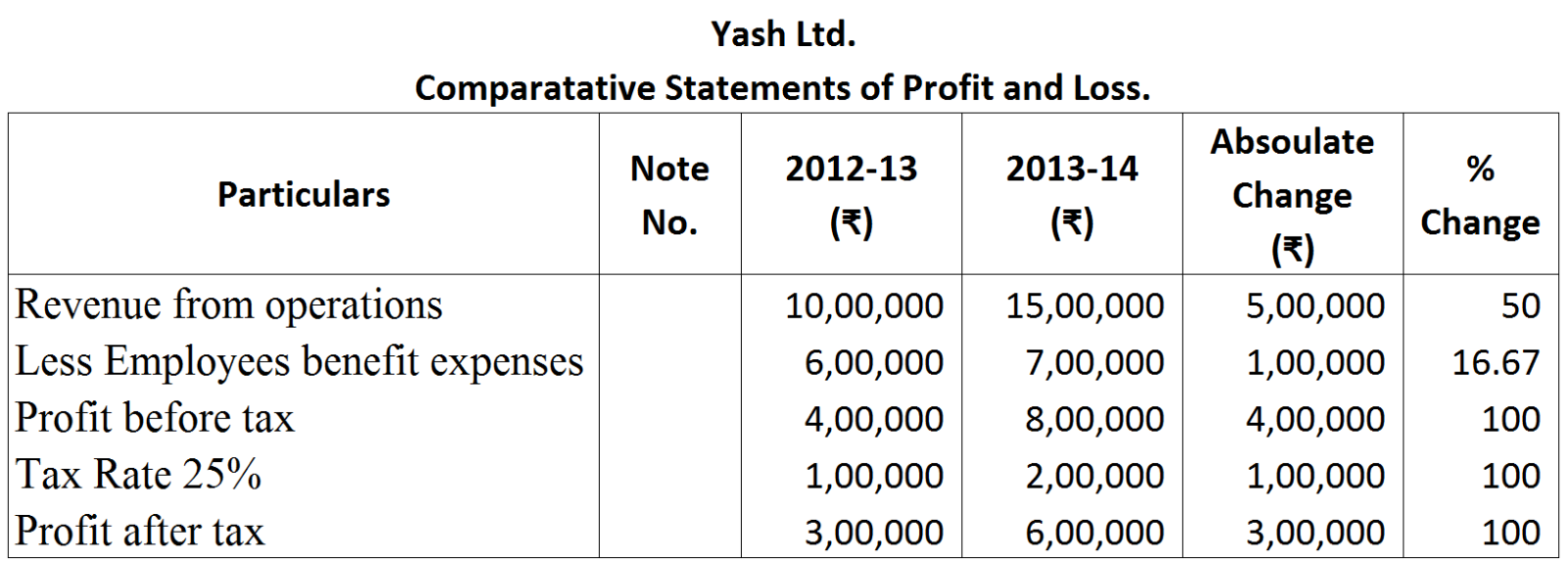
The motto of ' Pharma Ltd.', a company engaged in the manufacturing of low-cost generic medicines, is 'Healthy India'. Its management and employees are hardworking, honest and motivated. The net profit of the company doubled during the year ended $31.3.2014$. Encouraged by its performance, the company decided to pay bonus to all employees at double the rate than last year.
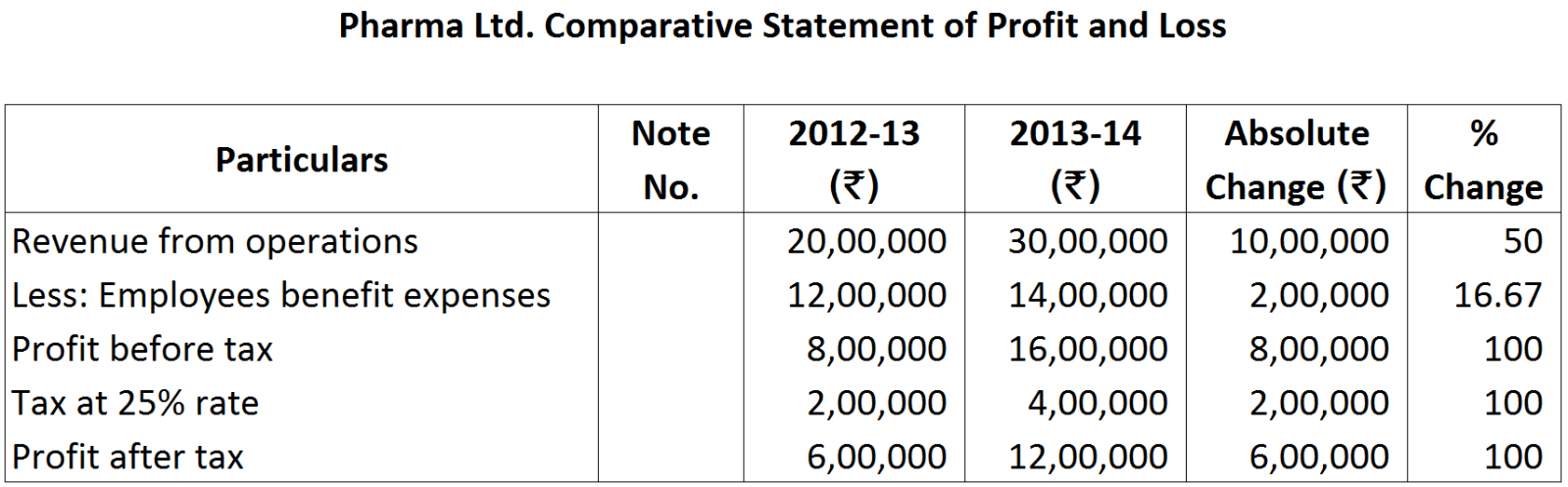
Following is the Comparative Statement of Profit and Loss of the company for the years ended $31.3.2013$ and $31.3.2014$.
  1. Calculate Net Profit Ratio for the years ending $31^{th}$ March $2013$ and $2014$.
  2. Identify any two values which 'Pharma Ltd.' is trying to propagate.
Answer
  1. $\text{Net Profit Ratio}=\frac{\text{Net Profit}}{\text{Revenue from operations}}\times{100}$
$\text{As on 31-03-2013 }=\frac{\text{Net Profit}}{\text{Revenue from operations}}\times{100}$
$=\frac{6,00,000}{20,00,000}\times100$
= 30%
$\text{As on 31-03-2014}=\frac{\text{Net Profit}}{\text{Revenue from operations}}\times100$
= $\frac{12,00,000}{30,00,000}\times100$
= 40%
  1. Values:
  • Participation of Employees in excess profits.
  • Treating employees a part of the company.
  • Ethical practices of company.
  • Hardwork and honesty of employees.
  • Serving the organisation with dignity.
View full question & answer
Question 34 Marks
The proprietary ratio of M. Ltd. is 0·80 : 1.
State with reasons whether the following transactions will increase, decrease or not change the proprietary ratio:
  1. Obtained a loan from bank ₹ 2,00,000 payable after five years.
  2. Purchased machinery for cash ₹ 75,000.
  3. Redeemed 5% redeemable preference shares ₹ 1,00,000.
  4. Issued equity shares to the vendors of machinery purchased for ₹ 4,00,000.
Answer
Transaction Effect on Quick Ratio Reasons
(i) Decrease No change in Shareholders’ funds but total assets will increase by ₹ 2,00,000.
(ii) No Change No change in total assets and Shareholders’ funds.
(iii) Decrease Both Shareholders’ funds and total assets are decreased by same amount.
(iv) Increase Shareholders’ funds and total assets both are increased.
View full question & answer
Question 44 Marks
  1. The quick ratio of a company is 1.5 : 1. State with reason which of the following transactions would (i) increase; (ii) decrease or (iii) not change the ratio:
  1. Paid rent ₹ 3,000 in advance.
  2. Trade receivables included a debtor Shri Ashok who paid his entire amount due ₹ 9,700.
  1. From the following information compute ‘Proprietary Ratio’:
 
Long Term Borrowings
2,00,000
Long Term Provisions
1,00,000
Current Liabilities
50,000
Non-Current Assets
3,60,000
Current Assets
90,000
Answer
  1.  
  1. Decrease
Reason: Liquid assets will decrease with no change in current liabilities.
  1. No change in the ratio
Reason: Increase in cash and decrease in debtors with no change in liquid assets.
  1. $\text{Proprietary ratio}=\frac{\text{Share holders funds }}{\text{Total assets }}$
$=\frac{₹1,00,000}{₹4,50,000}$

= .22 : 1 or 22%
Shareholders funds = Current assets + Non current assets – Long term borrowings – Long term provisions – Current liabilities
= ₹ 90,000 + ₹ 3,60,000 – ₹ 2,00,000 – ₹ 1,00,000 – ₹ 50,000 = ₹ 1,00,000 Total Assets = Current Assets + Non current assets
= ₹ 90,000 +₹ 3,60,000
= ₹ 4,50,000
View full question & answer
Question 54 Marks
The Current Ratio of a company is 2·1 : 1·2. State with reasons which of the following transactions will increase, decrease or not change the ratio:
  1. Redeemed 9% debentures of ₹ 1,00,000 at a premium of 10%.
  2. Received from debtors ₹ 17,000.
  3. Issued ₹ 2,00,000 equity shares to the vendors of machinery.
  4. Accepted bills of exchange drawn by the creditors ₹ 7,000.
Answer
 
 
Reason
(i)
Increase/Decrease
if redemption of debentures takes place in the current year where outstanding debentures considered as current liability in such case ratio will increase.
Alternatively, Redemption of Debenture will decrease cash, but current liabilities will remain the same.
(ii)
No change
It will increase cash and decrease debtors with the same amount. No change in current assets and current liabilities.
(iii)
No change
Both current assets and current liabilities are not affected.
(iv)
No change
No change in current assets and current liabilities. Because increase in one current liability results in decrease in another current liability with the same amount.
View full question & answer
Question 64 Marks
Compute 'Debtors Turnover Ratio' from the following information:
a. Total Sales $₹ 5,20,000,$ Cash Sales $60 \%$ of the Credit Sales, Closing Debtors $₹ 80,000$, Opening Debtors are $3 / 4^{\text {th }}$ of Closing Debtors.
b. Current liabilities of a company are ₹ $1,60,000$. Its Liquid ratio is $1.5: 1$ and Current ratio is $2.5: 1$. Calculate Quick assets and Current assets.
Answer
  1. ${\text{Debtors Turnover Ratio}=\frac{\text{Net Credit Sales}}{\text {Average Debtors}}}$
$=\frac{\text{₹ 32,500}}{\text {₹ 7,0000}}=4.64\text{times}$
Notes:
  1. Calculation of Credit Sales or Credit Revenue from Operations:
Let the Credit sales = x; Cash sales or Cash Revenue from Operations$= .6x$
Credit Sales + Cash sales = total sale
$x + .6x = ₹ 520000$
$1.6x = ₹ 520000$
$x = ₹ 520000/1.6 =, 325000$ (Credit Sales)
  1. $\text{Average Debtors (Average Trade Receivables}=\frac{\text{Opening Debtors+ Closing Debtors}}{2}$
$=\frac{₹60,000\ +\ 80,000}{2}=₹\ 7000$
$\text{Opening Debtors}=₹\ 80000\times\frac{3}{4}=₹\ 60,000$
  1. Current Assets $= 160000 \times 2.5 = ₹ 4,00,000$
Quick Assets $= 160000 \times 1.5 = ₹ 2,40,000$
View full question & answer
Question 74 Marks
Calculate Current Ratio of a company from the following information:
Stock Turnover Ratio: 4 times
Stock in the end was ₹ 20,000 more than stock in the beginning.
Sales ₹ 3,00,000 Gross Profit Ratio 25%
Current Liabilities ₹ 40,000 Quick Ratio 0.75 : 1.
Answer
Stock turnover ratio = 4 times = cost of goods sold/average stock
Cost of goods sold = Sales - Gross profit = 3,00,000 - 75,000 = 2,25,000
Ave. stock = op. stock + closing stock/2 = X + X + {20,000)/2 = 2,25,000/4 = 56,250
let the opening stock be ‘X’ 2x + 20,000/2 = 56250, 2x = 56250 - 20,000 x 2
x = 92500/2 = 46250 op. stock = 46250 cl. stock = 46250 + 20,000 = 66250
Current liabilities = 40,000 Quick assets 0.75:1 = 40,000/0.75 = 30,000
Current assets = quick assets + stock = 30,000 + 66250 = 96250
Current ratio = current assets/current liabilities = 96250/40,000 = 2.41 : 1.
View full question & answer
Question 84 Marks
Assuming that the Debt-Equity ratio is 2, State giving reasons whether this ratio would increase, decrease or remain unchanged in the following cases:
  1. Purchase of fixed asset on a credit of 2 months.
  2. Purchase of fixed asset on a long term deferred payment basis.
  3. Issue of new shares for cash.
  4. Issue of bonus shares.
  5. Sale of fixed asset at a loss of ₹ 3,000.
Answer
 
Effect
$\text{Reason}\ \ \frac{1,80,000}{2}$
a)
No Change
Neither the equity nor the debts are affected.
b)
Increase
As the Debts are increasing.
c)
Decrease
As Share holders fund will increase.
d)
No Change
As both remain unaffected.
e)
Increase
As Equity will be decreased.
View full question & answer
Question 94 Marks
  1. A business has a current ratio of 3: 1 and quick ratio of 1.2:1. If the working capital is ₹ 1,80,000/-, calculate the total Current liabilities and value of Stock.
  2. From the given information calculate the Stock turnover ratio. Sales ₹ 2,00,000; GP : 25% on cost; Stock at the beginning is 1/3 of the stock at the end which was 30% of sales.
Answer
  1. $\text{Current Ratio}=\frac{\text{Current Assets}}{\text{Current Liabilities}}$$=\frac{3}{1}$
Current Assets = 3 Current Liabilities

Working Capital = Current Assets – Current Liabilities

1,80,000 = 3 Current Liabilities – Current Liabilities

1,80,000 = 2Current Liabilities

Current Liabilities = 90, 000
  1. Sales 2,00,000 GP @ 25% on cost = 40,000 CGS = 1,60,000
CL stock 30% of Sales = 60,000, OP stock 1/3 of C.St. = 20,000, AV

Stock = 40,000, STR = 1,60,000/40,000 = 4 times
View full question & answer
Question 104 Marks
  1. Net Profit after Interest but before tax: ₹ 1,40,000; 15% long-term debts: ₹ 4,00,000; Shareholders funds: ₹ 2,40,000; Tax rate 50%. Calculate Return on Capital Employed.
  2. Opening Stock: ₹ 60,000; Closing Stock: ₹ 1,00,000; Stock Turnover Ratio 8 times; Selling price 25% above cost. Calculate the Gross Profit Ratio.
Answer
  1. Net profit after interest but before tax = ₹ 1,40,000.
Interest = 15% of 4,00,000.

= ₹ 60,000.

Net profit before interest and tax = 1,40,000 + 60,000 = 2,00,000.

Capital Employed = Long terms debts + Shareholders funds.

= ₹ (4,00,000 + 2,40,000) = ₹ 6,40,000.

$\text{Return on capital employed}=\frac{\text{Net profit before interest and tax}}{\text{Capital employed.}}$

$=\frac{2,00,000}{6,40,000} \times100.$

= 31.25 %.
  1. $\text{Average Stock = Opening Stock}+\frac {\text{Closing Stock}}2$
$=\frac{160000}{2}= 80000/-$

$\text{Stock Turnover Ratio}=\frac{\text{Cost of goods sold}}{\text{Average stock}}$

$8=\frac{\text{Cost of goods sold}}{80000}$

Therefore, Cost of goods sold = 6,40,000/-

$\text{Selling price}=\text{25% above Cost}=640000+\frac{1}{4}\times640000 = 8,00,000/-$

$\text{Gross Profit Ratio}=\frac{\text{Gross Profit}}{\text{sales}}\times100$

$=\frac{1,60,000}{8,00,000} \times100$

= 20%.
View full question & answer
Question 114 Marks
From the following information calculate any two of the following ratios:
  1. Net Profit Ratio
  2. Debt-Equity Ratio
  3. Quick Ratio
Information:
 
Paid up Capital
20,00,000
Capital Reserve
2,00,000
9% Debentures
8,00,000
Net Sales
14,00,000
Gross Profit
8,00,000
Indirect Expenses
2,00,000
Current Assets
4,00,000
Current Liabilities
3,00,000
Opening Stock
50,000
Closing Stock ---- 20% more than opening stock
Answer
Any Two of the following ratios:
  1. $\text{Net Profit Ratio}=\frac{\text{Net Profit}}{\text{Net Sales}}\times{10}$
Net Profit = Gross Profit – Indirect expenses

= 8,00,000 – 2,00,000

= Rs. 6,00,000

$\text{Net Profit Ratio}=\frac{6,00,000}{14,00,000}\times{100} $

= 42.86 %
  1. $\text{Debt Equity Ratio}=\frac{\text{Debt}}{\text{Equity}} $
Debt = Debentures = Rs. 8,00,000

Equity = Equity Share Capital + Capital Reserve

= 20,00,000 + 2,00,000

= Rs.22,00,000

$\text{Debt Equity Ratio}=\frac{8,00,000}{22,00,000}=4:11 $

$\text{Debt equity Ratio}=\frac{8,00,000}{28,00,000}=2 : 7 $
  1. $\text{Quick Ratio}=\frac{\text{Liquid Assets}}{\text{Current Liabilities}}$
Liquid Assets = Current Assets – Closing Stock

Liquid Assets = 4,00,000 - 60,000

= ₹ 3,40,000

Current Liabilities = ₹ 3,00,000

$\text{Quick Ratio}=\frac{3,40,000}{3,00,000}=17: 15\ \text{ or}\ 1.13 :1 $
View full question & answer
Question 124 Marks

From the following information, calculate any two of the following ratios:
  1. Debt-Equity Ratio;
  2. Working Capital Turnover Ratio;
  3. Return on Investment.
Information:
Equity Share Capital ₹ 10,00,000; General Reserve ₹ 1,00,000; Profit and Loss Account after Tax and Interest ₹ 3,00,000; 12% Debentures ₹ 4,00,000; Creditors ₹ 3,00,000; Land and Building ₹ 13,00,000; Furniture ₹ 3,00,000; Debtors ₹ 2,90,000; Cash ₹ 1,10,000 and Preliminary expenses ₹1,00,000.
Sales for the year ended 31.3.2011 was ₹ 30,00,000 and Tax paid 50%.
Answer
  1. $\text{Debt Equity Ratio }= \frac{\text{Debt}}{\text{Equity}}$
Debt = 12% Debenture

= ₹ 4,00,000

Equity = Equity share Cap. + Gen. Res. + Pr.& Loss. A/c – Preliminary Expenses

= 10,00,000 + 1,00,000 + 3,00,000 - 1,00,000

= ₹ 13,00,000

Debt EquityRatio = $\frac{4,00,000} {13,00,000}$

= 0.30 :1
  1. $\text{Working Capital TurnoverRati}=\frac{\text{Net Sales}}{\text{Working Capital}} \frac{30,00,000}{1,00,000}=\ 30\ \text{Times}$
Working Capital = Current Assets – Current Liabilities

= 4,00,000 - 3,00,000 = ₹ 1,00,000
  • Current Assets = Debtor + Cash = 2,90,000 + 1,10,000 = ₹ 4,00,000
  • Current Liabilities =Creditors = ₹ 3,00,000
  1. $\text{Return on Investment = }\frac{\text{profit before interest & tax }\times100}{\text{Capital Employed}}$
$=\frac{6,48,000\times 100}{17,00,000}=\ \text{ 38.12 %}$

$\text{Profit Before Tax = }\frac{\text{profit Afte tax}\times100}{\text{100 - tax rate}}= \ \ \frac{3,00,000 100\times 100}{50}=\ \text{₹ 6,00,000}$
  • Profit before Interest and Tax = 6,00,000 + 48,000 [Interest on Debentures]
= ₹ 6,48,000
  • Capital Employed = Equity Share Capital + General Reserve + P/LA/c + 12% Debentures – Preliminary Expenses.
= 10,00,000 + 1,00,000 + 3,00,000 + 4,00,000 - 1,00,000

= ₹ 17,00,000

Alternate Answer

Capital Employed = Net fixed Assets + Working Capital

= 16,00,000 + 1,00,000 = ₹ 17,00,000
View full question & answer
Question 134 Marks
  1. What is meant by ‘Liquidity’ of business?
  2. From the following details obtained from the financial statements of JN Ltd. calculate ‘interest coverage ratio.
Net profit after tax ₹ 2,00,000; 12% Long-Term Debt ₹ 40,00,000; Rate of tax 40%.
Answer
  1. Profitability of business refers to the earning capacity of the business.
  2. $\text{Interest Coverage Ratio}=\frac{\text{Net Profit before Interest and Tax}}{\text{Fixed Interest Charges}}$
Net Profit after tax = ₹ 2,00,000
Tax rate = 40%
Net Profit before tax = ₹ 2,00,000 x 100 /60
= ₹ 3,33,333
Add: Interest
 
12% Long term debt i.e 12/100 x ₹ 40,00,000
= 4,80,000
Profit before Interest and Tax
8,13,333
$\text{Interest Coverage Ratio}=\frac{₹\ 8,13,333} {₹\ 4,80,000}$
= 1.69 times
View full question & answer
Question 144 Marks
State with reason whether the following transactions will increase, decrease or not change the ‘Return on Investment’:
  1. Purchase of machinery worth ₹ 2,00,000 by issue of equity shares.
  2. Charging depreciation of ₹ 5,000 on machinery.
  3. Redemption of debentures in cash ₹ 70,000.
  4. Converting ₹ 50,000, 9% debentures into equity shares.
Answer
Transaction Effect on Return on
Investment
Reasons
(i) Decrease No change in Net Profit before Interest and
Tax and increase in capital employed
(ii) Decrease Decrease in Net Profit before Interest and Tax
and in capital employed
(iii) Increase No change in Net Profit before Interest and
Tax but decrease in capital employed
(iv) No change No change in Net Profit before Interest and
Tax and capital employed
View full question & answer
Question 154 Marks
  1. What is meant by ‘Profitability’ of business?
  2. From the following details obtained from the financial statements of JN Ltd. calculate ‘interest coverage ratio.
Net profit after tax ₹ 2,00,000; 12% Long-Term Debt ₹ 40,00,000; Rate of tax 40%.
Answer
  1. Profitability of business refers to the earning capacity of the business.
  2. $\text{Interest Coverage Ratio}=\frac{\text{Net Profit before Interest and Tax}}{\text{Fixed Interest Charges}}$
Net Profit after tax = ₹ 2,00,000
Tax rate = 40%
Net Profit before tax = ₹ 2,00,000 x 100/60
= ₹ 3,33,333
Add: Interest
 
12% Long term debt i.e 12/100 x ₹ 40,00,000
4,80,000
Profit before Interest and Tax
8,13,333
$\text{Interest Coverage Ratio} =\frac{₹\ 8,13,333} {₹\ 4,80,000}$
= 1.69 times
View full question & answer
Question 164 Marks
The Quick ratio of a company is 0.8 : 1. State with reason whether the following transactions will increase, decrease or not change the quick ratio:
  1. Purchase of loose tools ₹ 2,000.
  2. Insurance premium paid in advance ₹ 500.
  3. Sale of goods on credit ₹ 3,000.
  4. Honoured a bills payable ₹ 5,000 on maturity.
Answer
Transaction Effect on Quick Ratio Reasons
(i) Decrease Quick assets have decreased but current
liabilities have not changed.
(ii) Decrease Quick assets have decreased but current
liabilities have not changed.
(iii) Increase Quick assets have increased but current
liabilities have not changed.
(iv) Decrease Both Quick assets and Current Liabilities have
decreased by the same amount.
View full question & answer
Question 174 Marks
  1. What is meant by ‘Profitability’ of business?
  2. From the following information calculate Operating Profit Ratio:
Opening Stock ₹ 10,000; Purchases ₹ 1,20,000; Revenue from operations ₹ 4,00,000; Purchase Returns ₹ 5,000; Returns from Revenue from operations ₹ 15,000; Selling Expenses ₹ 70,000; Administrative Expenses ₹ 40,000; Closing Stock ₹ 60,000.
Answer
$\text{Operating Profit Ratio } = \frac{\text{ Operating Profit }}{\text{Net Revenue from Operations }}\times{100}$
Net Revenue from Operations = ₹ 4,00,000- ₹ 15,000 = ₹ 3,85,000
Cost of revenue from operations = Opening Stock + Purchases – Purchase return – Closing Stock
= ₹ (10,000 +1,20,000 – 5,000 – 60,000)
= ₹ 65,000
Gross Profit = Net Revenue from operations – Cost of revenue from operations
= ₹ 3,85,000 – ₹ 65,000
= ₹ 3,20,000
Operating Expenses = Selling expenses + Administrative expenses
= ₹ 70,000 + ₹ 40,000
= ₹ 1,10,000
Operating Profit = Gross Profit - Operating Expenses
= ₹ 3,20,000 – ₹ 1,10,000
= ₹ 2,10,000
$\text{Operating Profit Ratio}= \frac{₹\ 2,10,000}{ ₹\ 3,85,00}\times{100}\\\ \ \ \ \ \ \ \ \ \ \ \ \ \ \ \ \ \ \ \text{= 54.55%}$
View full question & answer
Question 184 Marks
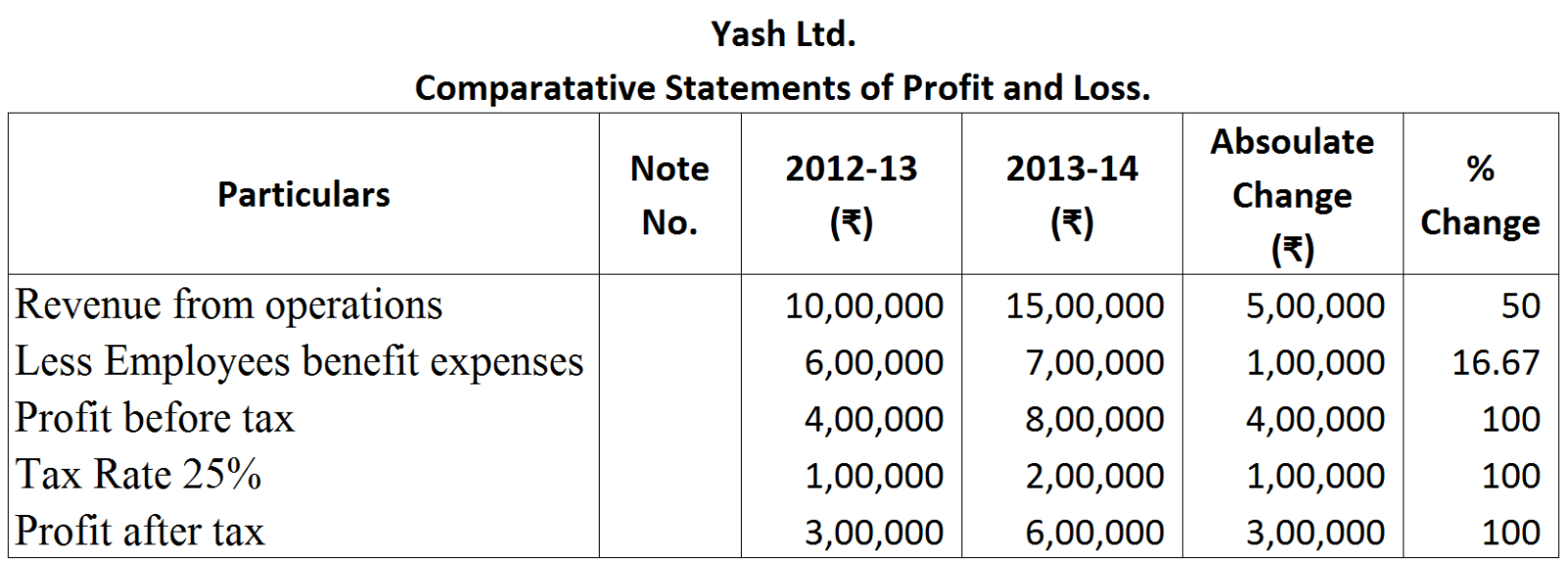
The motto of Yash Ltd., an advertising company is ‘Service With Dignity’. Its management and work force is hard-working, honest and motivated. The net profit of the company doubled during the year ended $31-3-2014$. Encouraged by its performance company decided to give one month extra salary to all its employees. Following is the Comparative Statement of Profit and Loss of the company for the years ended $31^{st}$ March $2013$ and $2014$.
  1. Calculate Net Profit Ratio for the years ending $31^{st}$ March, $2013$ and $2014$.
  2. Identify any two values which Yash Ltd. is trying to propagate.
Answer
  1. $\text{Net Profit Ratio}=\frac{\text{Net Profit after tax}}{\text{ Revenue from operations}}\times100$
$\text{As on 31-03-2013 }=\frac{\text{3,00,000}}{\text{ 10,00,000}}\times100$
= 30%
$\text{As on 31-03-2014}=\frac{\text{6,00,000}}{\text{ 15,00,000}}\times100$
= 40%
  1. Values:
  • Participation of Employees in excess profits.
  • Treating employees a part of the company.
  • Ethical practices of company
  • Hardwork and honesty of employees.
  • Serving the organisation with dignity.
View full question & answer
Question 194 Marks
  1. From the following information compute 'Debt-Equity Ratio'.
 
Long term Borrowings 8,00,000
Long term Provisions 4,00,000
Current Liabilities 2,00,000
Non-current Assets 14,40,000
Current Assets 3,60,000
  1. The Quick Ratio of Z Ltd. is 1 : 1. State with reason which of the following transactions would (i) increase; (ii) decrease or (iii) not change the ratio:
  1. Included in the trade payables was a Bills payable of ₹ 3,000 which was met on maturity.
  2. Debentures of ₹ 50,000 were converted into Equity shares.
Answer
  1. $\text{Debt Equity ratio}=\frac{\text{Debt}}{\text{ Equity}}$
Debt = Long term borrowings + Long term provisions = ₹ 8,00,000 + 4,00,000 = 12,00,000

Equity = Current Assets + Non Current Assets – Debt – Current Liabilities

= 3,60,000 + 14,40,000 – 12,00,000 – 2,00,000 = ₹ 4,00,000

$\text{Debt Equity ratio} =\frac{12,00,000}{4,00,000}=3:1$
  1.  
  CHANGE   REASON
1 No Change : Both Current Assets and Current Liabilities are decreasing with same amount.
2 No Change : Neither Current Assets nor Current Liabilities are changing.
View full question & answer
Question 204 Marks
  1. What is meant by ‘Liquidity of Business’?
  2. From the following information calculate operating ratio: Revenue from operations ₹ 6,80,000; Rate of Gross Profit on cost 25%; Selling expenses ₹ 1,44,000; Administrative expenses ₹ 73,000.
Answer
  1. Liquidity of business refers to the firm’s ability to meet its current obligations/short term liabilities.
  2. $\text{Operating Ratio}=\frac{\text{Cost of Revenue from operations + Operating Expenses x 100}}{\text{Revenue from Operations}}$
Operating Expenses = Selling Expenses + Administrative expenses
= ₹ 1,44,000 + R 73,000
= ₹ 2,17,000
Cost of Revenue from operations = ₹ 6,80,000 x 100/125
= ₹ 5,44,000
$\text{Operating Ratio}=\frac{₹\ 5,44,000+₹\ 2,17,000 \times 100}{ ₹\ 6,80,000}$
= 111.91%
View full question & answer
Question 214 Marks
The motto of Yash Ltd., an advertising company is ‘Service With Dignity’. Its management and work force is hard-working, honest and motivated. The net profit of the company doubled during the year ended $31-3-2014$. Encouraged by its performance company decided to give one month extra salary to all its employees. Following is the Comparative Statement of Profit and Loss of the company for the years ended $31st$ March $2013$ and $2014$.
  1. Calculate Net Profit Ratio for the years ending $31^{st}$​​​​​​​ March, $2013$ and $2014$.
  2. Identify any two values which Yash Ltd. is trying to propagate.
Answer
  1. $\text{Net Profit Ratio}=\frac{\text{Net Profit after tax}}{\text{ Revenue from operations}}\times100$
$\text{As on 31-03-2013 }=\frac{\text{3,00,000}}{\text{ 10,00,000}}\times100$
= 30%
$\text{As on 31-03-2014}=\frac{\text{6,00,000}}{\text{ 15,00,000}}\times100$
= 40%
  1. Values:
  • Participation of Employees in excess profits.
  • Treating employees a part of the company.
  • Ethical practices of company
  • Hardwork and honesty of employees.
  • Serving the organisation with dignity.
View full question & answer
Question 224 Marks
  1. From the following information, compute Debt-Equity Ratio:
 
Long Term Borrowings 4,00,000
Long Term Provisions 2,00,000
Current Liabilities 1,00,000
Non-current-Assets 7,20,000
Current-Assets 1,80.000
  1. The current ratio of Y Ltd. is 2 : 1. state with reason which of the following transactions would (i) increase ; (ii) decrease or (iii) not change the ratio.
  1. Trade receivables included debtors of ₹ 40,000 which were received.
  2. Company purchased furniture of ₹ 45,000. The vendor was paid by issue of equity shares of ₹ 10 each at par.
Answer
  1. $\text{Debt Equity ratio}=\frac{\text{Debt}}{\text{ Equity} }$
Debt = Long term borrowings + Long Term Provisions

= ₹ 4,00,000 + ₹ 2,00,000

= ₹ 6,00,000

Equity = Current Assets + Non Current Assets – Debt - Current Liabilities

= 1,80,000 + 7,20,000 - 600,000 - 1,00,000 = ₹ 2,00,000

$\text{Debt Equity ratio}=\frac{ 6,00,000}{2,00,000 }=3:1$
  1.  
  CHANGE   REASON
1 No change : Neither Current Assets nor Current Liabilities are changing.
2 No change : Neither Current Assets nor Current Liabilities are changing.
View full question & answer
Question 234 Marks
  1. What is meant by solvency of business?
  2. From the following details obtained from the financial statements of Jeev Ltd., calculate interest coverage ratio:
Net Profit after tax ₹ 1,20,000, 12% Long-term Debt ₹ 20,00,000, Tax Rate 40%.
Answer
  1. Solvency of business refers to the ability of the business to pay its long tem liabilities.
  2. $\text{ Interest Coverage Ratio } = \frac{\text{ Net Profit before Interest and Tax }}{\text{ Fixed Interest Charges }}$
Net Profit after tax=
₹ 1,20,000
Tax rate =
40%
Net Profit before tax ₹ 1,20,000 x 100 /60
₹ 2,00,000
Add :
Interest
12% Long term debt i.e 12/100 x ₹ 40,00,000
2,40,000
Profit before Interest and Tax
4,40,000
Interest Coverage Ratio
₹ 4,40,000
 
₹ 2,40,000
=1.833 times
View full question & answer
Question 244 Marks
From the following information related to Naveen Ltd. calculate
  1. Return on Investment and
  2. Total Assets to Debt Ratio.
Information : Fixed Assets ₹ 75,00,000; Current Assets ₹ 40,00,000; Current Liabilities ₹ 27,00,000; 12% Debentures ₹ 80,00,000 and Net Profit before Interest, Tax and Dividend ₹ 14,50,000.
Answer
  1. $\text{Return on Investment}=\frac{\text{Net Profit before Interest, tax and Dividend}}{\text{Capital Employed}} \times 100$
Net Profit before Interest, tax and Dividend = ₹ 14,50,000
Capital Employed = Fixed Assets + Current Assets – Current Liabilities
= ₹ 75,00,000 + ₹ 40,00,000 – ₹ 27,00,000 = ₹ 88,00,000
$\text{Return on Investment}=\frac{\text{₹ 14,50,000}}{\text{ ₹ 88,00,000 }}\times100$
= 16.47%
  1. $\text{Total Assets to Debt Ratio}=\frac{\text{Total Assets}}{\text{Long term debt}}$
Total Assets = Fixed Assets + Current Assets = 75,00,000 + 40,00,000 = ₹ 1,15,00,000
Long term Debt = 12% Debentures = ₹ 80,00,000
$\text{Total Assets to Debt Ratio}=\frac{\text{1,15,00,000}}{\text{ 80,00,000 }}$
= 1.44 : 1.
View full question & answer
Question 254 Marks
  1. from the following information compute 'Debt-Equity Ratio'.
Long term Borrowings ₹ 2,00,000
Long term Provisions ₹ 1,00,000
Current Liabilities ₹ 50,000
Non-current Assets ₹ 3,60,000
Current Assets ₹ 90,000
  1. The current ratio of X. Ltd is 2 : 1. State with reason which of the following transaction would (i) increase; (ii) decrease or (iii) not change the ratio:
  1. Included in the trade payables was a bills payable of 9,000 which was met on maturity.
  2. Company issued 1,00,000 equity shares of ₹ 10 each to the Vendors of machinery purchased.
Answer
  1. $\text{Debt Equity ratio} = \frac{\text{Debt}}{\text{Equity}}$
Debt = Long term borrowings + Long term provisions = ₹ 2,00,000 + 1,00,000 = 3,00,000

Equity = Current Assets + Non Current Assets - Debt - Current Liabilities.

= 90,000 + 3,60,000 - 3,00,000 - 50,000 = ₹ 1,00,000

$\text{Debt Equity ratio} = \frac{3,00,000}{1,00,000} = 3 : 1$
  1.  
  CHANGE   REASON
(1) Increase : Both Current Assets and Current Liabilities are decreasing with same amount.
(2) No change : Neither Current Assets nor Current Liabilities are changing.
View full question & answer
Question 264 Marks
  1. Compute 'Working Capital Turnover Ratio' from the following information: Cash Sales ₹ 1,30,000; Credit Sales ₹ 3,80,000; Sales Returns ₹ 10,000; Liquid Assets ₹ 1,40,000; Current Liabilities ₹ 1,05,000 and Inventory ₹ 90,000.
  2. Calculate 'Debt Equity Ratio' from the following information: Total Assets ₹ 3,50,000; Total Debt ₹ 2,50,000 and Current Liabilities ₹ 80,000.
Answer
  1. Calculation of “Working Capital turnover Ratio”
$\text{Working Capital turnover Ratio }= \frac {\text{net sales}}{\text{Net Working capital}}=\frac{5,00,000}{1,25,000}=\text{4 times}$

$\text{Net sales = Cash sales + Credit sales – Sales Returns}$

$\text{ = ₹ 1,30,000 + ₹ 3,80,000 - ₹ 10,000 = ₹ 5,00,000}$

$\text{Net Working Capital= CA} = ₹\ 2,30,000 - ₹\ 1,05,000 = ₹\ 1,25,000$

$\text {CA= Liquid Assets + Inventory = ₹ 1,40,000+ ₹ 90,000 = ₹ 2,30,000}$

$\text{CL} = 1,05,000\text{(Given)}$
  1. $\text {Calculation of Debt Equity Ratio}$
$\text {Debt Equity Ratio} = \frac{\text{Debt / Long Term Debt}}{\text{Equity / Share Holder Fund}}$

$\text {Debt = Total Debt - CL}$

${\text = {2,50,000 - 80,000 = 1,70,000}}$

$\text{Equity = Total Assets – Total Debts}$

$\text{= 3,50,000 - 2,50,000 = 1,00,000}$

$\text{Debt Equity Ratio}=\frac {1,70,000}{1,00,000}=1.7 : 1$
View full question & answer
Question 274 Marks
From the following information, calculate any two of the following ratios:
  1. Debt-Equity Ratio.
  2. Working Capital Turnover Ratio and.
  3. Return on Investment.
Information: Equity Share Capital ₹ 50,000, General Reserve ₹ 5,000; Profit and Loss Account after tax and interest ₹ 15,000; 9% Debentures ₹ 20,000; Creditors ₹ 15,000; Land and Building ₹ 65,000; Equipments ₹ 15,000; Debtors ₹ 14,500 and Cash ₹ 5,500. Discount on issue of shares ₹ 5,000.
Sales for the year ended 31-3-20 11 was ₹ 1,50,000. Tax rate 50%.
Answer
  1.  
$\text{Debt Equity Ratio }=\frac{\text{Debt}}{\text{Equrty}}\\$

$\text{Debt}={\text{9% Debentures}}\\$

$\text{ }=\text{₹ 20,000}\\$

$\text{Equity = Equity share Cap. + Gen. Rev. + Pr.& Loss. A/c –Disc. on Issue of Share}\\$

$=50,000+5,000+15,000-5,000\\ $

$=\text{₹ }65,000=\frac{20,000}{65,000}=0.31:1$
  1.  
$\text{Working Capital Turnover Ratio}=\frac{\text{Net Sales}}{\text{Working Capital}}\text{ } \frac{1,50,000}{5,000}=\text{30 Times}\\ $

$\text{Working Capital = Corrent Assets - Current Liabilities}\\ $

$\text{ }=20,000-15,000=\text{₹ }5,000$
  • $\text{Current Assets = Debtors + Cash= 14,500+5,500 = 20,000}$
  • $\text{Current Liabilities = Creditors= 15,000}$
  1. $\text{Return on Investment}=\frac{\text{profit before interest & tax}\times 100}{\text{Capital Employed}}$
$\text{Profit Before Tax}=\frac{\text{profit After tax}\times 100}{\text{100-tax rate}}\\$

$=\frac{1,50,000\times 100}{50}=\text{₹ }30,000$
  • $\text{Profit before Interest and Tax = 30,000 + 1,800 [Interest on Debentures]}$
$\text{ }\text{ }\text{ }\text{ }\text{ }\text{ }\text{ }\text{ }\text{ }\text{ }\text{ }\text{ }\text{ }\text{ }\text{ }\text{ }\text{ }\text{ }\text{ }\text{ }\text{ }\text{ }\text{ }\text{ }\text{ }\text{ }\text{ }\text{ }\text{ }\text{ }\text{ }\text{ }\text{ }\text{ }\text{ }\text{ }\text{ }\text{ }\text{ }\text{ }\text{ }\text{ }\text{ }\text{ }\text{ }\text{ }\text{ }\text{ }\text{ }\text{ }\text{ }\text{ }\text{ }\text{= }\text{₹ 31,800} $​​​
  • $\text{Capital Employed = Equity Share Capital + General Reserve + P/L }\text{ A/c} \text {+ 9% Debentures – Discount on Issue of Shares}$
$ \text{= 50,000 + 5,000 + 15,000 + 20,000 - 5,000}\\$

${= ₹ 85,000}\\$

$\text{=}\frac{31,800\times100}{85,000}=\text{37.41%}\\$
View full question & answer
Question 284 Marks
On the basis of the following information, calculate:
  1. Debt-Equity Ratio and
  2. Working Capital Turnover Ratio.
Information:
Net Sales 60,00,000
Cost of goods sold 45,00,000
Other current assets 11,00,000
Current liabilities 4,00,000
Paid up share capital 6,00,000
6% Debentures 3,00,000
9% Loan 1,00,000
Debenture Redemption Reserve 2,00,000
Closing Stock 1,00,000
Answer
  1. Debt Equity ratio = Debt / Equity
= 4,00,000 / 8,00,000 = 0.5 : 1

Debt = 6% Debentures + 9% Loan = ₹ 3,00,000 + ₹ 1,00,000 = ₹ 4,00,000

Equity = Paid up Share Capital + Debenture Redemption Reserve

= ₹ 6,00,000 + ₹ 2,00,000 = ₹ 8,00,000
  1. Working Capital Turnover Ratio = Cost of goods sold / Working Capital
or Net Sales / Working Capital

= 45,00,000 / 8,00,000 or 60,00,000 / 8,00,000

= 5.63 times or 7.5 times.

Working capital = other Current Assets + Closing Stock - Current Liabilties

= ₹ 11,00,000 + ₹ 1,00,000 - ₹ 4,00,000

= ₹ 8,00,000
View full question & answer
Question 294 Marks
  1. A business has a current ratio of 3 : 1 and quick ratio of 1 : 2 : 1. If the working capital is ₹ 1,80,000/-, calculate the total Current Assets and value of Stock.
  2. From the given information calculate the Stock turnover ratio. Sales ₹ 2,00,000; GP: 25% on cost; Stock at the beginning is 1/3 of the stock at the end which was 30% of sales.
Answer
  1. CR 3:1 QR 1.2:1 Stock = CA-QA WC = ₹1,80,000 CA= ₹2,70,000 CL = ₹ 90, 000
Quick Assets = 90,000 x 1.2 = ₹ 1,08,000
Stock = CA-QA = ₹ 2,70,000 – ₹ 1,08,000 = ₹ 1,62,000
Alternate Answer
Stock 90,000 x 1.8 = ₹ 1,62,000
  1. Sales ₹ 2,00,000 GP @ 25% on cost = ₹ 40,000 CGS = ₹ 1,60,000
CL stock 30% of Sales = ₹ 60,000 OP stock 1/3 of C.St. = ₹ 20,000AV

Stock = ₹ 40,000 STR =$\frac{\text{₹ 1,60,000}}{\text{₹ 40,000}}$= 4 times
View full question & answer
Question 304 Marks
  1. Net Profit after Interest but before tax ₹ 1,40,000; 15% long term debts ₹ 4,00,000, Share holders funds ₹ 2,40,000; Tax rate 50%. Calculate Return on capital employed.
  2. Opening Stock: ₹ 60,000; Closing Stock: ₹ 1,00,000; Stock turnover Ratio 8 times; Selling price 25% above cost; Calculate the Gross Profit ratio.
Answer
  1. Net profit after interest but before tax = ₹ 1,40,000
Interest = 15% of 4,00,000

= ₹ 60,000

Net profit before interest and tax = 1,40,000 + 60,000 = 2,00,000

Capital Employed = Long terms debts + Shareholders funds

= ₹ (4,00,000 + 2,40,000) =₹ 6,40,000

$\text{Return on capital employed} = \frac {\text{Net profit before interest and tax}}{\text{Capital employed}}$

$= \frac{2,00,000}{6,40,000}\times 100$

= 31.25 %
  1. $\text{Average Stock} = \text{Opening Stock} +\frac{\text{ Closing Stock}}2$
$= \frac{160000}{2} = 80000/-$

$\text{Stock Turnover Ratio}=\frac{\text{Cost of goods sold}}{\text{Average stock}}$

$8 =\frac {\text{Cost of goods sold}} {80000}$

Therefore, Cost of goods sold = 640000/-

Selling price = 25% above Cost $=640000+\frac{1}{4} \times 640000 = 800000/-$

$\text{Gross Profit Ratio}=\frac{\text{Gross Profit}}{\text{sales}} \times 100$

$= \frac{160000}{800000} \times{100}$

= 20%.
View full question & answer
Question 314 Marks
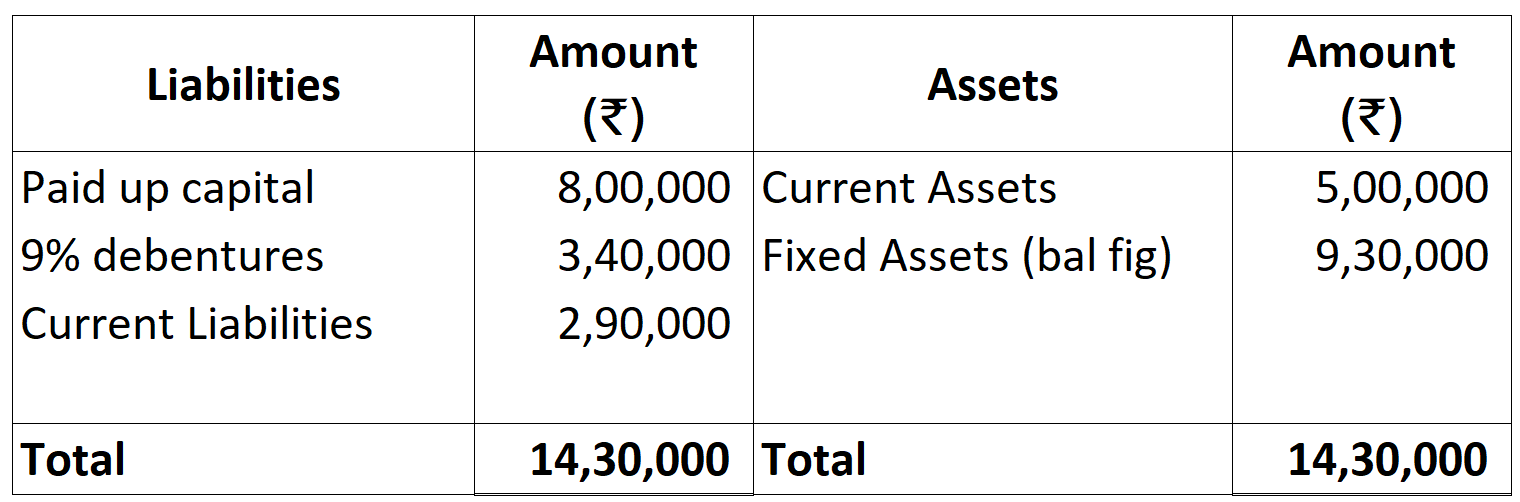
From the following information calculate any two of the following ratios:
  1. Gross Profit Ratio;
  2. Working Capital Turnover Ratio and
  3. Proprietary Ratio.
Information:
Paid up capital Rs. 8,00,000
Current assets Rs. 5,00,000
Credit sales Rs. 3,00,000
Cash sales 75% of Credit sales
9% Debentures Rs. 3,40,000
Current liabilities Rs. 2,90;000, and
Cost of goods sold Rs. 6,80,000
Answer
  1.  
Credit sales = Rs. 3,00,000
Cash sales = 75% of credit sales = 3/4 x 3,00,000 = 2,25,000
Total Sales = Cash sales + Credit Sales
  = 2,25,000 + 3,00,000
= 5,25,000
Gross Profit = Net Sales – Cost of goods sold
  = 5,25,000 – 6,80,000
= - 1,55,000
Hence, Gross = 1,55,000
Loss
$\text{Gross Loss Ratio}=\frac{\text{Gross Loss}}{\text{Net Sales}}\times100$
$=\frac{1,55,000}{5,25,000}\times100$
= 29.52%
Alternate Answer
Gross Profit Ratio = $\text{Gross Profit Ratio}=\frac{\text{Gross profit}}{\text{Net Sales}}\times100$
$=\frac{- 1,55,000}{5,25,000}\times100$
$=- 29.52\text%$
  1. Working Capital = Current Assets – Current Liabilities​​​​​​
= 5,00,000 – 2,90,000 = 2,10,000
Working Capital:
$\text{turnover ratio}=\frac{\text{Net Sales}}{\text{Working Capital}}$
$=\frac{5,25,000}{2,10,000}$
= 2.5 times
Alternate Answer
Working Capital:
$\text{turnover ratio}=\frac{\text{Cost of goods sold}}{\text{Working Capital}}$
$=\frac{6,80,000}{2,10,000}$
  1. $\text{Proprietary ratio}=\frac{\text{Proprietors fun}}{\text{Total assets}}$
$=\frac{8,00,000}{14,30,000}$
= 80 : 143 or 55.94%
Calculation of proprietors funds:
View full question & answer
Question 324 Marks
From the following information obtained from the books of Kundan Ltd., calculate the inventory turnover ratio for the years $2015-16$ and $2016-17$:
  $2015-16$ $2016-17$
 
Inventory on $31^{st}$​​​​​​​ March $7,00,000$ $17,00,000$
Revenue from operations $50,00,000$ $75,00,000$
(Gross profit is $25 \%$ on cost of revenue from operations)
In the year $2015-16$, inventory increased by $₹ 2,00,000$.
Answer
Inventory Turnover Ratio: $=\frac{\text{Cost of goods Sold (COGS)}}{\text{Average Inventory}}$
$2015-16$
COGS = Revenue from Operations - Gross Profit
$=75,000-\Big(75,000\times\frac{25}{125}\Big)$
$= 75,000 - 15,00,000 = ₹ 60,00,000$
Average Inventory $=\frac{\text{Opening Inventory}+\text{Closing Inventory}}{2}$
$=\frac{7,00,000+17,00,000}{2}=₹12,00,000$
Inventory Turnover Ratio $=\frac{\text{Cost of Goods Sold (COGS)}}{\text{Average Inventory}}$
$=\frac{60,00,000}{12,00,000}=5\text{times}$
$2016-17$
Cost of Goods Sold (COGS) = Revenue from Operations - Gross Profit
$=50,00,000-\Big(50,00,000\times\frac{25}{125}\Big)$
$= 50,00,000 - 10,00,000 = 40,00,000$
Average Inventory $=\frac{\text{Opening Inventory}+\text{Closing Inventory}}{2}$
$=\frac{5,00,000+7,00,000}{2}=₹6,00,000$
Inventory Turnover Ratio $=\frac{\text{Cost of Goods Sold (COGS)}}{\text{Average Inventory}}$
$=\frac{40,00,000}{6,00,000}=6.67\text{times}$
View full question & answer
Question 334 Marks
  1. Calculate ‘Total Assets to Debt ratio’ from the following information:
 
Equity Share Capital 4,00,000
Long Term Borrowings 1,80,000
Surplus i.e. Balance in statement of Profit and Loss 1,00,000
General Reserve 70,000
Current Liabilities 30,000
Long Term Provisions 1,20,000
  1. The Debt Equity ratio of a company is 1 : 2. State whether ‘Issue of bonus shares’ will increase, decrease or not change the Debt Equity Ratio.
Answer
  1. Total Assets = Total Liabilities
Total Assets = Equity Share Capital + Long-term Borrowings + Surplus i.e. Balance of statement of Profit and Loss + General Reserves + Long term provisions + Current Liabilities

Total Assets = ₹ (4,00,000 + 1,80,000 + 1,00,000 + 70,000 + 30,000 + 1,20,000)

Total Assest = ₹ 9,00,000

Long-term Debt = Long-term Borrowings + Long-term provisions = ₹ (1,80,000 + 1,20,000) = ₹ 3,00,000

Total Assets to Debt Ratio $=\frac{\text{Total Assets}}{\text{Long-term debt}}$

$=\frac{9,00,000}{3,00,000}= 3:1$
  1. Debt Equity Ratio $=\frac{\text{Debt}}{\text{Equity}}$
Issue of bonus shares will increase the value of equity thereby causing a decrease in the debt-equity ratio.
View full question & answer
Question 344 Marks
  1. Calculate Revenue from operations of BN Ltd. From the following information:
Current assets ₹ 8,00,000.
Quick ratio is 1.5 : 1
Current ratio is 2 : 1
Inventory turnover ratio is 6 times
Goods were sold at a profit of 25% on cost.
  1. The Operating ratio of a company is 60%. State whether ‘Purchase of goods costing ₹ 20,000’ will increase, decrease or not change the operating ratio.
Answer
  1. Gross Profit = Revenue from Operation - Cost of Goods Sold
Current Assets = ₹ 8,00,000

Current Ratio $=\frac{\text{Current Assets}}{\text{Current Liabilities}}$

$\frac{2}{1}=\frac{8,00,000}{\text{Current Liabilities}}$

Current Liabilities $=\frac{8,00,000}{2}=₹\ 4,00,000$

Quick Ratio $=\frac{\text{Quick Assets}}{\text{Current Liabilities}}$

$\frac{1.5}{1}=\frac{\text{Quick Assets}}{4,00,000}$

Quick Assets = ₹ 6,00,000

Stock = Current Assets - Quick Assets = ₹ (8,00,000 - 6,00,000) = ₹ 2,00,000

Inventory turnover Ratio $=\frac{\text{Cost of Good Sold}}{\text{Average Stock}}$

$6=\frac{\text{Cost of Good Sold}}{2,00,000}$

Cost of Goods Sold = 6 × 2,00,000 = ₹ 12,00,000

Gross Profit $=12,00,000\times\frac{25}{100}=₹\ 3,00,000$

Revenue from Operation = Cost of Goods Sold + Gross Profit

= ₹ (12,00,000 + 3,00,000) = ₹ 15,00,000
  1. Operating Ratio $=\frac{\text{Operating Cost}}{\text{Net Sales}} × 100$
Also, Operating Cost = Cost of Goods Sold + Operating Expenses

Since, cost of goods sold includes purchases as well as closing stock so a purchase of ₹ 20,000 worth of goods will increase the value of both closing stock as well as purchases and hence will lead to change in the value of COGS. Thus, the operating ratio will remain unchanged.
View full question & answer
Question 354 Marks
  1. Calculate Revenue from operations of BN Ltd. From the following information:
Current assets ₹ 8,00,000
Quick ratio is 1.5 : 1
Current ratio is 2 : 1
Inventory turnover ratio is 6 times
Goods were sold at a profit of 25% on cost.
  1. The Operating ratio of a company is 60%. State whether ‘Purchase of goods costing ₹ 20,000’ will increase, decrease or not change the operating ratio.
Answer
  1. Gross Profit = Revenue from Operation - Cost of Goods Sold
Current Assets = ₹ 8,00,000

Current Ratio $=\frac{\text{Current Assets}}{\text{Current Liabilities}}$

$\frac{2}{1}=\frac{8,00,000}{\text{Current Liabilities}}$

Current Liabilities $=\frac{8,00,000}{2}=₹\ 4,00,000$

Quick Ratio $=\frac{\text{Quick Assets}}{\text{Current Liabilities}}$

$\frac{1.5}{1}=\frac{\text{Quick Assets}}{4,00,000}$

Quick Assets = ₹ 6,00,000

Stock = Current Assets - Quick Assets = ₹ (8,00,000 - 6,00,000) = ₹ 2,00,000

Inventory turnover Ratio $=\frac{\text{Cost of Good Sold}}{\text{Average Stock}}$

$6=\frac{\text{Cost of Good Sold}}{2,00,000}$

Cost of Goods Sold = 6 × 2,00,000 = ₹ 12,00,000

Gross Profit $=12,00,000\times\frac{25}{100}=₹\ 3,00,000$

Revenue from Operation = Cost of Goods Sold + Gross Profit

= ₹ (12,00,000 + 3,00,000) = ₹ 15,00,000
  1. Operating Ratio $=\frac{\text{Operating Cost}}{\text{Net Sales}} × 100$
Also, Operating Cost = Cost of Goods Sold + Operating Expenses

Since, cost of goods sold includes purchases as well as closing stock so a purchase of ₹ 20,000 worth of goods will increase the value of both closing stock as well as purchases and hence will lead to change in the value of COGS. Thus, the operating ratio will remain unchanged.
View full question & answer
Question 364 Marks
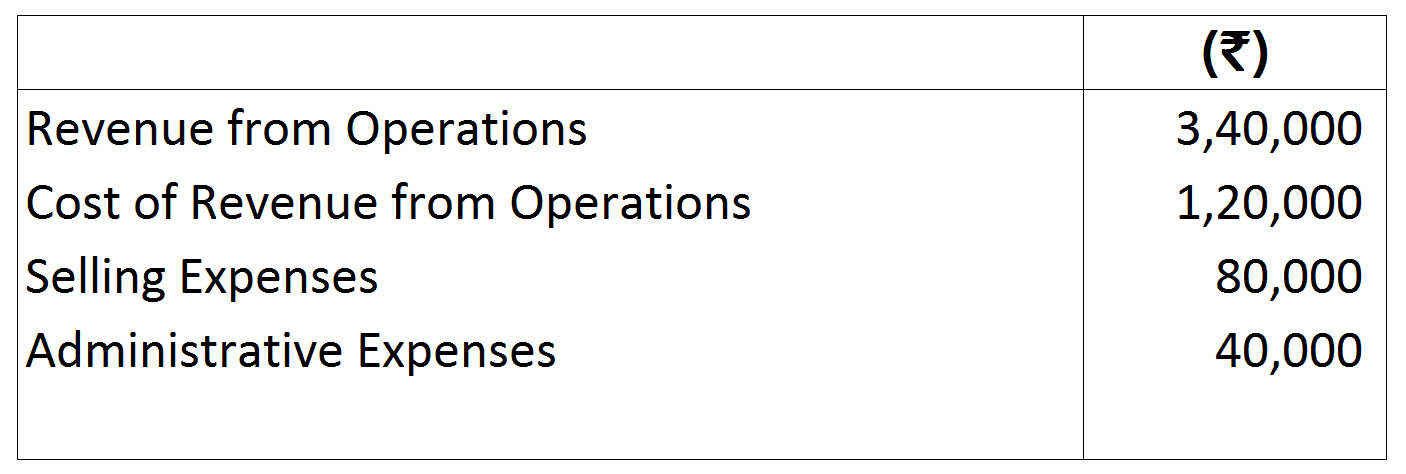
Given the following information:
Answer
Gross Profit = Revenue from Operations - Cost of revenue from operations
= ₹ 3,40,000 - ₹ 1,20,000 = ₹ 2,20,000
Gross Profit Ratio $=\frac{\text{Gross Profit}}{\text{Net Revenue from Operations}}\times100$
$=\frac{₹\ 2,20,000}{₹\ 3,40,000}\times100=64.71\%$
Operating Expenses = Selling Expenses + Administrative Expenses
= 80,000 + 40,000 = 1,20,000
Operating Ratio $=\frac{\text{Cost of Revenue from Operations + Operating Expenses}}{\text{Net Revenue from Operations}}\times100$
$=\frac{₹\ 1,20,000+₹\ 1,20,000}{₹\ 3,40,000}\times100=70.59\%$
View full question & answer
Question 374 Marks
Gross Profit ratio of a Company was 25%. Its cash revenue from operations were ₹ 5,00,000 and its credit revenue from operations were 90% of the total revenue from operations. If the indirect expenses of the company were ₹ 1,50,000, calculate its net profit ratio.
Answer
Credit revenue from operations were 90% of total revenue from operation. It means cash revenue from operations were 10% of total revenue from operations. If cash revenue from operations were 10, total revenue from operations were 100. If cash revenue from operations were ₹ 5,00,000, total revenue from operations were$=\frac{100}{10}\times5,00,000=₹\ 50,00,000$ Gross Profit $=₹\ 50,00,000 \times\frac{ 25}{ 100 }= ₹\ 12,50,000$ Net Profit = Gross Profit - Indirect Expenses= ₹ 12,50,000 - ₹ 1,50,000 = ₹ 11,00,000
Net Profit Ratio $=\frac{\text{Net Profit}}{\text{Net Revenue from Operations}}\times100$
$=\frac{11,00,000}{50,00,000}\times=22\%$
View full question & answer
Question 384 Marks
Current Assets of a Company are ₹ 3,06,000 and its Current ratio is 1.8 Afterwards, it issued new equity shares off ₹ 1,00,000. Calculate the revised current ratio.
Answer
Current Ratio $=\frac{\text{Current Assets}}{\text{Current Liabilities}}$1.8 (Given) $=\frac{₹\ 3,06,000\text{(Given)}}{\text{Current Liabilities}}$
$\therefore$ Current Liabilities $=\frac{₹\ 3,06,000}{1.8}=₹\ 1,70,000$
Issue of new equity shares results in increase in bank and this leads to increase in current assets. Hence, after the issue of new equity shares of ₹ 1,00,000:
Current Assets = ₹ 3,06,000 + ₹ 1,00,000
= ₹ 4,06,000
Revised Current Ratio $=\frac{\text{Current Assets}}{\text{Current Liabilities}}$
$=\frac{₹\ 4,06,000 }{₹\ 7,10,000}=2.388:1$
View full question & answer
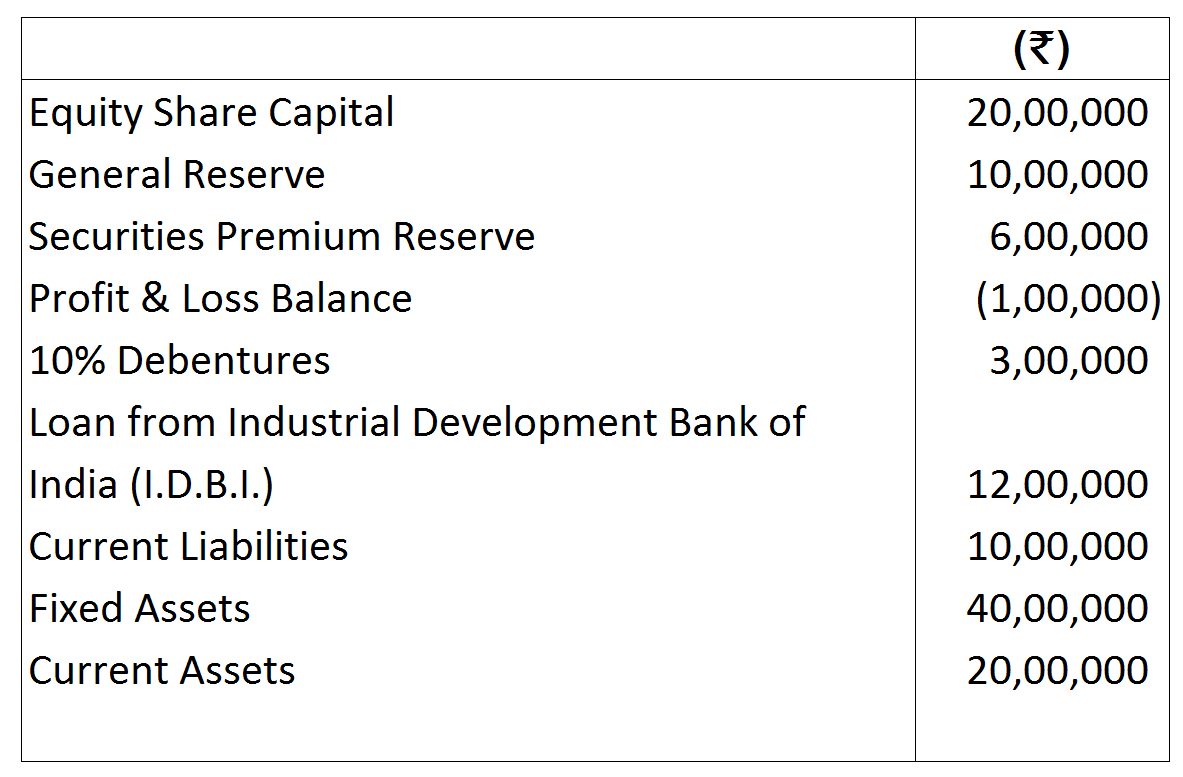
Question 394 Marks
From the following, ascertain Debt-Equity Ratio and Proprietary Ratio:
Answer
  1. Debt-Equity Ratio $= \frac{\text{Long Term Debts}}{\text{Shareholder's Funds}}$
Long Term Debts = 10% Debentures+ Loan from IDBI

= ₹ 3,00,000 + ₹ 12,00,000 = ₹ 15,00,000

Shareholder's Funds = Equity Share Capital + General Reserve + Securities Premium Reserve - Profit & Loss Balance

= ₹ 20,00,000 + ₹ 1,00,000 + ₹ 6,00,000 - ₹ 1,00,000

= ₹ 35, 00,000

Debt Equity Ratio $= \frac{₹\ 15,00,000}{₹\ 35,00,000}= 0.43:1$
  1. Proprietary Ratio $=\frac{\text{Shareholder's Funds}}{\text{Total Assets}}\times100$
Total Assets = Fixed Assets + Current Assets

₹ 40,00,000 + ₹ 20,00,000 = ₹ 60,00,000

Proprietary Ratio $=\frac{₹\ 35,00,000}{₹\ 60,00,000}\times100=58.33\%$
View full question & answer
Question 404 Marks
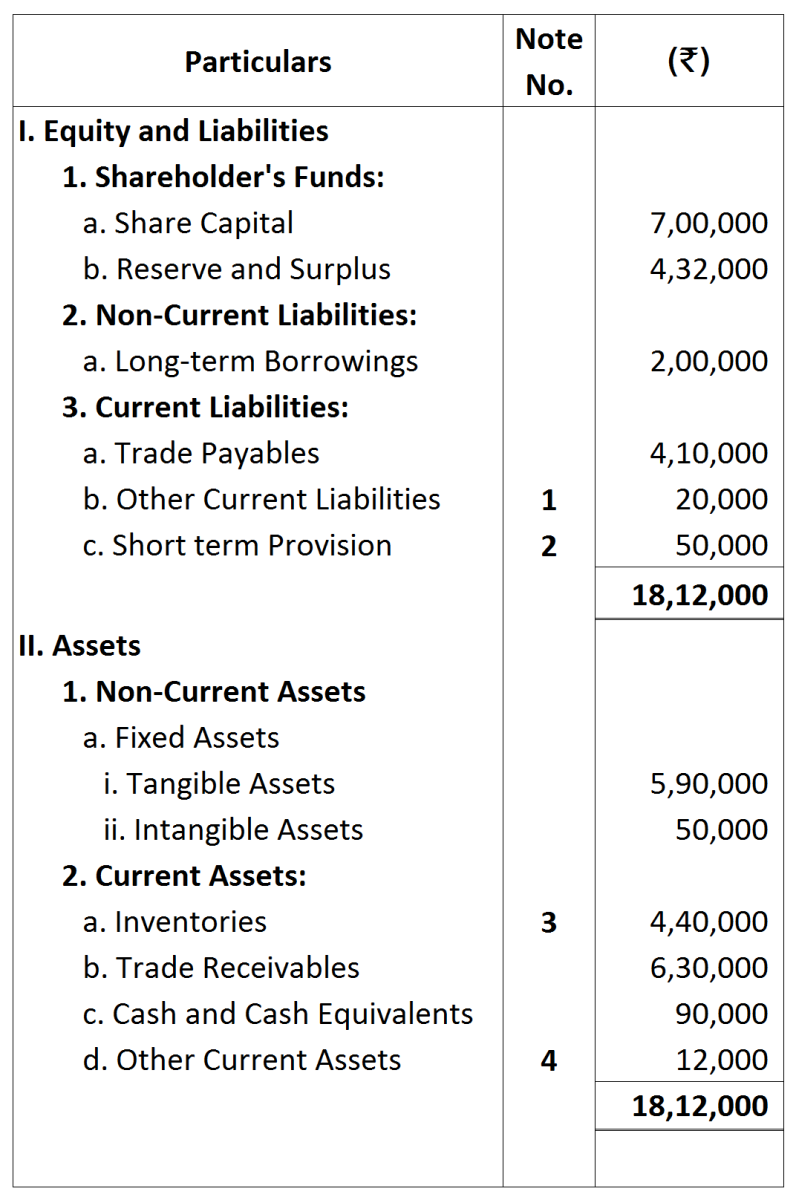
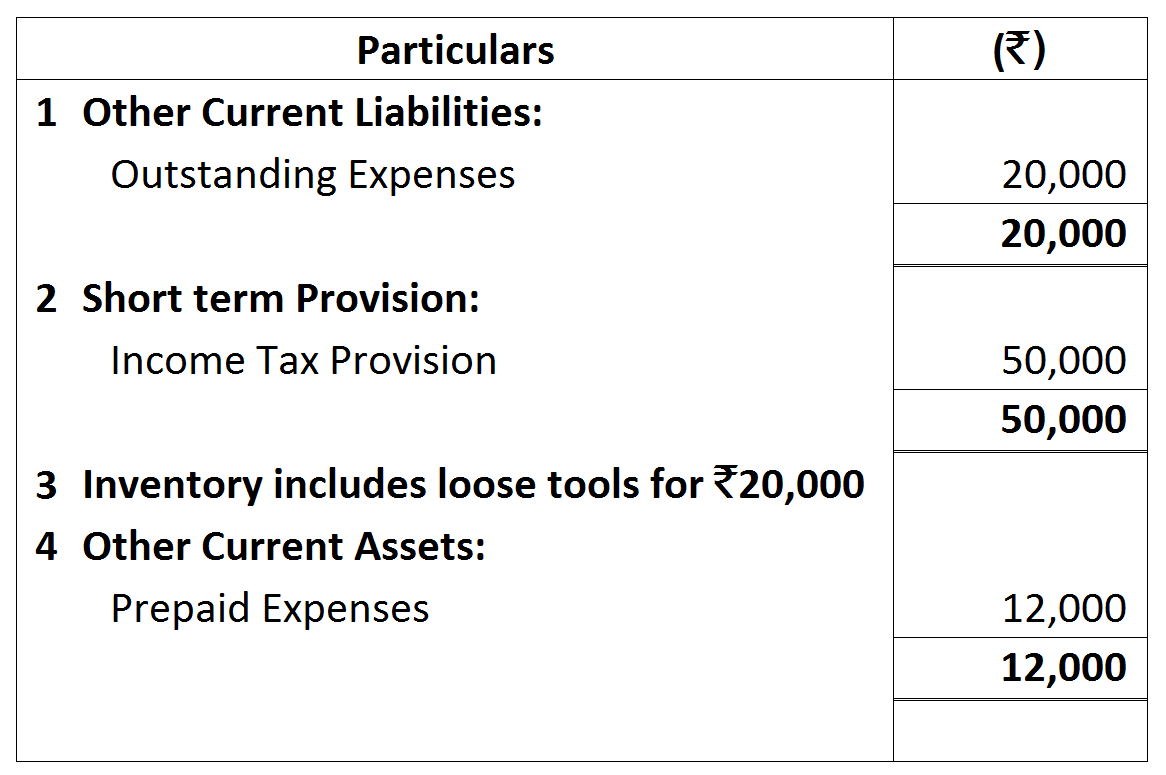
Calculate Current Ratio and Quick Ratio from the following Balance Sheet:

Answer
Current Ratio $=\frac{\text{Current Assets}}{\text{Current Liabilities}}$ Current Assets = Inventory+ Trade Receivables + Cash & Cash Equivalents + Prepaid Exp. = ₹ 4,20,000 + ₹ 6,30,000 + ₹ 90,000 + ₹ 12,000 = ₹ 11,52,000 Current Liabilities = Trade Payables + Outstanding Expenses + Income Tax Provision = ₹ 4,10,000 + ₹ 20,000 + ₹ 50,000 = ₹ 4,80,000 Current Ratio $= \frac{₹\ 11,52,000}{₹\ 4,80,000}= 2.4:1$ Quick Ratio $=\frac{\text{Liquid Assets}}{\text{Current Liabilities}}$ Liquid Assets = Trade Receivables + Cash & Cash Equivalents = ₹ 6,30,000 + ₹ 90,000 = ₹ 7,20,000Quick Ratio $=\frac{₹\ 7,20,000 }{₹\ 4,80,000 }=1.5:1$
Throw light on the short-term financial position of the Company with the help of suitable ratios.
View full question & answer
Question 414 Marks
State giving reasons, which of the following transactions would improve, reduce or not change the Current Ratio, if Current Ratio of a company is 0.8 : 1:
  1. Cash paid to Trade Payables.
  2. Purchase of Stock-in-Trade on credit.
  3. Purchase of Stock-in-Trade for cash.
  4. Payment of Dividend payable.
  5. Bills Payable discharged.
  6. Bills Receivable endorsed to a creditor.
  7. Bills Receivable endorsed to a creditor dishonoured.
Answer
  1. Let’s assume Current Assets as ₹ 80,000 and Current Liabilities as ₹ 1,00,000
Current Ratio $=\frac{\text{Current Assets}}{\text{Current Liabilities}}$

Current Ratio $=\frac{80,000}{1,00,000}=0.8:1$
  1. Cash paid to Trade Payables (say ₹ 50,000)
Current Ratio $=\frac{80,000-50,000}{1,00,000-50,000}=0.6:1\text{ Reduce}$
  1. Purchase of Stock-in-Trade for cash (say ₹ 50,000)
Current Ratio $=\frac{80,000+50,000}{1,00,000+50,000}=0.87:1\text{ Improve}$
  1. Purchase of Stock-in-Trade for cash (say ₹ 50,000)
Current Ratio $=\frac{80,000+50,000-50,000}{1,00,000}=0.8:1\text{ No Change}$
  1. Payment of Dividend (say ₹ 50,000)
Current Ratio $=\frac{80,000-50,000}{1,00,000-50,000}=0.6:1\text{ Reduce}$
  1. Bills Payable discharged (say ₹ 50,000)
Current Ratio $=\frac{80,000-50,000}{1,00,000-50,000}=0.6:1\text{ Reduce}$
  1. Bills Receivable endorsed to a Creditor (say ₹ 50,000)
Current Ratio $=\frac{80,000-50,000}{1,00,000-50,000}=0.6:1\text{ Reduce}$
  1. Bills Receivable endorsed to a Creditor dishonoured (say ₹ 50,000)
Current Ratio $=\frac{80,000+50,000}{1,00,000+50,000}=0.87:1\text{ Improve}$
View full question & answer
Question 424 Marks
From the following information, calculate Gross Profit Ratio:
 
 
Credit Sales
5,00,000
Decrease in Inventory
10,000
Purchases
3,00,000
Returns Outward Wages
10,000
Carriage Inwards
10,000
Rate of Credit Sale to Cash Sale.
4 : 1
Answer
Credit Sales = 5,00,000
Rate of Credit Sale to Cash Sale = 4 : 1
$\text{Case Sales}=\frac{1}{4}\times5,00,000=₹\ 1,25,000$
Total Sales = Cash Sales + Credit Sales = ₹ 1,25,000 + ₹ 5,00,000 = ₹ 6,25,000
Cost of Goods Sold = Purchases – Return Outward + Carriage Inwards + Wages + Decrease in Inventory
= ₹ 3,00,000 - ₹ 10,000 + ₹ 10,000 + ₹ 50,000 + ₹ 10,000
= ₹ 3,60,000
Gross Profit = Total Sales - Cost of Goods Sold
= ₹ 6,25,000 - ₹ 3,60,000 = ₹ 2,65,000
Gross Profit Ratio $=\frac{\text{Gross Profit}}{\text{Net Sales}}\times100$
$=\frac{2,65,000}{6,25,000}\times100=42.40\%$
View full question & answer
Question 434 Marks
Rate of Gross profit on cost of a company is 25%. Its Gross profit is ₹ 5,00,000. Its shareholders' Funds are ₹ 12,00,000; Current liabilities are ₹ 3,00,000 and Current Assets are ₹ 10,00,000.
Calculate its Working Capital Turnover Ratio.
Answer
Working Capital Turnover Ratio $=\frac{\text{Revenue from Operations}}{\text{Working Capital}}$
Gross Profit is ₹ 5,00,000 and rate of G.P. on Cost of Revenue from Operations is 25%
Hence, Cost of Revenue from Operations $=5,00,000\times\frac{100}{25}=₹\ 20,00,000$
Revenue from Operations = Cost of Revenue from Operations + Gross Profit
= ₹ 20,00,000 + ₹ 5,00,000 = ₹ 25,00,000
Working Capital = Current Assets - Current Liabilities
= = ₹ 10,00,000 - ₹ 3,00,000 = ₹ 7,00,000
Working Capital Turnover Ratio $=\frac{25,00,000}{7,00,000}=3.57\text{ times}$
View full question & answer
Question 444 Marks
How would you study the Solvency position of the firm?
Answer
Solvency position of a firm is studied with the help of the Solvency Ratios. Solvency ratios are the measures of the long-term financial position of the firm in terms of its ability to pay its long-term liabilities. In other words, the solvency of the firm is measured by its ability to pay its long term obligation on the due date. The long term obligations include payments of principal amount on the due date and payments of interests on the regular basis. Long term solvency of any business can be calculated on the basis of the following ratios.
  1. Debt-Equity Ratio: It depicts the relationship between the borrowed fund and owner’s funds. The lower the debt-equity ratio higher will be the degree of security to the lenders. A low debt-equity ratio implies that the company can easily meet its long term obligations.
$\text{Debt-Equity Ratio}=\frac{\text{Long-term Debt}}{\text{Equity/ Share holders Fund}}$

Equity or the Shareholders Fund includes Preference Share Capital, Equity Share Capital, Capital Reserve, Securities Premium, General Reserve less Accumulated Loss and Fictitious Assets
  1. Total Assets to Debt Ratio: It shows the relationship between the total assets and the long term loans. A high Total Assets to Debt Ratio implies that more assets are financed by the owner’s fund and the company can easily meet its long-term obligations. Thus, a higher ratio implies more security to the lenders.
$\text{Total Assets to Debt Ratio}=\frac{\text{Total Assets}}{\text{Long-term Debt}}$

Total Assets includes all fixed and current assets except fictitious assets like, Preliminary Expenses, Underwriting Commission, etc.

Debt includes all long-term loans that are to be repaid after one year. It includes debentures, mortgage loans, bank loans, loans from other financial institutions, etc.
  1. Interest Coverage Ratio: This ratio depicts the relationship between amount of profit utilise for paying interest and amount of interest payable. A high Interest Coverage Ratio implies that the company can easily meet all its interest obligations out of its profit.
$\text{Interest Coverage Ratio}=\frac{\text{Net Profit before Interest and Tax}}{\text{Interest on Long-term Loans}}$
  1. Proprietary Ratio: It shows the relationship between the Shareholders Fund and the Total Assets. This ratio reveals the financial position of a business. The higher the ratio the higher will be the degree of safety for the creditors. It is calculated as:
$\text{Proprietary Ratio}=\frac{\text{Shareholders Fund}}{\text{Total Assets}}\text{ or }\frac{\text{Equity}}{\text{Total Assets}}$

Total Assets includes all fixed and current assets except fictitious assets like, Preliminary Expenses, Underwriting Commission, etc.
View full question & answer
Question 454 Marks
Calculate Total Assets to Debt Ratio from the following:
Answer
Total Assets to Debt Ratio $=\frac{\text{Total Assets}}{\text{Debt}}$
Capital Employed = Shareholder's Funds (i.e., Share Capital + Reserve and Surplus) + Long term Debts.
₹ 60,00,000= ₹ 20,00,000 + ₹ 16,00,000 + Long term Debts.
Long term Debts = ₹ 24,00,000
Total Assets = Shareholder's Funds (i.e., Share Capital + Reserve and Surplus) + Long term Debts + Current Liabilities (i.e., Trade Payables + Outstanding Exp.)
= ₹ 20,00,000 + ₹ 16,00,000 + ₹ 24,00,000 + ₹ 8,00,000 + ₹ 40,000
= ₹ 68,40,000
Total Assets to Debt Ratio $=\frac{68,40,000}{24,00,000}=2.85:1$
View full question & answer
Question 464 Marks
What are liquidity ratios? Discuss the importance of current and liquid ratio.
Answer
Liquidity ratios are calculated to determine the short-term solvency of a business, i.e. the ability of the business to pay back its current dues. Liquidity means easy conversion of assets into cash without any significant loss and delay. Short-term creditors are interested in ascertaining liquidity ratios for timely payment of their debts. Liquidity ratio includes,Current Ratio: It explains the relationship between current assets and current liabilities. It is calculated as:
$\text{Current Ratio}=\frac{\text{Current Assets}}{\text{Current Liabilities}}$
Currents Assets are those assets that can be easily converted into cash within a short period of time like, cash in hand, cash at bank, marketable securities, debtors, stock, bills receivables, prepaid expenses. etc. Current Liabilities are those liabilities that are to be repaid within a year like, bank overdraft, bills payables, Short-term creditors, provision for tax, outstanding expenses etc.
Importance of Current Ratio,
It helps in assessing the firm’s ability to meet its current liabilities on time. The excess of current assets over current liabilities provide a sense of safety and security to the creditors. The ideal ratio of current assets over current liabilities is 2 : 1. It means that the firm has sufficient funds to meet its current liabilities. A higher ratio indicates poor investment policies of management and low ratio indicates shortage of working capital and lack of liquidity.
  1. Liquid Ratio: It explains the relationship between liquid assets and current liabilities. It indicates whether a firm has sufficient funds to pay its current liabilities immediately. It is calculated as:
$\text{Liquid Ratio}=\frac{\text{Liquid Assets}}{\text{Current Liabilities}}$
Liquids Assets = Current Assets - Stock - Prepaid Expenses
Importance of Liquid Ratio,
It helps in determining whether a firm has sufficient funds if it has to pay all its current liabilities immediately. It does not include stock, since it takes comparatively more time to convert the stock into cash. Further prepaid expenses are also not included in liquid assets, since these cannot be converted into cash. The ideal Liquidity Ratio is considered to be 1 : 1. It means that the firm has a rupee in form of liquid assets for every rupee of current liabilities.
View full question & answer
Question 474 Marks
A company earns a gross profit of 20% on cost. Its credit revenue from operations are twice its cash revenue from operations. If the credit revenue from operations are ₹ 4,00,000, calculate the gross profit ratio of the company.
Answer
Credit Revenue from Operations
= ₹ 4,00,000
$\therefore$ Cash Revenue from Operations
= ₹ 2,00,000
Hence, Total Revenue from Operations
= ₹ 6,00,000
Gross Profit is 20% of Cost of Revenue from Operations
Therefore, goods costing ₹ 100 must have been sold for ₹ 120
Hence, If Revenue from Operations are ₹ 120, G.P. = ₹ 20
If Revenue from Operations are ₹ 6,00,000, G.P. $= ₹ \ 6,00,000\times\frac{20}{120}$
$= ₹ \ 1,00,000$
Gross Profit Ratio $=\frac{\text{Gross Profit}}{\text{Net Revenue from Operations}}\times100$
$=\frac{₹ \ 1,00,000}{₹ \ 6,00,000}\times100 = 16.67\% $
View full question & answer
Question 484 Marks
Current Ratio 2.2 : 1; Acid Test Ratio 0.95 : 1; Working Capital ₹ 36,000. Calculate Current Assets, Current Liabilities and Inventory.
Answer
Working Capital = Current Assets - Current Liabilities
Current Ratio = 2.2 : 1, therefore, based on current ratio the working capital is 2.2 - 1 = 1.2
If Working Capital is 1.2,
Current Assets = 2.2
If Working Capital is 1,
Current Assets $=\frac{2.2}{1.2}$
If Working Capital is 36,000
Current Assets $=\frac{2.2}{1.2}\times₹\ 36,000$
= ₹ 66,000
Current Liabilities = Current Assets - Working Capital
= ₹ 66,000 - ₹ 36,000 = ₹ 30,000
Acid Test Ratio $=\frac{\text{Liquid Assets}}{\text{Current Liabilities}} $
0.95 (Given) $=\frac{\text{Liquid Assets}}{ ₹\ 30,000}$
$\therefore$ Liquid Assets = ₹ 30,000 × 0.95 = ₹ 28,500
Inventory = Current Assets - Liquid Assets
= ₹ 66,000 - ₹ 28,500 = ₹ 37,500
View full question & answer
Question 494 Marks
Calculate Return on Investment (ROI) from the following details: Net Profit after Tax ₹ 6,50,000; Rate of Income Tax 50%; 10% Debentures of ₹ 100 each ₹ 10,00,000; Fixed Assets at cost ₹ 22,50,000; Accumulated Depreciation on Fixed Assets up to date ₹ 2,50,000; Current Assets ₹ 12.00,000: Current Liabilities ₹ 4,00,000.
Answer
Net Fixed Assets = Fixed Assets (at cost) - Accumulated Depreciation
= 22,50,000 - 2,50,000 = 20,00,000
Capital Employed = Net Fixed Assets + Current Assets - Current Liabilities
= 20,00,000 + 12,00,000 - 4,00,000
= 28,00,000
Interest on 10% Debentures = 10% of 10,00,000 = 1,00,000
Let Profit before Tax be = x
Profit after Tax = Profit Before Tax - Tax
Tax Rate = 50%
$\therefore$ Tax = 0.5x
x - 0.5x = 6,50,000
x = 13,00,000
Net Profit before Tax = x = 13,00,000
Profit before Interest and Tax = Profit before Tax + Interest on Long-term Debt
= 13,00,000 + 1,00,000
= 14,00,000
Return on Investment = $\frac{\text{Net Profit before Interest and Tax}}{\text{Capital Employed}}\times100$
$=\frac{14,00,000}{28,00,000}\times100=50\%$
View full question & answer
Question 504 Marks
Current Ratio 3.6 : 1; Working Capital ₹ 84,500; Inventory ₹ 50,000 Calculate Current Assets, Current Liabilities, Quick Ratio.
Answer
Working Capital = Current Assets - Current Liabilities
Current Ratio = 3.6 : 1,
therefore, based on current ratio the working capital is 3.6 - 1 = 2.6
If Working Capital is 2,
Current Assets = 3.6
If Working Capital is 1,
Current Assets $=\frac{3.6}{2.6}$
If Working Capital is 4,00,000,
Current Assets $=\frac{3}{2}\times ₹ \ 84,500$
= ₹ 1,17,000
Current Liabilities = Current Assets- Working Capital
₹ 1,17,000 - ₹ 84,500 = ₹ 32,500
Quick Ratio $=\frac{\text{Liquid Assets}}{\text{Current Liabilities}}$
Liquid Assets = Current Assets - Inventory
= ₹ 1,17,000 - ₹ 50,000
= ₹ 67,000
Quick Ratio $=\frac{₹\ 67,000}{₹\ 32,500}=2.06:1$
View full question & answer
4 Marks Question - Accountancy STD 12 Commerce Questions - Vidyadip