Questions

6 Marks Question

🎯

Test yourself on this topic

6 questions · timed · auto-graded

Question 16 Marks
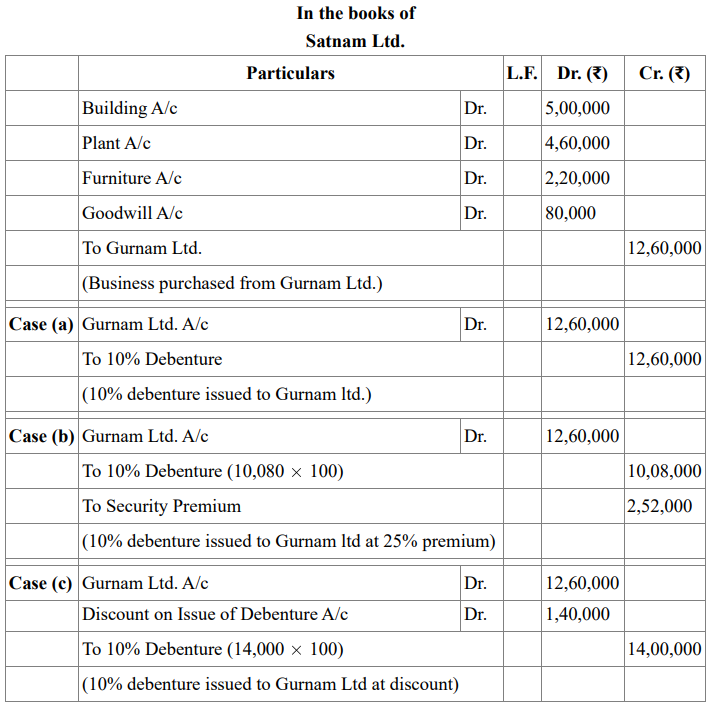
Satnam Ltd. purchased Building worth ₹ 5,00,000, Plant worth ₹ 4,60,000 and Furniture worth ₹ 2,20,000 from Gurnam Ltd. for a purchase consideration of ₹ 12,60,000. Satnam Ltd. paid the purchase consideration by issuing 10% debentures of ₹ 100 each. Pass the necessary journal entries in the books of Satnam Ltd. for the acquisition of assets and issue of 10% debentures when:
a. Debentures were issued at par.
b. Debentures were issued at premium of 25%.
c. Debentures were issued at a discount of 10%.
View full question & answer
Question 26 Marks
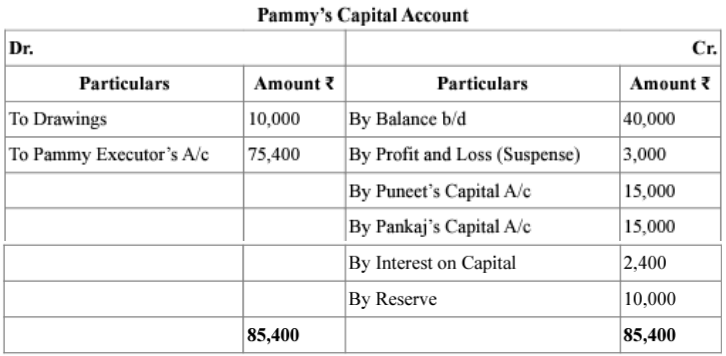
Puneet, Pankaj and Pammy are partners in a business sharing profits and losses in the ratio of 2 : 2 : 1 respectively. Their balance sheet as on March 31, 2019 was as follows:
Books of Puneet, Pankaj and Pammy Balance Sheet as on March 31, 2019
LiabilitiesAmount ₹AssetsAmount ₹
Sundry Creditors1,00,000Cash at Bank20,000
Capital Accounts:Stock30,000
Puneet60,000Sundry Debtors80,000
Pankaj1,00,000Investments70,000
Pammy40,0002,00,000Furniture35,000
Reserve50,000Buildings1,15,000
3,50,0003,50,000
Mr. Pammy died on September 30, 2017. The partnership deed provided the following:
i. The deceased partner will be entitled to his share of profit up to the date of death calculated on the basis of previous year's profit.
ii. He will be entitled to his share of goodwill of the firm calculated on the basis of 3 years' purchase of average of last 4 years' profit. The profits for the last four financial years are given below:
for 2015-16; ₹ 80,000; for 2016-17, ₹ 50,000; for 2017-18, ₹ 40,000; for 2018-19, ₹ 30,000.
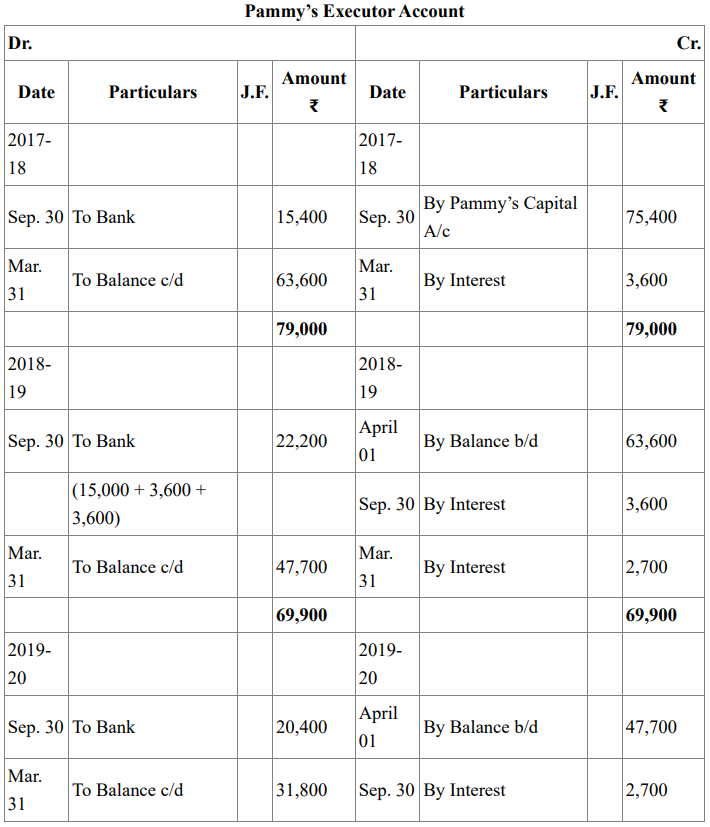
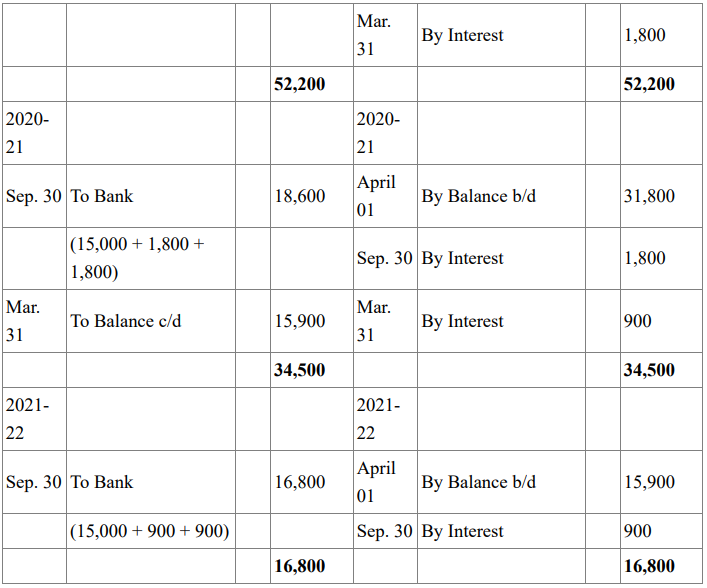
The drawings of the deceased partner up to the date of death amounted to ₹ 10,000. Interest on capital is to be allowed at 12% per annum. Surviving partners agreed that ₹ 15,400 should be paid to the executors immediately and the balance in four equal yearly instalments with interest at 12% p.a. on the outstanding balance.
Show Mr. Pammy's Capital account, his Executor's account till the settlement of the amount due.
View full question & answer
Question 36 Marks
View full question & answer
Question 46 Marks
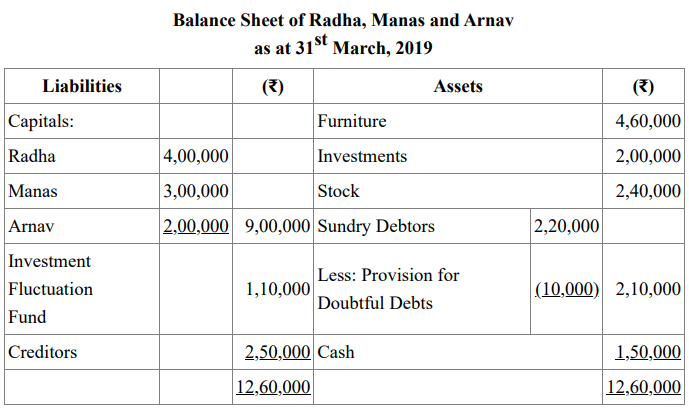
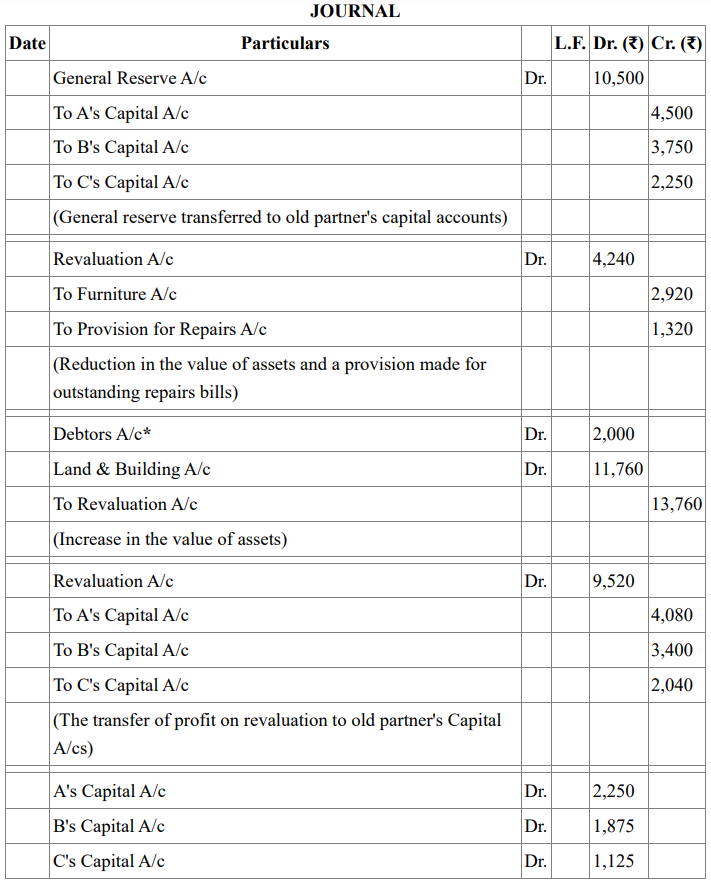
The following is the balance sheet of A, B and C sharing profits and losses in proportion of 6 : 5 : 3 respectively:-
LiabilitiesAssets
Creditors18,900Cash1,890
Bills Payable6,300Debtors26,460
General Reserve10,500Stock29,400
Capitals:-Furniture7,350
A35,400Land & Building45,150
B29,850Goodwill5,250
C14,55079,800
1,15,5001,15,500
They agreed to take D into partnership and give him $\frac{1}{8}$ th share on the following terms:-
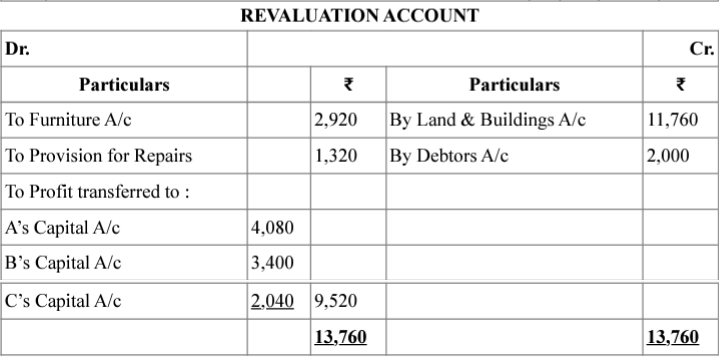
i. That Furniture be depreciated by ₹ 2,920.
ii. An Old Customer, whose account was written off as bad, has promised to pay ₹ 2,000 in full settlement of his full debt.
iii. That a provision of ₹ 1,320 be made for outstanding repair bills.
iv. That the value of land and building having appreciated be brought upto ₹ 56,910.
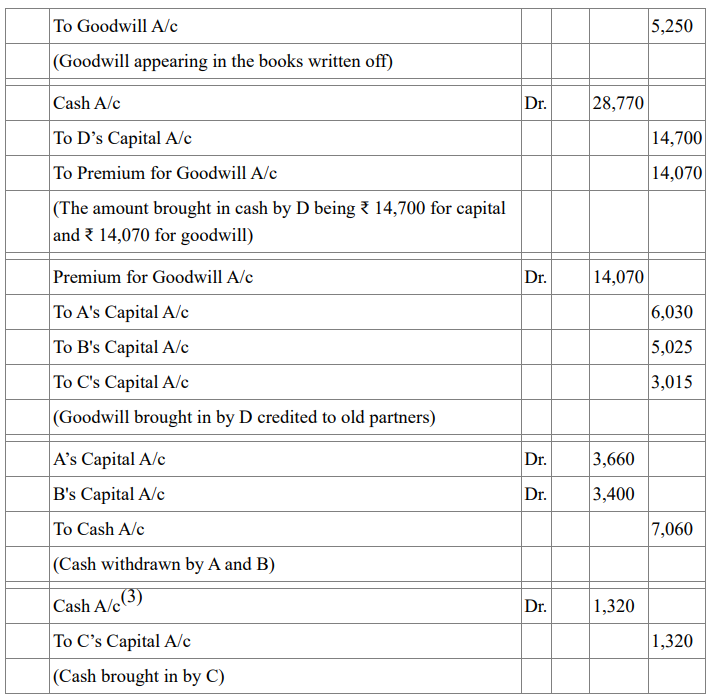
v. That D should bring in ₹ 14,700 as his capital.
vi. That D should bring in ₹ 14,070 as his share of goodwill.
vii. That after making the above adjustments, the capital accounts of old partners be adjusted on the basis of the proportion of D's Capital to his share in business, i.e., actual cash to be paid off or brought in by the old partners, as the case may be.
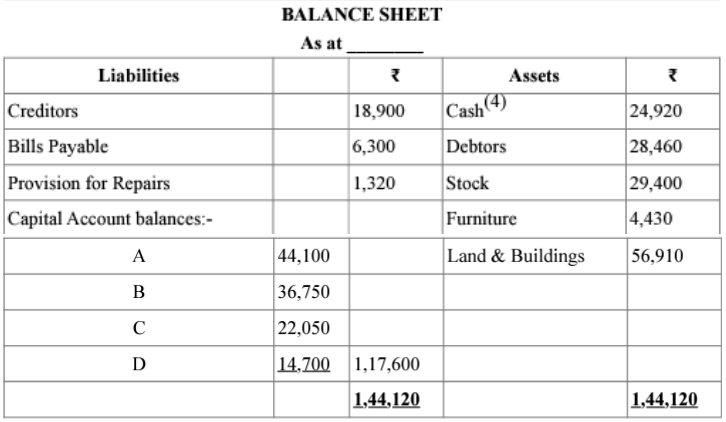
Pass the necessary journal entries and prepare the balance sheet of the new firm.
Answer

Image
Image
Image
Image
Image
New profit sharing ratio will be calculated as under :
Share given to $D=\frac{1}{8}$
Balance of profits $=1-\frac{1}{8}=\frac{7}{8}$
A's new share $=\frac{7}{8} \times \frac{6}{14}=\frac{3}{8}$
B's new share $=\frac{7}{8} \times \frac{5}{14}=\frac{5}{16}$
C's new share $=\frac{7}{8} \times \frac{3}{14}=\frac{3}{16}$
D's share $=\frac{1}{8}$
A : B : C : D $=\frac{3}{8}: \frac{5}{16}: \frac{3}{16}: \frac{1}{8}=\frac{6}{16}: \frac{5}{16}: \frac{3}{16}: \frac{2}{16}$
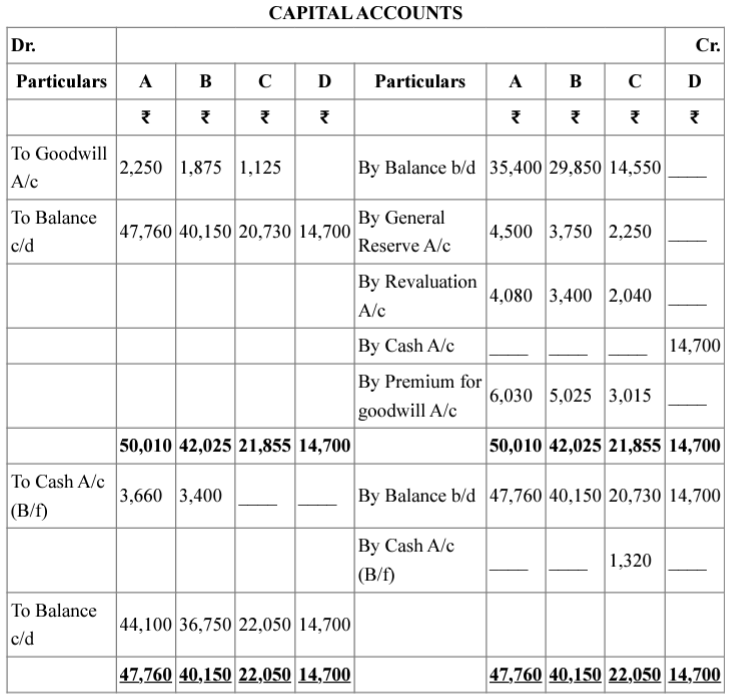
D brings in ₹14,700 as Capital according to his $\frac{1}{8}$th share of profit. Therefore, according to D's Capital, the total Capital of the new firm will be $=14,700 \times \frac{8}{1}=$ ₹ 1,17,600
$\therefore$ A's Capital in new firm $=1,17,600 \times \frac{6}{16}=$ ₹ 44,100
B's Capital in new firm $=1,17,600 \times \frac{5}{16}=$ ₹ 36,750
C's Capital in new firm $=1,17,600 \times \frac{3}{16}=$ ₹ 22,050
D's Capital in new firm $=1,17,600 \times \frac{2}{16}=$ ₹ 14,700
Notes:
1. A's Capital in the new firm should be ₹ 44,100, whereas his existing capital shown by his Capital A/c is ₹ 47,760. Therefore, his excess Capital ₹ 47,760 - ₹ 44,100 = ₹ 3,660 will be refunded to him.
2. B's Capital in the new firm should be ₹36,750, whereas his existing capital shown by his Capital A/c is ₹ 40,150. Therefore, his excess Capital ₹ 40,150 - ₹ 36,750 = ₹ 3,400 will be refunded to him.
3. C's Capital in the new firm should be ₹ 22,050, whereas his existing capital is only ₹ 20,730. Therefore, he will bring in ₹ 22,050 - ₹ 20,730 = ₹ 1,320.
4.
Calculation of Cash Balance: 
Opening Balance 1,890
Add: Capital and goodwill brought in by D 28,770
Add: Cash brought in by C 1,320
  31,980
Less: Amount paid to A3,660 
Less: Amount paid to B3,4007,060
Closing Balance 24,920
 

View full question & answer
Question 56 Marks
Viswas Ltd. issued a prospectus inviting applications for 20,000 shares of ₹ 10 each at a premium of ₹ 4 per share, payable as follows:
On Application₹ 4 (including premium ₹ 1)
On Allotment₹ 3 (including premium ₹ 1)
On First Call₹ 3 (including premium ₹ 1)
On Second and Final Call₹ 4 (including premium ₹ 1)
Applications were received for 30,000 shares and pro-rata allotment was made on the applications for 24,000 shares. It was decided to utilise excess application money towards the sums due on allotment.
X, who was allotted 500 shares, failed to pay the allotment money and on his subsequent failure to pay the first call, his share were forfeited.
Y, who applied for 1,800 shares, failed to pay the two calls and his shares were forfeited after the second call. Of the shares forfeited, 1,700 shares were re-issued as fully paid up for ₹ 8 per share, the whole of Y's shares being included.
Prepare Cash Book, Journal and Balance Sheet.
Answer
self
View full question & answer
Question 66 Marks
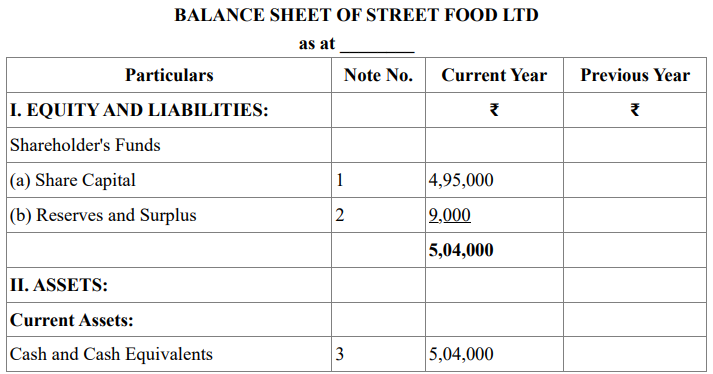
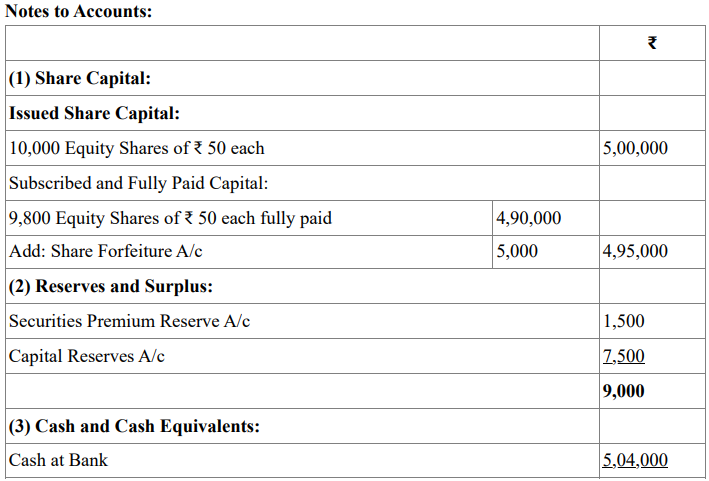
Street Food Ltd. issued a prospectus offering 10,000 equity shares of ₹ 50 each at par payable as follows:
On Application15
On Allotment10
On First Call15
On Final Call10
Rohit, the holder of 500 equity shares did not pay the amount due on both the calls. These 500 shares were forfeited by the Board of Directors and 300 of these shares were subsequently re-issued at ₹ 55 per share.
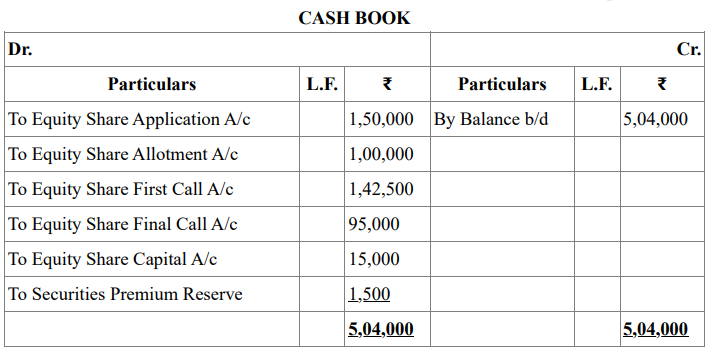
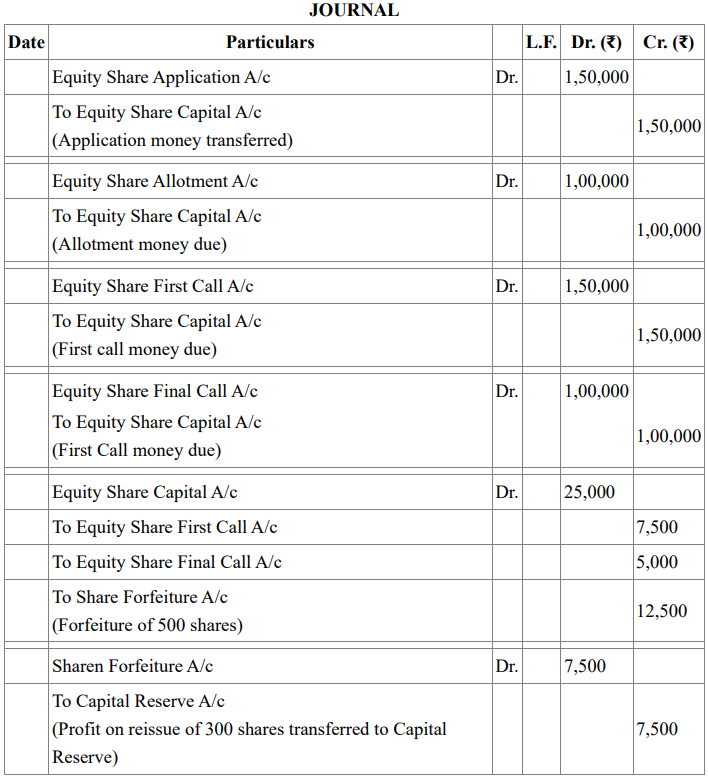
Show the entries in the Cash Book and Journal of the Company.
View full question & answer
6 Marks Question - Accountancy STD 12 Commerce Questions - Vidyadip