Questions

3 Marks Question

🎯

Test yourself on this topic

29 questions · timed · auto-graded

Question 13 Marks
What is Jail cost of living? How is it estimated?
Answer
Dada Bhai Naroji gave the concept of Jail cost of living. He assumed that in a jail a prisoner is given only basic minimum needs. But in jail only adults live while in a society children also live. Therefore, he adjusted jail cost of living by assuming that $\frac{1}{3}$ of population is of adult males, $\frac{1}{3}$ of population is of adult females and $\frac{1}{3}$ are children. Out of $\frac{1}{3}$ children half depend on mother's milk and help eat half of an adult's diet. Therefore jail cost of living is equal to:$\frac{1}{3}(\text{full})+\frac{1}{3}(\text{full})+\frac{1}{6}(\text{nil})+\frac{1}{6}(\text{half})=\frac{3}{4}\text{th}$ Jail cost of Living
View full question & answer
Question 23 Marks
Give a brief note on the National Rural Employment Guarantee Act, 2005.
Answer
National Rural Employment Guarantee Act 2005 is an Indian labour law and social security measure that aims to guarantee the right to work. The act was first proposed in 1991 by Narsimha Rao. In 2006, it was finally accepted in the parliament and commenced implementation in 200 districts of India. It aims to enhance livelihood security in rural areas by providing at least 100 days of wage employment in a financial year to every household whose adult members volunteer to do unskilled manual work.
View full question & answer
Question 33 Marks
Explain the role of public distribution system as a measure to reduce poverty.
Answer
Public Distribution System was started by Indian government to facilitate the supply of foodgrains to the poor at a subsidised price. The main purpose of PDS was to act as price supporting programmes for the consumers during the period of food shortage. It was considered as an instrument of price stabilization. Now, it is the key element of the government's food security system in India. It is an instrument for ensuring availability of certain essential commodities at easily affordable prices especially for the poor. The stock of foodgrains by Food Corporation of India, is released every month for distribution through PDS. Many poor people are benefitted by the scheme.
View full question & answer
Question 43 Marks
Distinguish between rural poor and urban poor.
Answer
  • Urban poor are like push cart vendors, street cobblers etc., whereas rural poor are landless agricultural labourers, cultivators with very small landholdings.
  • Urban poor to a large extent are the overflow of the rural poor, who migrate to the urban areas in search of employment, whereas the rural poor engage in a variety of non-agricultural jobs.
View full question & answer
Question 53 Marks
'Relative poverty exists in every country'. Explain.
Answer
Relative poverty refers to poverty of people relative to other people, regions or nations. It is an indicator of the contrast between the lives of the poor and the lives of those around them. Since income is unequally distributed in almost of the countries, it can be said that relative poverty exists in every country.
View full question & answer
Question 63 Marks
Do you think Monthly Per Capita Expenditure method is a suitable method to identify the poor? Why?
Answer
The Monthly Per Capita Expenditure method has a major drawback as a mechanism to measure poverty.
It groups all the poor together and does not differentiate between the degrees of poverty.
It is difficult to measure or identify who, among the poor people needs help the most.
View full question & answer
Question 73 Marks
Discuss the features of poor people.
Answer
Shahein Rafi Khan and Damian Killen have given following features of poor people.
  1. Poverty is hunger.
  2. Poverty is being sick and not being able to see a doctor.
  3. Poverty is not being able to go to a school and not knowing how to read.
  4. Poverty is not having a job. Poverty is fear for the future, having food once in a day.
  5. Poverty is losing child to illness, brought by unclean water.
  6. Poverty is powerlessness, lack of representation and freedom.
View full question & answer
Question 83 Marks
State the main problems that are generally associated with poverty of the economy.
Answer
Poverty in an economy is the result of:
  1. Rapidly rising population.
  2. Low productivity in agriculture.
  3. Under utilised resources.
  4. Low rate of economic development.
  5. Price rise.
View full question & answer
Question 93 Marks
Write a note on different categories of poverty.
Answer
We can categorize poor into three categories:
  1. Chronic Poor: Those who are below poverty line most of the time and reach above poverty line once in a while are called chronic poor. It includes:
  • Always Poor: Those who are always below poverty line.
  • Usually Poor: Those who are mostly below poverty line but once in a while they come above poverty line.
  1. Transient poor: Those people who keep fluctuating between the category of poor and non poor are called transient poor. It includes:
  • Churning poor: Those people who regularly move in and out of the poverty. These are seasonally employed people. When they have jobs they are above poverty line and when they don't have a job they are below poverty line.
  • Occasionally poor: Those who are rich most of the time but sometimes out of a business fluctuation or other mishappening become poor.
  1. Non Poor: These are the people who have never ever gone below poverty line.
View full question & answer
Question 103 Marks
Explain “Minimum Needs Programme".
Answer
Minimum Needs Programme: This is third approach which aims to provide minimum basic amenities to the people. India was among the pioneers who visualised that through public expenditures on social consumption needs, (Foodgrains at subsidised rates, education, health, water supply and sanitation) people's living standard could be improved. Programmers under this approach are expected to supplement the consumption of the poor by creating employment in education and health. Three major programmes that aim at improving the food and nutritional status of poor are:
  1. Public Distribution System.
  2. Integrated Child Development Scheme.
  3. Midday Meal Scheme.
View full question & answer
Question 113 Marks
How did the two scholars Shaheen Rafi Khan and Damian Killen envisage poverty?
Answer
Both the scholars Shaheen Rafi Khan and Damian Killen visualized.
  1. Poverty is hunger.
  2. Poverty is being sick and not being able to see a doctor.
  3. Poverty is not being able to go to school.
  4. Poverty is not having a job.
  5. Poverty is fear for the future.
  6. Poverty is powerlessness, lack of representation and freedom.
View full question & answer
Question 123 Marks
Give an evidence of extreme gender inequality.
Answer
Extreme gender inequality is visible in the areas of participation of education, gainful employment and the decision making within the family. Women especially the poor received less care in the journey of motherhood. Their neglection led to infant mortality or even their own death during child birth.
View full question & answer
Question 133 Marks
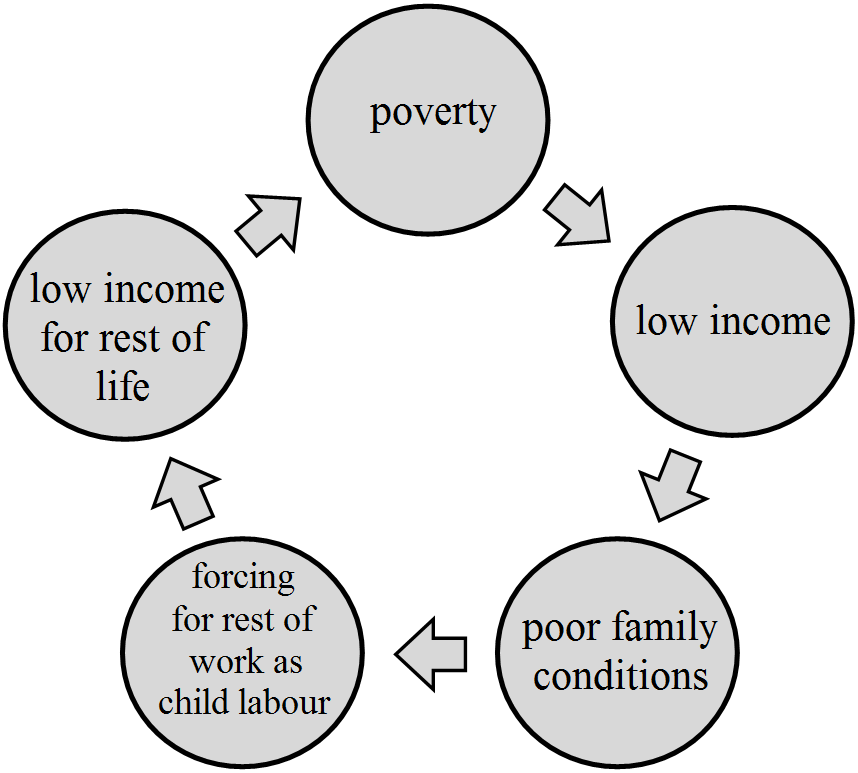
How are poverty and child labour related to each other?
Answer
There is a circular relation between poverty and child labour. They have a cause-effect relationship. Child labour is both a cause as well as effect of poverty. Child labour continues to remain in poverty for rest of his life and he becomes child labour because he was poor.
View full question & answer
Question 143 Marks
What programme has the government adopted to help the elderly people and poor and destitute women?
Answer
  • The government has a variety of social security programmes to help a few specific groups.
  • One such programme is National Social Assistance Programme.
  • Under this programme, elderly people who do not have anyone to take care of them, i.e., destitutes are given pension to sustain themselves.
  • Poor women who are destitute and widows are also covered under this scheme.
View full question & answer
Question 153 Marks
Differentiate between absolute poverty and relative poverty.
Answer
Difference between absolute poverty and relative poverty:
S. No.
Basis of Difference
Absolute Poverty
Relative Poverty
i.
Meaning
Absolute poverty means that the person is not able to achieve a minimum level of consumption.
Relative poverty means that a person is poor in comparison of certain other person.
ii.
Prevalent in
This concept is prevalent in less developed countries.
This concept is prevalent in developed countries.
View full question & answer
Question 163 Marks
Is accelerated growth a sufficient condition to ensure removal of poverty within a reasonable period?
Answer
Although accelerated growth is a necessary condition to ensure removal of poverty, it is not a sufficient condition for removal of poverty. It is very important that accelerated growth should be accompanied by levelling up of income i.e. benefits of growth must flow towards the poorer sections of the society and additional income generated should not accrue to the already rich persons but should benefit the to poor persons.
View full question & answer
Question 173 Marks
What is the difference between relative and absolute poverty? Which measure is generally used to determine these types of poverty?
Answer
Absolute poverty/ relative poverty:
S.No.
Basis
Absolute Poverty
Relative Poverty
1.
Meaning
It refers to a phenomenon in which a section of the society is unable to fulfill even its basic necessities of life concerning food, clothing, housing, education and health.
It refers to a phenomenon in which inequalities of income exist and hence one person is poor in relation to other person.
2.
Couse
Many causes like: over population, low economic growth, over dependence on agriculture etc.
Inequalities of income
3.
Remedy
There are remedies to remove absolute Poverty by PAPs and other ways.
It can not be removed as people have different skills and accordingly their incomes vary.
4.
Measurement
It is measured by Poverty Line.
It is measured by Gini Co-efficient.
View full question & answer
Question 183 Marks
Name three major programmes that aim at improving the food and nutritional value of the poor.
Answer
Three major programmes that aim at improving the food and nutritional value of the poor are:
  1. Public Distribution System.
  2. Integrated Child Development Scheme.
  3. Mid-day Meal Scheme.
View full question & answer
Question 193 Marks
How calorie norms are fixed for average rural person and average urban person in India for poverty line?
Answer
First of all, composition of population in rural and urban areas is ascertained. Entire population is categorised into sixteen categories on the basis of age, sex and activity and calories for each group is ascertained. Now calorie requirement of a certain group is multiplied by its proportion in the population. Adding all such products, we get the average calorie requirements for rural and urban person, which was fixed at 2400 and 2100 calories respectively.
View full question & answer
Question 203 Marks
Government had allocated ₹ 42 crore for the upliftment of Pahadi Korwas, a tribal community. Under this project, a road was developed in the Kach Ketha village costing ₹ 17.44 lakh. However, the officials failed to notice that there was only one Korwa family in that village and they were suffering from acute water shortage. Also, these funds were grossly misappropriated as only 'Lal Mitti' was put over a Kutcha road. As Ramdas says, "Instead of spending ₹ 17.44 lakh of that road, if they had spent a few thousands on improving the damaged well on my land, wouldn't that have been better?"
  1. What according to you would have truly benefitted Ramdas Korwa-developing the road or improving the well?
  2. ₹ 17.44 lakh were spent on developing the road. Is this cost justified?
  3. What values do you find disturbing in the above case?
Answer
  1. I think that Ramdas Korwa would have benefitted if the well on his field was improved, because it would have ensured year long availability of water and would have helped him to increase his agricultural output.
  2. No, I don't think that this cost is justified. The road built was not 'Pucca'. Only Lal Mitti was put over a Kutcha road. This clearly indicates that funds were misappropriated.
  3. The values which I find disturbing are as follows:
  1. Total disregard towards the needs of the poor people.
  2. Gross negligence.
  3. Corruption.
View full question & answer
Question 213 Marks
There are various schemes launched by the Indian Government to eradicate poverty directly or indirectly.
  1. Mention any four anti-poverty programmes launched by the government to eradicate poverty.
  2. What values can be added to improve the result of these anti-poverty programmes?
Answer
  1. Various schemes run by the Indian Government to eradicate poverty directly or indirectly are:
  1. National Food for Work Programme.
  2. Pradhan Mantri Gram Sadak Yojana.
  3. National Social Assistance Programme.
  4. Pradhan Mantri Jan Dhan Yojana.
  1. Values that can be added to improve the result of these anti-poverty programmes are:
  1. Population control.
  2. Creation of new employment opportunities.
  3. Education.
  4. Proper implementation and right targeting.
View full question & answer
Question 223 Marks
Discuss the causes behind failure of poverty alleviation programmes.
Answer
Poverty Alleyiation Programmes could not succeed due to:
  1. Lack of Resources: Resources allocated to different programmes were far less than required keeping in mind the magnitude of poverty.
  2. Lack of Proper implementation: Due to corruption, lack of training, pressure from local leaders, and lack of awareness amongst the beneficiary group, these programmes were not properly implemented.
  3. Lack of Active participation of Beneficiary Group: Poor people did not actively participate in the implementation of these programmes.
  4. Lack of Infrastructure: Infrastructure required for implementation of these programmes was lacking in the economy.
View full question & answer
Question 233 Marks
It is necessary to sensitise the government officials to be specially sympathetic to the poor people? Why and in what way?
Answer
Poverty alleviation programmes have completed almost six decades. But these programmes have failed to address the problem of poverty. It is mainly because of the careless and insensitive attitude of the government officials. These officials have no regard for the needs of the poor people. They are corrupt and use the power in their hand to benefit the undeserving. Effective implementation of these programmes can only be achieved if the government officials are sympathetic to the poor people.
So, it is necessary to sensitise the government officials to be specially sympathetic to the poor people.
View full question & answer
Question 243 Marks
What are the occupations of the rural and urban poor?
Answer
The rural poor work mainly as landless agricultural labourers, cultivators with very small landholdings, who are engaged in a wide variety of non-agricultural jobs.
The urban poor work as casual labourers, doing variety of jobs on roadside, selling various things, vendors, rickshaw pullers, domestic servants, etc.
View full question & answer
Question 253 Marks
Why did “Growth oriented Approach" of the government proved to be ineffective?
Answer
Growth oriented approach was based on the expectation that the effects of economic growth will spread over to the poor section of the society as well. It was expected that rapid industrialisation and transformation of agriculture through green revolution will benefit backward regions as well. But it could not happen because:
  1. Overall growth rate of industry and agriculture was quite low.
  2. Population growth made per capita income to rise at further low levels.
  3. The gap between the rich and the poor widened.
  4. There was lack of political willingness in implementation of land reforms.
Therefore the benefits of growth did not trickle down to the weaker sections of the society.
View full question & answer
Question 263 Marks
How is poverty of people categorised?
Answer
There are many ways to categorise the poverty of people:
  1. Those who are always poor' and those who are usually poor are grouped together as 'chronic poor'.
  2. The 'churning poor are those who regularly pull in and out of poverty (small farmers and seasonal workers).
  3. The transient poor are those who are occasionally poor when they run into a patch of bad luck.
  4. The non-poor are those who are never poor.
View full question & answer
Question 273 Marks
What is poverty? Is there a definite way to identify people living in poverty?
Answer
Poverty is defined as a state of being under privileged and deprived of having equal opportunity in society. It can be estimated but we cannot give a sure shot formula to identify if a person is living in poverty or not. If we visit slums we might find television, fridge, coolers in those slums. It is more so because there are varying degrees of poverty and due to inflation poverty line itself keeps changing.
View full question & answer
Question 283 Marks
Poverty is the most important problem faced by Indian economy today. In this context, state which human value is needed to deal with the problem of poverty?
Answer
The value of human welfare is the most important while dealing with the problem of poverty. It is necessary for the government of the country to ensure that the people living below poverty line are adequately taken care of by introducing welfare measures for the poor and the downtrodden.
View full question & answer
Question 293 Marks
What was Dadabhai Naoroji's concept of poverty line?
Answer
According to Dadabhai Naoroji, the average poverty line was three-fourth of the adult jail cost of living. The computation of jail cost of living can be understood in the following manner: Adult population $=\frac23$ Food consumed by them $=\frac23\times1=\frac23$ Child population $=1-\frac23=\frac13$ Food consumed by half of the child population,$=\frac13\times\frac12\times0=0$
Food consumed by other half of the child population,$=\frac13\times\frac12\times1\times\frac12=\frac1{12}$
Average poverty line = Total food consumed by adult and child population$=\frac23+0+\frac1{12}=\frac9{12}=\frac34$
So, poverty line is $\frac34\text{th}$ of the adult jail cost of living.
View full question & answer
3 Marks Question - Economics STD 12 Commerce Questions - Vidyadip