Questions

3 Marks Question

🎯

Test yourself on this topic

36 questions · timed · auto-graded

Question 13 Marks
What are 'micro-credit progrmmes'?
Answer
Micro-credit programmes like Self-Help Groups (SHG's) promote thrift in small proportions by a minimum contribution from each member. From the pooled money loan/ credit is given to the needy members. This can be repaid in small installments at a reasonable rate of interest by the member in need. Such programmes have in turn empowered the women.
View full question & answer
Question 23 Marks
What is rural development? What does it include?
Answer
Rural development, a comprehensive term, essentially means a plan of action for the development of the rural areas which are lagging behind in terms of socioeconomic development.It includes many areas of development like:
  • Development of human resources like literacy (especially female literacy), education and skill development, health etc.
  • Land reforms.
  • Infrastructure development focussing on electricity, irrigation, credit, marketing, transport facilities, information dissemination etc.
  • Special measures for alleviation of poverty laying emphasis on access to productive employment opportunities.
View full question & answer
Question 33 Marks
How is every village- 'A Knowledge Centre'? Explain.
Answer
M.S. Swaminathan Research Foundation in Chennai, along with the support from Sri Ratan Tata Trust, Mumbai, have established 'The Jamshedji Tata National Virtual Academy for Rural Prosperity'. The academy envisaged to identify a million grass roots. Knowledge workers to be enlisted as fellows of the academy. This programme provides an info-Kiosk (PC with internet and video conferencing facility, scanner, photocopier etc.) at a low cost and also trains the Kiosk-owner, who then provides different services and in turn earns a reasonable sum of income.
The Government of India has further joined the alliance by providing a financial support of 100 crores. This proves that every village is envisaged as a 'Knowledge Centre'.
View full question & answer
Question 43 Marks
Discuss three problems of animal husbandry in India.
Answer
Major problems of animal husbandry in India are:
  1. Though, in terms of numbers, our livestock population is quite impressive but its productivity is quite low as compared to other countries.
  2. It requires improved technology and promotion of good breeds of animals to enhance productivity.
  3. Improved veterinary care and credit facilities to small and marginal farmers and landless labourers would enhance sustainable livelihood options through livestock production.
View full question & answer
Question 53 Marks
Give any three causes of backwardness of Indian agriculture.
Answer
Main causes of backwardness of Indian agriculture are as follows:
  1. Rich farmers own large amount of land, whereas poor farmers own small pieces of land. Some are landless cultivators too. Size of farms are further reducing due to fragmentation and sub division of land holdings.
  2. Farmers do not have proper irrigation facilities. Indian agriculture is heavily dependent on rains for water, which is not reliable.
  3. Adequate facilities for agricultural marketing are not available. Poor farmers do not have transport facility. Middleman also exploit farmers by following corrupt policies and by buying the produce at a very low price.
View full question & answer
Question 63 Marks
Write the role of multinational companies in rural development.
Answer
Economic reforms offered the opportunities to multinational companies to expand their functions all around the country. Many multinational companies are entering in the rural marketing. They are doing well for the sake of farmers as stated below:
  1. They are making contracts with farmers.
  2. They are motivating farmers to grow desirable food, fruits and vegetables of the desired quality.
  3. They are providing them seeds and other inputs.
  4. They are offering them pre-decided prices.
View full question & answer
Question 73 Marks
Why do you attach so much importance to agriculture in present Indian economy?
Answer
Agriculture is the most important sector of Indian economy because:
  1. It accounts for about 58 percent of employment in the country (as per 2001 census).
  2. Moreover, this sector is a supplier of food, fodder for a population of over 120 crores and raw materials for agro-industries.
  3. Recently, the rural sector (including agriculture) is being seen as a potential source of domestic demand, showing its relevance in growth of secondary and tertiary sectors.
  4. Various studies indicate that the potential of rain fed areas has not been fully utilised. A targeted development of rain fed areas should be prioritised. India's 60-year quest for land reform remains incomplete.
View full question & answer
Question 83 Marks
Why have marketing cooperatives received a setback in recent years?
Answer
Cooperatives in marketing have received a setback in recent times due to inadequate coverage of farmer members, lack of appropriate link between marketing and processing cooperatives and inefficient financial management.
View full question & answer
Question 93 Marks
Agricultural marketing refers to the farmers' act of bringing their produce to the market for sale! Is the statement correct?
Answer
No, the statement is incorrect. Agricultural marketing does not simply refer to the farmers' act of bringing their produce to the market for sale. It includes all those activities/processes which help them in getting maximum price for their produce. These processes include grading, packaging and storing.
View full question & answer
Question 103 Marks
How is agricultural diversification helpful for farmers? Explain.
Answer
  • Agricultural diversification is helpful for farmers in the sense that the big risk which they face in solely depending upon farming for livelihood gets reduced.
  • Diversification towards new areas is also necessary to provide productive sustainable options to the livelihood of the rural masses.
  • Diversification provides supplementary and gainful employment during off-season.
  • Diversification in agriculture thereby enhances the income level of rural people. Hence, it helps to overcome poverty.
View full question & answer
Question 113 Marks
What do you mean by agricultural marketing?
Answer
Agricultural marketing involves the assembling storage, processing, transportation, packaging, grading and distribution of different agricultural commodities across the country. It refers to those processes that start from harvesting and end with final sale of products by the farmers. A strong and good agricultural activity helps farmers in getting good prices for their produce.
View full question & answer
Question 123 Marks
It has been realised that agricultural finance is not available in sufficient quantity at right time and at reasonable rate of interest. As an agriculturist, suggest any two measures to make the existing system of agricultural finance serve fully the needs of agriculture effectively.
Answer
As an agriculturist, I would offer following suggestions to improve the existing system of agricultural finance:
  1. The supply of finance should be fully institutionalised and dependence on private sources for credit should be eliminated.
  2. It should be ensured that finance is used for production. Loans can be given in the form of goods like seeds, fertilisers, etc.
View full question & answer
Question 133 Marks
State any three main drawbacks of rural banking.
Answer
The main drawbacks of rural banking are:
  • With the exception of commercial banks, other formal institutions of rural banking sector have not been able to develop a culture of deposit mobilisation.
  • On the top of it the loan default rates in the rural areas have been chronically very high.
  • Lack of a desired rapport between rural banking and the borrowers in these areas has been found.
View full question & answer
Question 143 Marks
Why were alternate marketing channels set up?
Answer
The setting up of alternate marketing channels had the main objective of removing intermediaries in between the farmer and the market.
It was realised that if farmers sell their produce directly to consumers, it would increase their share in the price paid by the consumer.
These marketing channels also encourage farmers for higher production by giving them better prices, loans for seeds and other inputs and reduce the price-risks of farmers, thereby giving them more security.
View full question & answer
Question 153 Marks
What is a multi-agency system? Why was it set up in India?
Answer
For a long time, the major source of rural credit was private moneylenders who exploited poor farmers in a number of ways. This system was highly inadequate, expensive and exploitative in nature.Since independence, multi-agency system consisting of cooperatives, commercial banks and regional rural banks, has been adopted to provide cheaper and adequate credit to farmers.
The major policy of this system of credit is progressive institutionalisation of rural credit to weaker sections and less developed regions.
View full question & answer
Question 163 Marks
How have animal husbandry and fisheries emerged as an important source of diversification?
Answer
Animal husbandry in India uses mixed crop-livestock farming system. Livestock production provides increased stability in income, food security, transport, fuel and nutrition for the family without disrupting other foodproducing activities. Livestock sector provides alternate livelihood options to over 70 million small and marginal farmers including landless labourers.
With progressive increase in budgetary allocation and introduction of new technologies in fisheries, the fishery has developed as an important source of livelihood for rural poor and women.
View full question & answer
Question 173 Marks
What are the limitations of rural credit in India?
Answer
The RBI has observed four major weaknesses of rural Credit:
  1. Weak recycling of credit.
  2. Poor deposit mobilization.
  3. Ineffective lending.
  4. Poor loan recovery.
To maintain it with these weaknesses state governments are forced to use their funds unproductively. Still, quality of credit has not improved. Credit flows to agriculture has been region dominated. Performance of Rural Financial Institutions (RFI) is far from satisfactory.
They give three reasons for such a performance which are:
  1. Low absorptive capacity in rural areas.
  2. High transaction costs.
  3. Greater risks.
View full question & answer
Question 183 Marks
To solve the various problems associated with rural credit, enumerate the objectives which should be followed by the cooperative credit societies.
Answer
To solve the various problems associated with rural credit, the cooperative credit societies should pursue the following objectives:
  1. They should ensure timely flow of credit to the farmers.
  2. They should provide adequate credit support, covering all areas of needs of farmers.
View full question & answer
Question 193 Marks
Classify rural credit in different categories on the basis of time period.
Answer
Rural credit may be classified as:
  1. Long-term credit: These loans are for a period of 5 to 20 years. These loans are required to acquire permanent assets like tractors, land, costly equipment, tubewells, etc.
  2. Medium-term credit: Such loans generally stretch over a period of 12 months to 5 years. These ­­loans are required for purchasing machinery, constructing fences and digging wells.
  3. Short-term credit: These loans are for a period of 6 to 12 months. These loans are required for buying seeds, tools, manure, fertilisers, etc. These loans are given to the needy borrowers by cooperatives moneylenders and banks.
View full question & answer
Question 203 Marks
How kisan credit card caters to the credit needs of rural population?
Answer
Kisan Credit Card (KCC) scheme is an example of credit facility which was introduced by the government in 1998-99. It facilitates access to credit from commercial banks and Regional Rural Banks. Under the scheme, the eligible farmers are provided with a Kisan Card and passbook from the relevant bank. The farmers can make withdrawals and repayments of cash within the credit limit as specified in the Kisan Credit Card (KCC).
View full question & answer
Question 213 Marks
What are the traditional and modern challenges related to rural development?
Answer
Traditional Challenges: are those which the rural areas have been facing for a long time. Rural credit and agricultural marketing are examples of traditional challenges.
Modern Challenges: are those which the rural areas face with the changing times. Diversification of agricultural activities and problems related to organic farming are examples of modern challenges.
View full question & answer
Question 223 Marks
Discuss the problems of fishing community and give some suggestions.
Answer
Fishing community is suffering from:
  1. Acute poverty.
  2. Rampant underemployment.
  3. Absence of mobility of labour to other sectors.
  4. High rate of illiteracy.
  5. Indebtedness.
Some of the suggestions to improve the situation are:
  1. We need to spread training and education among fishing community.
  2. We need to provide credit through SHGs at cheap rates to make it affordable for them.
View full question & answer
Question 233 Marks
Write a short note on Operation Flood'.
Answer
It is a system whereby all the farmers can pool their
milk produced according to different grading (based on quality, and the same is processed and marketed to urban centres through cooperatives. In this system, farmers are assured of fair price and income from the supply of the milk to urban markets. Gujarat state holds a success story of the efficient implementation of milk cooperatives, which has been followed by many states.
View full question & answer
Question 243 Marks
Globalisation of the economy has helped the farmers in marketing their produce and has helped in raising their standard of living. Do you agree?
Answer
Globalisation has expanded the market of the national companies and has allowed various MNCs to operate in India. So, several national and international fast food chains and hotels have been opened in India. These organisations enter into contracts with the farmers to supply them farm products of the desired quality at reasonable prices, thus helping the farmers to market their produce.
View full question & answer
Question 253 Marks
Explain the project 'TANWA'.
Answer
  • Tamil Nadu Women in Agriculture (TANWA) refers to a project initiated in Tamil Nadu, mainly to train women in latest agricultural techniques.
  • It provides incentive to women to participate keenly in it, so as to promote agricultural productivity along with raising their family income.
  • Trained women successfully make and sell vermi compost and earn income from it.
  • Other Farm Women's Groups function like mini banks through a micro-credit system.
  • With the accumulated savings women indulge in other income-generating activities like mushrooms cultivation, doll making etc.
View full question & answer
Question 263 Marks
Why has rural banking not been able to give adequate credit to farmers?
Answer
Rural banking has not been able to give adequate credit to farmers. This is mainly due to lack of proper infrastructure and instruments to dispense credit to needy farmers. It has also failed to develop a culture of deposit mobilisation, lending to worthwhile borrowers and effective loan recovery. Agriculture loan default rates are also high with high incidence of overdue installments by the farmers.
View full question & answer
Question 273 Marks
What do you understand by the term 'distress sale?
Answer
Lack of agricultural marketing infrastructure often forces the farmers to sell their produce at low prices for fear of spoilage or to pay off an imminent debt. This is termed as distress sale. Farmers tend to suffer highly on account of these sales, because they not only get a low price for their produce, but are also cheated by use of false weights and are charged a high commission.
View full question & answer
Question 283 Marks
Name the states which are major producers of marine products.
Answer
Kerala, Gujarat, Maharashtra and Tamil Nadu are the major producers of marine products.
View full question & answer
Question 293 Marks
Give an account of livestock in India.
Answer
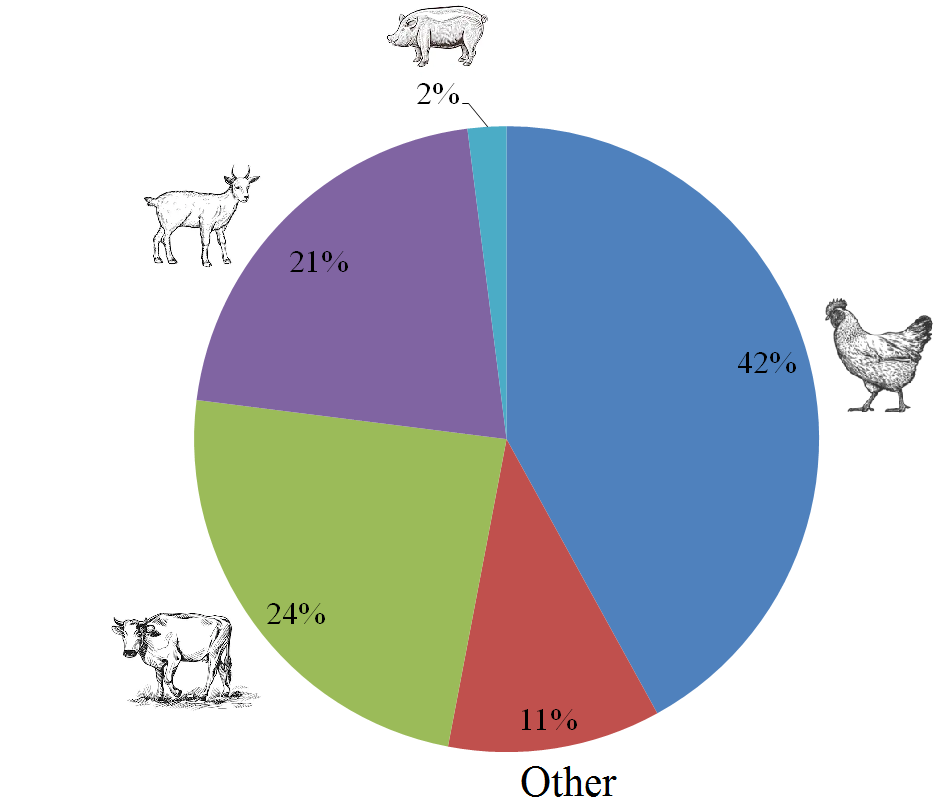
Given below are statistical facts about livestock in India.
  1. Poultry accounts for the largest share with 42 percent followed by others.
  2. Other animals which include camels, asses, horses, ponies and mules are in the lowest rung.
  3. India had about 287 million cattle, including 90 million buffaloes, in 1997.
View full question & answer
Question 303 Marks
Give one difference between the conventional farming and organic farming.
Answer
Under organic farming, the produce is pesticide-free and produced in an environmentally sustainable way, whereas in the conventional farming the produce is based on chemical based fertilisers and toxic pesticides, which in turn deplete the soil and devastate natural eco-system.
View full question & answer
Question 313 Marks
What is the role of NABARD in rural credit in India?
Answer
National Bank for Agriculture and Rural Development (NABARD) was set up by the RBI in 1982 to take over the agricultural credit functions of the RBI and the refinance functions of Agricultural Refinance Development Corporation (ARDC).
It serves as a refinancing institution for all kinds of production and investment credit to agriculture, small-scale industries, cottage and village industries, handicrafts and rural crafts and real artisans. It has the responsibility of coordinating the activities of Central and State Governments, the Planning Commission and other all-India and State level institutions for rural development.
View full question & answer
Question 323 Marks
Economists and scholars have identified certain key issues that are associated with rural development.
Write the name of some key issues.
Answer
Key issues in rural development are:
  1. Literacy.
  2. Health.
  3. Land reforms.
  4. Productive resources.
  5. Infrastructure development.
  6. Poverty alleviation.
View full question & answer
Question 333 Marks
How has horticulture encouraged Indian rural development?
Answer
Horticulture plays an important role in providing crops for nutrition and food, besides addressing employment concerns. It gives employment to around 19 percent of the total labour force.
  • It has become a means of improving livelihood for many women and underprivileged classes too.
  • Flower harvesting, nursery maintenance, hybrid seed production, tissue culture, propagation of fruits, flowers and food processing give employment and remunerative options for women in rural areas.
View full question & answer
Question 343 Marks
Why do farmers borrow?
Answer
Borrowings of a farmer can be for the following purposes:
  1. Productive borrowings: These borrowings include loans to buy seeds, fertilisers and agricultural equipment and implements.
  2. Unproductive borrowings: These borrowings include loans for social purposes such as marriage and festive occasions, or to meet expenditure on illness, death, etc.
View full question & answer
Question 353 Marks
How is cooperative marketing beneficial to individual farmers?
Answer
Cooperative marketing is a measure to ensure a fair price to farmers. It links rural credit, farming and marketing processes to the best advantage of the farmers.
  1. Member farmers sell their surplus to the co operative society, which substitutes collective bargaining in place of individual bargaining.
  2. It advances loans to member farmers and enables them to wait for better prices.
  3. Through proper storage facilities, transport facilities, direct marketing, and a control on the supply of agricultural goods it enables the member farmers to fetch a better price for their produce.
View full question & answer
Question 363 Marks
Why is it important to develop proper storage facilities in rural areas?
Answer
It is essential to develop proper storage facilities in rural areas so that farmers can wait for better price for their produce in the market. They are forced to sell their crops at very low prices to traders for the fear of damage to their produce from fire, rodents or pests, due to lack of proper storage facilities.
View full question & answer
3 Marks Question - Economics STD 12 Commerce Questions - Vidyadip