Questions

4 Marks Question

🎯

Test yourself on this topic

19 questions · timed · auto-graded

Question 14 Marks
'Good Wash Ltd.' are the manufacturers of different sizes of fully automatic washing machines marked as 'small', 'medium', 'large' and 'industrial'. From the information given below, calculate the 'Break-Even Quantity' of the machines manufactured per month.
Information:
Machine Unit Selling Unit Variable Fixed Expenditure
Small 10,000 3,000 35,000
Medium 15,000 8,000 35,000
Large 20,000 13,000 70,000
Industrial 35,000 20,000 1,50,000
Answer
Formula for break-even point =Fixed expenses
Gross margin Gross Margin = Selling price per unit - variable cost per unit.
Machine Selling Price Variable cost Gross margin Fixed cost BEP-calculation In units
Small 10000 3000 7000 35000 35000/7000 5
Medium 15000 8000 7000 35000 35000/7000 5
Large 20000 13000 7000 70000 70000/7000 10
Industrial 35000 20000 15000 150000 150000/15000 10
View full question & answer
Question 24 Marks
Illustrate how an entrepreneur assesses the working capital requirements of an enterprise taking into consideration the operating cycle.
Answer
Any appropriate example explaining the following points to assess the requirement of working capital:
  1. Length of operating cycle.
  2. Realisation of cash from debtors.
View full question & answer
Question 34 Marks
A factory is engaged in manufacturing shirts. The following information is available to you:
Sales - Rs. 4,00,000
Direct Labour Cost (2,000 units) - ₹ 40,000
Direct Material Cost (2,000 units) - ₹ 1,00,000
Direct Expenses (2,000 units) - ₹ 20,000
Fixed Cost - ₹ 1,20,000
Find out:
  1. Variable cost per unit.
  2. Total cost.
  3. Quantity to be sold at Break-Even Point.
Answer
  1. $\text{Variable cost per unit}=\frac{\text{Direct labour cost +Direct material cost + Direct expenses}}{\text{no. of units}}$
$\text{=40,000 + 1,00,000 + 20,000 = ₹ 1,60,000} ={\frac{\text1,60,000}{2,000}}$
  1. $\text{Total cost = Fixed cost + Variable cost}$
$\text{= 1,20,000 + 1,60,000 = ₹ 2,80,000}$
  1. $\text{Sales at BEP}= {\frac{\text {Fixed cost}} {\text{Selling price - Variable cost per unit}}}$
$=\frac{1,20,000}{200-80}={\frac{1,20,000}{120}}={\text{1,000 units}}$
View full question & answer
Question 44 Marks
Manohar and Manav were running a partnership firm. The firm is engaged in the production and marketing of edible oils. Manohar was looking after the production and Manav used to look after the remaining operations of the business. The firm was doing good business and earning profits more than the rate of profit of the industry. They used to be fair in their dealings with the customers and other stakeholders of the business. They used to do their quantitative planning meticulously. The edible oil produced by the firm is as per the fssai Standards.
  1. Explain any one type of plan prepared each by Manohar and Manav with quantitative expressions.
  2. Identify any two values observed by Manohar and Manav.
Answer
  1.  
  1. Manohar:
  • Production Budget: An estimate of a number of units which must be manufactured to meet the sales goal.
  1. Manav:
  • Marketing Budget: An estimate of the funds needed for promotion, advertising, and public relations in order to market the product or service.
  • Sales Budget: An estimate of future sales used to create company sales growth.
  • Capital Budget: Used to determine whether a firm’s long term investments are worth pursuing.
  • Cash flow budget: Prediction of future cash receipts and expenditures for a particular time period.
  • Project budget: Prediction of the costs associated with a particular company project.
  1. Values: Fair dealing with customers; Honesty; Fulfilling social responsibility.
View full question & answer
Question 54 Marks
'Nomy India Ltd.' are the producers of different sizes of televisions. From the information given below, calculate the 'Break-Even Quantity' of the T.V. sets manufactured per month.
Informations:
Size of T.V. sets Unit selling price Unit variable cost Fixed expenses per month:
Size Rs. Rs. Rs.
24" 5,000 2,000 4,000
32" 10,000 7,000 6,000
36" 15,000 12,000 8,000
42" 20,000 14,000 9,000
Answer
Formula for break-even point = $\frac{\text{Fixed expenses}}{\text{Gross margin}}$
Gross margin = Selling price per unit - Variable cost per unit
Size Selling Price Variable Cost Gross Margin Fixed Cost BEP-Calculation In Units
24 5000 2000 3000 4000 4000/3000 1.33
32 10000 7000 3000 6000 6000/3000 2
36 15000 12000 3000 8000 8000/3000 2.66
46 20000 14000 6000 9000 9000/6000 1.5
View full question & answer
Question 64 Marks
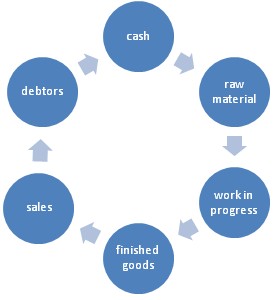
Illustrate how an entrepreneur assess the working capital requirements of an enterprise taking into consideration the operating cycle.
Answer
An entrepreneur assess working capital requirement according to the operating cycle:
  • In a business concern operating cycle begins with outflow of cash towards the purchase of raw materials, payment of labour, power, fuel and other expenses converting the raw materials into work in progress and converting them into finished goods. Sale of finished good for cash or credit.
  • If on credit then conversion of account receivables into cash.
  • This operating cycle indicates that funds once tied up in the form of raw materials are later converted into the form of finished goods
  • In a manufacturing concern there is a time gap between the first step of purchasing of raw-materials to last step of selling of goods and realizing cash. This time duration is called operating cycle. It is also called the “changing” or circulating capital because money circulates in various forms of assets in a continued manner.
The operating cycle is explained with help of diagram below:
View full question & answer
Question 74 Marks
A factory is engaged in manufacturing shirts. The following information is available to you:
Sales - Rs. 2,00,000.00
Direct Labour Cost (1000 Units) - Rs. 20,000.00
Direct Material Cost (1000 Units) - Rs. 50,000.00
Direct Expenses (1000 Units) - Rs. 10,000.00
Fixed Cost - Rs. 60,000.00
Find out:
  1. Variable cost per unit.
  2. Total cost.
  3. Quantity to be sold at Break-Even-Point.
Answer
$\text{variable cost per unit} = \frac{\text{Direct Labour Cost + Direct material Cost + Direct Expenses}}{\text {no. of units}} $=$\text{Total cost } = \frac{\text{20,000 + 50,000 + 10,000}}{\text{1,000}} = \frac{\text 80,000}{1,000}=\text {Rs 80 per unit}$
Total cost = Fixed cost+ variable cost
= 60,000 + 80,000= Rs 1,40,000
$\text{Sales at BEP}=\frac {\text {Fixed Cost}}{\text{Selling Price - Variable Cost Per Unit} } $
$=\frac{\text {60,000}}{\text{200 - 80}}=\frac{\text {60,000}}{\text {120}}=\text {500 units}$
View full question & answer
Question 84 Marks
‘Flavouright Foods Ltd.’ started a business of making nachos (corn chips) in three variants, Classic Cheese, Toasted Corn and Tangy Tomato. To start with, all the three variants will be sold in a standard packing of 100 gms each, the selling price would differ due to the ingredients used. Fixed costs are ₹ 38,000.
Sales price and variable costs per unit are as follows:
Particulars Classic Cheese Toasted Corn Tangy Tomato
Sales Price ₹ 80 45 60
Variable Cost ₹ 40 15 20
Packets sold 100 40 60
From the above information calculate:
  1. Weighted contribution margin per unit.
  2. Breakeven point–total and per product.
Answer
Particulars
Classic Cheese
Toasted Corn
Tangy Tomato
Sales Price (₹)
80
45
60
Variable Cost (₹)
40
15
20
Contribution (SP-VC) (₹)
40
30
40
Sales Mix (%) (Units of packets sold/total sales) X100
50%
20%
30%
Weighted Contribution (Contribution X Sales mix %) (₹)
20
6
12
Hence,
Total weighted contribution margin
= 20 + 6 + 12
= ₹ 38/unit
$=\frac{\text{Fixed cost}}{\text{weight average contribute per unit}}$
$=\frac{38,000}{38}$
= 1,000 units
Break even per product:
particulars
Classic cheese
Toasted
Tangy tomato
Sales mix(%)
50%
20%
30%
BPE per product
500 units (1000x50%)
200 units (1000x20%)
300 units (1000x30%)
 
View full question & answer
Question 94 Marks
Answers to these questions should not exceed 250 words:
What is a budgeting process?
Answer
Budgeting is a collective process in which operating units prepare their plans in conformity with corporate goals published by top management.Each unit plan is intended to contribute to the achievement of the corporate goals.Unit managers prepare projections of sales, operating costs, overhead costs, and capital requirements. They calculate operating profits and returns on the investment they intend to use.
The budget itself is the projection of these values for the next calendar or fiscal year.In this process, each unit presents its plans and budget to a reviewing upper management panel and may, thereafter, make whatever changes result from instructions or negotiations with the higher level.
Texts presenting, documenting, and defending the rationales underlying the numbers are usually part of the planning document.Approved budgets then become the road map for operations in the coming year. Ideally monthly or quarterly budget reviews track performance against the budget.As part of such reviews, changes to the budget may be approved. At the end of year managers are judged by their performance against the budget.
View full question & answer
Question 104 Marks
Answers to these questions should not exceed 75 words:
Explain Inventory Control and state its objectives.
Answer
Inventory Control is a systematic and detail record of purchase of materials, their storage capacity, quantity in order to supply, quantity order for large discounts, handling delivery of materials etc. It is a process which facilitates an entrepreneur in smooth production operation and to take important decisions in a production line.
The objectives of inventory management are:
  1. To ensure that the supply of raw materials and finished goods will remain continuous so that production process is not halted and demands of customers are duly met.
  2. To minimise carrying cost of inventory.
  3. To keep investment in inventory at optimum level.
  4. To reduce the losses of theft, obsolescence and wastage, etc.
  5. To make arrangement for sale of slow moving items.
  6. To minimise inventory ordering costs.
View full question & answer
Question 114 Marks
What is working capital? What is the need for working capital? What value is exhibited by the business by maintaining adequate working capital?
Answer
Working capital refers to that part of total capital which is required for holding current assets.
It may also be defined as the excess of current assets over current liabilities.
A business needs working capital for a number of uses. Some of them are as follows:
  1. Ensures solvency of the business: Working capital helps a business to operate smoothly without any financial problem for making the payment of short-term liabilities.
  2. Enhances goodwill: Sufficient working capital enables a business concern to make prompt payments and hence helps in creating and maintaining goodwill. Goodwill is enhanced because all current liabilities and operating expenses are paid on time.
  3. Ensures easy availability of loans: A firm having adequate working capital can arrange loans from banks and financial institutions in easy and favourable terms.
  4. Regular supply of raw material: Prompt payment to creditors of raw materials ensures regular supply of inventory and uninterrupted production.
  5. Smooth business operation: Working capital is really a life blood of any business organisation and it helps in its smooth functioning.
  6. Ability to face crisis Adequate working capital enables a firm to face crisis in emergencies such as depression.
The value exhibited by the business is:.
Fulfilling responsibility: The business is being responsible by maintaining adequate working capital as it will enable it to meet its current liabilities successfully.
View full question & answer
Question 124 Marks
A factory is engaged in manufacturing washing machines. The following information is available to you:
Sales = ₹ 4,00,000
Direct labour cost (2,000 units) = ₹ 40,000
Direct material cost (2,000 units) = ₹ 1,00,000
Direct expenses (2,000 units) = ₹ 20,000
Fixed cost = ₹ 1,20,000
Find out:
  1. Variable cost per unit.
  2. Total Cost.
  3. Quantity to be sold at break-even point.
Answer
  1. Total Variable Cost = Direct Labour Cost + Direct Material Cost + Direct Expeses
= 40,000 + 1,00,000 + 20,000 + ₹ 1,60,000
Variable Cost Per Unit $=\frac{\text{Total Variable Cost}}{\text{Number Of Units}}=\frac{1,60,000}{4,00,000}=₹\ 80$
  1. Total Cost = Total Variable Cost + Fixed Cost
= 1,60,000 + 1,20,000 = ₹ 2,80,000
  1. Break - even Point=$\frac{\text{Fixed Cost}}{\text{P/V } \text{Ration}}$
P\V Ration = $\frac{\text{Sales }-\text{Total Variable Cost}}{\text{Sales}}$
$=\frac{4,00,000-1,60,000}{4,00,000}=0.6$
$[\because\text{Selling Price Per Unit}=\frac{4,00,000}{2,000}=₹\ 200]$
Quantity to be Sold at Break - even point $=\frac{2,00,000}{200}=1,000\ \text{units}$
View full question & answer
Question 134 Marks
A factory is engaged in manufacturing coolers. The following information is available to you: Sales = ₹ 2,50,000 Direct labour cost (for 100 units) = ₹ 25,000 Direct material cost (for 100 units) =₹ 62,500 Direct expenses (for 100 units) = ₹ 12,500 Fixed cost = 75,000Calculate:
  1. Variable cost per unit.
  2. Total cost.
  3. Break-even point.
Are actual sales exceeding the sales required to break-even? If yes, then what values are exhibited by the business in achieving those sales?
Answer
  1. Variable Cost = Direct Labour Cost + Direct Material Cost + Expenses
= 25000 + 62,500 + 12,500 = ₹ 1,00,000
Variable Cost Per Unit $= \frac{\text{Variable Cost}}{\text{Number Of Units}}=\frac{1,00,000}{100}=₹\ 1,000\ \text{per unit}$
  1. Total Cost = Fixed Cost + Variable Cost = 75,000 + 1,00,000 = ₹ 1,75,000
  2. $\text{Break} - \text{even Point}= \frac{\text{Fixed Cost}}{\text{P/V Ration}}$
$\text{P/V}\ \text{Ration}=\frac{\text{Sales} -\text{Variable Cost}}{\text{Sales}}$
$=\frac {2,50,000-1,00,000}{2,50,000}=0.6$
$\text{Break} - \text{Even Point}=\frac{75,000}{0.6}=₹\ 1,25,000$
View full question & answer
Question 144 Marks
Ramu is buying and selling ice-cream. Explain his working capital= requirements.
Answer
Ramu is engaged in a trading business. Working capital requirement of a trading business is less as compared to a manufacturing business because of a shorter Cash Conversion Cycle. So, his working capital needs will comprise of:
  1. Cash for purchasing ice-creams.
  2. Cash for payment of various operating expenses as rent, salaries and wages of selling staff, electricity bill, etc.
  3. Cash for meeting short-term liabilities, ex-payment to creditors for credit purchase of ice-creams.
View full question & answer
Question 154 Marks
Arjun owns a factory which manufactures glass products. Some of his products are also patented. During the last 3 years of operating business, he has failed to provide for depreciation and amortisation. Now, some of the assets need replacement and he is facing shortage of funds. Advise him, as to why he should charge depreciation and amortisation? Which values are violated by him by not providing for the above?
Answer
When an asset is purchased, it is nothing more than a payment in advance for the use of the asset. Depreciation or amortisation is the cost of using that asset per year and should, therefore, be debited to profit and loss account of the business. If depreciation is not provided, the profits of the concern will be overstated. It is also possible that owners have withdrawn such profits. So, at the end of the working life of the asset, there will be no funds to purchase the assets, as in the given instance. So, depreciation and amortisation should be charged to business as an expense.The values violated by Arjun are:
  1. Lack of responsible behaviour.
  2. Not working towards sustainable growth.
View full question & answer
Question 164 Marks
Calculate Return on Investment (Rol) and Return on Equity (RoE) on the basis of given information. You have newly started a beauty parlour business, you spend ₹1,50,000 to open the parlour of which you invested ₹70,000 of your own money and borrowed a loan for ₹80,000. Interest rate per annum is 7%. Sales revenue per month is₹ 80,000. Cost of goods sold is₹ 30,000 per month. Fixed expenses is ₹30,000 (salary ₹20,000, rent and utility ₹10,000), depreciation₹ 3,000 and tax @ 14%. What values are exhibited by the business by being able to achieve such ratios?
Answer
Total Capital Invested
₹ 1,50,000
Equity (Own money)
₹ 70,000
Debt
₹ 80,000
Income Statement of beuty parlour fpor 1st month Sales Revenue
₹ 80,000
(-) Cost of Goods Sold
₹ 30,000
Gross margin
₹ 50000
(-) Fixed Expenses
 
Salary
₹ 20,000
Rent and Unity
₹ 10,000
Interest@7%
 
$\bigg(80,000\times\frac{7}{100}\times\frac{1}{12}\bigg)$
₹ 467
Depreciation $\bigg(\frac{3,000}{12}\bigg)$
₹ 250
Profit Before Tax
₹ 19,283
(-) Tax @ 14%
₹ 16,583
Return on Investment (RoI) = $\frac{\text{Net Profit (Profit after tax)}}{\text{Total Capital Investment}}\times100=\frac{16,583}{70,000}\times100=11.05\%$
Return on Equity (RoI) =$\frac{\text{Net Profit}}{\text{Equity}}\times100\frac{16,583}{70,000}\times100=23.69\%$
Note Depreciation and fixed expenses are assumed to be calculated on monthly basis. The profitability ratios are an average.
The values being exhibited by the business are:
  1. Reasonable returns to investors: The business is able to offer reasonable return to investors, thus compensating them for parting with capital.
  2. Sustainable development: These ratios will help the business to sustain and grow in the long-run.
View full question & answer
Question 174 Marks
Nitin is a young entrepreneur who has decided to venture into the business of manufacturing cycles for children. He wants to have an assessment that in how many days, his investment will start generating cash flows. So, give him the operating cycle of a manufacturing company.
Answer
for a manufacturing company, operating cycle is the length of time needed to complete the following:
  1. Conversion of cash into raw materials.
  2. Conversion of raw materials into work-in-progress.
  3. Conversion of work-in-progress into finished goods.
  4. Conversion of finished goods into accounts receivables.
  5. Conversion of accounts receivables into cash.
View full question & answer
Question 184 Marks
Answers to these questions should not exceed 30 words:
What is financial management? What is the main objective of financial management?
Answer
  1. Financial management means planning, organizing, directing and controlling the financial activities such as procurement and utilization of funds of the enterprise.
  2. It is an activity which is concerned with acquisition and conservation of capital funds in meeting financial need an overall objectives of business organisation.
  3. It means applying general management principles to financial resources of the enterprise.
Objectives of financial management:

The financial management is generally concerned with procurement, allocation and control of financial resources of a concern. The objectives can be-

Main objectives of financial management is wealth maximization of shareholder’s wealth.
  1. To ensure regular and adequate supply of funds to the concern.
  2. To ensure adequate returns to the shareholders.
  3. To ensure optimum funds utilization. Once the funds are procured, they should be utilized in maximum possible way at least cost.
View full question & answer
Question 194 Marks
Ravi is the owner of an umbrella manufacturing unit. During the month of June, in anticipation of increase in demand, he produced 500 umbrellas. Total cost of production for umbrellas was ₹ 50,000. Out of the above, ₹ 10,000 were fixed expenses.
Find out the variable expenses and unit cost per umbrella.
Answer
Variable Expenses = Total Expenses - Fixed Expenses
= ₹ 50,000 - ₹ 10,000 = ₹ 40,000
Unit cost is cost per unit of the variable cost.
So, unit cost of umbrella $=\frac{40,000}{500}=₹\ 80$
View full question & answer
4 Marks Question - Entrepreneurship STD 12 Commerce Questions - Vidyadip