Questions · Page 1 of 2

3 Marks Question

🎯

Test yourself on this topic

50 questions · timed · auto-graded

Question 13 Marks
Explain Interval training method.
Answer
Interval training method:- Interval training method is also called terrace training. It is training of heart, through endurance training. If you run your heart beats at a faster rate.
Dr. Woldemar and Gerschler, introduced this training method in 1930. In this method the athlete used to run 400m. race, 10 to 20 times daily, instead of running 10 to 20 miles daily. In fact this training method is based on effort and recovery principle. During interval training recovery period is given to the athlete after each speedy workout. Recovery period can be adjusted according to the efficiency of the athlete. The load can be increased by reducing the recovery period or by increasing the workout.
For an athlete of 400m. following Examples are applicable in his training.
  1. 400m. race with 80% speed.
  2. Walking or jogging until his heart rate comes down to 120 to 140 approximately.
  3. 400m. race with 80% speed. (repetition)
View full question & answer
Question 23 Marks
Explain, what is strength and write the methods for improving strength?
Answer
Strength:
Ability of the muscles to overcome the resistance/Capacity of the body to exert force/force that muscle can exert against resistance.
Methods:
  1. Isometric.
  2. Isotonic.
  3. Isokinetic.
View full question & answer
Question 33 Marks
Briefly, explain different types of co-coordinative abilities.
Answer
  1. Orientation ability.
  2. Coupling Ability.
  3. Reaction Ability.
  4. Balance Ability.
  5. Rhythm Ability.
  6. Adaptation Ability.
  7. Differentiation Ability.
View full question & answer
Question 43 Marks
Dynamic strength is divided into three parts. Write in brief about each.
Answer
  1. Maximum strength.
  2. Explosive strength.
  3. Strength endurance.
View full question & answer
Question 53 Marks
Explain any two methods for flexibility development.
Answer
Static Stretching Method: Static Stretching Method involves gradually easing into the stretch position and holding the position. The amount of time a static stretch is help depends on one’s purpose. If it is a part of cool down, then the stretch should be held for 10 seconds. If it is to improve the range of flexibility, then hold it for 30 seconds. In static stretching, it is advised to move further into the stretch position as the stretch sensation comes to lower level.
Dynamic Stretching Method: Dynamic Stretching consists of controlled leg and arm swings that take you gently to the limit of your range of motion. Where the event requires a dynamic movement, it is appropriate to conduct dynamic stretching exercises. Start with the movement at half speed for a couple of repetitions and then gradually work up to full speed.
View full question & answer
Question 63 Marks
Explain any three principles of training in brief.
Answer
Principles of Training: Training should be matched to an individual’s needs. By using the principles of training as a framework, we can plan a personal training programme that uses scientific principles to improve performance, skill, game ability and physical fitness.
A successful training programme will meet individual needs which are personal fitness needs based on age, gender, fitness level and the sport for which we are training. A successful training programme will also include exercise in the correct heart-rate target zone.
The Key principles when planning a programme are:
Specificity – Training must be matched to the needs of the sporting activity to improve fitness in the body part which the sport uses.
Overload – Fitness can only be improved by training more than you normally do. You must work hard.
Progression – Start slowly and gradually increase the amount of exercise and keep overloading.
Reversibility – Any adaptation that takes place as a result of training will be reversed when you stop training. If you take a break or don’t train often or enough you will loose fitness.
View full question & answer
Question 73 Marks
Explain concepts of training?
Answer
Concept of Training Method: It is the study of various exercises done to develop sports Performance. The knowledge of sports training is essential for the coaches. Sports training is considered as long term training programme which aims to improve performance of sportsmen, it makes sportsmen psychologically and physiologically conditioned to be exhibite peak sports performance. Within the one year, the training programmes are divided into three parts:
  1. Preparatory period.
  2. Competition period.
  3. Transitional period.
View full question & answer
Question 83 Marks
Explain two methods for speed development?
Answer
  1. Acceleration Runs: Acceleration runs are usually adopted to develop speed. Specially in attaining maximum speed From stationary position, it should be kept in mind that the technique of any event should be learnt in the beginning. Only then we should switch over to acceleration runs.
  2. Pace Races: Pace races means, running the whole distance of race at a constant speed in pace races. An athlete runs the race with uniform speed. Generally 800 meters and above races are included in pace races. As a matter of fact, an athlete can run a distance of 300 meters at full speed. So, in longer race such as 800 meters or above races he must conserve his energy by reducing his speed.
View full question & answer
Question 93 Marks
What is Endurance? Explain its types.
Answer
The ability to sustain a physical activity over longer period of time resisting fatigue is called Endurance.
  1. Endurance according to Nature of activity:
  • Basic Endurance.
  • General Endurance.
  • Specific Endurance
  1. Endurance according to duration of activity:
  • Long term Endurance.
  • Medium term Endurance.
  • Short term Endurance.
View full question & answer
Question 103 Marks
What is Fartlek training? Write in brief.
Answer
  • Gosta Holmer developed Fartlek training in 1937.
  • Fartlek training method is used for developing endurance.
  • It is a combination of Aerobic and Anaerobic/Continuous and internal training.
  • Fartlek is derived from Swedish word which means 'speed play'.
  • Athletes speed or pace is not preplanned and is decided according to the surroundings.
  • Self discipline is most important while undertaking the training.
  • The range of heart beat should be 140 to 180/minute.
Example:
Jogging, slow running– 5 to 10 minutes.
Steady, hard running– 1.5 to 2.5/ km.
Rapid walking– 5 minutes.
Sprints for about 50 to 60mts.
Full speed up hill running for 175 to 200 mts.
Free running/easy running.
Fast pace/minute.
View full question & answer
Question 113 Marks
What is Endurance? How endurance can be developed through fartlek method?
Answer
Endurance is the ability to sustain an activity over a longer period of time, under the condition of fatigue. Endurance can be developed through fartlek method are as follows:
  1. Endurance develops through Continuous & Interval Training; fartlek combines both training.
  2. Endurance develops according to duration of activity; fartlek can vary from aerobic walking to anaerobic sprinting.
  3. Endurance develops according to nature of activity; fartlek can change it according to the surrounding.
  4. Endurance develops under the condition of fatigue; self discipline plays a vital role in Fartlek training method.
  5. Fartlek training keeps the heart rate up allowing an athlete to get good cardio-vascular endurance.
  6. Due to the sprinting interval, it makes the body versatile.
  7. It is not rigid but flexible in nature.
View full question & answer
Question 123 Marks
What do you understand by relative strength? Explain the importance of body weight in determining relative strength.
Answer
Relative strength is strength in relation to your body weight. Relative strength have a determining importance in sports in which the athlete shifts his body in space without any additional external weight. (High Jump, Long Jump) as well as in sports in which he has to restrict his own weight within the framework of weight division. (e.g. boxing, wrestling, weight lifting etc.)

e.g. if 1 RM (repetition maximum) is 50 kgs and body wt. is 50 kg and if 1 RM is 70 kg and body wt. is 50 kg, in second category the relative strength is more.
View full question & answer
Question 133 Marks
What are the two methods for flexibility development?
Answer
  1. A flexible person can easily bend, twist and turn. Children are more flexible than adults. It can be maintained through routine stretching bending and relaxing exercise like Yoga Asanas.
  2. Athletes are required to be more flexible; Good flexibility reduces the chances of their getting injured.
View full question & answer
Question 143 Marks
Explain any two methods for speed development.
Answer
  1. Acceleration Runs: Acceleration runs are usually adopted to develop speed. Specially in attaining maximum speed from stationary position, it should be kept in mind that the technique of any event should be learnt in the beginning. Only then we should switch over to acceleration runs.
  2. Pace Races: Pace races means, running the whole distance of race at a constant speed in pace races. An athlete runs the race with uniform speed. Generally 800 meters and above races are included in pace races. As a matter of fact, an athlete can run a distance of 300 meters at full speed. So, in longer race such as 800 meters or above races he must conserve his energy by reducing his speed.
View full question & answer
Question 153 Marks
Explain any two Methods for speed development?
Answer
  1. Acceleration Runs: Acceleration runs are usually adopted to develop speed. Specially in attaining maximum speed from stationary position, it should be kept in mind that the technique of any event should be learnt in the beginning. Only then we should switch over to acceleration runs.
  2. Pace Races: Pace races means, running the whole distance of race at a constant speed in pace races. An athlete runs the race with uniform speed. Generally, 800 meters and above races are included in pace races. As a matter of fact, an athlete can run a distance of 300, meters at full speed. So, in longer races such as 800 meters or above races he must conserve his energy by reducing his speed.
View full question & answer
Question 163 Marks
What do you mean by active flexibility and passive flexibility?
Answer
Passive Flexibility: The ability to do movements with greater distance with external help is called passive flexibility, e.g., stretching exercises with the help of a partner
Active Flexibility: Active flexibility is the ability to do movement for a longer distance without external help
View full question & answer
Question 173 Marks
Define circuit training.
Answer
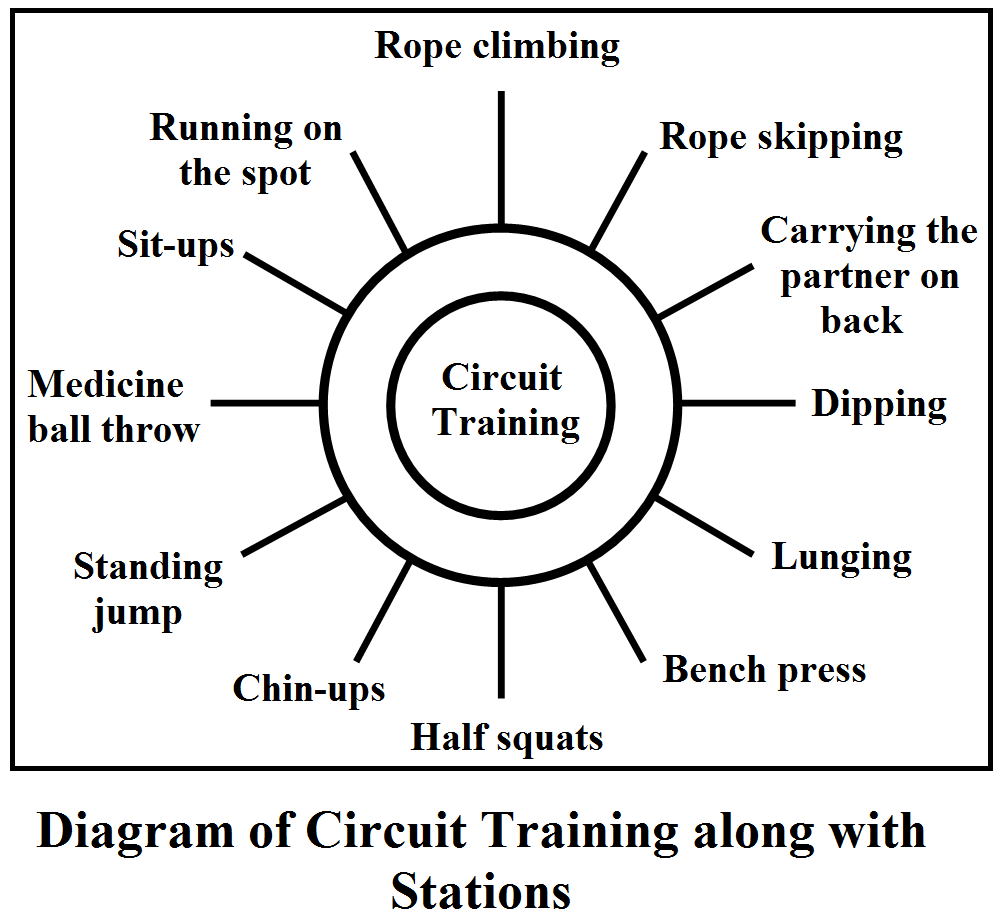
Circuit training is the training method in which certain exercises of various kinds are performed with or without apparatus with given dosage.
View full question & answer
Question 183 Marks
State any one method to develop speed.
Answer
Acceleration Runs; Acceleration runs are usually adopted to develop speed, specially in attaining maximum speed from stationary position. It should be kept in mind that the technique of any event should be learnt in the beginning. Only then, we shouJd switch over to acceleration runs.
View full question & answer
Question 193 Marks
What is short term endurance?
Answer
Short term endurance is needed to resist fatigue in sports activities lasting from about 45 seconds to 2 minutes. This endurance also depends to a large extent oln strength endurance and speed endurance.
View full question & answer
Question 203 Marks
What is fartlek training?
Answer
It is such a training method that blends continuous training with interval training. This training method lays emphasis on both aerobic and anaerobic systems. In this method, pace or speed is not pre-planned and thus it is left to the discretion of individual.
View full question & answer
Question 213 Marks
"Pace races mean, running the whole distance of a race at a constant speed." Which are the races included in pace races?
Answer
Pace races mean running the whole distance of a race at a constant speed. In pace races, an athlete runs the race with uniform speed. Generally, 800m and above races are included in pace races.
View full question & answer
Question 223 Marks
What is adaptation ability?
Answer
Adaptation Ability: Adaptation ability is the ability to adjust or change the movement effectively on the basis of changes or anticipated changes in the situation. The change in situation can be expected one or can be sudden or unexpected one.
View full question & answer
Question 233 Marks
What is long term endurance?
Answer
Long term endurance is needed in such sports activities which last for more than 11 minutes. The sports activities such as 5,000m, 10,000m cross country and marathon races require such type of endurance.
View full question & answer
Question 243 Marks
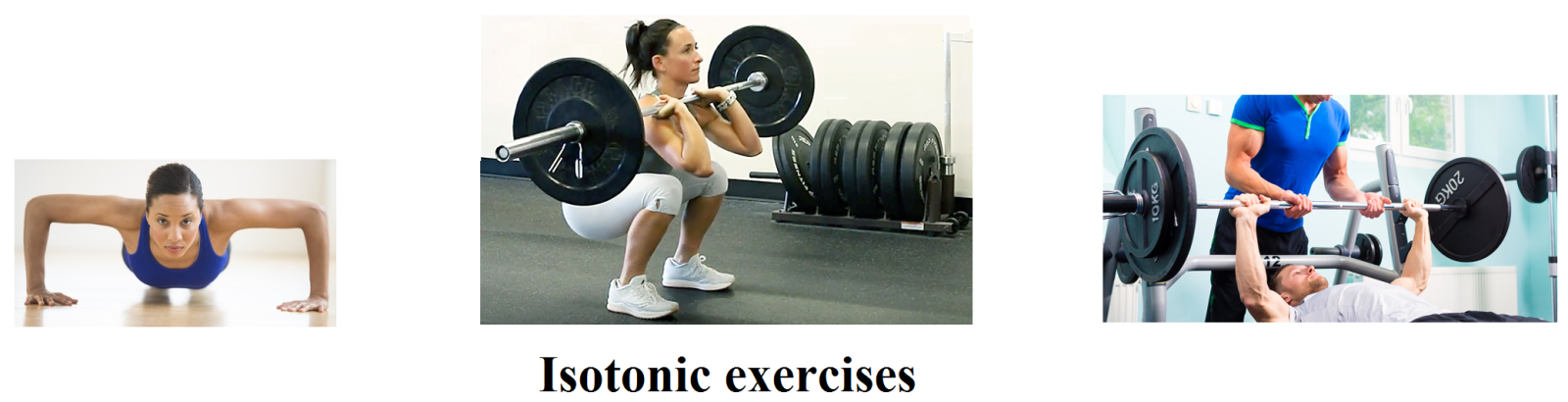
What are isotonic exercises?
Answer
Isotonic exercises are those exercises in which movements can be seen directly. Work is done in these exercises. Isotonic exercises tone up the muscles. Muscles become flexible. Length of the muscles can be increased by isotonic exercises.
View full question & answer
Question 253 Marks
What is active flexibility?
Answer
Active flexibility is the ability to do movement for a longer distance without external help, e.g., to do a stretch without the help of a partner. Active flexibility can further be divided into two parts-static flexibility and dynamic flexibility.
View full question & answer
Question 263 Marks
What do you mean by coordinative abilities?
Answer
The coordinative abilities are those abilities of an individual which enable the individual to do various related activities properly as well as efficiently.
View full question & answer
Question 273 Marks
What is continuous training method?
Answer
Continuous training is one of the best methods for improving endurance. In this method of training, an exercise is performed for a long duration without any break.
View full question & answer
Question 283 Marks
What is strength endurance?
Answer
Strength endurance can be defined as the ability to overcome resistance or to act against resistance under conditions of fatigue.
View full question & answer
Question 293 Marks
What is passive flexibility?
Answer
The ability to do movements with greater distance with external help is called passive flexibility, e.g., stretching exercises with the help of a partner. Passive flexibility is always more than active flexibility. In fact, passive flexibility is the foundation for active flexibility.
View full question & answer
Question 303 Marks
What do you mean by circuit training?
Answer
Circuit training is the training method in which certain exercises of various kinds are performed with or without apparatus with given dosage.
View full question & answer
Question 313 Marks
What is static strength?
Answer
Static strength is also called isometric strength. It is the ability of muscles to act against resistance. Static strength can be measured by dynamometer.
View full question & answer
Question 323 Marks
What is sports training?
Answer
Training means the process of preparation for some task. But here our main task is fitness and conditioning our body for sports and games. It is for this reason that this terms is prevalently used in sports and games. Here, it is called 'sports training'.
View full question & answer
Question 333 Marks
What is interval training method?
Answer
This training method is based upon "effort and recovery'' principle. During interval training, recovery period is given to the athlete after each speedy workout. Recovery period can be adjusted according to the efficiency of athlete.
View full question & answer
Question 343 Marks
What is dynamic strength?
Answer
Dynamic strength can be called isotonic strength because it is related to movements. In pull-ups and push-ups, we require dynamic strength.
View full question & answer
Question 353 Marks
Define orientation ability.
Answer
It is the ability to determine the position of the body and its parts in time and space in relation to gravity, moving objects like ball, opponent, partner, playing field, etc.
View full question & answer
Question 363 Marks
What is rhythm ability?
Answer
Rhythm ability is the ability to observe or perceive the rhythm of a movement and to do the movement with the required rhythm.
View full question & answer
Question 373 Marks
Discuss about reaction ability and balance ability.
Answer
Reaction Ability: Reaction ability is the ability to react immediately or quickly and effectively to a signal.
Balance Ability: Balance ability is the ability to maintain balance during the complete body movements and to regain balance quickly after the balance-disturbing movements.
View full question & answer
Question 383 Marks
How to increase load in circuit training?
Answer
  1. Number of repetitions can be increased per exercise.
  2. Frequency can be increased.
  3. Additional load can be increased.
  4. Interval between exercises can be reduced.
  5. Number of rounds can be increased.
View full question & answer
Question 393 Marks
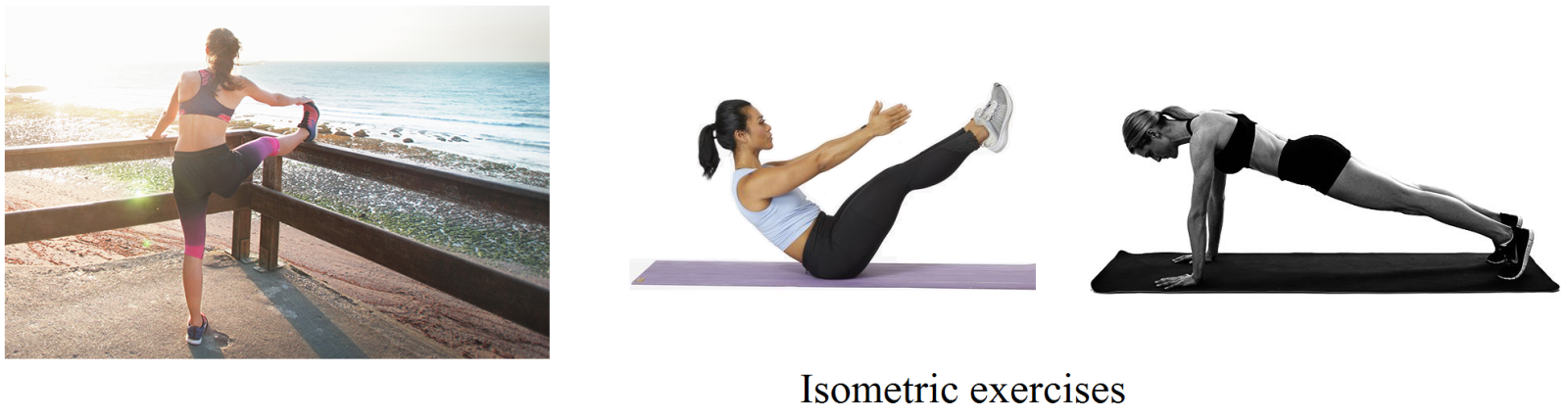
What are isometric exercises?
Answer
Isometric exercises are those exercises, which are not visible. In fact, there are no direct movements, hence they cannot be observed. In these exercises, work is performed but it is not seen directly.
View full question & answer
Question 403 Marks
What do you mean by dynamic strength and static strength?
Answer
  1. Dynamic Streagth: Dynamic strength can be called isotonic strength because it is related to movements. In pull-ups and push-ups, we require dynamic strength.
  2. Static strength: Static strength is also called isometric strength. It is the ability of muscles to act against resistance. Static strength can be measured by dynamometer.
View full question & answer
Question 413 Marks
Define speed.
Answer
Barrow and McGee, define speed as "the capacity of an individual to perform successive movement of the same pattern at a fast rate."
View full question & answer
Question 423 Marks
Define maximum strength and explosive strength.
Answer
  1. Maximum Strength: It is the ability to work against maximum resistance. Maximum strength is not used in majority of sports. It is usually used in those sports where very heavy resistances are to be tackled
  2. Explosive Strength: Explosive strength can be defined as the ability to overcome resistance with high speed. In fact, it is a combination of strength and speed abilities.
View full question & answer
Question 433 Marks
What do you mean by circuit training? Discuss its main characteristics?
Answer
"Circuit training is the training method in which certain exercises of various kinds are performed with or without apparatus, with given dosage.

Main Characteristics of Circuit Training Method:
  1. Exercises are simple to learn and simple to execute.
  2. Exercises are performed with medium resistance or with medium weight.
  3. Number of repetitions is more.
View full question & answer
Question 443 Marks
State continuous training method in brief.
Answer
Continuous training is one of the best methods for improving endurance. In this method of training, an exercise is performed for a long duration without any break. In this method, intensity remains low because the exercise is done for a longer period. Cross country race is the best example of continuous method. In this method, the rate of heartbeat remains in between 140-160 beats per minute. The total duration of the exercise should not be less than30 minutes. This duration of exercise can be increased according to endurance ability of the sportsperson or athlete.
View full question & answer
Question 453 Marks
State briefly balance ability and rhythm ability.
Answer
  1. Balance Ability: Balance ability is the ability to maintain balance during the complete body movements and to regain balance quickly after the balance-disturbing movements.
  2. Rhythm Ability: Rhythm ability is the ability to observe or perceive the rhythm of a movement and to do the movement with the required rhythm.
View full question & answer
Question 463 Marks
Discuss the types of strength.
Answer
  1. Dynamic Strength: Dynamic strength can be called isotonic strength because it is related to movements. In pull-ups and push-ups, we require dynamic strength. dynamic strength can be divided into three parts-
  1. Maximum strength.
  2. Explosive strength.
  3. strength Endurance.
  1. Static strength: Static strength is also called isometric strength. It is the ability of muscles to act against resistance. Static strength can be measured by dynamometer. This type of strength is not seen directly. Static strength is not usually applied in sports but in weightlifting it is used in phases.
View full question & answer
Question 473 Marks
Explain any three methods to improve flexibility.
Answer
  1. Ballistic Method: In ballistic method, the movement is performed with a swing in a rhythmic way. The related joint is stretched with a swing.
  2. Static Stretching Method: Static stretching method involves gradually easing into the stretch position and holding the position. The amount of time a static stretch is held depends on one's purpose.
  3. Dynamic Stretching Method: Dynamic stretching consists of controlled leg and arm swings that take you gently to the limit of your range of motion.
View full question & answer
Question 483 Marks
Discuss any three types of coordinative abilities.
Answer
  1. Orientation Ability:It is the ability to determine the position of the body and its parts in time and space in relation to gravity, moving objects like ball, opponent, partner, playing field, etc.
  2. Coupling Ability: Coupling ability is the ability to combine the movements of different body parts for performing perfect sports movements.
  3. Balance Ability: Balance ability is the ability to maintain balance during the complete body movements and to regain balance quickly after the balance-disturbing movements.
View full question & answer
Question 493 Marks
What do you mean by flexibility? Discuss the various types of flexibility.
Answer
Flexibility can be defined as the ability to execute movements with greater amplitude or range.
There are various types of flexibility that are described below:
  1. Passive Flexibility: The ability to do movements with greater distance with external help is called passive flexibility.
  2. Active Flexibility: Active flexibility is the ability to do movement for a longer distance without external help. Active flexibility can further be divided into two.
  1. Parts-static flexibility.
  2. Dynamic flexibility.
View full question & answer
Question 503 Marks
Discuss any two methods of improving strength.
Answer
  1. Isometric Exercises: Isometric exercises are those exercises, which are not visible. In fact, there are no direct movements, hence they cannot be observed. In these exercises, work is performed but it is not seen directly.
  1. Isotonic Exercises: Isotonic exercises are those exercises in which movements can be seen directly. Work is done in these exercises. Isotonic exercises tone up the muscles. Muscles become flexible.
View full question & answer