Questions

5 Marks Questions

🎯

Test yourself on this topic

6 questions · timed · auto-graded

Question 15 Marks
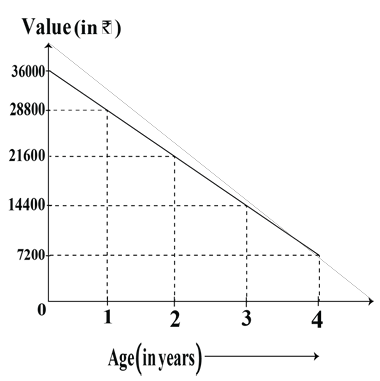
In 4 years, a mobile costing ₹ 36,000 will have a salvage value of ₹ 7200.
The following graph shows the depreciation of a mobile’s value over 4 years.
Image

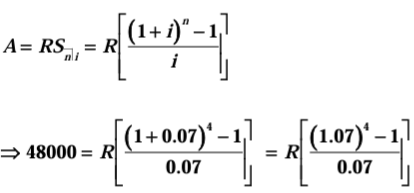
A new mobile at that time (i.e., after 4 years) is expected to cost for ₹ 55,200. In order to provide funds for the difference between the replacement cost and the salvage cost, a sinking fund is set up into which equal payments are placed at the end of each year. If the fund earns interest at the rate 7% compounded annually, how much should each payment be? Also find the amount of Annual Depreciation of the mobile’s value over 4 years and find the rate of depreciation (under straight line method).
Use (1.07)4=1.3107.
View full question & answer
Question 25 Marks
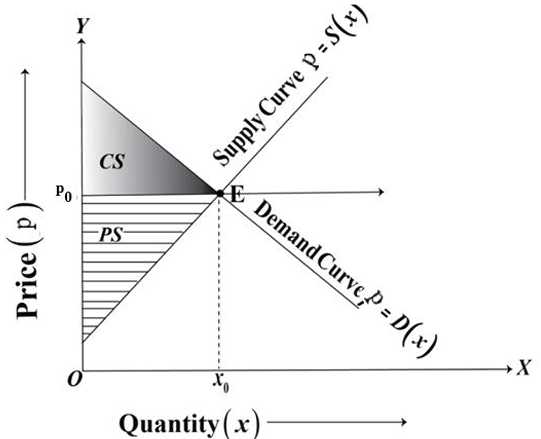
Supply and demand curves of a tyre manufacturer company is given below:


Image

The above graph showing the demand and supply curves of a tyre manufacturer company which are linear. ‘ABC’ tyre manufacturer sold 25 units every month when the price of a tyre was ₹ 20000 per units and ‘ABC’ tyre manufacturer sold 125 units every month when the price dropped to ₹ 15000 per unit. When the price was ₹ 25000 per unit, 180 tyres were available per month for sale and when the price was only ₹ 15000 per unit, 80 tyres remained. Find the demand function. Also find the consumer surplus if the supply function is given to be 𝑺(𝒙) = 𝟏𝟎𝟎 𝒙 + 𝟕𝟎𝟎𝟎
Answer
Let us consider demand function be $p=D(x)=a x+b \ldots \ldots . .(i)$
When $x = 2 5$ then $p = 2 0 0 0$
From equation (i), we have $2 0 0 0 0 = 2 5 a + b . \ldots . . . . . .(i i)$
And when $x = 1 2 5$ then $p = 1 5 0 0 0$
From equation ( $i$ ), we have $15000=125 a+b . . . . . . . . .(i i)$
On solving equations (i) and (ii), we get $a=- 5 0$ and $b = 2 1 2 5 0$
Therefore, demand function, $p=D(x)=-50 x+21250$
For equilibrium point $D\left(x_0\right)=S\left(x_0\right)$
$
\Rightarrow-50 x_0+21250=100 x_0+7000
$
$
\Rightarrow-150 x_0=-14250
$
$
\Rightarrow x_0=95
$
On putting value of $x_0$ in demand function and supply function, we get
$
p_0=16500
$
$\therefore$ Consumer surplus $(C S)$
$
=\int_0^{x_0} D(x) d x-p_0 x_0
$
$
=\int_0^{95}(-50 x+21250) d x-16500 \times 95
$
$
=\left(-50 \frac{x^2}{2}+2150 x\right)_0^{96}-1567500
$
= 1793125-1567500
=₹ 225625
View full question & answer
Question 35 Marks
A toy rocket is fired, from a platform, vertically into the air, its height above the ground after $t$ seconds is given by $s(t)= a t ^2+ b t + c$, where $a , b , c \in R ; a \neq 0$ and $s(t)$ is measured in
metres. After $1 0$ second, the rocket is $1 6 ~ m$ above the ground; after $2 0$ seconds, $2 2 ~ m$; after 30 seconds, $2 5$ m.
(i) Write down a system of three linear equations in terms of $a , b$ and $c$.
(ii) Hence find the values of $a , b$ and $c$, using matrix method.
Answer
(i) $s(t)=a t^2+b t+c ; t \geq 0$
Clearly, $(10,16),(20,22),(30,25)$ lie on the curve of $s(t)$.
Then, 100a+10b+c=16
$
\begin{aligned}
400 a+20 b+c & =22 \\
900 a+30 b+c & =25
\end{aligned}
$
(ii) Let, $A=\left(\begin{array}{ccc}100 & 10 & 1 \\ 400 & 20 & 1 \\ 900 & 30 & 1\end{array}\right) ; X=\left(\begin{array}{l}a \\ b \\ c\end{array}\right) ; B=\left(\begin{array}{l}16 \\ 22 \\ 25\end{array}\right)$
Then, the system becomes, $A X=B$
$
\begin{aligned}
|A|= & 100(-10)-400(-20)+900(-10) \\
& =-1000+8000-9000 \\
& =-2000 \neq 0
\end{aligned}
$
Now, adj $A=\left(\begin{array}{ccc}-10 & 500 & -6000 \\ 20 & -800 & 6000 \\ -10 & 300 & -2000\end{array}\right)^T=\left(\begin{array}{ccc}-10 & 20 & -10 \\ 500 & -800 & 300 \\ -6000 & 6000 & -2000\end{array}\right)$
Therefore, $A^{-1}=\frac{1}{|A|}(\operatorname{adj} A)=\frac{1}{-2000}\left(\begin{array}{ccc}-10 & 20 & -10 \\ 500 & -800 & 300 \\ -6000 & 6000 & -2000\end{array}\right)$
Then, $X=A^{-1} B=\frac{1}{-2000}\left(\begin{array}{ccc}-10 & 20 & -10 \\ 500 & -800 & 300 \\ -6000 & 6000 & -2000\end{array}\right)\left(\begin{array}{l}16 \\ 22 \\ 25\end{array}\right)$
$
=\frac{1}{-2000}\left(\begin{array}{c}
30 \\
-2100 \\
-14000
\end{array}\right)
$
$
=\left(\begin{array}{c}
-\frac{3}{200} \\
\frac{21}{20} \\
7
\end{array}\right)
$
Therefore, $a=-\frac{3}{200}, b=\frac{21}{20}, c=7$.
View full question & answer
Question 45 Marks
An owl was sitting at $( 0 , k ) ; k > 0$. Then it starts flying along the path whose equation is given by $y = a x ^ { 2 } + b x + c$, where $a \in R -\{0\}, b , c \in R$. It passes through the points $( 1 , 2),(2,1)$ and (4,5). Using Cramer's Rule, find the values of $a, b, c$ and hence $k$
Answer
$
y=a x^2+b x+c
$
Owl passes through the points $( 1 , 2 ),( 2 , 1 )$ and $( 4 , 5 )$. So, it must satisfy the given equation
Therefore,
$
\begin{array}{l}
2=a+b+c \\
1=4 a+2 b+c \\
5=16 a+4 b+c
\end{array}
$
Now, $\quad D=\left|\begin{array}{ccc}1 & 1 & 1 \\ 4 & 2 & 1 \\ 16 & 4 & 1\end{array}\right|=1(2-4)-1(4-16)+1(16-32)=-6 \neq 0$
$
\begin{aligned}
D_a & =\left|\begin{array}{lll}
2 & 1 & 1 \\
1 & 2 & 1 \\
5 & 4 & 1
\end{array}\right|=2(2-4)-1(1-5)+1(4-10)=-6 \\
D_b & =\left|\begin{array}{ccc}
1 & 2 & 1 \\
4 & 1 & 1 \\
16 & 5 & 1
\end{array}\right|=1(1-5)-2(4-16)+1(20-16)=24
\end{aligned}
$
and
$D_c=\left|\begin{array}{ccc}1 & 1 & 2 \\ 4 & 2 & 1 \\ 16 & 4 & 5\end{array}\right|=1(10-4)-1(20-16)+2(16-32)=-30$
$
\therefore a=\frac{D_a}{D}=\frac{-6}{-6}=1 ;, b=\frac{D_b}{D}=\frac{24}{-6}=-4,, c=\frac{D_c}{D}=\frac{-30}{-6}=5
$
Therefore, equation of the curve is $y = x ^2- 4 x + 5$
When owl is sitting at $( 0 , k )$ then $x = 0 \Rightarrow k = 5$
View full question & answer
Question 55 Marks
The quarterly profits of a small-scale industry (₹ in thousands) are as follows.
YearQuarter 1Quarter 2Quarter 3Quarter 4
202039472056
202168596672
202288606067
Calculate 4-quarterly moving averages.
Answer
Yearly/ QuarterlySmall scale industry4-quarterly moving total4-quarterly moving average4-year centered moving average

2020
I39


II4716240.5
III2019147.7544.125
iv5620350.7549.25

2021
I6824962.2556.5
II5926566.2564.25
III6628571.2568.75
iv7228671.571.375


2022
I8828070.0070.75
II6027568.7569.375
III60


iv67


View full question & answer
Question 65 Marks
Fit a straight-line trend by using the method of least squares for the following data and calculate the trend values.
YearProduction (in tonnes)
19622
19634
19643
19654
19664
19672
19684
19699
19707
197110
19728
Answer
Here, number of observations
n=11 (odd number)
Year (t)Production (y)𝑥=𝑡𝑖−1967$x^2$xy
19622-525-10
19634-416-16
19643-39-9
19654-24-8
19664-11-4
19672000
19684114
196992418
197073921
19711041640
1972852540
Total$\sum y=57$$\sum x=0$$\sum x^2=110$$\sum xy=76$
Year $1 9 6 7$ is taken as year of origin.
The normal equations are $\sum y=n a+b \sum x$ and $\sum x y=a \sum x+b \sum x^2$
Since, $\sum x = 0$ i.e., deviation from actual mean is zero,
we have $a=\frac{\sum y}{n}=\frac{57}{11}=5.18, b=\frac{\sum x y}{\sum x^2}=\frac{76}{110}=0.69$
Therefore, the required equation of the trend line $y = 5 . 1 8 + 0 . 6 9 x$
The trend values are
$
1.73,2.42,3.11,3.8,4.49,5.18,5.87,6.56,7.25,7.94,8.63
$
View full question & answer
5 Marks Questions - Applied Maths STD 12 Science Questions - Vidyadip