MCQ 11 Mark
If $A$ and $B$ are two square matrices, then $|A . B|$ is same as which of the following?
- ✓
$| A | \cdot| B |$
- B
$| B | \cdot| A |$
- C
$|B-A|$
- D
$| A - B |$
AnswerCorrect option: A. $| A | \cdot| B |$
(A) $| A | \cdot| B |$
Explanation: Determinant of product of two square matrices is equal to the product of the individual determinant of the square matrices.
View full question & answer→MCQ 21 Mark
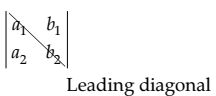
For a determinant containing 4 elements $a_1, b_1, a_2$ and $b_2;$ what will the elements of leading diagonals?
- A
$a_1, b_1$
- B
$a_1, b_2$
- C
$a_2, b_1$
- D
$a_1, b_2$
View full question & answer→MCQ 31 Mark
$\left|\begin{array}{ccc}2 & 3 & 4 \\5 & 6 & 8 \\6 x & 9 x & 12 x\end{array}\right|=\ldots\ldots$
Answer(A) $0$
$\text{Explanation:}\left|\begin{array}{ccc}2 & 3 & 4 \\ 5 & 6 & 8 \\ 6 x & 9 x & 12 x\end{array}\right|\text { (Taking } 3 x \text { common from } R _3 \text {) }$
$=3 x\left|\begin{array}{lll}2 & 3 & 4 \\ 5 & 6 & 8 \\ 2 & 3 & 4\end{array}\right|\quad(\because \text{R}_{1} ~\text{and} ~\text{R}_{3} ~\text{are same})$
$=3x \times 0$
$=0$
View full question & answer→MCQ 41 Mark
If $\left|\begin{array}{cc}x-2 & -3 \\ 3 x & 2 x\end{array}\right|=3$, then $x=\ldots . .(x \in I)$
Answer(B) $-3$
Explanation: Given $\left|\begin{array}{cc}x-2 & -3 \\ 3 x & 2 x\end{array}\right|=3$
$\begin{array}{lr}\Rightarrow & (x-2) \cdot 2 x-3 x(-3)=3 \\ \Rightarrow & 2 x^2-4 x+9 x=3 \\ \Rightarrow & 2 x^2+5 x-3=0 \\ \Rightarrow & (2 x-1)(x+3)=0\end{array}$
$\begin{array}{ll}\Rightarrow & x=\frac{1}{2} \text { or } x=-3 \\ \Rightarrow & x=-3 \quad(\text { since } x \in I )\end{array}$
View full question & answer→MCQ 51 Mark
Cramer's rule is not suitable for which type of problems?
- A
Small systems with 4 unknowns
- B
- ✓
- D
Answer(C) Large systems
Explanation: Generally, in large systems, excessive multiplicative operations are required which becomes very cumbersome to solve.
View full question & answer→MCQ 61 Mark
Cramer's rule fails for __________.
- A
Determinant $> 0$
- B
Determinant $< 0$
- ✓
Determinant $= 0$
- D
Determinant $=$ non-real
AnswerCorrect option: C. Determinant $= 0$
(C) Determinant $=0$
Explanation: Cramer's rule is applicable only when the determinant value is not equal to zero.
View full question & answer→MCQ 71 Mark
The inverse of a matrix is defined for
Answer(A) Only square matrices
Explanation: If a given matrix is a square matrix, then only we can find its inverse.
View full question & answer→MCQ 81 Mark
If $|A|=0$, then
Answer(A) Singular Matrix
Explanation: For singular matrix, $|A|=0$.
View full question & answer→MCQ 91 Mark
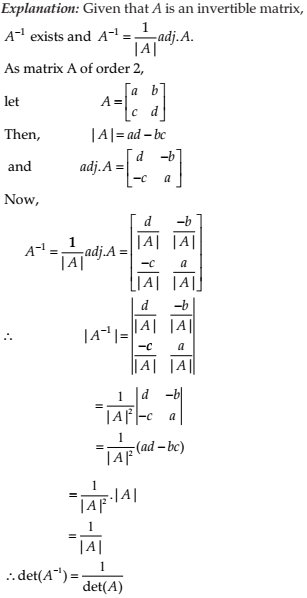
If $A$ is an invertible matrix of order 2, then $\operatorname{det}\left(A^{-1}\right)$ is equal to
View full question & answer→MCQ 101 Mark
Let $A$ be a non-singular square matrix of order $3 \times 3$. Then $|\operatorname{adj} A|$ is equal to
- A
$|A|$
- ✓
$|A|^2$
- C
$|A|^3$
- D
$3|A|$
AnswerCorrect option: B. $|A|^2$
(B) $|A|^2$
Explanation: We know that,
$(\operatorname{adj} A) A=|A|$
$I=\left[\begin{array}{ccc}|A| & 0 & 0 \\ 0 & |A| & 0 \\ 0 & 0 & |A|\end{array}\right]$
$\Rightarrow|(\operatorname{adj} A) A|=\left|\begin{array}{ccc}|A| & 0 & 0 \\ 0 & |A| & 0 \\ 0 & 0 & |A|\end{array}\right|$
$\Rightarrow|\operatorname{adj} A||A|=|A|^3\left|\begin{array}{lll}1 & 0 & 0 \\ 0 & 1 & 0 \\ 0 & 0 & 1\end{array}\right|=|A|^3(I)$
$\therefore \quad|\operatorname{adj} A|=|A|^2$
View full question & answer→MCQ 111 Mark
If $\Delta=\left|\begin{array}{lll}a_{11} & a_{12} & a_{13} \\ a_{21} & a_{22} & a_{23} \\ a_{31} & a_{32} & a_{33}\end{array}\right|$ and $A_{i j}$ is cofactor of $a_{i j}$, then value of $\Delta$ is given by
- A
$a_{11} A_{31}+a_{12} A_{32}+a_{13} A_{33}$
- B
$a_{11} A_{11}+a_{12} A_{21}+a_{13} A_{31}$
- C
$a_{21} A_{11}+a_{22} A_{12}+a_{23} A_{13}$
- ✓
$a_{11} A_{11}+a_{21} A_{21}+a_{31} A_{31}$
AnswerCorrect option: D. $a_{11} A_{11}+a_{21} A_{21}+a_{31} A_{31}$
(D) $a_{11}A_{11}+a_{21}A_{21}+a_{31}A_{31}$
Explanation: We know that:
$\Delta=$ Sum of the product of the elements of a column (or a row) with their corresponding co-factors
$\therefore \Delta=a_{11} A_{11}+a_{21} A_{21}+a_{31} A_{31}$
View full question & answer→MCQ 121 Mark
Which of the following is correct?
- A
Determinant is a square matrix.
- B
Determinant is a number associated to a matrix.
- ✓
Determinant is a number associated to a square matrix.
- D
AnswerCorrect option: C. Determinant is a number associated to a square matrix.
(C) Determinant is a number associated to a square matrix.
Explanation: We know that every square matrix, $A=\left[a_{i j}\right]$ of order $n$. We can associate a number called the determinant of a square matrix $A$, where $a_{i j}=(i, j)^{\text {th }}$ element of $A$.
Thus, the determinant is a number associated to a square matrix.
View full question & answer→MCQ 131 Mark
Let $A$ be a square matrix of order $3 \times 3$, then $|k A|$ is equal to
- A
$k|A|$
- B
$k^2|A|$
- ✓
$k^3|A|$
- D
$3 k|A|$
AnswerCorrect option: C. $k^3|A|$
(C) $k^3|A|$
Explanation: We know that, $A$ be a square matrix of order $3 \times 3$
i.e., $A=\left[\begin{array}{lll}a_1 & b_1 & c_1 \\ a_2 & b_2 & c_2 \\ a_3 & b_3 & c_3\end{array}\right]$
Then, $k A=\left[\begin{array}{lll}k a_1 & k b_1 & k c_1 \\ k a_2 & k b_2 & k c_2 \\ k a_3 & k b_3 & k c_3\end{array}\right]$
$\therefore \quad|k A|=\left[\begin{array}{lll}k a_1 & k b_1 & k c_1 \\k a_2 & k b_2 & k c_2 \\k a_3 & k b_3 & k c_3\end{array}\right]$
Taking out common factor $k$ from each row
$\begin{aligned}& =k^3\left|\begin{array}{lll}a_1 & b_1 & c_1 \\a_2 & b_2 & c_2 \\a_3 & b_3 & c_3\end{array}\right| \\& =k^3|A| \\\therefore \quad|k A| & =k^3|A|\end{aligned}$
View full question & answer→MCQ 141 Mark
If $\left|\begin{array}{cc}x & 2 \\ 18 & x\end{array}\right|=\left|\begin{array}{cc}6 & 2 \\ 18 & 6\end{array}\right|$, then $x$ is equal to
AnswerCorrect option: B. $\pm 6$
(B) $\pm 6$
Explanation: Given that,
$\left|\begin{array}{cc}x & 2 \\18 & x\end{array}\right|=\left|\begin{array}{cc}6 & 2 \\18 & 6\end{array}\right|$
$\Rightarrow \quad x^2-36=36-36$
$\Rightarrow \quad x^2-36=0$
$\Rightarrow \quad x^2=36$
$\Rightarrow \quad x= \pm 6$
View full question & answer→MCQ 151 Mark
There are two values of $a$ which makes determinant, $\Delta=\left|\begin{array}{ccc}1 & -2 & 5 \\ 2 & a & -1 \\ 0 & 4 & 2 a\end{array}\right|=86$. Then sum of these numbers is:
Answer(C) $-4$
Explanation: We have,
$\Delta=\left|\begin{array}{ccc}1 & -2 & 5 \\2 & a & -1 \\0 & 4 & 2 a\end{array}\right|=86$
Expanding along first column
$\begin{array}{lr}\Rightarrow & 1\left(2 a^2+4\right)+2(4 a+0)+5(8-0)=86 \\\Rightarrow & 2 a^2+4+8 a+40=86 \\\Rightarrow & 2 a^2+8 a+44-86=0 \\\Rightarrow & a^2+4 a-21=0 \\\Rightarrow & a^2+7 a-3 a-21=0 \\\Rightarrow & (a+7)(a-3)=0\end{array}$
$\begin{array}{l}\therefore a=-7,3 \\ \text { Required sum }=-7+3=-4\end{array}$
View full question & answer→MCQ 161 Mark
If A and B are invertible matrices, then which of the following is not correct?
- A
$adj.$ $A=|A| \cdot A^{-1}$
- B
$\operatorname{det}\left(A^{-1}\right)=[\operatorname{det}(A)]^{-1}$
- C
$(A B)^{-1}=B^{-1} A^{-1}$
- ✓
$(A+B)^{-1} \neq B^{-1}+A^{-1}$
AnswerCorrect option: D. $(A+B)^{-1} \neq B^{-1}+A^{-1}$
(D) $(A+B)^{-1} \neq B^{-1}+A^{-1}$
Explanation: Since, A and B are invertible matrices, so, we can say that
$(A B)^{-1}=B^{-1} A^{-1} \quad \quad \ldots \ldots\text{(i)}$
Also, $\quad A^{-1}=\frac{1}{|A|}(\operatorname{adj} A)$
$\Rightarrow \quad \operatorname{adj} A=A^{-1} \cdot|A| \quad \quad \ldots \ldots\text{(ii)}$
$\begin{array}{ll}\text { Also, } & \operatorname{det}(A)^{-1}=[\operatorname{det}(A)]^{-1} \\ \Rightarrow & \operatorname{det}(A)^{-1}=\frac{1}{[\operatorname{det}(A)]}\end{array}$
$\Rightarrow \operatorname{det}(A) \cdot \operatorname{det}(A)^{-1}=1 \quad \quad \ldots \ldots\text{(iii)}$
From equation (iii), we conclude that it is true.
$\text{Again,}\quad (A+B)^{-1}=\frac{1}{|(A+B)|}adj(A+B)$
$\Rightarrow\quad (A+B)^{-1}\neq B^{-1}+A^{-1}\quad\quad\ldots\ldots\text{(iv)}$
View full question & answer→MCQ 171 Mark
If $A=\left|\begin{array}{ccc}2 & \lambda & -3 \\ 0 & 2 & 5 \\ 1 & 1 & 3\end{array}\right|$, then $A^{-1}$ exist, if
- A
$\lambda=2$
- B
$\lambda \neq 2$
- C
$\lambda \neq-2$
- ✓
Answer(D) None of these
Explanation:
Given that,
$A=\left|\begin{array}{ccc}2 & \lambda & -3 \\0 & 2 & 5 \\1 & 1 & 3\end{array}\right|$
Expanding along $R_1,$
$|A|=2(6-5)-\lambda(-5)-3(-2)$
$=2+5\lambda+6$
We know that $A^{-1}$ exists, if $A$ is non-singular matrix,
$i.e.,$ $|A|\neq0$
$\therefore 2+5\lambda +6\neq0$
$\Rightarrow 5\lambda\neq-8$
$\therefore \lambda\neq\frac{-8}{5}$
So, $A^{-1}$ exists if and only if $\lambda\neq\frac{-8}{5}.$
View full question & answer→MCQ 181 Mark
If $\left|\begin{array}{cc}2 x & 5 \\ 8 & x\end{array}\right|=\left|\begin{array}{cc}6 & -2 \\ 7 & 3\end{array}\right|$, then the value of $x$ is:
AnswerCorrect option: C. $\pm 6$
(C) $\pm 6$
Explanation: Given that
$\therefore \quad\left|\begin{array}{cc}2 x & 5 \\ 8 & x\end{array}\right|=\left|\begin{array}{cc}6 & -2 \\ 7 & 3\end{array}\right|,$
$\Rightarrow 2x^{2}-40=18+14$
$\Rightarrow 2x^{2}=32+40$
$\Rightarrow x^{2}=\frac{72}{2}=36$
$\therefore x=\pm6$
View full question & answer→MCQ 191 Mark
If $A^2-A+I=0$, then the inverse of matrix $A$ is:
Answer(C) $I-A$
Explanation: We have, $A^{2}-A+I=0$
$\Rightarrow A^{-1} (A^{2}-A+I) = A^{-1}(0)$
$\Rightarrow A^{-1}A^{2}-A^{-1}A+A^{-1}I=0$
$\Rightarrow A-I+A^{-1}=0$
$\Rightarrow A^{-1}=I-A$
View full question & answer→MCQ 201 Mark
If $A$ is a square matrix of order $3 \times 3$ such that $|A|$ $=4$, then $|3 A|$ is equal to:
Answer(C) 108
$\begin{aligned}\text{Explanation:}\quad|3 A| & =(3)^3|A| \quad {[\because \text { order of matrix }=3] } \\ & =27 \times 4 \quad[\text { Given }|A|=4] \\ & =108\end{aligned}$
View full question & answer→MCQ 211 Mark
If solving a system of linear equations in 3 variables by Cramer's rule, we get $\Delta=0$ and at least one of $\Delta_{x '} \Delta_{y'} \Delta_z$ is non-zero then the system of linear equations has
- ✓
- B
- C
infinitely many solutions
- D
Answer(A) no solution
Explanation: If $\Delta=0$ and at least (one of $\Delta_{x'} \Delta_{y'} \Delta_z$ ) $\neq$ 0
The system of linear equations has no solution.
View full question & answer→MCQ 221 Mark
If two square matrices $A$ and $B$ are such that $|A B|=12$ and $|B|=-4$, then value of $|A|$ is:
Answer(C) $-3$
Explanation:
$\begin{array}{rlrl}& & |A B| & =12 \\\Rightarrow & & |A||B| & =12 \\\Rightarrow && -4|A| & =12 \\\Rightarrow & & |A| & =-3\end{array}$
View full question & answer→MCQ 231 Mark
In a $3 \times 3$ matrix $A$, value of $a_{12} c_{13}+a_{22} c_{23}+a_{32} c_{33'}$ where $c_{i j}$ is the cofactor of $a_{i j}$ is:
Answer(A) $0$
Explanation: The summation of product of $a_{i j}$ of $2^{\text {nd }}$ column with corresponding $c_{i j}$ of 3 column $=0$
View full question & answer→MCQ 241 Mark
If $A$ is a square matrix of order 3 and $|A|=-2$, then $|\operatorname{adj}(A)|$ is equal to
Answer(D) $4$
Explanation :
$ \begin{aligned}|\operatorname{adj}(A)| & =|A|^{n-1} \\\Rightarrow \quad|\operatorname{adj}(A)| & =(-2)^2 \\& =4\end{aligned}$
View full question & answer→