Questions

2 Marks Questions

🎯

Test yourself on this topic

14 questions · timed · auto-graded

Question 12 Marks
The decrease in monetary value of an asset over time due to use, wear and tear or obsolescence is called depreciation. The simplest and most commonly used method of computing depreciation is straight line or linear method of depreciation. In this method the depreciation amount is the same for every year over the useful life of the asset i.e., the depreciation amount charged until the asset gets reduced to zero, value or its salvage value at the end of its useful life. In linear depreciation method the annual depreciation of an asset is found by dividing the total depreciation by the number of year in its estimated useful life.
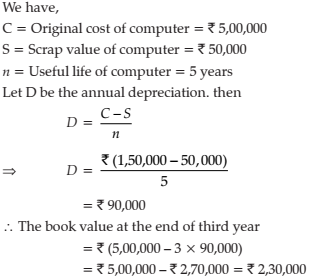
Q. 1. A mainframe computer whose cost is ₹ 5,00,000 will depreciate to a scrap value of ₹ 50,000 in 5 years. Using linear method of depreciation, find the book value of computer at the end of third year.
Q. 2. An asset costing ₹ $1,50,000$ is expected to have a useful life of 5 years and scrap value of ₹ 30,000 . Find the annual depreciation charge and the depreciation rate by using the linear depreciation method.
Answer
(1)
Image
(2) we have,
C = Original cost of asset = ₹ 150,000
S = Scrap value / salvage value = ₹ 30,000
n = Useful life = 5 years
the annual depreciation charge, D is given by
$\begin{aligned} & D=\frac{C-S}{n} \\ \Rightarrow \quad D & =\frac{1,50,000-30,000}{5}\end{aligned}$
$\Rightarrow$ D = ₹ 24,000
Now, Depreciation Rate
$
\begin{array}{l}
=\frac{\text { Annual Depreciation }}{\text { Cost of the asset }- \text { Salvage value }} \times 100 \\
=\frac{24,000}{1,50,000-30,000} \times 100 \\
=\frac{24,000}{12,000} \times 100 \\
=20 \%
\end{array}
$
View full question & answer
Question 22 Marks
Everyone needs money at every stage of their life. Sometimes it so happen that they have been desire to purchase their favourite stuff but they are incapable to purchase due to shortage of money. Loans are available for these purposes only. Loans are provided to people for such critical circumstances which many occur at any time. In order to fullfill the wish to purchase a new car, Anaya takes a loan of ₹ $5,00,000$ form a bank at an interest rate of $6 \%$ p.a. for 10 years. She wants to pay back the loan in equated monthly instalments.
Q. 1. Find the EMI by using flat rate method.
Q. 2. Find the EMI by reduce balance method. [Given $(1.005)^{-120}=0.54963$ ]
Answer
(1) We have
P = Principle = ₹ 5,00,000
$\begin{aligned} i & =\text { interest rate } \\ & =\frac{6}{12 \times 100} \\ & =\frac{1}{200}=0.005 \\ n & =\text { no. of period of } n \text { months } \\ & =12 \times 10=120\end{aligned}$
Using formula of Flat Rate Method, we have
$
EMI=P\left(i+\frac{1}{n}\right)
$
=₹ 5,00,000 $\left(0.005+\frac{1}{120}\right)$
=₹(2,500+4,166.67)
=₹ 6,666,67
(2) Formula for Reduce balance method is
$
\begin{array}{l}
EMI=\frac{(1+i)^n}{(1+i)^n-1} \times(P \times i) \\
or\quad EMI=\frac{P i}{1-(1+i)^{-n}} \\
or \quad EMI=\frac{5,00,000 \times 0.005}{1-(1+0.005)^{-120}}
\end{array}
$
$\begin{array}{l}=\frac{2500}{1-0.54963} \\ =\frac{2500}{0.45037}\end{array}$
= ₹ 5550.9914 - ₹ 5551
View full question & answer
Question 32 Marks
₹ 5000 is invested in a Term Deposit Scheme that fetches interest $6 \%$ per annum compounded quarterly. What will be interest after one year ?
Given that $(1.015)^4=1.0613$
Answer
We know that, Compound interest,$
I=P\left[(1+i)^n-1\right]
$
Here,P=₹ 5000,
$\begin{aligned} i & =6 \% \text { p.a. } \\ & =0.06 \text { p.a. } \\ & =0.06 \times(1 / 4) \text { per quarter } \\ & =0.015 \text { per quarter } \\ I & =5000\left[(1+0.015)^4-1\right] \\ & =5000\left\{(1.015)^4-1\right\} \\ & =5000(1.0613-1) \\ & =5000 \times 0.0613 \\ & =306.82\end{aligned}$
View full question & answer
Question 42 Marks
Assume that the year-end revenues of a business over a three-year period, are mentioned in the following table:
Year-End31-12-201731-12-2020
Year End Revenue9,00013,000
Calculate the CAGR of the revenues over the three-years period spanning the "end" of 2017 to the "end" of 2020. Given that $\left(\frac{13}{9}\right)^{\frac{1}{3}}=1.13$.
Answer
The CAGR of the revenues over the three-year period spanning the "end" of 2017 to the "end" of 2020 is:
$\begin{aligned}\left(\frac{\text { Final value }}{\text { Initial vlaue }}\right)^{\frac{1}{n}}-1 & =\left(\frac{13000}{9000}\right)^{\frac{1}{3}}-1 \\ & =1.13-1 \\ & =0.13 \\ & =13 \%\end{aligned}$
View full question & answer
Question 52 Marks
Anna owns a produce truck, invested ₹ 700 in purchasing the truck, some other initial admin related and insurance expenses of ₹ 1500 to get the business going, and has now a day to day expense of ₹ 500 / p . m. Consider hypothetically that her everyday profit is ₹ 550 p.m. (ideally, it will be based on sales). At the end of 6 months, Anna takes up her accounts and calculates her rate of return.
Answer
self
View full question & answer
Question 62 Marks
Mr. Lal took a car loan of ₹ 10 lakhs at an $11 \%$ interest for a 15 years loan tenure. What would be his EMI ? Given $(1.0091)^{180}=5.1069$.
View full question & answer
Question 72 Marks
A company borrowed ₹ 60,000 for renovation. The company plans to set up a sinking fund that will pay back the loan at the end of 5 years. Assuming a rate of $10 \%$ compounded semiannually, and the sinking fund of the ordinary annuity. Given that $(1.05)^{10}=1.06288$
Answer
Given, P=₹ 60,000, r=10 % or 0.10, No. of years, $n=5$ years and No. of payments per year, $m=2$ (Semi annually)
Sinking Fund,$
A=\frac{\left[\left(1+\left(\frac{r}{m}\right)\right)^{n \times m}\right]-1}{\left(\frac{r}{m}\right)} \times P
$
$\begin{aligned} A & =\frac{\left[\left(1+\left(\frac{0.10}{2}\right)\right)^{5 \times 2}\right]-1}{\left(\frac{0.10}{2}\right)} \times 60,000 \\ & =\frac{\left[(1.05)^{10}\right]-1}{0.05} \times 60,000 \\ & =\frac{0.06288}{0.05} \times 60,000\end{aligned}$
=₹ 754,673.55 ∼ ₹ 754,673
View full question & answer
Question 82 Marks
A company ABC Ltd has raised funds in the form of 1,000 zero-coupon bonds worth ₹ 1,000 each. The company wants to set up a sinking fund for repayment of the bonds, which will be after 10 years. Determine the amount of the periodic contribution if the annualized rate of interest is $5 \%$, and the contribution will be done half-yearly. Given that $(1.025)^{20}=1.6386$.
Answer
Sinking Fund, A=₹ 1,000 x1000=₹ 1,000,000, $r=5 \%$ or 0.05, No. of years, $n=10$ years and No. of payments per year, $m=2$ (Half Yearly)
Periodic Contribution,
$
\begin{array}{l}
P=\frac{A \times\left(\frac{r}{m}\right)}{\left[\left(1+\left(\frac{r}{m}\right)\right)^{n \times m}\right]-1} \\
P=\frac{1,000,000 \times\left(\frac{0.05}{2}\right)}{\left[\left(1+\left(\frac{0.05}{2}\right)\right)^{10 \times 2}\right]-1}
\end{array}
$
$\begin{array}{l}=\frac{1,000,000 \times 0.025}{1.6386-1} \\ =\frac{25,000}{0.6386}\end{array}$
=₹ 39,148.136 ∼ ₹ 39,148
Therefore, the company will be required to contribute a sum of ₹ 39,148 half-yearly in order to build the sinking fund to retire the zero-coupon bonds after 10 years.
View full question & answer
Question 92 Marks
Find the present value of a perpetuity of ₹ 3,120 payable at the beginning of each year, if money is worth $6 \%$ effective.
View full question & answer
Question 102 Marks
Your grandfather is retiring at the end of next year. He would like to ensure that his heirs receive payments of ₹ 75,000 a year forever, starting when he retires. How much does he need to invest in the beginning of this year to produce the desired cash flow, if money is worth $6 \%$ compounded annually.
Answer
Given, R=₹ 75,000 and $i=\frac{6}{100}=0.06$
Present value,$
\begin{array}{l}
P=\frac{R}{i} \\
P=\frac{75,000}{0.06}
\end{array}
$
=₹ 12,50,000
View full question & answer
Question 112 Marks
Suppose a manufacturing company purchases a machinery for ₹ 100,000 and the useful life of the machinery are 10 years and the residual value of the machinery is ₹ 20,000 . Calculate depreciation.
View full question & answer
Question 122 Marks
What is scrap value?
Answer
The value of a depreciable asset at the end of its useful life is called scrap value or salvage value or depreciated value.
View full question & answer
Question 132 Marks
What is useful life?
Answer
The time period in which an asset is expected to be functional and fit for purpose is called useful life. It is generally measured in years.
View full question & answer
Question 142 Marks
Mr. Roy purchased a home for ₹ 200,000 in 2012. In the next few years, homes in neighbourhood have been selling well due to the new shopping plaza a couple of miles away, which increased the market value of his home. So in 2017, he decided to downsize and sell his home. Based on the current market value during this time, he was able to sell his home for ₹ 250,000. Find his rate of return.
Answer
$\begin{array}{l} \text { Given, } \text { Current value }=250,000 \\ \text { Original value }=200,000\end{array}$
Rate of return
$=\frac{\text { Current Value }- \text { Original Value }}{\text { Original Value }} \times 100$
$=\frac{250,000-200,000}{200,000} \times 100=25 \%$
View full question & answer
2 Marks Questions - Applied Maths STD 12 Science Questions - Vidyadip