Questions

3 Marks Question

🎯

Test yourself on this topic

8 questions · timed · auto-graded

Question 13 Marks
Consider the following hypothesis test:
$H _0: \mu=15$
$
H_{a}: \mu \neq 15
$
A sample of 50 provided a sample mean of 14.15. The population standard deviation is 3.
i. Compute the value of the test statistic.
ii. What is the p-value?
iii. At $\alpha=0.05$, what is your conclusion?
iv. What is the rejection rule using the critical value? What is your conclusion?
Answer
Given $\mu_0=15, n =50, \bar{x}=14.15, \sigma=3$
$
\begin{array}{l}

\text { i. } Z=\frac{\bar{x}-\mu_0}{\frac{\sigma}{\sqrt{n}}}=\frac{14.15-15}{\frac{3}{\sqrt{50}}}=\frac{-0.85 \times \sqrt{50}}{3} \\
=-2.003 \\
\therefore Z=-2 \\
\text { ii. } \because Z=-2<0
\end{array}
$
So, $p$-value $=2$ (Area under the standard normal curve to the left of $Z$)
$
\begin{array}{l}
=2 \times(0.0228)=0.0456 \\
\therefore p \text {-value }=0.0456
\end{array}
$
iii. $\because$ p-value $<0.05($ Given $\alpha=0.05)$
So, reject $H _0$
iv. Reject $H _0$ if $Z \leq-Z_{\frac{\alpha}{2}}$
$
\begin{array}{l}
\because-Z_{\frac{\alpha}{2}}=-Z_{0.025}=-1.96 \\
\because-2<-1.96
\end{array}
$
So, reject $H _0$
View full question & answer
Question 23 Marks
Fit the straight line trend to the following series data:
Year20172018201920202021
Sales of sugar (in thousand kg)8090928394
Also, tabulate the trend values.
Answer
Year
t
Sale
y
x = t - 2019xyx2yt
201780-2-160483.6
201890-1-90185.7
20199200087.8
202083183189.9
2021942188492.0
n=5$\sum y=439$$\sum x=0$$\sum xy=21$$\sum x^2=10$ 

Now, $a=\frac{\Sigma y}{n}=\frac{439}{5}=87.8$
$
b=\frac{\Sigma x y}{\Sigma x^2}=\frac{21}{10}=2.1
$
Hence, trend equation is $y_t=87.8+2.1x$
$
\begin{array}{l}
y_{2017}=87.8+2.1(-2)=83.6 \\
y_{2018}=87.8+2.1(-1)=85.7 \\
y_{2019}=87.8+2.1(0)=87.8 \\
y_{2020}=87.8+2.1(1)=89.9 \\
y_{2021}=87.8+2.1(2)=92.0
\end{array}
$
View full question & answer
Question 33 Marks
Two biased dice are thrown together. For the first die $P(6)=\frac{1}{2}$, other scores being equally 2 likely while for the second die, $P (1)=\frac{2}{5}$ and other scores are equally likely. Find the probability distribution of 'the number of ones seen'.
Answer
For the first die, it is given that $P(6)=\frac{1}{2}$ and other scores are equally likely.
$
\begin{array}{l}
\text { i.e., } P(1)=P(2)=P(3)=P(4)=P(5)=p_1 \text { (say) } \\
\therefore P(1)+P(2)+P(3)+P(4)+P(5)+P(6)=1
\end{array}
$
$
\Rightarrow 5 p_1+\frac{1}{2}=1 \Rightarrow p_1=\frac{1}{10}
$
So, for the first die, we have
$
P(1)=P(2)=P(3)=P(4)=P(5)=\frac{1}{10} \text { and } P(6)=\frac{1}{2}
$
For the second die, it is given that $P(1)=\frac{2}{5}$ and other scores are equally likely.
$
\begin{array}{l}
\text { i.e., } P(2)=P(3)=P(4)=P(5)=P(6)=p_2 \text { (say) } \\
\therefore P(1)+P(2)+P(3)+P(4)+P(5)+P(6)=1 \\
\Rightarrow \frac{2}{5}+5 p_2=1 \Rightarrow p_2=\frac{3}{25}
\end{array}
$
So, for the second die, we have
$
\begin{array}{l}
P(1)=\frac{2}{5} \text { and } P(2)=P(3)=P(4)=P(5)=P(6)=\frac{3}{25} \\
P(1)=\frac{2}{5} \text { and } P(2)=P(3)=P(4)=P(5)=P(6)=\frac{3}{25}
\end{array}
$
When two dice are thrown, there may not be one on both the dice or one of the dice may show one or both of them show one.
This, if X denotes 'the number of ones seen'. Then, X can take values 0,1 and 2 such that
$P ( X =0)=$ Probability of not getting one on both dice
$=$ (Probability of not getting one on first die) $\times$ (Probability of not getting one on second die)
$
=\left(1-\frac{1}{10}\right) \times\left(1-\frac{2}{5}\right)=\frac{9}{10} \times \frac{3}{5}=\frac{27}{50}
$
$P ( X =1)=$ Probability of getting one on one die and another number on the other die
$
=\frac{1}{10} \times\left(1-\frac{2}{5}\right)+\left(1-\frac{1}{10}\right) \times \frac{2}{5}=\frac{21}{50}
$
$P ( X =2)=$ Probability of getting one on both dice $=\frac{1}{10} \times \frac{2}{5}=\frac{2}{50}$
Thus, the probability distribution of X is as given below:
X012
P(X)$\frac{27}{50}$$\frac{21}{50}$$\frac{2}{50}$
View full question & answer
Question 43 Marks
In a precision bombing attack, there is a 50% chance that any one bomb will strike the target. Two direct hits are required to destroy the target completely. How many bombs must be dropped to give a 99% chance or better, of completely destroying the target?
Answer
$
p=50 \%=\frac{1}{2} \therefore q=\frac{1}{2}
$
Let n be the number of bombs to be draped.
$
\begin{array}{l}
n \rightarrow \text { atleast } 2 \text { bombs should hit target } \\
\text { Probability } \geq 0.99 \text { [i.e. } 99 \%] \\
P(x \geq 2) \geq 0.99 \\
1-P(x<2) \geq 0.99 \\
1-[P(n=0)+P(n=1)] \geq 0.99 \\
1-\left[{ }^n c_0 p^0 q^n+n_{c_1} p^1 q^{n-1}\right] \geq 0.99 \\
1-\left[\frac{1}{2^n}+n \times \frac{1}{2} \times\left(\frac{1}{2}\right)^{n-1}\right] \geq 0.99 \\
1-\frac{1}{2^n}(1+n) \geq 0.91 \\
0.01 \geq \frac{1+n}{2^n}
\end{array}
$
View full question & answer
Question 53 Marks
The marginal cost of production of x units of a commodity is 30 + 2x. It is known that fixed costs are ₹ 120. Find
i. the total cost of producing 100 units
ii. the cost of increasing output from 100 to 200 units.
Answer
i. $MC =30+2 x$.
As MC $=\frac{d C }{d x}$,
$C(x)=\int(M C) d x=\int(30+2 x) d x$
$=30 x+x^2+k$, where $k$ is constant of integration.
Given fixed cost (in ₹) = 120 i.e. when x = 0, C(x) = 120
$\Rightarrow 30 \times 0+0^2+ k =120 \Rightarrow k =120$.
$\therefore C ( x )=120+30 x + x ^2$
$\therefore$ Total cost of producing 100 units $=120+30 \times 100+100^2=$13120 (in ₹).
ii. Cost of increasing output from 100 to $200=C(200)-C(100)$
$
=\left(120+30 \times 200+200^2\right)-13120=33000(\text { in ₹ }) .
$
Alternatively, we can obtain it as
$
\begin{array}{l}
\int_{100}^{200}(MC) dx=\int_{100}^{200}(30+2 x) dx=\left[30 x+x^2\right]_{100}^{200} \\
=\left(30 \times 200+200^2\right)-\left(30 \times 100+100^2\right)=33000(\text { in ₹ }) .
\end{array}
$
View full question & answer
Question 63 Marks
A machine costing ₹ 30,000 is expected to have a useful life of 4 years and a final scrap value of ₹ 4000. Find the annual depreciation charge using the straight-line method. Prepare the depreciation schedule.
Answer
We are given that
$
\begin{array}{l}
C=30,000 ; n=4 ; S=4000 \\
\text { Annual depreciation }=\frac{C-S}{n} \\
=\frac{30000-4000}{4} \\
=6500
\end{array}
$
Depreciation schedule
YearAnnual depreciationAccumulated depreciationBook Value
00030,000
16500650023,500
265001300017,000
3650019,50010,500
4650026,0004000
View full question & answer
Question 73 Marks
If $\sqrt{1-x^2}+\sqrt{1-y^2}=4(x-y)$, then show that $\frac{d y}{d x}=\frac{\sqrt{1-y^2}}{\sqrt{1-x^2}}$.
Answer

$\begin{array}{l}\sqrt{1-x^2}+\sqrt{1-y^2}=4( x - y ) \\ \text { put } x =\sin \theta, y =\sin \theta \\ \theta=\sin ^{-1} x \phi=\sin ^{-1} y \\ \sqrt{1-\sin ^2 \theta}+\sqrt{1-\sin ^2 \phi}=4(\sin \theta-\sin \phi) \\ \cos \theta+\cos \phi=4 \sin \theta-\sin \phi \\ 2 \cos \left(\frac{\theta+\phi}{2}\right) \cos \frac{\theta-\phi}{2}=2 \cdot 4 \cos \left(\frac{\theta+\phi}{2}\right) \sin \left(\frac{\theta-\phi}{2}\right) \\ \frac{\cos \theta-\phi}{2}=4 \cdot \sin \frac{\theta-\phi}{2} \\ \frac{\cos \left(\frac{\theta-\phi}{2}\right)}{\sin \left(\frac{\theta-\phi}{2}\right)}=4 \\ \frac{\theta-\phi}{2}=\cot ^{-1} 4 \\ \theta-\phi=2 \cot ^{-1} 4\end{array}$
$
\sin ^{-1} x-\sin ^{-1} y=2 \cot ^{-1} 4
$
diff. w.r.t. x we get
$
\begin{array}{l}
\frac{1}{\sqrt{1-x^2}}-\frac{1}{\sqrt{1-y^2}} \cdot \frac{d y}{d x}=0 \\
\frac{d y}{d x}=\sqrt{\frac{1-y^2}{1-x^2}}
\end{array}
$
Hence proved
View full question & answer
Question 83 Marks
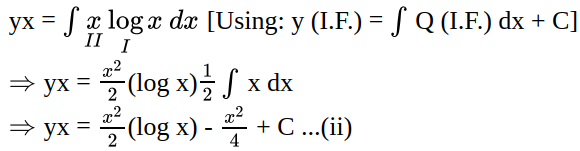
Solve the initial value problem: $x \frac{d y}{d x}+ y = x \log x , y (1)=\frac{1}{4}$
View full question & answer
3 Marks Question - Applied Maths STD 12 Science Questions - Vidyadip