Questions

Case study (4 Marks)

🎯

Test yourself on this topic

4 questions · timed · auto-graded

Question 14 Marks
A company started airlines business and for running business it bought aeroplanes. Now an aeroplane can carry maximum of 200 passengers. A profit of ₹ 400 is made on each first-class ticket and a profit of ₹300 is made on each second class ticket. The airline reserves at least 20 seats for first class. However, at least four times as many passengers prefer to travel by second class than by first class. Company wants to make maximum profit by selling tickets of first-class (x) and second class (y).
i. To get maximum profit how many first-class tickets should be sold?
ii. What is the difference between the maximum profit and minimum profit value?
iii. Write any two corner points of feasible region.
OR
What will be the minimum profit value?
Answer
i. 40
ii. 8000
iii. (20,180), (20,0), (40,0)
OR
8000
View full question & answer
Question 24 Marks
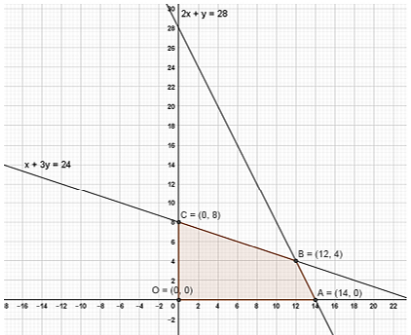
A factory manufactures tennis rackets and cricket bats. A tennis racket takes $1 \frac{1}{2}$ hours of machine time and 3 hours of craftsmanship in its making; while a cricket bat takes 3 hours of machine time and 1 hour of craftsmanship. In a day, the factory has availability of not more than 42 hours of machine time and 24 hours of craftsmanship. Profit on a racket and on a bat are ₹ 20 and ₹ 10 respectively.
i. If x and y are the numbers of bats and rackets manufactured by the factory, then write the expression of total profit.
ii. Write the constraint that relates the number of craftsmanship hours.
iii. Determine the maximum profit (in ₹) earned by the factory.
OR
How many bats and rackets respectively, are to be manufactured to earn maximum profit?
View full question & answer
Question 34 Marks
Flexible payment arrangements, in which the borrower might pay higher sums of his or her choosing, are not the same as EMIs. Borrowers on EMI programmes are usually only allowed to make one set payment per month. Borrowers profit from an EMI since they know exactly how much money they will have to pay towards their loan each month, making personal financial planning easier. Lenders benefit from the loan interest, as it provides a consistent and predictable stream of income.
Example:
A loan of ₹400000 at the interest rate of 6.75% p.a. compounded monthly is to be amortized by equal payments at the end of each month for 10 years.
$\left(\right.$Given $\left.(1.005625)^{120}=1.9603,(1.005625)^{60}-1.4001\right)$
(a) Find the size of each monthly payment.
(b) Find the principal outstanding at the beginning of 61st month.
(c) Find the interest paid in 61st payment.
OR
Find the principal contained in 61st payment.
Answer
Flexible payment arrangements, in which the borrower might pay higher sums of his or her choosing, are not the same as EMIs. Borrowers on EMI programmes are usually only allowed to make one set payment per month. Borrowers profit from an EMI since they know exactly how much money they will have to pay towards their loan each month, making personal financial planning easier. Lenders benefit from the loan interest, as it provides a consistent and predictable stream of income.
Example:
A loan of ₹400000 at the interest rate of 6.75% p.a. compounded monthly is to be amortized by equal payments at the end of each month for 10 years.
$\left(\right.$Given $\left.(1.005625)^{120}=1.9603,(1.005625)^{60}-1.4001\right)$
(i) ₹ 4593
(ii) ₹ 233336.89
(iii) ₹ 1312.52
OR
₹ 3280.48
View full question & answer
Question 44 Marks
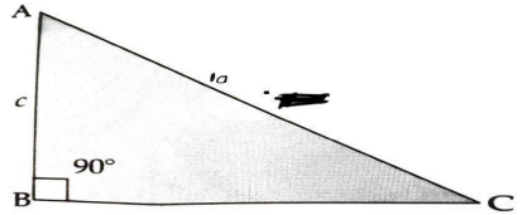
The sum of the length of hypotenuse and a side of a right-angled triangle is given by AC + BC = 10
Image
(a) Base BC =?
(b) If S be the area of the triangle, then find the value of $\frac{d S}{d c}$ ?
(c) What is the values of c when $\frac{d S}{d c}$=0?
Find the value of $\frac{d^2 S}{d c^2}$ at $C =\frac{10 \sqrt{3}}{3}$ ?
Answer
The sum of the length of hypotenuse and a side of a right-angled triangle is given by AC + BC = 10
Image
(i) $\frac{100-c^2}{20}$
(ii) $\frac{100-3 c^2}{40}$
(iii) $\frac{10 \sqrt{3}}{3}$
$\frac{-\sqrt{3}}{2}$
View full question & answer
Case study (4 Marks) - Applied Maths STD 12 Science Questions - Vidyadip