Questions

Case study (4 Marks)

🎯

Test yourself on this topic

6 questions · timed · auto-graded

Question 14 Marks
Using matrix method, solve the following system of equations for x, y and z :
x - y + z = 4
2x + y - 3z = 0
x + y + z = 2
Answer
The matrix equation AX = B is
$\left[\begin{array}{ccc}1 & -1 & 1 \\ 2 & 1 & -3 \\ 1 & 1 & 1\end{array}\right]\left[\begin{array}{l}x \\ y \\ z\end{array}\right]=\left[\begin{array}{l}4 \\ 0 \\ 2\end{array}\right]$
|A| = 10
$\operatorname{adj} A=\left[\begin{array}{ccc}4 & -5 & 1 \\ 2 & 0 & -2 \\ 2 & 5 & 3\end{array}\right]^{\prime}=\left[\begin{array}{rrc}4 & 2 & 2 \\ -5 & 0 & 5 \\ 1 & -2 & 3\end{array}\right]$
Here $A ^{-1}=\frac{1}{10}\left[\begin{array}{rrr}4 & 2 & 2 \\ -5 & 0 & 5 \\ 1 & -2 & 3\end{array}\right]$
So, $\left[\begin{array}{l}x \\ y \\ z\end{array}\right]=\frac{1}{10}\left[\begin{array}{ccc}4 & 2 & 2 \\ -5 & 0 & 5 \\ 1 & -2 & 3\end{array}\right]\left[\begin{array}{l}4 \\ 0 \\ 2\end{array}\right]=\left[\begin{array}{c}2 \\ -1 \\ 1\end{array}\right]$
Thus, $x =2, y =-1, z =1$
View full question & answer
Question 24 Marks
Find the inverse of the matrix :
$A=\left[\begin{array}{rrr}-1 & 1 & 2 \\ 3 & -1 & 1 \\ -1 & 3 & 4\end{array}\right]$
and hence show that $AA ^{-1}=1$.
Answer
Here, |A| = -(-4 - 3) - (12 + 1) + 2(9 - 1)
$=7-13+16=10 \neq 0$
$\begin{array}{l}\Rightarrow \operatorname{adj}( A )=\left[\begin{array}{rrr}-7 & -13 & 8 \\ 2 & -2 & 2 \\ 3 & 7 & -2\end{array}\right]^T=\left[\begin{array}{rrr}-7 & 2 & 3 \\ -13 & -2 & 7 \\ 8 & 2 & -2\end{array}\right] \\ \text { Hence } A ^{-1}=\frac{1}{10}\left[\begin{array}{rrr}-7 & 2 & 3 \\ -13 & -2 & 7 \\ 8 & 2 & -2\end{array}\right] \\ A A^{-1}=\frac{1}{10}\left[\begin{array}{ccc}-1 & 1 & 2 \\ 3 & -1 & 1 \\ -1 & 3 & 4\end{array}\right]\left[\begin{array}{ccc}-7 & 2 & 3 \\ -13 & -2 & 7 \\ 8 & 2 & -2\end{array}\right]=\left[\begin{array}{lll}1 & 0 & 0 \\ 0 & 1 & 0 \\ 0 & 0 & 1\end{array}\right]\end{array}$
View full question & answer
Question 34 Marks
Find principal contained in 40th payment.
Answer
Given, $P =₹ 250000, i =\frac{6}{12 \times 100}=0.005$ and $n =5 \times 12=60$
Principal paid in 40th payment = EMI - Interest paid in 40th payment
= 4832.69 - 480.48 = ₹ 4352.21
View full question & answer
Question 44 Marks
An equated monthly installment (EMI) is a set monthly payment provided by a borrower to a creditor on a set day, each month. EMIs apply to both interest and principal each month, and the loan is paid off in full over some years.
How is EMI calculated?
There are two ways in which EMI can be calculated. These methods are:
•The flat rate method: When the loan amount is progressively being repaid, each interest charge is computed using the original principal amount in the flat rate method.
•The reducing balance method: The reducing balance technique, compared to the flat rate method, determines the interest payment according to the outstanding principal.
Example:
A loan of ₹250000 at the interest rate of 6% p.a. compounded monthly is to be amortized by equal payments at the end of each month for 5 years.
$\left(\right.$ Given $\left.(1.005)^{60}=1.3489,(1.005)^{21}=1.1104\right)$
(a) Find the size of each monthly payment.
(b) Find the principal outstanding at beginning of 40th month.
(c) Find interest paid in 40th payment.
Answer
An equated monthly installment (EMI) is a set monthly payment provided by a borrower to a creditor on a set day, each month. EMIs apply to both interest and principal each month, and the loan is paid off in full over some years.
How is EMI calculated?
There are two ways in which EMI can be calculated. These methods are:
The flat rate method: When the loan amount is progressively being repaid, each interest charge is computed using the original principal amount in the flat rate method.
The reducing balance method: The reducing balance technique, compared to the flat rate method, determines the interest payment according to the outstanding principal.
Example:
A loan of ₹250000 at the interest rate of 6% p.a. compounded monthly is to be amortized by equal payments at the end of each month for 5 years.
$\left(\right.$ Given $\left.(1.005)^{60}=1.3489,(1.005)^{21}=1.1104\right)$
(i) Given, P =₹ 250000,$i =\frac{6}{12 \times 100}=0.005$ and $n =5 \times 12=60$
$EMI =\frac{250000 \times 0.005 \times(1.005)^{60}}{(1.005)^{60}-1}$
$=\frac{250000 \times 0.005 \times 1.3489}{0.3489}=₹ 4832.69$
(ii) Given, $P =₹ 250000, i =\frac{6}{12 \times 100}=0.005$ and $n =5 \times 12=60$
Principal outstanding at beginning of 40th month
$=\frac{ EMI \left[(1+i)^{60-40+1}-1\right]}{i(1+i)^{60-40+1}}=\frac{4832.69 \times\left[(1.005)^{21}-1\right]}{0.005 \times(1.005)^{21}}$
$=\frac{4832.69 \times[1.1104-1]}{0.005 \times 1.1104}=\frac{4832.69 \times 0.1104}{0.005 \times 1.1104}=₹ 96096.72$
(iii)Given, $P =₹ 250000, i =\frac{6}{12 \times 100}=0.005$ and $n =5 \times 12=60$
Interest paid in 40th payment $=\frac{\operatorname{EMI}\left[(1+i)^{60-40+1}-1\right]}{(1+i)^{60-40+1}}$
$=\frac{4832.69 \times\left[(1.005)^{21}-1\right]}{(1.005)^{21}}=\frac{4832.69 \times 0.1104}{1.1104}=₹ 480.48$
View full question & answer
Question 54 Marks
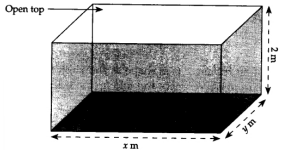
Find the least cost of construction of the tank.
Answer
The least cost of the tank = ₹ $\left[1120+720\left(2+\frac{4}{2}\right)\right]$
= F(1120 + 2880) =F 4000
View full question & answer
Question 64 Marks
View full question & answer
Case study (4 Marks) - Applied Maths STD 12 Science Questions - Vidyadip