Questions

Case study (4 Marks)

🎯

Test yourself on this topic

3 questions · timed · auto-graded

Question 14 Marks
Read the following text and answer the following questions on the basis of the same:
While making the notes on linear inequalities, Riya note down the following points in her notebook.
Inequality: Two real numbers or two algebraic expressions related by the symbol '$<$', '$>$', '$\leq$' prime , form an inequality.
Linear Inequality: An inequality is said to be linear, if each variable occurs in first degree only and there is no term involving the product of the variables.
e.g., $a x+b \leq 0, a x+b y+c>0, a x \leq 4$.
An inequality in one variable in which degree of variable is 2, is called quadratic inequality in one variable,
e.g., $a x^2+b x+c \geq 0,3 x^2+2 x+4 \leq 0$.
Linear equality In one Variable: A linear inequality which has only one variable, is called linear inequality in one variable.
e.g., $a x+b<0$, where $a \neq 0,4 c+7 \geq 0$.
(i) Rules of solving inequalities:
• If $a \geq b$ then $a \pm k \geq b \pm k$ where $k$ is any number.
• If $a \geq b$ then $k a$ is not always $\geq k b$
If $k>0$ (i.e., positive) then $a \geq b \Rightarrow k a \geq k b$
If $k>0$ (i.e., negative) then $a \geq b \Rightarrow k a \leq k b$
Thus, always reverse the sign of inequality while multiplying or dividing both sides of an inequality by a negative number.
(ii) Procedure to solve a linear inequality in one variable:
• Simplify both sides by collecting like terms.
• Remove fractions (or decimals) by multiplying both sides by appropriate factor (L.C.M. of denominator or a power of 10 in case of decimals.)
• Isolate the variable on one side and all constants on the other side. Collect like terms whenever possible.
• Make the coefficient of the variable equal to 1.
• Choose the solution set from the replacement set.
Solution set: A solution to an inequality is a number which when substituted for the variable, makes the inequality true. The set of all solutions of an inequality is called the solution set of the inequality.
Q. 1. The solution set for the following figure is:

Image
(A) $x \in(-\infty, 5)$ $\quad$ (B) $x \in(-\infty, 5]$ $\quad$ (C) $x \in[5, \infty)$ $\quad$ (D) $x \in(5, \infty)$
Q. 2. If $\frac{-3}{4} x \leq-3$ then x ... 4.
(A) x < 4 $\quad$ (B) $x \geq 4$ $\quad$ (C) x > 4 $\quad$ (D) x = 4
Q. 3. The solution set for the given inequality is:
$4 x+3 \geq 2 x+17,3 x-5<-2$
(A) x < 1 $\quad$ (B) $x \geq 7$ $\quad$ (C) No Solution $\quad$ (D) x > 1
Q. 4. The solution set for the following figure is:
Image
(A) $x \in(-\infty,-2]$ $\quad$ (B) $x \in(\infty, 2)$ $\quad$ (C) $x \in(-2, \infty]$ $\quad$ (D) $x \in[-2, \infty)$
Answer
1. (D) $x \in(5, \infty)$
Explanation: The given figure represents all value of x greater than 5 excluding 5 on the real number line.
So, $x \in(5, \infty)$
2. (B) $x \geq 4$
Explanation: $\frac{-3}{4} x \leq-3$
$x \geq 4 \quad \Rightarrow \quad x \geq-3 \times \frac{-4}{3}$
3. (C) No Solution
Explanation: We have,
$4 x+3 \geq 2 x+17$
$\Rightarrow 4 x-2 x \geq 17-3$
$\Rightarrow 2 x \geq 14$
$\Rightarrow x \geq \frac{14}{2}$
$\Rightarrow x \geq 7$
Also, we have $3x - 5 < - 2$
$\Rightarrow 3x < - 2 + 5$
$\Rightarrow 3x < 3$
$\Rightarrow x < 1$
On combining Eqs. (i) and (ii), we see that solution is not possible because nothing is common between these two solutions,
(i.e., $x<1, x \geq 7$).
4. (A) $x \in(-\infty,-2]$
Explanation: The given figure represent all real values of x less than and equal to $-2.$
So $x \in(-\infty,-2]$.

View full question & answer
Question 24 Marks
Answer
1. (C) 7 km/h
Explanation: Speed of the man in still water
= 5 km/h
and speed of the river = 2 km/h
Downstream speed = Speed of man in still water + Speed of the river
$= 5+2=7$ km/h
2. (D) 3 km/h
Explanation: Upstream speed = Speed of man in still water - Speed of the river
$= 5-23$ km/h
3. (A) Distance from A to B/downstream speed + Distance from B to A/upstream speed
4. (A) 2.25 km/h
Explanation: Downstream speed = Distance travelled downstream/Time taken
=$\frac{30}{4}$ Km/h
Upstream speed = Distance travelled in upstream/Time taken
$=\frac{12}{4}$
Speed of the stream $=\frac{1}{2}$ (Downstream speed - upstream speed)
$=\frac{1}{2}\left(\frac{30}{4}-\frac{12}{4}\right)$
$=\frac{1}{2}\left(\frac{18}{4}\right)$
$= 2.25$ km/h
View full question & answer
Question 34 Marks
Answer
1. (A) $\frac{1}{15}$
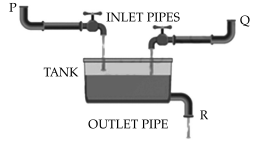
Explanation: Pipe P can fill the tank in 15 hours.
So, in 1 hour tank filled by pipe $P=\frac{1}{15}$
2. (B) $\frac{1}{30}$
Explanation: Pipe R can empty the tank in 30 hours.
So, in 1 hour tank emptied by pipe $R =\frac{1}{30}$
3. (C) $\frac{4}{30}$
Explanation: When P, Q and R all are open, then
tank filled in 1 hour = $\frac{1}{15}+\frac{1}{10}-\frac{1}{30}=\frac{4}{30}$
4. (A) 6 hours
Explanation: If pipe R is closed, then
In one hour tank filled $=\frac{1}{15}+\frac{1}{10}=\frac{5}{30}$
So entire tank gets filled in $\frac{30}{5}$ = 6 hours
View full question & answer
Case study (4 Marks) - Applied Maths STD 12 Science Questions - Vidyadip