Questions

3 Marks Question

🎯

Test yourself on this topic

14 questions · timed · auto-graded

Question 13 Marks
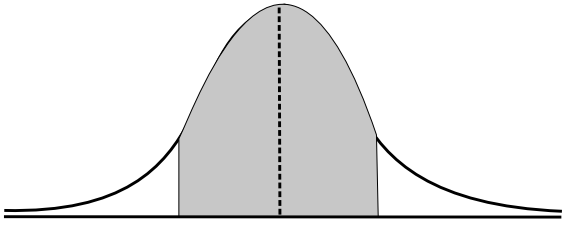
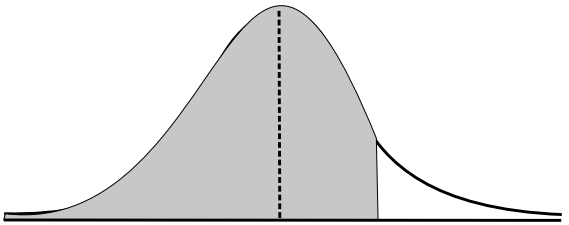
A bank manager has observed that the length of time the customers have to wait for being attended by the teller is normally distribution with mean time of 5 minutes and standard deviation of 0.7 minutes. Find the probability that a customer has to wait
(i) for less than 6 minutes
(ii) between 3.5 and 6.5 minutes
View full question & answer
Question 23 Marks
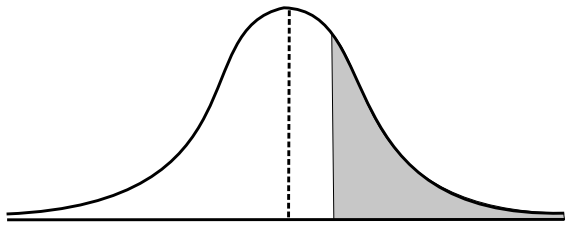
Assume that the mean height of soldiers is 69.25 inches with a variance of 9.8 inches. How many soldiers in a regiment of 6,000 would you expect to be over 6 feet tall?
View full question & answer
Question 33 Marks
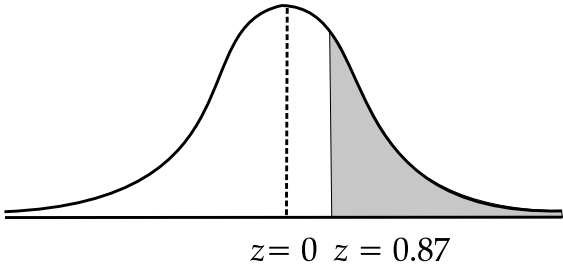
900 light bulbs with a mean life of 125 days are installed in a new factory. Their length of life is normally distributed with a standard deviation of 18 days. What is the expected number of bulbs expire in less than 95 days?
View full question & answer
Question 43 Marks
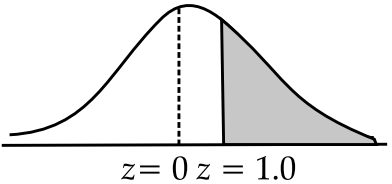
The marks obtained in a certain exam follow normal distribution with mean 45 and SD 10. If 1,300 students appeared at the examination, calculate the number of students scoring (i) less than 35 marks and (ii) more than 65 marks.
View full question & answer
Question 53 Marks
Two cards are drawn successively with replacement from a well shuffled pack of 52 cards. Find the probability distribution of the number of diamond cards drawn. Also, find the mean and the variance of the distribution.
Answer

Let $X =$ denote the random variable. $X = 0, 1, 2, n = 2, p = 1/4, q = 3/4$

$x_1$$0$$1$$2$Total
$p_i$${ }^2 C_0\left(\frac{3}{4}\right)^2=\frac{9}{16}$${ }^2 C_1 \frac{1}{4}\left(\frac{3}{4}\right)=\frac{6}{16}$${ }^2 C_2\left(\frac{1}{4}\right)^2=\frac{1}{16}$ 
$x_i p_i$$0$$6/16$$2/16$$1/2$
$x_i^2 p_i$$0$$6/16$$4/16$$5/8$

$\begin{aligned} \text { Mean } & =\Sigma x_i \cdot p_i=\frac{1}{2} \\ \text { Variance } & =\Sigma x_i^2 p_i-\left(\Sigma x_i p_i\right)^2 \\ & =\frac{5}{8}-\frac{1}{4}=\frac{3}{8}\end{aligned}$

View full question & answer
Question 63 Marks
From a lot of 30 bulbs which includes 6 defectives, a sample of 4 bulbs is drawn at random one by one with replacement. Find the probability distribution of the number of defective bulbs. Hence find the mean of the distributions.
Answer

Let $X=$ No. of defective bulbs out of 4 bulbs drawn with replacement
$\begin{aligned}\text{or}\quad\quad X & =0,1,2,3,4 \\ p & =\text { Probability of defective bulb }=\frac{6}{30}=\frac{1}{5}, \\ q & =\text { Probability of good bulb }=\frac{4}{5}\end{aligned}$

$X=x_i$$0$$1$$2$$3$$4$
$P(x)=p_i$$\begin{array}{l}4 C_0 p^0 \cdot q^4 \\ =\left(\frac{4}{5}\right)^4 \\ =\frac{256}{625}\end{array}$$\begin{array}{l}{ }^4 C _1 p \cdot q^3 \\ =4 \cdot \frac{1}{5} \cdot \frac{64}{125} \\ =\frac{256}{625}\end{array}$$\begin{array}{l}{ }^4 C_2 p^2 \cdot q^2 \\ =6 \cdot \frac{1}{25} \cdot \frac{16}{25} \\ =\frac{96}{625}\end{array}$$\begin{array}{l}{ }^4 C _3 p^3 \cdot q \\ =4 \cdot \frac{1}{125} \cdot \frac{4}{5} \\ =\frac{16}{625}\end{array}$$\begin{array}{l}{ }^4 C_4 \cdot p^4 \\ =\left(\frac{1}{5}\right)^4 \\ =\frac{1}{625}\end{array}$

$\operatorname{Mean}(\mu)=\Sigma p_i x_i$
$=0 \times \frac{256}{625}+1 \times \frac{256}{625}+2 \times \frac{96}{625}+3 \times \frac{16}{625}+4 \times \frac{1}{625}$
$\therefore \quad$ Mean $(\mu)=\frac{4}{5}$

View full question & answer
Question 73 Marks
Five cards are drawn one by one, with replacement, from a well-shuffled deck of 52 cards. Find the probability that
(i) all the five cards are diamonds.
(ii) only 3 cards are diamonds.
(iii) none is diamond.
Answer
Here, $n=5, p=\frac{13}{52}=\frac{1}{4}$
$q=1-\frac{1}{4}=\frac{3}{4}$
$P(x=5)={ }^5 C_5\left(\frac{1}{4}\right)^5\left(\frac{3}{4}\right)^0$
$=\frac{1}{1024}$
$P(x=3)={ }^{5}C_{3}(\frac{1}{4})^{3}(\frac{3}{4})^{2}$
$=\frac{90}{1024}=\frac{45}{512}$
$P(x=0)={ }^{5}C_{0}(\frac{1}{4})^{0}(\frac{3}{4})^{5}$
$=\frac{243}{1024}$
View full question & answer
Question 83 Marks
For 6 trails of an experiment, let X be a binomial variate which satisfies the relation $9P(X = 4) = P(X = 2).$ Find the probability of success.
Answer
Let $p =$ Probability of success, $q =$ Probability of failure and $X$ be a random variable that denote the number of success in 6 trials.
As, X follows binomial distribution with parameters, $n = 6 p$ and $q.$
$\begin{array}{l}\therefore P(X=r)={ }^6 C_r p^r q^{6-r} \\ \text { where, } X=0,1,2,3,4,5,6 \\ \text { and } p+q=1 \\ \text { Also given, } 9 P(X=4)=P(X=2) \\ \therefore 9 \times\left({ }^6 C_4 ~p^4 q^2\right)={ }^6 C_2 p^2 q^4 \\ \text { or } \quad 9 p^2=q^2\quad\quad[\because { }^{6}C_{4}={ }^{6}C_{2}]\end{array}$
$\begin{array}{l}\text { or } \quad 9 p^2=(1-p)^2\quad\quad[\because p+q=1] \\ \text { or } \quad 9 p^2=1+p^2-2 p \\ \text { or } \quad 8 p^2+2 p-1=0 \\ \text { or } \quad 8 p^2+4 p-2 p-1=0 \\ \text { or } 4 p(2 p+1)-1(2 p+1)=0 \\ \text { or } \quad(2 p+1)(4 p-1)=0\end{array}$
$\therefore \quad p=-\frac{1}{2}$ or $p=\frac{1}{4}$
Thus, $p=\frac{1}{4} \quad[\because$ probability cannot be negative$]$
View full question & answer
Question 93 Marks
Four cards are drawn successively with replacement from a well shuffled deck of 52 cards.
What is the probability that:
(i) All the four cards are spades?
(ii) Only 2 cards are spades ?
Answer
$2:p=$ Probability of getting spade card
$=\frac{13}{52}=\frac{1}{4}$
and $q=1-p=1-\frac{1}{4}=\frac{3}{4}$
Using formula for getting probability of $X$ successes in $n$ trials, i.e.,
$P(X=r)={ }^n C_r ~p^r q^{n-r}$
As given $ n=4$
Probability of getting all four spade cards i.e.,
$P($all four are spades$)={ }^4 C_r\left(\frac{1}{4}\right)^r\left(\frac{3}{4}\right)^{4-r}$
Here putting $r=4$, we get
$P($all four are spades)
$={ }^4 C_4\left(\frac{1}{4}\right)^4\left(\frac{3}{4}\right)^{4-4}$
$=\frac{1}{256}$
(ii) Probability of getting only 2 spade card i.e.,
$P\left(\right.$only 2 are spades$)$ $={ }^4 C_r\left(\frac{1}{4}\right)^r\left(\frac{3}{4}\right)^{n-r}$
Here, Putting $r=2$, we get
$P($only 2 are spades$)={ }^4 C_2\left(\frac{1}{4}\right)^2\left(\frac{3}{4}\right)^2$
$=\frac{27}{128}$
View full question & answer
Question 103 Marks
A die is thrown 6 times. If "getting an odd number" is a "success", what is the probability of (i) 5 successes? (ii) atmost 5 successes?
Answer
Let $p$ be the probability of success i.e., getting an odd number
$\therefore n=6$
$p=\frac{n(1,3,5)}{n(1,2,3,4,5,6)}=\frac{3}{6}=\frac{1}{2}$
and $q=1-p=1-\frac{1}{2}=\frac{1}{2}$
Let $x$ be the binomial variable 'number of successes'
$\therefore$ By Binomial distribution,
$P(x=r)={ }^n C_r~ p^{r~} q^{n-r}, 0 \leq r \leq n$
$\therefore P(x=r)={ }^6 C_r\left(\frac{1}{2}\right)^{r}\left(\frac{1}{2}\right)^{6-r}, 0 \leq r \leq 6$
$\begin{array}{l}={ }^6 C_r\left(\frac{1}{2}\right)^6, 0 \leq r \leq 6 \\ =\left(\frac{1}{64}\right){ }^6 C_r, 0 \leq r \leq 6\end{array}$
(i) P(exactly 5 successes) $= P(x = 5)$
$=\left(\frac{1}{64}\right){ }^6 C_5=\left(\frac{1}{64}\right) \times 6=\frac{3}{32}$
(ii) $P($atmost 5 successes$)=P(x \leq 5)$
$= P(x = 0) + P(x = 1) + P(x = 2) + P(x = 3) + P(x = 4) + P(x = 5)$
$\begin{array}{l}=\frac{1}{64}\left[{ }^6 C _0+{ }^6 C _1+{ }^6 C _2+{ }^6 C _3+{ }^6 C _4+{ }^6 C _5\right] \\ =\frac{1}{64}[1+6+15+20+15+6] \\ =\frac{63}{64}\end{array}$
View full question & answer
Question 113 Marks
Let $X$ denote the number of colleges where you will apply after your results and $P(X = x)$ denotes your probability of getting admission is x number of colleges. It is given that :
$P(X=x)=\left\{\begin{array}{ll}k x & , \text { if } x=0 \text { or } 1 \\ 2 k x & , \text { if } x=2 \\ k(5-x) & ,\text { if } x=3 \text { or } 4 \\ 0 & , \text { if } x>4\end{array}\right.$
where k is a positive constant. Find the value of k. Also, find the probability that you will get admission in (i) exactly one college (ii) at most 2 colleges (iii) at least 2 colleges.
Answer
$\text{We have, }P(X=x)=\left\{\begin{array}{ll}k x & , \text { if } x=0 \text { or } 1 \\ 2 k x & , \text { if } x=2 \\ k(5-x) & ,\text { if } x=3 \text { or } 4 \\ 0 & , \text { if } x>4\end{array}\right.$
We know that, sum of all the probabilities of a distribution is always 1.
$\therefore P(X=0)+P(X=1)+P(X=2)+P(X=3)$$+P(X=4)+\ldots . .=1$
$\text{or } 0 + k + 4k + 2k + k + 0 +0 .....=1$
$\text{or } 8k = 1$
$\text{or }k=\frac{1}{8}$
$\text{Now, }P(X=x)=\left\{\begin{array}{l}\frac{x}{8}, \text { if } x=0 \text { or } 1 \\ \frac{x}{4}, \text { if } x=2 \\ \frac{(5-x)}{8}, \text { if } x=3 \text { or } 4 \\ 0, \text { if } x=0 \text { or } 1\end{array}\right.\quad....(1)$
$\therefore$ (i) $P$ (getting admission in exactly one college)
$=P(X=1)=\frac{1}{8}$
(Using (1))
(ii) $P$ (getting admission in at most 2 colleges)
$=P(X \leq 2)$
$= P(X = 0) + P(X = 1) + P(X = 2)$
$=0+\frac{1}{8}+\frac{2}{4}=\frac{5}{8}$
(iii) $P$ (getting admission in at least 2 colleges)
$= P(X > 2) = 1 - P(X < 2)$
$= 1 - [P(X = 0) + P(X = 1)]$
$=1-\left[0+\frac{1}{8}\right]=1-\frac{1}{8}=\frac{7}{8}$
View full question & answer
Question 123 Marks
A biased die is such that $P(4)=\frac{1}{10}$ and other scores are equally likely. The die is tossed twice. If X is the 'number of fours obtained', find the variance of X.
Answer
$X$$0$$1$$2$
$P(X)$$\left(\frac{9}{10}\right)^2=\frac{81}{100}$$2 \times \frac{9}{10} \times \frac{1}{10}=\frac{18}{100}$$\left(\frac{1}{10}\right)^2=\frac{1}{100}$
$XP(X)$$0$$\frac{18}{100}$$\frac{2}{100}$
$X^2 P(X)$$0$$\frac{18}{100}$$\frac{4}{100}$
Variance $=\Sigma X^2 P(X)-[\Sigma X P(X)]^2$
$=\frac{22}{100}-\left(\frac{20}{100}\right)^2=\frac{18}{100}=0.18$
View full question & answer
Question 133 Marks
The random variable X can take only values $0, 1, 2, 3.$ Given that $P(X = 0) = P(X = 1) = p$ and $P(X = 2)$ $=P(X=3)$ such that $\Sigma p_i x_i^2=2 \Sigma p_i x_{i,}$ find the value of $p.$
Answer
$x$$P(x)$
$0$$P$
$1$$P$
$2$$k$
$3$$k$
$\Sigma p(x)=1$ or $2 p+2 k=1$
$\text{or }k=\frac{1}{2}-p$
$x_i$$p_i$$p_i x_i$$p_i x_i^2$
$0$$p$$0$$0$
$1$$p$$p$$P$
$2$$\frac{1}{2}-p$$1-2p$$2-4p$
$3$$\frac{1}{2}-p$$\frac{3}{2}-3 p$$\frac{9}{2}-9 p$
  $\frac{5}{2}-4 p$$\frac{13}{2}-12 p$
Given, $\Sigma p_i x_i^2=2 \Sigma p_i x_i$
$\frac{13}{2}-12 p=5-8 p$
$-4 p=\frac{-13}{2}+5=\frac{-3}{2}$
$\therefore p=\frac{3}{8}$
View full question & answer
Question 143 Marks
A class has 15 students whose ages are 14, 17, 15, 14, 21, 17, 19, 20, 16, 18, 20, 17, 16, 19 and 20 years. One student is selected in such a manner that each has the same chance of being chosen and the age X of the selected student is recorded. What is the probability of the random variable X ? Find the mean.
Answer
$X = x$$14$$15$$16$$17$$18$$19$$20$$21$
$p(x)$$\frac{2}{15}$$\frac{1}{15}$$\frac{2}{15}$$\frac{3}{15}$$\frac{1}{15}$$\frac{2}{15}$$\frac{3}{15}$$\frac{1}{15}$
Mean of $x=\Sigma x P(X)$
$=\frac{1}{15}[28+15+32+51+18+38$$+60+21]$
$=\frac{1}{15}[263]=17.53$
View full question & answer
3 Marks Question - Applied Maths STD 12 Science Questions - Vidyadip