Questions · Page 1 of 2

2 Marks Questions

🎯

Test yourself on this topic

50 questions · timed · auto-graded

Question 12 Marks
How do ecologists estimate the total number of species present in the world?
Answer
The diversity of living organisms present on the Earth is very vast. According to an estimate by researchers, it is about seven millions. The total number of species present in the world is calculated by ecologists by statistical comparison between a species richness of a well-studied group of insects of temperate and tropical regions. Then, these ratios are extrapolated with other groups of plants and animals to calculate the total species richness present on the Earth.
View full question & answer
Question 22 Marks
What is the significance of the slope of regression in a species-area relationship?
Answer
The slope of regression (z) has a great significance in order to find a species-area relationship. It gives an estimate of species richness of area. It is independent of taxonomical category or type of area studied. It has been found that in smaller areas where the species-area relationship is analysed, the value of slopes of regression is similar regardless of the taxonomic group or the region. However, when a similar analysis is done in larger areas, then the slope of regression is much steeper.
View full question & answer
Question 32 Marks
Suggest two practices giving one example of each, that help protect rare or threatened species.
Answer
  1. In situ conservation, biodiversity hotspot/biosphere reserve/national parks/sanctuaries/Ramsar sites/sacred groves.
  2. Ex situ conservation, Zoological parks/botanical garden/wild life safari parks/cryopreservation techniques/Tissue culture/seed bank/pollen banks.
View full question & answer
Question 42 Marks
List any four techniques where the principle of ex-situ conservation of biodiversity has been employed.
Answer
Cryopreservation, in vitro fertilisation, micro propagation/tissue culture, sperm bank/seed bank/gene bank.
View full question & answer
Question 52 Marks
Mention one application for each of the following:
  1. Passive immunisation.
  2. Antihistamine.
  3. Colostrum.
  4. Cytokinin-barrier.
Answer
  1. Provide preformed antibodies/anti-toxins for quick response in case of infection by deadly microbes(tetanus) or snake bite.
  2. Reduces symptoms of allergy.
  3. Provides passive immunity/antibodies/Ig A to new born.
  4. Protection of non-infected cells from further viral infection.
View full question & answer
Question 62 Marks
Why are sacred groves highly protected?
Answer
Sacred groves are highly protected - because of religious and cultural traditions, refuges for large number of rare and threatened plants/ecologically unique and biodiversity-rich regions.
View full question & answer
Question 72 Marks
Where would you expect more species biodiversity – in tropics or in polar regions? Give reasons in support of your answer.
Answer
There are three levels of biodiversity.
  1. Genetic diversity.
  2. Species diversity.
  3. Ecological diversity.
Species diversity – It is variety of species and their relative abundance found with in a region. It is trait of a biotic community.
View full question & answer
Question 82 Marks

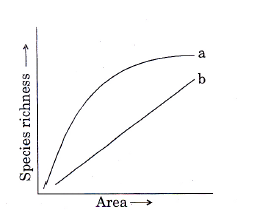
The above graph shows Species-Area relationship. Write the equation of the curve ‘a’ and explain.
Answer
$S = CA^Z,$
  1. Within a region, species richness increases with increasing explored area but only up to a limit.
  2. Relationship between species richness and area for a wide variety of taxa turns out to be rectangular hyperbola.
View full question & answer
Question 92 Marks
Differentiate between in situ and ex situ approaches of conservation of biodiversity.
Answer
  in situ   ex situ
- Protection of endangered species of plants and animals by protecting the natural habitat/ecosystem. - Protection of endangered species by removing them from the natural habitat by placing under special care.
View full question & answer
Question 102 Marks
Giving two reasons explain why there is more species biodiversity in tropical latitudes than in temperate ones.
Answer
  • Remain relatively undisturbed for millions of years so longer time for diversification.
  • Less seasonal/more constant/predictable weather.
  • More solar energy available for productivity.
View full question & answer
Question 112 Marks
Name the pioneer and the climax species in a water body. Mention the changes observed in the biomass and the biodiversity of the successive seral communities developing in the water body.
Answer
Pioneer species; Phytoplanktons.Climax species; Forest/Trees.
There will be gradual increase in the biomass.
Free floating angiosperms/rooted hydrophytes/sedges/grasses.
View full question & answer
Question 122 Marks
Suggest four advanced ex-situ methods to conserve threatened biodiversity.
Answer
Cryopreservation, in vitro fertilisation, tissue culture, seed banks.
View full question & answer
Question 132 Marks
State how does ex-situ conservation help in protecting biodiversity.
Answer
Threatened animals and plants are taken out from their natural habitat and placed in special settings/by cryopreservation technique/in vitro fertilisation of eggs/tissue culture/seed-banks.
View full question & answer
Question 142 Marks
Why the plants that inhabit a desert are not found in a mangrove? Give reasons.
Answer
Desert plants are not adapted to survive in saline/aquatic conditions.
Plants are conformers/stenothermal/cannot maintain constant internal environment/temperature/osmotic concentration of the body fluids affects kinetics of enzymes through basal metabolism/activity and other physiological functions of the organisms.
View full question & answer
Question 152 Marks
Mention the kind of biodiversity of more than a thousand varieties of mangoes in India represent. How is it possible?
Answer
Genetic diversity/single species show high diversity at genetic level.
Single species show high diversity at genetic level over its distributional range/different varieties grow in different geographical areas/climatic conditions/breeding/mutations.
View full question & answer
Question 162 Marks
Explain why very small animals are rarely found in polar region.
Answer
Lose of body heat is directly proportional to the surface area. Since small animals have larger surface area relative to their volume they tend to lose body heat at a very fast rate in colder regions. Lose of body heat in colder regions could prove threat to their survival. This is the reason why very small animals are rarely found in polar regions.
View full question & answer
Question 172 Marks
Justify with the help of an example where a deliberate attempt by humans has led to the extinction of a particular species.
Answer
The Nile perch introduced into Lake Victoria in East Africa, eventually led to the extinction of an ecologically unique assemblage of more than 200 species of cichlid fish in the lake//
Abingdon tortoise in Galapagos islands became extinct, after goats were introduced due to greater browsing efficiency of goats//
Connell’s field experiment showed that the competitively superior barnacle Balanus, excludes smaller barnacleChathamalus//
over exploitation by man, caused extinction of Stellar’s sea cow/Passenger pigeon.
View full question & answer
Question 182 Marks
In the biosphere immense biological diversity exists at all levels of biological organisation. Explain any two levels of biodiversity.
Answer
Genetic diversity: A single species might show high diversity at the genetic level over its distributional range. The genetic variation shown by the medicinal plant Rauwolfia vomitoria growing in different Himalayan ranges might be in terms of the potency and concentration of the active chemical (reserpine) that the plant produces. India has more than 50000 genetically different strains of rice and 1000 varieties of mango/any other example explained.
Species diversity: The diversity at the species level. For example, the Western Ghats have a greater amphibian species diversity than the Eastern Ghats.
Ecological diversity: At the ecosystem level, India, for instance, with its deserts/rain forests/mangroves/coral reefs/wetlands/estuaries and alpine meadows has a greater ecosystem diversity than a Scandinavian country like Norway.
View full question & answer
Question 192 Marks
Alien species invasion is one of the causes of biodiversity loss. Explain with the help of an example.
OR
Sometimes alien species affect the indigenous organisms leading to their extinction. Substantiate this statement with the help of any two examples.
Answer
  1. When alien species (those species which are introduced from elsewhere into a particular region) are introduced deliberately into an ecosystem for some purpose, some of then may become invasive and cause damage and decline or even extinction of the native species in the ecosystem.
  2. The introduction of Nile perch into Lake Victoria led to the extinction of more than 200 species of cichlid fish in that lake.
  3. Introduction of African catfish Clarias gariepinus for aquaculture poses a threat to the indigenous catfishes in Indian rivers.
  4. Carrot grass (Parthenium) and Lantana introduced into our country have become invasive and caused environmental damage; they pose a threat to the native species of plants in our forests.
  5. Illegal introduction of African catfish, Clarias gariepinus for aquaculture purposes poses a threat to the indigenous catfishes in our rivers.
View full question & answer
Question 202 Marks
Write in brief about Ramsar convention.
Answer
These are the wetlands designated as internationally important under the convention on wetlands held at Ramsar, Iran in 1971 for the conservation and wise use of wetlands. Thus, known as Ramsar convention.
View full question & answer
Question 212 Marks
What is mass extinction? Give an example.
Answer
Mass extinction refers to large-scale loss of species, within a short span of time.e.g. extinction of dinosaurs.
View full question & answer
Question 222 Marks
What are the different levels of biodiversity?
Answer
There are three levels of biodiversity:
  1. Genetic diversity.
  2. Species diversity.
  3. Ecological diversity.
View full question & answer
Question 232 Marks
What is fragmented habitat? Give one example.
Answer
When large sized habitats are broken into smaller parts due to human activities they are called fragmented habitat and it leads to population decline. Example, a small forest near an urban settlement.
View full question & answer
Question 242 Marks
What is Ramsar Convention? How was it called previously?
Answer
Ramsar Convention is a global environmental treaty that provides the framework for national action and international cooperation for the conservation and wise use of wetlands and their resources.
It was called convention on wetlands of International Importance.
View full question & answer
Question 252 Marks
What could have triggered mass extinctions of species in the past?
Answer
  1. Volcanic eruption.
  2. Earthquake.
  3. Extremes of temperatures.
  4. Glaciations.
  5. Continental drift.
View full question & answer
Question 262 Marks
Mention the kind of biodiversity represented by more than a 1000 varieties of mangoes in India. How is it possible?
Answer
The different varieties of mangoes in India represent genetic diversity. The vast genetic diversity is because India lies withing tropical latitudes giving it a constant and predictable environment. Also more solar energy is available which leads to higher productivity.
View full question & answer
Question 272 Marks
Discuss one example, based on your day-to-day observations, showing how loss of one species may lead to extinction of another.
Answer
In case a species becomes extinct, the plant and animal species associated within an obligatory way also become extinct. For example,
  1. When a fish species which is a host for a number of parasites becomes extinct, the parasite species which are uniquely dependent on the host fish will also become extinct.
  2. The insects may be polyphagous (feed on more than one plant species) or monophagous (feed on only one particular plant species) in nature. The monophagous insect species are valuable and may become extinct if the plant species upon which it feeds becomes extinct.
View full question & answer
Question 282 Marks
Hot-spots occupy less than 2% of earth's land surface. Yet, they are given priority for conservation of biodiversity. Give two reasons for this.
Answer
  1. Hot spots are the regions of very high species richness and endemism, i.e. some species are found only in this region and not anywhere else.
  2. Strict protection of these hot-spots could reduce the mass extinctions by about 30 percent.
View full question & answer
Question 292 Marks
Suggest a place where one can go to study coral reefs, mangrove vegetation and estuaries.
Answer
For studying coral reefs, one should go to the coast along Tamil Nadu. For mangrove vegetation, one should go to the southern tip of West Bengal. For estuaries, one should go and travel through the backwaters of Kerala.
View full question & answer
Question 302 Marks
Would the extinction of one insect pollinator affect the ecosystem? Explain.
Answer
It would affect the ecosystem because insect pollinators form a part of food web. It may lead to co-extinction of species in the case of a co-evolved plant. It is a case of mutualism where extinction of one invariably leads to the extinction of the other.
View full question & answer
Question 312 Marks
Name any four recent extinctions of animals.
Answer
Animals that recently became extinct are:
  1. Stellar's sea cow.
  2. Dodo.
  3. Thylacine.
  4. Quagga.
  5. Three subspecies of tiger.
View full question & answer
Question 322 Marks
What does the term genetic diversity refer to? What is the significance of large genetic diversity in a population?
Answer
Genetic diversity is the measure of variety in genetic information contained in the organisms.Significance of large genetic diversity are as follows:
  1. Larger genetic diversity provides adaptability at the time of environmental changes and helps the species in surviving.
  2. Larger genetic diversity is also useful in the evolution of species.
View full question & answer
Question 332 Marks
List any four factors which may lead to loss of biodiversity.
Answer
Causes of Biodiversity Losses There are four major causes of biodiversity loss. These are also known as ‘The Evil Quartet’.
  1. Habitat loss and fragmentation.
  2. Over-exploitation.
  3. Alien (exotic) species invasions.
  4. Co-extinctions.
View full question & answer
Question 342 Marks
Define the terms:
  1. Bioprospecting
  2. Endemism
Answer
  1. Bioprospecting: Exploring molecular, genetic and species-level diversity for products of economic importance.
  2. Endemism: Species confined to that region and not found anywhere else.
View full question & answer
Question 352 Marks
How does over-exploitation of beneficial species affect biodiversity?
Answer
  1. Humans depend on nature for food and shelter.
  2. But over-exploitation of natural resources has led to extinction of many species in the last 500 years, e.g. Stellar's sea-cow and Passenger pigeon, are lost due to over-exploitation.
  3. Many marine fish populations around the world are over-exploited, thus endangering the continued existence of some commercially important species.
View full question & answer
Question 362 Marks
What is the ecological importance of biodiversity?
Answer
The ecological importance of biodiversity:
  1. Biodiversity is required for maintaining and sustainable use of goods and services from ecosystem.
  2. Various insects help in pollination.
  3. Various micro-organisms help in the decomposition of organic matter thereby increasing the soil fertility and cleaning the environment.
  4. Various drugs and medicines are extracted from plants.
View full question & answer
Question 372 Marks
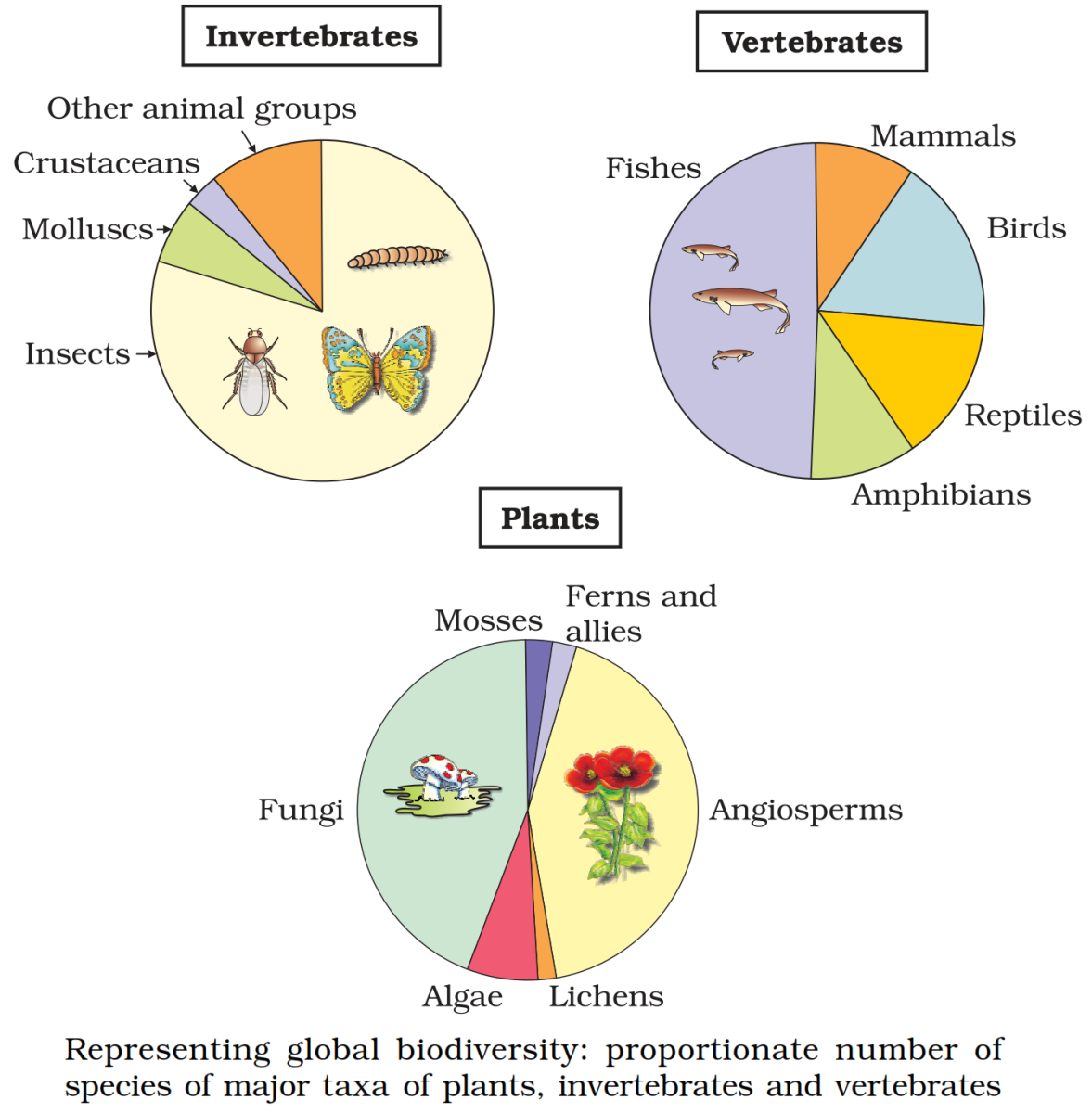
Represent diagrammatically the global biodiversity of major taxa of invertebrates.
Answer
The global biodiversity of major taxa of invertebrates.
View full question & answer
Question 382 Marks
List the features that make a stable biological community.
Answer
The characteristics that make a community stable are:
  1. Less variation in productivity from year to year.
  2. Resistance or resilience to occasional disturbances (natural or man-made).
  3. Resistance to invasions by alien species.
View full question & answer
Question 392 Marks
What is cryopreservation? Give its one use.
Answer
Cryopreservation is a preservation technique in which sperms, eggs, cells, tissues, etc., are stored at ultra-low temperature of -196ºC under nitrogen. Cells and gametes of threatened species can be preserved by this method.
View full question & answer
Question 402 Marks
Seeds of different genetic strains are kept for long periods in seed banks. Explain the conservative strategy involved in this process.
Answer
The strategy is called Ex-situ conservation. In this technique, seeds are preserved in viable and fertile condition for long periods using cryopresrvation techniques.
View full question & answer
Question 412 Marks
Give three reasons as to why prokaryotes are not given any figures for their diversity.
Answer
Number of fungi species in the world is more than the total number of species of fishes, amphibians, reptiles and mammals. But biologists are still not sure about the diversity of prokaryotic species like protists, archaea, bacteria, etc.This is because of the following reasons:
  1. The conventional taxonomic methods are not sufficient for identifying these microbial species.
  2. Most of the species cannot be cultured under laboratory conditions.
  3. lf molecular and biochemical criteria are adopted for delineating microbial species, this would put their diversity into million's.
View full question & answer
Question 422 Marks
When and where was the World Summit on sustainable development held? How many countries signed the convention? What was the objective?
Answer
  1. The World Summit on sustainable development was held in 2002, in Johannesburg, South Africa.
  2. 190 countries signed the convention.
  3. Its objective was to achieve by 2010, a significant reduction in the current rate of biodiversity loss at global, regional and local levels.
View full question & answer
Question 432 Marks
Which region/ biome in the world is considered as the ‘Lungs of the planet’? Give two reasons for its degradation.
Answer
The Amazon rain forests are considered as the lungs of the planet. They are cut and cleared for cultivation of soya beans. Some part has been converted into grass lands for raising beef cattle.
View full question & answer
Question 442 Marks
Is it true that there is more solar energy available in the tropics? Explain briefly.
Answer
As one moves from the equator to the polar regions, the length of the day decreases and the length of the night increases. The length of day and night are same at the equator.
Therefore, it is true that there is more solar energy available in the tropics.
View full question & answer
Question 452 Marks
Mention the three zones of a biosphere reserve.
Answer
A biosphere reserve consists of three zones namely transition zone, core zone and buffer zone. They have been setup under MAB programme of UNESCO.
View full question & answer
Question 462 Marks
When and where was the Earth Summit held? What was its objective?
Answer
The first Earth Summit was held in Rio de Janeiro in 1992.
Its objectives were:
  1. Conservation of biodiversity.
  2. Sustainable utilisation of the benefits from biodiversity.
View full question & answer
Question 472 Marks
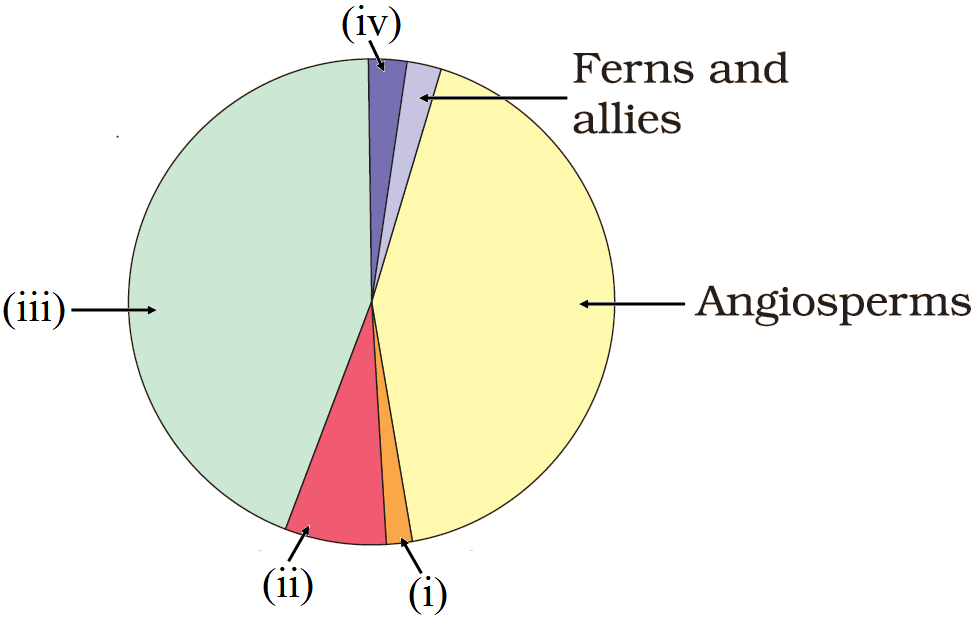
Identify the areas labelled (i), (ii), (iii) and (iv) in the pie chart given below representing the biodiversity of plants showing their proportionate number of species of major taxa.
Answer
  1. Lichens.
  2. Algae.
  3. Fungi.
  4. Mosses.
View full question & answer
Question 482 Marks
Which type of conservation measures, in situ or ex-situ, will help the larger number of species to survive? Explain.
Answer
In situ conservation measures will help larger number of species to survive because this approach involves protection of species in their natural habitat, e.g., national parks, sacred groves, biodiversity hot spots, etc.
View full question & answer
Question 492 Marks
Represent diagrammatically the proportion of different groups of plants, invertebrates and vertebrates (Global biodiversity).
View full question & answer
Question 502 Marks
Name any four regions, where sacred groves are found.
Answer
  1. Aravalli Hills of Rajasthan.
  2. Chanda and Bastar areas of Madhya Pradesh
  3. Khasi and Jaintia hills of Meghalaya.
  4. Western Ghat region of Karnataka and Maharashtra.
View full question & answer