Questions

2 Marks Questions

🎯

Test yourself on this topic

38 questions · timed · auto-graded

Question 12 Marks
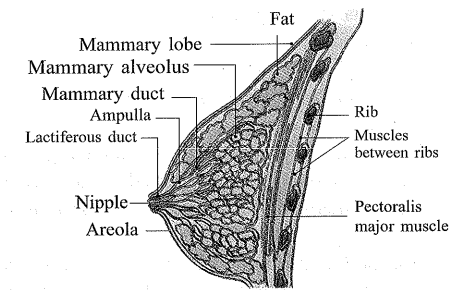
With a labeled diagram describe structure of mammary gland.###Write the structure of mammary gland (Diagram is not required)
Answer
→ A functional mammary gland is a characteristic of all female mammals.
→ The mammary glands are paired structures (breasts) that contain glandular tissue and variable amount of fat.
Image
→ The glandular tissue of each breast is divided into 15-20 mammary lobes containing clusters of cells called alveoli.
→ The cells of alveoli secrete milk, which is stored in the cavities (lumens) of alveoli.
→ The alveoli open into mammary tubules.
→ The tubules of each lobe join to form a mammary duct.
→ Several mammary ducts join to form a wider mammary ampulla which is connected to lactiferous duct through which milk is sucked out.
View full question & answer
Question 22 Marks
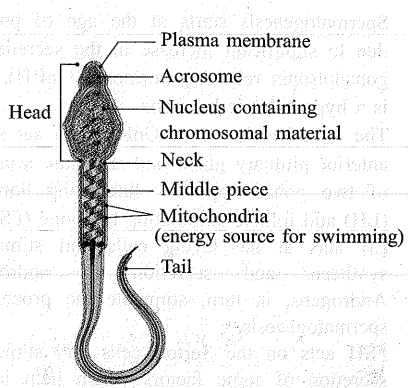
Write a short note on sperm. (With a labeled diagram.)###Draw a labelled diagram of sperm.
Answer

Image
→ The structure of a sperm is a microscopic structure composed of a head, neck, a middle piece and a tail.
→ A plasma membrane envelops the whole body of sperm.
→ The sperm head contains an elongated haploid nucleus, the anterior portion of which is covered by a cap-like structure, acrosome.
→ The acrosome is filled with enzymes that help fertilisation of the ovum.
→ The middle piece possesses numerous mitochondria, which produce energy for the movement of tail that facilitate sperm motility essential for fertilisation.
→ The human male ejaculates about 200 to 300 million sperms during a coitus of which, for normal fertility, at least 60 per cent sperms must have normal shape and size and at least 40 per cent of them must show vigorous motility.
→ Sperms released from the seminiferous tubules, are transported by the accessory ducts. Secretions of epididymis, vas deferens, seminal vesicle and prostate are essential for maturation and motility of sperms.
→ The seminal plasma along with the sperms constitute the semen.
→ The functions of male sex accessory ducts and glands are maintained by the testicular hormones (androgens).
Image
View full question & answer
Question 32 Marks
How spermiogenesis and spermiation differ from each other?###Define spermiogenesis and spermiation.
Answer
→ Spermiogenesis It is a process by which spermatids are transformed into spermatozoa or mature sperm cells. → Spermiation It is the process of releasing spermatozoa from the seminiferous tubules.
View full question & answer
Question 42 Marks
Write a short note on hormonal regulation of spermatogenesis.###Name the hormones involved in regulation of spermatogenesis.
Answer
→ Spermatogenesis starts at the age of puberty due to significant increase in the secretion of gonadotropin releasing hormone (GnRH). This is a hypothalamic hormone.
→ The increased levels of GnRH then act at the anterior pituitary gland and stimulate secretion of two gonadotropins - luteinising hormone (LH) and follicle stimulating hormone (FSH).
→ LH acts at the leydig cells and stimulates synthesis and secretion of androgens. Androgens, in turn, stimulate the process of spermatogenesis.
→ FSH acts on the Sertoli cells and stimulates secretion of some factors which help in the process of spermiogenesis.
View full question & answer
Question 52 Marks
Describe the structure of a seminiferous tubule
Answer
→ Each testicular lobule contains one to three highly coiled seminiferous tubules in which sperms are produced.
→ Each seminiferous tubule is lined on its inside by two types of cells called male germ cells (spermatogonia) and Sertoli cells.
→ The male germ cells undergo meiotic divisions finally leading to sperm formation, while sertoli cells provide nutrition to the germ cells.
→ The regions outside the seminiferous tubules called interstitial spaces, contain small blood vessels and interstitial cells or leydig cells.
→ Leydig cells synthesise and secrete testicular hormones called androgens.
→ Other immunologically competent cells are also present in interstitial spaces.
View full question & answer
Question 62 Marks
Write two major functions each of testis and ovary.
Answer
→ Functions of testis:
1. Testis produces spermatozoa which are male gametes.
2. In testis, the male sex hormone testosterone is developed.
→ Functions of ovary :
1. The ovary produces ovum by the process of oogenesis.
2. Graafian follicles in the ovary produce a female sex hormone called estrogen.
View full question & answer
Question 82 Marks
How many eggs do you think were released by the ovary of a female dog which gave birth to 6 puppies?
Answer
→ Dogs are species which has poly ovulatory where one ovary releases more than one ovum at the time of ovulation.
→ Therefore six eggs were released by the ovary of a female dog which gave birth to the six puppies.
View full question & answer
Question 92 Marks
How many eggs are released by a human ovary in a month? How many eggs do you think would have been released if the mother gave birth to identical twins? Would your answer change if the twins born were fraternal?
Answer
→ One ovum is released by a human ovary in a month. Identical twins are developed from a single egg. Hence, only one egg would have been released when the mother gave birth to identical twins. If the twins are fraternal then they must have been developed from two eggs.
View full question & answer
Question 112 Marks
What is parturition? Which hormones are involved in induction of parturition?
Answer
→ Parturition is the process of giving birth to a baby as the development of the foetus gets completed in the mother's womb.
→ The hormones involved in this process are oxytocin and relaxin.
→ Oxytocin leads to the contraction of smooth muscles of myometrium of the uterus, which directs the full term foetus towards the birth canal.
→ On the other hand, relaxin hormone causes relaxation of the pelvic ligaments and prepares the uterus for child birth.
View full question & answer
Question 122 Marks
What is menstrual cycle? Which hormones regulate menstrual cycle?
Answer
→ Menstrual cycle: It is the reproductive cycle of female primates (such as monkeys, apes, and humans).
→ The menstrual cycle is the sequence of events that begins with one menstruation and ends with the next.
→ Menstruation occurs every 28/29 days in human females.
→ Menstruation, the follicular phase, ovulation, and the luteal phase are the four phases of the menstrual cycle.
→ Hormones that regulate the menstrual cycle are: Follicle-stimulating hormone (FSH), Luteinizing hormone (LH), Estrogen and Progesterone.
View full question & answer
Question 132 Marks
Name the functions of the following: (a) Corpus luteum (b) Endometrium (c) Acrosome (d) Sperm tail (e) Fimbriae
Answer
→ (a) Corpus luteum It secretes progesterone. Progesterone is essential for the maintenance of the endometrium. (b) Endometrium Implantation of the fertilised ovum and many events of pregnancy take place in the endometrium.
(c) Acrosome It is filled with enzymes that hydrolyze egg membrane thus, helping the sperm in penetration of ovum during fertilisation of the ovum.
(d) Sperm tail It provides motility to sperm.
(e) Fimbriae After ovulation, fimbriae helps in the collection of the ovum.
View full question & answer
Question 162 Marks
What are the major functions of male accessory ducts and glands?
Answer
→ Male accessory ducts include vasa efferentia, epididymis. vas deferens and rete testis. They transport and temporarily store spermatozoa.
→ Male accessory glands include seminal vesicles, bulbourethral gland, and prostate gland. These glands secrete fluids that lubricate the female reproductive system and sperms.
View full question & answer
Question 172 Marks
What are the major components of seminal plasma?
Answer
→ The major components of seminal plasma are mucous, fructose, calcium, ascorbic acid, certain enzymes, and some secretions of accessory glands.
View full question & answer
Question 182 Marks
Write a short note on lactation.
Answer
→ The mammary glands of the female undergo differentiation during pregnancy and start producing milk towards the end of pregnancy by the process called lactation. This helps the mother in feeding the newborn.
→ The milk produced during the initial few days of lactation is called colostrum which contains several antibodies absolutely essential to develop resistance for the new-born babies.
→ Breast-feeding during the initial period of infant growth is recommended by doctors for bringing up a healthy baby.
View full question & answer
Question 192 Marks
What do you think the doctors inject to induce delivery?
Answer
→ Certain hormones are required to induce delivery. These hormones control the reflex action to deliver the baby. → Oxytocin is a hormone that is responsible for inducing uterine contractions, labour, and delivery of the baby.
→ When oxytocin is insufficient in the body, it becomes difficult for the baby to be delivered.
→ Doctors inject this hormone artificially to carry out the delivery smoothly.
View full question & answer
Question 202 Marks
Describe the mechanism of parturition.
Answer
→ Parturition 1S induced by a complex neuroendocrine mechanism. The signals for parturition originate from the fully developed foetus and the placenta which induce mild uterine contractions called foetal ejection reflex.
→ This triggers release of oxytocin from the maternal pituitary. Oxytocin acts on the uterine muscle and causes stronger uterine contractions, which in turn stimulates further secretion of oxytocin.
→ The stimulatory reflex between the uterine contraction and oxytocin secretion continues resulting in stronger and stronger contractions. This leads to expulsion of the baby out of the uterus through the birth canal- parturition.
→ Soon after the infant is delivered, the placenta is also expelled out of the uterus.
View full question & answer
Question 212 Marks
What are the major features of embryonic development at various months of pregnancy?
Answer
→ The human pregnancy lasts 9 months.
→ In human beings, after one month of pregnancy, the embryo's heart is formed. The first sign of growing foetus may be noticed by listening to the heart sound carefully through the stethoscope.
→ By the end of the second month of pregnancy, the foetus develops limbs and digits.
→ By the end of 12 weeks (first trimester), most of the major organ systems are formed, for example, the limbs and external genital organs are well-developed.
→ The first movements of the foetus and appearance of hair on the head are usually observed during the fifth month.
→ By the end of about 24 weeks (end of second trimester), the body is covered with fine hair, eye-lids separate, and eyelashes are formed.
→ By the end of nine months of pregnancy, the foetus is fully developed and is ready for delivery.
View full question & answer
Question 222 Marks
Describe in brief Embryonic development after implantation.
Answer
→ Immediately after implantation, the inner cell mass (embryo) differentiates into an outer layer called ectoderm and an inner layer called endoderm.
→ A mesoderm soon appears between the ectoderm and the endoderm.
→ These three layers give rise to all tissues (organs) in adults.
→ The inner cell mass contains certain cells called stem cells which have the potency to give rise to all the tissues and organs.
View full question & answer
Question 232 Marks
Write a short note on hormones secreted during pregnancy.
Answer
→ During pregnancy placenta acts as an endocrine tissue and produces several hormones like human chorionic gonadotropin (hCG), human placental lactogen (hPL), estrogens, progestogens, etc.
→ In the later phase of pregnancy, a hormone called relaxin is also secreted by the ovary.
→ hCG, hPL and relaxin are produced in women only during pregnancy.
→ During pregnancy the levels of other hormones like estrogens, progestogens, cortisol, prolactin, thyroxine, etc., are increased several-folds in the maternal blood.
→ Increased production of these hormones is essential for supporting the fetal growth, metabolic changes in the mother and maintenance of pregnancy.
View full question & answer
Question 242 Marks
What are the functions of placenta?
Answer
→ The placenta is connected to the embryo through an umbilical cord which helps in the transport of substances to and from the embryo.
→ The placenta facilitate the supply of oxygen and nutrients to the embryo and also removal of carbon dioxide and excretory/waste materials produced by the embryo.
→ Placenta also acts as an endocrine tissue and produces several hormones like human chorionic gonadotropin (hCG), human placental lactogen (hPL), estrogens, progestogens, etc.
View full question & answer
Question 252 Marks
What is placenta? How does it develop?
Answer
→ Placenta is a structural and functional unit between developing embryo (foetus) and maternal body.
→ After implantation, finger-like projections appear on the trophoblast called chorionic villi which are surrounded by the uterine tissue and maternal blood.
→ The chorionic villi and uterine tissue become interdigitated with each other and jointly form placenta.
View full question & answer
Question 262 Marks
Explain the sex of the baby is determined by the father and not by the mother ###In our society the women are often blamed for giving birth to daughters. Can you explain why this is not correct?
Answer
→ The sex of the baby has been decided after completion of fertilisation.
→ The chromosome pattern in the human female is XX and in the male is XY.
→ Therefore, all the haploid gametes (ova) produced by the female have the sex chromosome X whereas in the male gametes (sperms) the sex chromosome could be either X or Y, hence, 50 per cent of sperms carry the X chromosome while the other 50 per cent carry the Y.
→ After fusion of the male and female gametes the zygote would carry either XX or XY depending on whether the sperm carrying X or Y fertilised the ovum.
→ The zygote carrying XX would develop into a female baby and XY would form a male.
→ That is why, scientifically it is correct to say that the sex of the baby is determined by the father and not by the mother.
View full question & answer
Question 272 Marks
Write a short note on fertilisation. (Till the formation of zygote.)
Answer
→ The process of fusion of a sperm with an ovum is called fertilisation.
→ During fertilisation, a sperm comes in contact with the zona pellucida layer of the ovum and induces changes in the membrane that block the entry of additional sperms. Thus, it ensures that only one sperm can fertilise an ovum.
→ The secretions of the acrosome help the sperm enter into the cytoplasm of the ovum through the zona pellucida and the plasma membrane. This induces the completion of the meiotic division of the secondary oocyte.
→ The second meiotic division is also unequal and results in the formation of a second polar body and a haploid ovum (ootid).
→ Soon the haploid nucleus of the sperms and that of the ovum fuse together to form a diploid zygote.
View full question & answer
Question 282 Marks
Why all copulations do not lead to fertilisation and pregnancy?
Answer
→ During copulation (coitus) semen is released by the penis into the vagina (insemination).
→ The motile sperms swim rapidly, pass through the cervix, enter into the uterus and finally reach the ampullary region of the fallopian tube.
→ The ovum released by the ovary is also transported to the ampullary region where fertilisation takes place.
→ Fertilisation can only occur if the ovum and sperms are transported simultaneously to the ampullary region. This is the reason why not all copulations lead to fertilisation and pregnancy.
View full question & answer
Question 292 Marks
Define (i) Menarche (ii) Menopause (iii) Menstrual cycle.
Answer
→ (i) Menarche The first menstruation begins - at puberty and is called menarche.
→ (ii) Menopause In human beings, menstrual cycles ceases around 50 years of age; that is termed as menopause.
→ (iii) Menstrual cycle - In human females, menstruation is repeated at an average interval of about 28/29 days, and the cycle of events starting from one menstruation till the next one is called the menstrual cycle.
View full question & answer
Question 302 Marks
Write a brief note on following phase of menstrual cycle. (i) Menstrual phase. (ii) Follicular phase / Proliferative phase (iii) Ovulatory phase (iv) Luteal phase / Secretory phase.
Answer
→ (i) Menstrual phase:
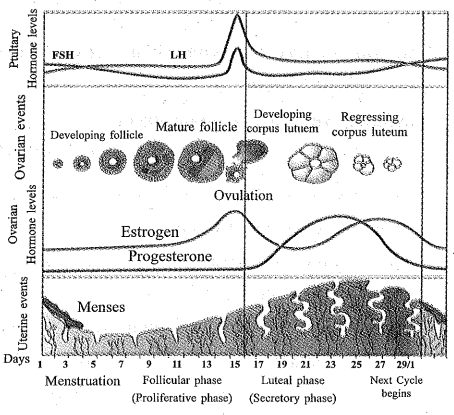
→ The cycle starts with this phase, when menstrual flow occurs and it lasts for 3-5 days.
→ The menstrual flow results due to breakdown of endometrial lining of the uterus and its blood vessels which forms liquid that comes out through vagina.
→ Menstruation only occurs if the released ovum is not fertilised
→ Lack of menstruation may be indicative of pregnancy.
→ However, it may also be caused due to some other underlying causes like stress, poor health etc.
→ (ii) Follicular phase / Proliferative phase: (Day 3-5)
→ The menstrual phase is followed by the follicular phase.
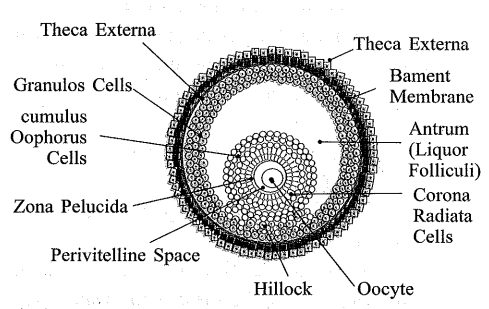
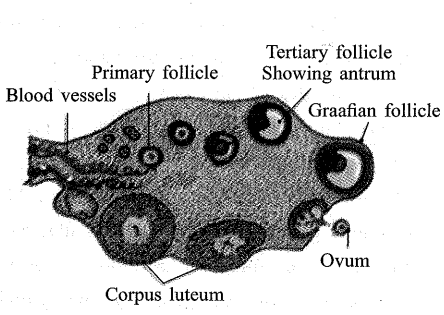
→ During this phase, the primary follicles in the ovary grow to become a fully mature Graafian follicle and simultaneously the endometrium of uterus regenerates through proliferation.
→ These changes in the ovary and the uterus are induced by changes in the levels of pituitary and ovarian hormones.
→ The secretion of gonadotropins (LH and FSH) increases gradually during the follicular phase, and stimulates follicular development as well as secretion of estrogens by the growing follicles.
→ (iii) Ovulatory phase: (Day 6-14)
→ Both LH and FSH attain a peak level in the middle of cycle (about 14th day).
→ Rapid secretion of LH leading to its maximum level during the mid-cycle called LH surge induces rupture of Graafian follicle and thereby the release of ovum (ovulation).
→ (iv) Luteal phase / Secretory phase: (Day 15-28)
→ The ovulation (ovulatory phase) is followed by the luteal phase during which the remaining parts of the Graafian follicle transform as the corpus luteum.
→ The corpus luteum secretes large amounts of progesterone which is essential for maintenance of the endometrium. Such an endometrium is necessary for implantation of the fertilised ovum and other events of pregnancy.
→ During pregnancy all events of the menstrual cycle stop and there is no menstruation.Image
View full question & answer
Question 312 Marks
Can you identify major differences between spermatogenesis and oogenesis?
Answer
→ In the male reproductive system, the process of formation of male gametes or sperms is called spermatogenesis, whereas in the female reproductive system, the formation of ovum is called oogenesis.
→ Spermatogenesis is a process that occurs in the seminiferous tubules of the testis. Whereas oogenesis occurs within the ovary of the female reproductive system.
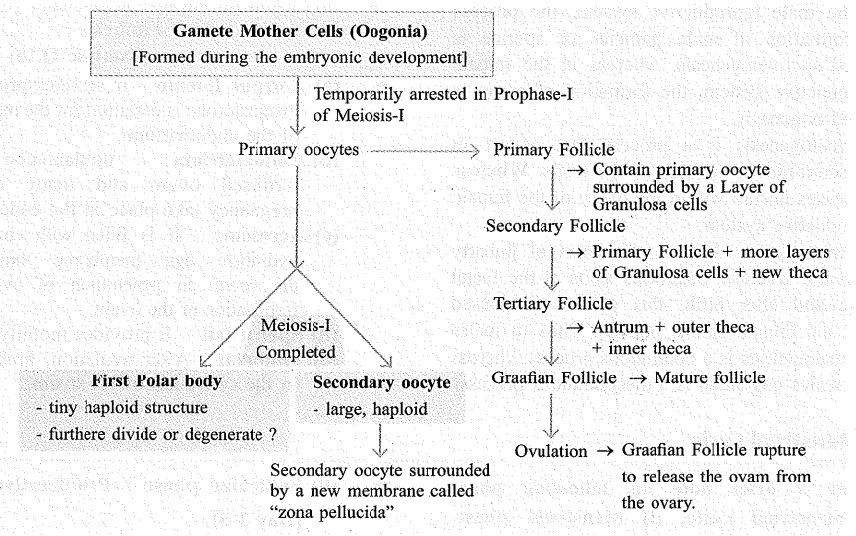
→ Spermatogenesis starts at the onset of puberty in males, whereas, oogenesis starts at the foetal stage and after birth, this process is paused until the female attains puberty. Thus in males spermatogenesis is a continuous process whereas in females oogenesis is a discontinuous process.
→ In oogenesis, the primary oocyte undergoes unequal meiotic division and gives rise to secondary oocyte and first polar body. This small polar body further degenerates, whereas in spermatogenesis, the primary spermatocyte divides equally and give rise to secondary spermatocytes. Thus, there is no polar body formation in spermatogenesis.
→ Generally meiotic division results in the formation of four daughter cells. But in oogenesis, only one ovum is produced as the end product, whereas in spermatogenesis, four sperms are produced.
View full question & answer
Question 322 Marks
Write a short note on ovaries.
Answer
→ Ovaries are the primary female sex organs that produce the female gamete (ovum) and several steroid hormones (ovarian hormones).
→ The ovaries are located one on each side of the lower abdomen.
→ Each ovary is about 2 to 4 cm in length.
→ It is connected to the pelvic wall and uterus by ligaments.
→ Each ovary is covered by a thin epithelium which encloses the ovarian stroma.
→ The stroma is divided into two zones  - a peripheral cortex and an inner medulla.
View full question & answer
Question 332 Marks
Mention location and parts of female reproductive system. What are the functions of female reproductive system?
Answer
→ The female reproductive system consists of a pair of ovaries along with a pair of oviducts, uterus, cervix, vagina and the external genitalia located in pelvic region.
→ These parts of the system along with a pair of the mammary glands are integrated structurally and functionally to support the processes of ovulation, fertilisation, pregnancy, birth and child care.
View full question & answer
Question 342 Marks
Give brief detail on male external genitalia.
Answer
→ The penis is the male external genitalia.
→ It is made up of special tissue that helps in erection of the penis to facilitate insemination.
→ The enlarged end of penis called the glans penis is covered by a loose fold of skin called foreskin.
View full question & answer
Question 352 Marks
Write a short note on male accessory glands.
Answer
→ The male accessory glands include paired seminal vesicles, a prostate and paired bulbourethral glands.
→ Secretions of these glands constitute the seminal plasma which is rich in fructose, calcium and certain enzymes.
→ The secretions of bulbourethral glands also helps in the lubrication of the penis.
View full question & answer
Question 362 Marks
Write a short note on male accessory ducts.
Answer
→ The male sex accessory ducts include rete testis, vasa efferentia, epididymis and vas deferens.
→ The seminiferous tubules of the testis open into the vasa efferentia through rete testis.
→ The vasa efferentia leave the testis and open into epididymis located along the posterior surface of each testis. The epididymis leads to vas deferens that ascends to the abdomen and loops over the urinary bladder.
→ It receives a duct from seminal vesicle and opens into urethra as the ejaculatory duct.
→ These ducts store and transport the sperms from the testis to the outside through urethra.
→ The urethra originates from the urinary bladder and extends through the penis to its external opening called urethral meatus.
View full question & answer
Question 372 Marks
Write a short note on external structure of testes.
Answer
→ The testes are situated outside the abdominal cavity within a pouch called scrotum.
→ The scrotum helps in maintaining the low temperature of the testes (2-2.5°C lower than the normal internal body temperature) necessary for spermatogenesis.
→ In adults, each testis is oval in shape, with a length of about 4 to 5 cm and a width of about 2 to 3 cm.
→ The testis is covered by a dense covering.
→ Each testis has about 250 compartments called testicular lobules.
View full question & answer
Question 382 Marks
Mention the main reprodutive events in humans.
Answer
→ The reproductive events in humans include
(i) Formation of gametes (gametogenesis), i.e., sperms in males and ovum in females,
(ii) Transfer of sperms into the female genital tract (insemination)
(iii) Fusion of male and female gametes (fertilisation)
(iv) Formation of zygote.
(v) Formation and development of blastocyst
(vi) Attachment of blastocyst to the uterine wall (implantation),
(vii) Embryonic development (gestation) and
(viii) Delivery of the baby (parturition).
View full question & answer
2 Marks Questions - Biology STD 12 Science Questions - Vidyadip