Questions

2 Marks Questions

🎯

Test yourself on this topic

17 questions · timed · auto-graded

Question 22 Marks
The life of offsprings of viviparous animals are not very much at risk. Justify statement giving two reasons.###There are more probability of survival of offsprings in viviparous organisms. Explain statement with reason.
Answer
In viviparous animals (mostly mammals including human), the development of zygote upto foetus takes place inside the mother’s body and are given birth through parturition by female after completing a definite gestation period and developmental stages. The proper embryonic care and look after enhance the chances of survival of offsprings in viviparous animals
View full question & answer
Question 32 Marks
Where are found leydig cells and what is their role in reproduction?
Answer
Leydig cells are found outside the seminiferous tubules in the region called interstitial spaces of testis follicules. These cells synthesize and secrete male sex hormone called androgens which regulate secondary sexual characters of human male.
View full question & answer
Question 42 Marks
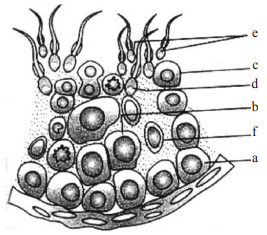
Write the answer of questions based on given diagram.
Image
(i) In which cell does take place spermatogenesis? Write name.
(ii) Write the name of ‘a’ and ‘b’ cells. What is the difference in both of them based on chromosome number?
(iii)Mark the mitotic cell and write its name.
(iv) What is ‘f’ cell? Write its function also.
(v) To which structure does the above diagram belong? Write the name. 
Answer
(i) ‘d’ spermatid.
(ii) ‘a’ spermatogonia and ‘b’ primary spermatocyte, both the cells are diploid and each contains 46 chromosomes.
(iii) Mitotic division—‘e’.
(iv) ‘f’ cell—sertoli cell.
Function : Provides nutrition and protection to developing sperms.
(v) Seminiferous tubules
View full question & answer
Question 52 Marks
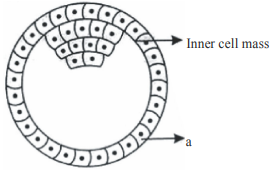
Study the given diagram and answer the asked questions :
(a) Write the name of human embryo stage as shown in diagram.
(b) Mention the name and function of ‘a’ labelled part.
(c) What happens to inner cell mass after implantation into uterus? Write.
(d) Where are stem cells in this embryo?
Image
Answer
(a) Blastocyst.
(b) Trophoblast, its function is to provide nutrition and protection to embryo.
(c) It forms true embryo.
(d) Stem cells lie in inner cell mass. 
View full question & answer
Question 62 Marks
Write two differences between spermatogenesis and spermiogenesis.
Answer
Differences between Spermatogenesis and Spermiogenesis : 
SpermatogenesisSpermiogenesis
1. This is second stage of pre-sperm formation1. This is the stage after pre-sperm formation.
2. In this, primary spermatocytes are formed from spermatogonia.2. In this, mature hoploid sperms are formed from spermatids.
3. It participates in the growth of spermatogenic cells.3. In this process the transfer of cells takes place.
4. Many processes are involved in this.  4. This is the last stage of sperm formation.
View full question & answer
Question 72 Marks
If ovary in female are removed surgically after fertilization, how will the pregnancy be affected? Explain.
Answer
The corpus luteum of ovary secretes estrogen, progeston and relaxin hormone actively. These hormones inhibit peristaltic movement in uterine wall to protect and maintain pregnancy therefore it is essential for corpus luteum to be active for about 6 weeks after conception and if ovaries are removed during this period it results into aborption but if it lasts for 3 weeks, placenta is developed meanwhile and starts secreting estrogen, proges and other hormones needed for maintenance of pregnancy and there will be no effect on pregnancy on removal of ovaries.
View full question & answer
Question 82 Marks
Write the significance or importance of spermatogenesis.
Answer
Significance of Spermatogenesis :
1. Haploid gametes called sperms are formed as a result of spermatogenesis.
2. The hereditary traits of parent are inherited in haploid set of chromosomes in sperms which enters the ovum through fertilization.
3. Sperm formed by spermatogenesis are haploid and tailed structure and this tail enables the sperm to swim in liquid medium.
View full question & answer
Question 92 Marks
How many sperms and ova will be produced by 25 primary spermatocyte and 25 primary oocyte. Give reason also.
Answer
100 sperms and 25 ova. We know that 4 sperms are formed from each primary spermatocyte in maturation phase by two successive division named meiosis-I and meiosis II therefore 25 primary spermatocytes produce 100 sperms. But on the other hand, one ovum is produced from one primary oocyte because of the four daughter cells formed during maturation phase, three smaller cells are called polar bodies which later degenerate whereas one bigger cell is left as mature ovum or egg cell hence 25 primary oocyte will produce 25 ova.
View full question & answer
Question 102 Marks
How many sperms and ova will be produced by 25 primary spermatocyte and 100 primary oocyte? Explain.
Answer
100 sperms and 100 ova will be produced. During spermatogenesis, there occurs two maturation division in each primary spermatocyte so that four sperms are produced
consequently. Thereby, 25 primary spermatocyte after completion of maturation phase produce 100 sperms.
Each primary oocyte, on completion of two maturation division produces one big large ovum and three polar bodies. The polar bodies later degenerate and only functional ovum is left, therefore 100 primary oocyte produce 100 ova.
View full question & answer
Question 112 Marks
What is puberty? Explain.
Answer
Puberty is the period during which immature reproductive organ of male and female human attain maturity and become functional.
Puberty becomes onset in female earlier than male. Human male attains puberty at the age of 14-16 years and his testis becomes active providing sperms whereas female attains puberty at the age of 12-14 years characterised by enlargement of breast and beginning of menstrual cycle.
View full question & answer
Question 122 Marks
What will be the effect on sperms on removal of prostate and cowper’s glands from man’s body?
Answer
Prostatic secretion forms major part of semen which activates the sperms, provides nutrition to sperms and neutralises the acidity of urine which may kill the sperms.
Secretion of cowper’s glands is alkaline that protects the sperms and lubricates the penis during copulation.
If both the glands are removed from man’s body, sperms will remain inactive and may get killed by acidity caused by urine. There will be dry orgasm, man will become impotent.
View full question & answer
Question 132 Marks
What will be the effect on ova if oviducts in female are replaced by plastic tubes?
Answer
In female oviduct is ciliated and its primary function is to receive the ovum from ovary and facilitate its forward movement for fertilization, to provide space to sperm so that fertilization could take place easily but on replacing the oviduct by plastic bag, how will sperms reach the egg in absence of mucous rich ciliary lining? Fertilization will not take place and the subsequent processes like implantation, pregnancy, embryo transformation etc. cannot take place. The egg will be destroyed in the plastic tube. 
View full question & answer
Question 142 Marks
Why is ovary called endocrine gland? Explain
Answer
Like other endocrine glands, ovary also secretes hormones like estrogen. Corpus luteum of ovary becomes active just after fertilization and secretes following hormones :
(i) Progestrone : It is essential for conception and maintenance of pregnancy, hence it is also called pregnancy maintaining hormones.
(ii) Relaxin : At the time of parturition, this hormone relaxes pubic symphysis so that birth canal/vagina becomes broad and assists in easy birth of baby.
View full question & answer
Question 152 Marks
Woman have more responsibility than man in the reproductive process. Why? Explain.
Answer
Women have more responsibility than men in the reproductive process because female reproductive system performed many functions like—ova formation, to recover the sperms during coitus, to prepare favourable environment for conception, to provide nutrition to foetus in mother’s womb and after parturition, breast feeding etc.
View full question & answer
Question 162 Marks
What are stem cells? Explain.
Answer
Stem cells are the special undifferentiated mass of cells with variable potency which are capable to form all tissues/organs of body. These cells in human being are derived from the inner cell mass of blastocyst. These cells are to be developed into any cell in the body. Adult stem cells/somatic stem cells are found in the neonatal and adults. They have the ability to divide and give rise to specific cell types.
View full question & answer
Question 172 Marks
What is gametogenesis? Write its any three significance.
Answer
The process of formation of gametes from primary germ cells in gonads i.e. testis and ovary of animals is called Gametogenesis.
Importance of Gametogenesis :
1. Haploid Gametes are formed as a result of gametogenesis. Male gamete fuses with female gamete to produce diploid zygote which develops to give birth new organism.
2. Crossing over taking place during gametogenesis produces new recombinants.
3. On the basis of similarities of gametogenesis, the evolutionary lineage of organisms can be explored.

View full question & answer