Questions

2 Marks Questions

🎯

Test yourself on this topic

8 questions · timed · auto-graded

Question 12 Marks
$(i)$ Assume that, $ \text{GPP}$ Forest $A = \text{GPP}$ Forest $B = \text{GPP}$ Forest $C,$ If Forest $A$ has $ \text{NPP} = 1254 J/m^2/day;$ Forest $B,  \text{NPP} =2157 J/m^2/day;$ and Forest $C,  \text{NPP} = 779 J/m^2/day,$ which one of these forests has maximum energy loss by respiration? Give reason.
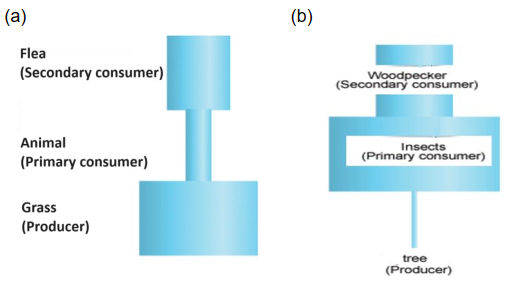
$(ii)$ Draw an ecological pyramid of number of the following food chains
$a.$ Grass$-$Animal$-$Fleas on the host animal
$b.$ Tree $-$ Insects $-$ Woodpecker
Answer
$(i)$ If $ \text{GPP}$ is equal, then we can manipulate the $ \text{NPP} $ equation and
solve.
$\rightarrow$ $ \text{NPP = GPP }-$ Respiration of plants;
$\rightarrow$ Respiration of Plants $= \text{GPP = NPP } $
$\rightarrow$ This means that the smallest $ \text{NPP} $ corresponds to the largest respiration. That is forest $C.$
$(ii)$
Image
View full question & answer
Question 22 Marks
$(i)$ It was estimated that if an evergreen forest has a $ \text{GPP} $ of $400 J/m^2/day$ and $150 J/m^2/day$ worth of carbon dioxide flows out of that forest, what is the $ \text{NPP} $ in that forest?
$(ii)$ Explain why pyramids of energy must always be upright.
Answer
$(i) \text{NPP} =   \text{GPP}   - R;$
Given $ \text{GPP} = 400 J/m^2/day$  
$R = 150 J/m^2/day$
$ \text{NPP} = 400 J/m^2/day - 150 J/m^2/day$
$= 250 J/m^2/day$
$(ii)$ Pyramid of energy is always upright. As energy flows from one trophic level to the next trophic level some amount of energy is lost in each trophic level in the form of heat. Therefore, the pyramid of energy is always upright and can never be inverted.
View full question & answer
Question 32 Marks
A culture plate of Lactobacillus shows blue-coloured colonies and colourless colonies. Explain the principle involved in the formation of such variance in the colour of colonies.
Answer
→ The variation in colour of colonies is due to the principle of insertional inactivation.
→ In this, a recombinant DNA is inserted within the coding sequence of an enzyme, ẞ-galactosidase. This results into inactivation of the enzyme, which is referred to as insertional inactivation.
→ The presence of a chromogenic substrate gives blue-coloured colonies if the plasmid in the bacteria does not have an insert.
→ Presence of insert results into insertional inactivation of the $\beta$ galactosidase and the colonies do not produce any colour, these are identified as recombinant colonies.
View full question & answer
Question 42 Marks
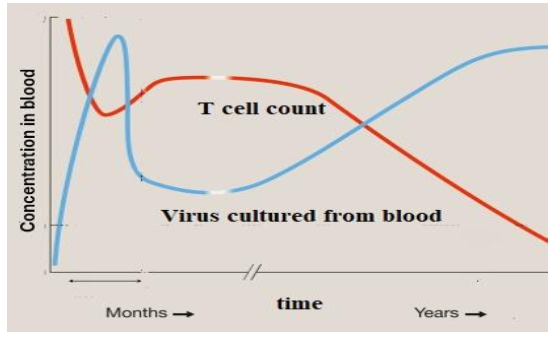
Given below is the relationship between the HIV levels in the blood and helper T cell count in a person detected with AIDS. Study the relationship and answer the questions that follow.
Image
A. What kind of relationship is observed in the virus levels and the immune response after some days of the initial infection?
B. Does it completely clear the virus from the body permanently? Give reason for your answer.
Answer
A. As the adaptive immune response gears up, there is a reciprocal relationship between virus levels in the blood and helper T lymphocytes levels. As the level of helper T levels rises, the virus levels decline.
B. Several years later, if untreated, HIV patient will lose the adaptive immune response, including the ability to make antibodies, as gradually the HIV enters the helper T lymphocytes leading to a progressive decrease in the number of helper T lymphocytes.
View full question & answer
Question 52 Marks
Given below is a schematic representation of a mRNA strandImage
(i) In the above sequence identify the translational unit in mRNA.
(ii) Where are UTRs found and what is their significance?
Answer
(i) Translational unit in mRNA is the sequence of RNA that is flanked by the start codon (AUG) and the stop codon (UAA) and codes for a polypeptide/ AUG AUC UCG UAA.
(ii) Untranslated regions (UTR). The UTRs are present at both 5' -end (before start codon) and at 3' -end (after stop codon). They are required for an efficient translation process.
View full question & answer
Question 62 Marks
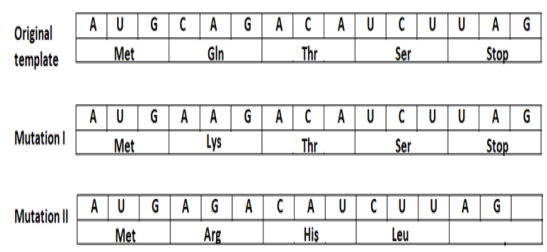
The schematic representation given below shows a DNA strand and two types of mutations in the DNA strand.
Image
(i) Identify the type of mutation exhibited in I and II.
(ii) Which of the above mutation is more harmful? Give reason.
Answer
(i) I is point mutation; II is Frame shift
(ii) Il as more codons are affected;
It is extremely likely to lead to large-scale changes to polypeptide length and chemical composition/ resulting in a non-functional protein that often disrupts the biochemical processes of a cell/Incorrect amino acids are inserted/ often premature termination occurs when a nonsense codon is read/ Frameshifts have very severe phenotypic effects.
View full question & answer
Question 72 Marks
(i) The human male ejaculates about 200 to 300 million sperm during a coitus, however the ovum is fertilized by only one sperm. How does the ovum block the entry of additional sperms?
(ii) All copulations will not lead to fertilization. Why?
Answer
(i) A sperm induces changes in the zona pellucida membrane on contact, blocking entry of other sperms.
(ii) Ovum and sperms should be transported simultaneously to the ampullary region for fertilization.
View full question & answer
Question 82 Marks
(i) A blood test reported negative for hCG. What does negative hCG imply? Name the tissue which produces hCG?
(ii) If a blood test reported positive for hCG in a person, then which other hormones would also be secreted by the tissue secreting hCG?
Answer
(i) Negative hCG implies no pregnancy (0.5); Placenta. (0.5)
(ii) Human placental lactogen (hPL), estrogen, progestogens, relaxin
View full question & answer
2 Marks Questions - Biology STD 12 Science Questions - Vidyadip