Questions

M.C.Q (1 Marks)

🎯

Test yourself on this topic

13 questions · timed · auto-graded

MCQ 11 Mark
During the secondary treatment of sewage, which of the following change in the effluent occur due to flocs?
  • Reduction in BOD
  • B
    Increase in BOD
  • C
    Decrease in DO
  • D
    No change in DO or BOD
Answer
Correct option: A.
Reduction in BOD
Reduction in BOD
View full question & answer
Question 21 Mark
Eco R1 cuts the DNA between bases G and A only when the sequence of GAATTC is present. The number of nucleotides present in the resultant sticky ends that will be formed in each of the two strands of DNA after this enzyme cuts the DNA will be:
 Vector DNAForeign DNA
A1 & 55 &1
B2 & 44 &2
C2 & 55 & 2
D3 & 44 & 3
Answer
A.1& 5; 5 &1
View full question & answer
MCQ 31 Mark
Adaptive radiation leads to which of the following?
  • A
    Increased competition among species
  • B
    Decreased speciation rates
  • C
    Limited morphological diversity among species
  • Rapid divergence of traits among populations inhabiting a given geographical area.
Answer
Correct option: D.
Rapid divergence of traits among populations inhabiting a given geographical area.
View full question & answer
MCQ 41 Mark
Idli – dosa dough rises due to production of which of the following gas?
  • A
    CO
  • $CO _2$
  • C
    NO
  • D
    $NO _2$
Answer
Correct option: B.
$CO _2$
$CO _2$
View full question & answer
MCQ 51 Mark
The following diagram shows a fragment of DNA which is going to be transcribed, the upper strand with polarity 3’ to 5’ is the template strand:
3´ ATTGCC 5´
5´ TAACGG 3´
After transcription the mRNA can be represented by:
  • A
    5´ AUUGCC 3´
  • B
    5´ AUUGCC 3’
  • 5´ UAACGG 3´
  • D
    5´ GGCAAU 3´
Answer
Correct option: C.
5´ UAACGG 3´
5´ UAACGG 3´
View full question & answer
MCQ 61 Mark
Which of the following features shows the mechanism of se determination in honey-bee?
(i) An offspring formed from the union of a sperm and egg develops as a female.
(ii) Males have half the number of chromosomes than that of female.
(iii) The males are haploid having 32 chromosomes.
(iv) All workers and males are diploid having 16 chromosomes
  • (i) and (ii)
  • B
    (ii) and (iii)
  • C
    (i) and (iv)
  • D
    (ii) and (iv)
Answer
Correct option: A.
(i) and (ii)
(i) and (ii)
View full question & answer
MCQ 71 Mark
In E.coli, the lac operon gets switched on when lactose is
  • present in the medium and it binds to the repressor.
  • B
    not present in the medium and the repressor binds to the operator.
  • C
    not present in the medium and RNA polymerase binds to the operator.
  • D
    Active lactose present in the medium binds to RNA polymerase.
Answer
Correct option: A.
present in the medium and it binds to the repressor.
View full question & answer
Question 81 Mark
Suresh and Rajesh have defective haemoglobin due to genetic disorders. In Suresh, the problem is qualitative as he is having incorrectly functioning globin molecules while in Rajesh the problem is quantitative as he is having very few globin molecules. Identify the disorder they are suffering from.
SureshRajesh
AThalassemia - Autosomal Dominant blood disorderSickle Cell Anaemia - Autosomal linked Recessive trait
BSickle Cell Anaemia - Autosomal linked Dominant traitThalassemia - Autosomal Recessive blood disorder
CSickle Cell Anaemia – Autosomal linked Recessive traitThalassemia – Autosomal Recessive blood disorder
DThalassemia - Autosomal Dominant blood disorderSickle Cell Anaemia - Autosomal linkedDominant trait
Answer
SureshRajesh
CSickle Cell Anaemia – Autosomal linked Recessive traitThalassemia – Autosomal Recessive blood disorder
View full question & answer
MCQ 91 Mark
E. coli has 4.6 X 10 6 base pairs and completes the process of replication in 18 minutes, then the average rate of polymerization is approximately
  • A
    2000 bp/s
  • B
    4000 bp/s
  • C
    3000 bp/s
  • D
    1000 bp/s
Answer
B. 4000 bp/s
It completes replication process in 18 minutes i.e. 18x 60 seconds.
Rate of polymerization = 4.6 x 10⁶ bp/ 18x 60 s
= 460000/108
= 4259.1bp/s or approximately 4000 bp/sec Thus, the correct option is B.
View full question & answer
MCQ 101 Mark
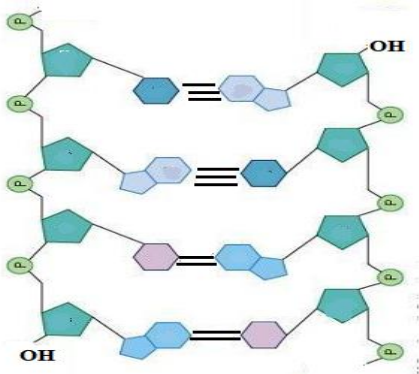
Observe the schematic diagram that depicts a small section of nucleic acid. The bases in two strands are paired through hydrogen bonds that are shown by the dark lines. Identify the correct sequence of nucleotide in the 5’-3’ direction.
Image
  • A
    GCAT
  • B
    CGTA
  • C
    TAGC
  • D
    ATCG
Answer
B. CGTA
View full question & answer
MCQ 111 Mark
A sample of normal double-stranded DNA was found to have thymine content of 27%. What will be the expected proportion of guanine in this strand?
  • A
    23%
  • B
    32%
  • C
    36%
  • D
    73%
Answer
A. 23%
According to Chargaff’s rules, in DNA, A =T and G=C;
Thus, A +T+G+C =100
Given T = 27% so A=T =27%
Thus A+T = 27 +27 =54%
Thus, G+C =100 – 54 = 46%
Since G = C so G = 46/2 =23%
View full question & answer
MCQ 121 Mark
To produce 1600 seeds, the number of meiotic divisions required will be
  • A
    2400
  • B
    2000
  • C
    1600
  • D
    1800
Answer
B. 2000
Formation of one seed requires fertilsation between one pollen grain and one egg. To produce 1600 seeds, 1600 pollen grains and 1600 eggs will be required. Each microspore mother cell results in the formation of 4 pollen grains after one cycle of meiotic division. So, 400 meiotic divisions will result in the production of 1600 pollen grains. One megaspore mother cell after one cycle of meiotic division results in the formation of 1 egg; so, 1600 meiotic divisions will take place to form 1600 eggs. Thus, total number of meiotic divisions required for the formation of 1600 seeds will be 400 + 1600 =2000.
View full question & answer
MCQ 131 Mark
Signals for parturition in human female originate from
  • A
    Fully developed foetus only
  • B
    Both placenta as well as fully developed foetus
  • C
    Placenta only
  • D
    Oxytocin released from maternal pituitary
Answer
Both placenta as well as fully developed foetus.
View full question & answer
M.C.Q (1 Marks) - Biology STD 12 Science Questions - Vidyadip