Question 15 Marks
How and why is the bacterium Thermus aquaticus employed in recombinant DNA technology? Explain.
Answer
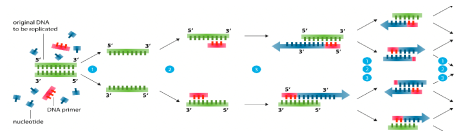
View full question & answer→The bacterium Thermus aquaticus is employed and used for amplification of the gene of interest using PCR technique. Usually Taq (Thermus aquaticus) DNA polymerase, a thermostable enzyme is isolated from a thermophilic bacterium. The enzyme extends the two primers towards each other in order to copy the DNA segment (act as a template) lying between the two primers.
The step requires the presence of deoxynucleoside triphosphates and Mg2+ and occurs at 72°C.
If these cycles are repeated many times, the DNA segment can be amplified to approximately a billion times the DNA segment are made.
i. These are restriction endonucleases enzymes which cut the DNA molecule at the specific base sequences into fragments with sticky ends.
e.g., Eco RI, Hind II
ii. The enzyme restriction endonuclease cleaves DNA at a specific site resulting in the formation of fragments with single strand portions at the ends called sticky-ends. In practice, the digestion by the restriction enzyme keeping all other conditions at the optimum level and checked by using agarose gel electrophoresis technique.
The step requires the presence of deoxynucleoside triphosphates and Mg2+ and occurs at 72°C.
If these cycles are repeated many times, the DNA segment can be amplified to approximately a billion times the DNA segment are made.
i. These are restriction endonucleases enzymes which cut the DNA molecule at the specific base sequences into fragments with sticky ends.
e.g., Eco RI, Hind II
ii. The enzyme restriction endonuclease cleaves DNA at a specific site resulting in the formation of fragments with single strand portions at the ends called sticky-ends. In practice, the digestion by the restriction enzyme keeping all other conditions at the optimum level and checked by using agarose gel electrophoresis technique.