Questions

5 Marks Questions

🎯

Test yourself on this topic

6 questions · timed · auto-graded

Question 15 Marks
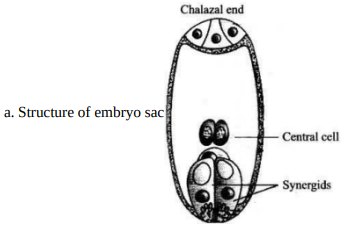
a. Draw the embryo sac of a flowering plant and label the following:
i. Central cell
ii. Chalazal end
iii. Synergids
b. Name the cell and explain the process it undergoes to develop into an embryo sac.
c. Explain the development of endosperm in coconut.
Answer
Image
b. Cell name - Functional Megaspore
Nucleus of functional megaspore divides mitotically three times to form 8 free nucleate stage of embryo sac, after this cell walls are laid down leading to 7 celled embryo sac.
c. Development of endosperm in coconut - The two polar nucleii fuses with one male gamete, to produce triploid primary endosperm nucleus (PEN), which divides repeatedly forming free nuclei, subsequently cell wall formation occurs.
View full question & answer
Question 25 Marks
Explain the relationship of ribosomes, 1-RNA and m-RNA during the process of translation in Prokaryotes.
Answer
During the process of translation in prokaryotes, amino acids are activated in the presence of ATP and they are linked to their aminoacylation of tRNA, as ribosome is the cellular factory for protein synthesis which exists as two subunits for the initiation and this small subunit of ribosome binds to mRNA at the start codon that is AUG. Then it is recognised by initiator 1-RNA, large subunit has two sites for subsequent amino acids to bind to each other with a peptide bond. Then it proceeds towards the elongation process where charged tRNAs sequentially bind to the appropriate codon in mRNA, by forming complementary base pairs with the tRNA anticodon. Then ribosome moves codon by codon along with the m-RNA, and amino acids are added one by one, at the end, a release factor binds to the stop codon which can be UAA/UAG/UGA for terminating the translation.
View full question & answer
Question 35 Marks
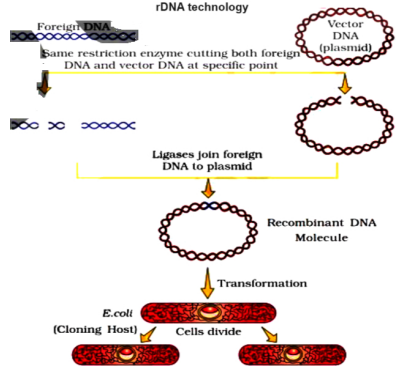
A gene was identified in a fungus by a research worker in a lab which was considered to be of a great importance in the field of agriculture. As a student of biotechnology, write the steps you would suggest to (i) Isolate this gene of interest from the fungus and (ii) amplify this gene for further experimentation and research.
View full question & answer
Question 45 Marks
If a desired gene is identified in an organism for some experiments, explain the process of the following:
i. Cutting this desired gene at specific location.
ii. Synthesis of multiple copies of this desired gene.
Answer
i. Cutting of the desired gene at a specific location is done by incubating the DNA with specific restriction endonuclease. Restriction enzymes recognise a particular palindromic nucleotide sequence and cut the DNA at that site.
ii. Synthesis of multiple copies of the desired gene is carried out by Polymerase Chain Reaction (PCR)
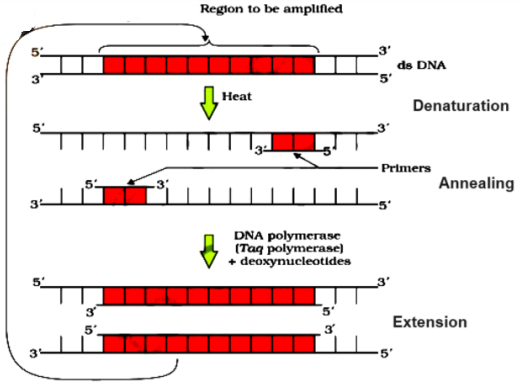
Amplification of recombinant DNA gene is done using Polymerase Chain Reaction (PCR). It is carried out in the following steps:
a. Denaturation -The double-stranded DNA is denatured by applying high temperature of 95°C for 15 seconds. Each separated strand acts as a template.
b. Annealing - Two sets of primers are added, which anneal to the 3'end of each separated strand.
c. Extension - DNA polymerase extends the primers by adding nucleotides complementary to the template provided in the reaction. Taq polymerase is used in the reaction, which can tolerate heat. All these steps are repeated many times to get several copies of the desired DNA.
View full question & answer
Question 55 Marks
Compare the processes of DNA replication and transcription in prokaryotes.
Answer
Similarities -
Both the processes involve -
i. Unwinding of the helix and separating the two DNA strands
ii. Breaking the hydrogen bonds between the bases / pairs
iii. Follow complimentary base pair rule
iv. Polymerization occurs in 5 → 3' direction
Disimilarities -

DNA replication
i. DNA nucleotides added are ATP, GTP, СТР, ТТР
ii. Deoxyribose sugar is the part of nucleotide
iii. Adenine pairs with Thymine
iv. Both strands copied
v. Resulting into two DNA molecules
Transcription
i. RNA nucleotides added are ATP, GTP, CTP, UTP
ii. Ribose sugar is the part of nucleotide
iii. Adenine with Uracil
iv. Only one strand copied
v. Resulting in formation of an RNA molecule.
View full question & answer
Question 65 Marks
a. Describe the process of double fertilisation in angiosperms.
b. Trace the development of polyploidal cell that is formed after double fertilisation in a non-albuminous seed and albuminous seed.
Answer
a. Double fertilization in angiosperms involves the fusion of two sperm cells with two distinct female gameles:
One of the male gametes, fuses with the nucleus of the egg cell, to form a diploid zygote (syngamy)
Second male gamete, fuses with two polar nuclei, to form (triploid) primary endosperm nucleus (triple fusion)
b. The primary endosperm nucleus undergoes successive nuclear divisions, to give rise to free nuclei / free nuclear endosperm, subsequent cell wall fomation results in cellular endosperm.
View full question & answer
5 Marks Questions - Biology STD 12 Science Questions - Vidyadip