Questions

3 Marks Question

🎯

Test yourself on this topic

9 questions · timed · auto-graded

Question 13 Marks
Write three differences between DNA and RNA.
Answer
Difference between DNA and RNA :
S.No.SymptomsDNARNA
1Number of strandDouble strandedSingle stranded
2Pentose sugarDeoxyribose $\left(C_6 H_{10} O_4\right)$Ribose $\left( C _5 H _{10} O _5\right)$
3Pyrimidine baseThymine and cytosineUracil and cytocine
View full question & answer
Question 23 Marks
What do you mean by semi-conservative replication? Describe the experiment conducted by Matthew Meselson and Franklin Stahl to prove that semi-conservative replication occurs in DNA. Draw a diagram of the semi-conservative DNA replication model.###What is the semi-conservative replication of DNA? Who proved this? Explain this experiment in detail.
Answer
self
View full question & answer
Question 33 Marks
Write any four main features of the structure of double helical DNA.
Answer
1. DNA is made of two polynucleotide chains which has a backbone of sugar phosphate with nitrogen bases projected inside.
2. The two chains exhibit anti-parallel polarity which meams if the one chain has the polarity in 5' to 3' end direction then other has 3' to 5' end.
3. The bases in two strands are paired through hydrogen bonds (H-bonds) forming the base pairs. Adenine pairs with Thymine by two hydrogen bonds from opposite strand and vice versa. Similarly Guanine pairs with Cytosine by 3 hydrogen bonds and vice-versa. In this way, purine always pairs with pyrimidine of the opposite strand and vice versa so that the two strands in a helix remain almost at a constant distance from each other.
4. The two chains are coiled in right handed fashion. The diameter of the DNA helix is 20Å (angstrom) i.e. both the strands in DNA are kept apart at a distance of 20Å or 2nm (nanometer). The pitch of the helix is 34Å or 3.4nm (a nanometer is 1 billionth of a metre that is $10^{-9}$m) and there are 10 base pairs in each turn therefore the distance between a base pair in a helix is approximately 3.4 Å or 0.34nm.
View full question & answer
Question 43 Marks
Explain the unit of transcription and gene.
Answer
A gene is the functional unit of inheritance which are located on the DNA. The DNA sequence coding for t-RNA or r-RNA molecule also define a gene. A cistron is a segment of DNA coding for a polypeptide, the structural gene in a transcription unit could be said as monocistronic (mostly in eukaryotes) or polycistronic (mostly in bacteria or prokaryotes). In eukaryotes, the monocistronic structural genes have interrupted coding sequences—the genes in eukaryotes are split. The coding sequences or expressed sequences are defined as exons. Exons are said to be those sequence that appear in mature or processed RNA. The exons are interrupted by introns. Introns or intervening sequences do not appear in mature or processed RNA.
Before processing, the primary transcript of RNA contains both exons and introns and are known as heterogenous nuclear RNA/hn-RNA. The split-gene arrangement further complicates the definition of a gene in terms of a DNA segment. Inheritance of a character is also affected by promoter and regulatory sequences of a structural gene. Hence, sometime the regulatory sequences are loosely defined as regulatory genes, even though these sequences do not code for any RNA or protein.
View full question & answer
Question 53 Marks
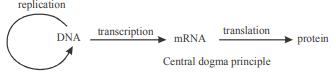
Who propounded the Central Dogma principle and what is meant by it?
Answer
Francis Cricks proposed the central dogma of molecular biology in 1958 in which it is clear that the flow of genetic information is unit-directional from DNA $\rightarrow$ mRNA $\rightarrow$ protein. This principal is known central dogma of molecular biology. All three types of RNAs named m-RNA, r-RNA and t-RNA, ribosome, amino acids and various factors like initiation factors, elongation factors, termination factors etc. participate in this process.
Image
View full question & answer
Question 63 Marks
Name the main stages of translation.
Answer
The formation of a poly-peptide chain from mRNA is known as translation. The process of translation takes place on ribosome. The sequence of three nitrogen bases present in 5'-3' direction on m-RNA is called genetic code. This code determines the sequence of amino acids in a poly-peptide chain. Ribosome joins the m-RNA at 5' and when it moves towards 3', messages of DNA present as codon in m-RNA are translated.
The process of translation is completed in following steps :
1. Activation of Amino acids
2. Charging of t-RNA
3. Initiation
4. Elongation of polypeptide chain
5. Termination of polypeptide chain
View full question & answer
Question 73 Marks
Write a note on heteronuclear RNA and small nuclear RNA.
Answer
Heteronuclear RNA : In eukaryotes, the RNA formed after transcription of DNA is called hnRNA. It is also called high molecular weight RNA or pre-nuclear RNA or DNA-like RNA. This primary messenger RNA is made up of two types of parts. One of these is called intron. There is no code in it. The second part is called exon which carries the genetic code. Of these, introns are removed by the process of RNA splicing. A nuclear organ called spliceosome helps in this process. After this m-RNA is formed, which takes part in the action of translation.
Small nuclear RNA : Small nuclear RNA (snRNA) is one of the small RNA localized in the nucleus of eukaryotic cell. they are complexed with many proteins to form RNA-protein complexes, termed as small nuclear ribonucleoproteins (snRNPs), in the cell nucleus. they are also called snurps. Small nuclear RNAs (snRNAs) are critical components of the spliceosome that catalyze the splicing of RNA.
View full question & answer
Question 83 Marks
Name the major enzymes involved in DNA replication.
Answer
The enzymes participating in DNA replication are as follows :
(i) Helicase enzymes : Open the double helix of DNA.
(ii) S.S.B. proteins keep the position stable by associating with single stranded binding proteins.
(iii) Topoisomerase enzymes : Reduce the coiling tension.
(iv) RNA polymerase or primase enzyme (R.N.A. primer) : make small part of RNA to process DNA synthesis.
(v) DNA polymerase III enzyme : work to advance the primer in 5'-3' direction.
(vi) DNA Polymerase I : Fills the spaces found between the DNA.
(vii) Ligase enzymes : Join the DNA fragments.
(viii) Endonuclease and exonuclease enzymes : work to connect the correct nucleotides.
View full question & answer
Question 93 Marks
What is meant by polynucleotide? Write its components.
Answer
Many nucleotides join together to form a chain of polynucleotides and form the structure of DNA and RNA. Each nucleotide has three components : nitrogenous base, pentose sugar (ribose in RNA and de-oxyribose in DNA) and a phosphate group. There are two types of nitrogenous bases—purines (adenine and guanine) and pyrimidines (cytosine, uracil and thymine). Cytosine is found in both DNA and RNA, whereas thymine is found in DNA. Uracil is found in RNA in place of thymine.
Nitrogenous base by binding to pentose sugar, forms nucleotides, such as - adenosine or deoxyadenosine, guanosine or deoxy guanosine, cytidine or deoxycytidine and uridine and deoxy thymidine. When the phosphate group gets attached to the nucleoside 5' hydroxyl group by phosphoester bond, then the corresponding nucleotide is formed. It happens that two nucleotides are joined by 3'-5' phosphoester bond to form a dinucleotides. In this way, several nucleotides join together to form a polynucleotide chain.
View full question & answer
3 Marks Question - Biology STD 12 Science Questions - Vidyadip