Questions

3 Marks Question

🎯

Test yourself on this topic

4 questions · timed · auto-graded

Question 13 Marks
Explain Commensalism interaction of population with different examples
Answer
→ This is the interaction in which one species benefits and the other is neither harmed nor benefited.
→ An orchid growing as an epiphyte on a mango branch, and barnacles growing on the back of a whale benefit while neither the mango tree nor the whale derives any apparent benefit.
→ The cattle egret and grazing cattle in close association, a sight you are most likely to catch if you live in farmed rural areas, is a classic example of commensalism.
→ The egrets always forage close to where the cattle are grazing because the cattle, as they move, stir up and flush out insects from the vegetation that otherwise might be difficult for the egrets to find and catch.
→ Another example of commensalism is the interaction between sea anemone that has stinging tentacles and the clown fish that lives among them. The fish gets protection from predators which stay away from the stinging tentacles. The anemone does not appear to derive any benefit by hosting the clown fish.
View full question & answer
Question 23 Marks
Explain logistic growth with equation.
Answer
→ No population of any species in nature has at its disposal unlimited resources to permit exponential growth.
→ This leads to competition between individuals for limited resources.
→ Eventually, the 'fittest' individual will survive and reproduce.
→ The governments of many countries have also realised this fact and introduced various restraints with a view to limit human population growth.
→ In nature, a given habitat has enough resources to support a maximum possible number, beyond which no further growth is possible.
→ This limit is nature's carrying capacity (K) for that species in that habitat.
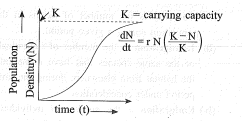
→ A population growing in a habitat with limited resources show initially a lag phase, followed by phases of acceleration and deceleration and finally an asymptote, when the population density reaches the carrying capacity.
→ A plot of N in relation to time (t) results in a sigmoid curve. This type of population growth is called Verhulst-Pearl Logistic Growth.
Image
→ The Verhulst-Pearl Logistic Growth equation :
$
dN / dt = rN ( K - N / K )
$
Where $N =$ Population density at time t
$r =$ Intrinsic rate of natural increase
$K=$ Carrying capacity
→ Since resources for growth for most animal populations are finite and become limiting sooner or later, the logistic growth model is considered a more realistic one.
→ Gather from Government Census data the population figures for India for the last 100 years, plot them and check which growth pattern is evident.
View full question & answer
Question 33 Marks
Explain Predation
Answer
Defenses of prey species to lessen impact of predation :
Camouflage (cryptic colouration) of some insects & frogs.
→ Some are poisonous and so avoided by the predators.
→ Monarch butterfly is highly distasteful to its predator bird. It is due to a special chemical in
its body.
→ It is acquired during its caterpillar stage by feeding on a poisonous weed.
→ Thorns (Acacia, Cactus etc.) are the most common morphological means of defense of plants.
→ Many plants produce chemicals that make the herbivore sick, inhibit feeding or digestion, disrupt its reproduction or kill it. E.g. Calotropis produce highly poisonous cardiac glycosides.
→ Therefore cattle or goats do not eat it.
→ Nicotine, caffeine, quinine, strychnine, opium, etc. are defenses against grazers and browsers.
View full question & answer
Question 43 Marks
Explain: Population density
Answer
→ The population size is measured by its density.
→ At given time, the organisms in the population is counted per given unit area.
→ For this the unit of measurement is decided such as unit per acre or unit per hectares. For small organisms, small units are considered.
→ In our country, every 10 years population is measured.
→ In a specific habitat, the population density is fluctuating. For instance in rainy season density is high whereas in dry season it is less.
→ The population density depends on the necessity of an organism.
View full question & answer
3 Marks Question - Biology STD 12 Science Questions - Vidyadip