Questions · Page 1 of 6

1 Marks Question

🎯

Test yourself on this topic

50 questions · timed · auto-graded

Question 11 Mark
Who had proposed the chromosomal theory of the inheritance?
Answer
Sutton and Boveri proposed the chromosomal theory of inheritance in 1902.
View full question & answer
Question 21 Mark
Name the type of cross that would help to find the genotype of a pea plant bearing violet flowers.
Answer
Test cross.
View full question & answer
Question 31 Mark
Name the stage of cell division where segregation of an independent pair of chromosomes occurs.
Answer
Anaphase-1 of Meiosis -1/Anaphase -1.
View full question & answer
Question 41 Mark
Name the type of cross that would help to find the genotype of a pea plant bearing violet flowers.
Answer
Test cross.
View full question & answer
Question 51 Mark
A male honeybee has 16 chromosomes whereas its female has 32 chromosomes. Give one reason.
Answer
Male Honey bee develops from unfertilized female gamete/unfertilised egg/Parthenogenesis of female gamete (16 chromosomes), female develops by fertilisation/fertilised egg (32 chromosomes).
View full question & answer
Question 61 Mark
Mention any two contrasting traits with respect to seeds in pea plant that were studied by Mendel.
Answer
Round/Wrinkled, Yellow/Green.
View full question & answer
Question 71 Mark
A garden pea plant produced axial while flowers. Another of the same species produced terminal violet flowers. Identify the dominant traits.
Answer
Axial, violet flower.
View full question & answer
Question 81 Mark
Name one autosomal dominant and one autosomal recessive Mendelian disorder in humans.
Answer
Autosomal dominant–Myotonic dystrophy.
Autosomal recessive–Phenylketonuria/sickle cell anaemia/cystic fibrosis/Thalesemia.
View full question & answer
Question 91 Mark
Mention two causes of frame-shift Mutation.
Answer
Insertion, deletion of three bases/one codon or multiple of three bases/multiple codon (hence one or more amino acid) (reading frame remains unaltered from that point onwards)
View full question & answer
Question 101 Mark
What is a Mutagen? Name a physical factor that can be a Mutagen.
Answer
All the physical and chemical factors that induce mutation, UV radiation/X rays.
View full question & answer
Question 121 Mark
What is point mutation? Give one example.
Answer
Arising due to change in a single base pair of DNA, sickle cell anemia.
View full question & answer
Question 131 Mark
Mention how does DNA polymorphism arise in a population.
Answer
Inheritable mutations (in a population), at high frequency.
View full question & answer
Question 151 Mark
State a difference between a gene and an allele.
Answer
Gene - contains information that is required to express a particular trait//unit of inheritance//segment of DNA called cistron//
Sequence of DNA coding for tRNA/rRNA/polypeptide/enzyme.
Allele - Genes which code for a pair of contrasting traits/(slightly) different forms of the same gene/individual gene in a particular gene pair (for same character).
View full question & answer
Question 161 Mark
A geneticist interested in studying variations and patterns of inheritance in living beings prefers to choose organisms for experiments with shorter life cycle. Provide a reason.
Answer
Many generations can be obtained (in a short time).
variations can be exhibited/selected faster.
View full question & answer
Question 171 Mark
A garden pea plant (A) Produced inflated yellow pod, and another plant (B) of the same species produced constricted green pods. Identify the dominant traits.
Answer
Inflated, green pods.
View full question & answer
Question 181 Mark
Name the event during cell division cycle that results in the gain or loss of chromosome.
Answer
Failure of segregation of chromatids/non-disjunction/aneuploidy.
View full question & answer
Question 191 Mark
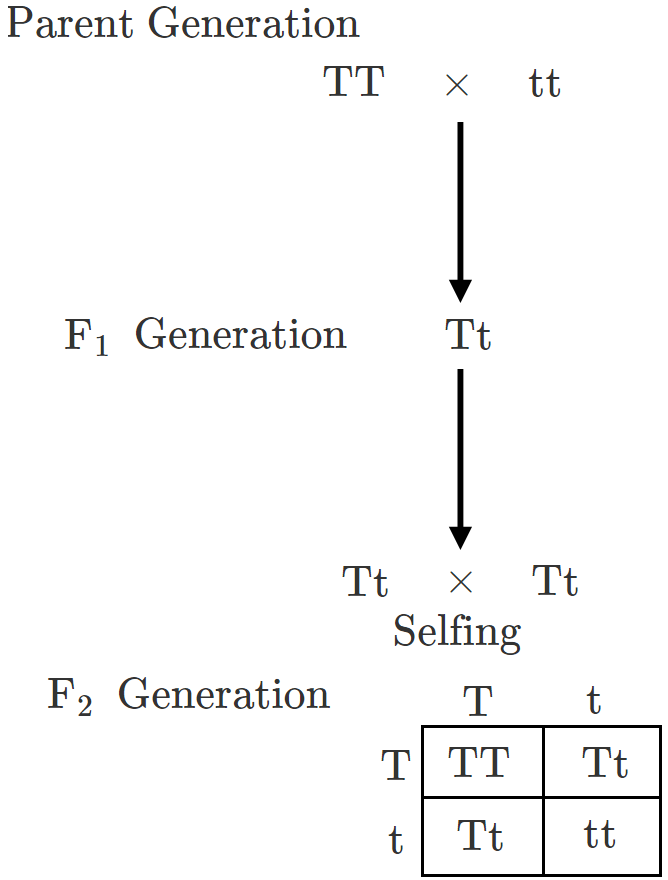
British geneticist R.C. Punnett developed a graphical representation of a genetic cross called “Punnett Square”. Mention the possible result this representation predicts of the genetic cross carried.
Answer
Punnett Square for Mendelian monohybrid cross between pure line tall and dwarf plant will appear as following:
Result of $\mathrm {F_2}$ generation phenotypic ratio of monohybrid cross is 3 : 1
View full question & answer
Question 201 Mark
What is a monohybrid cross?
Answer
Monohybrid cross is a cross made between two individuals of a species, considering the inheritance of the contrasting pair of a single character/ trait.
View full question & answer
Question 211 Mark
Do you think Mendel's laws of inheritance would have been different, if the characters he chose were located on the same chromosome? Why?
Answer
Mendel could not have framed the law of independent assortment, if the genes for all the characters Mendel chose, were present on the same chromosome and showed the phenomenon of linkage.
View full question & answer
Question 221 Mark
Name one such traiteach, in humans and Drosophila, whose genes are present on X-chromosome.
Answer
  1. Humans: colour-blindness, haemophilia.
  2. Drosophila: Eye colour, body colour.
View full question & answer
Question 231 Mark
Agenetic disorder is transferred from a phenotypically normal, but a carrier female to some of her sons. What is the nature of the disease?
Answer
It is a sex-linked (X-linked) disorder.
View full question & answer
Question 241 Mark
Write the scientific name of the organism that Morgan used for his linkage experiment.
Answer
Drosophila melanogaster.
View full question & answer
Question 251 Mark
List any two characters of pea plants used by Mendel in his experiments other than height of the plant and the colour of the seed.
Answer
The two characters of pea plant used by Mendel in his hybridisation experiment are:
  1. Flower colour: violet and white.
  2. Pod colour: Green and yellow.
View full question & answer
Question 261 Mark
How does the strength and weakness of linkage depend on linked genes?
Answer
The strength of linkage increases as the distance between two linked genes decreases. The linkage becomes weaker with the increase in the distance between genes.
View full question & answer
Question 271 Mark
Give an example of an organism exhibiting female heterogamety.
Answer
Female fowl (with ZW sex chromosomes).
View full question & answer
Question 281 Mark
Write the percentage of the pea plants that would be heterozygous tall in the F, generation, when the tall heterozygous F, pea plants are selfed.
View full question & answer
Question 291 Mark
Write the possible genotypes, Mendel got when he crossed $F_1$ tall pea plants with a dwarf pea plant.
Answer
Possible genotypes: Tt and tt.
View full question & answer
Question 311 Mark
On what basis is skin colour in humans considered polygenic?
Answer
Skin colour in humans is controlled by three different genes and the phenotype is the cumulative effect of all the dominant alleles; hence, its inheritance is considered as polygenic.
View full question & answer
Question 321 Mark
A garden pea plant produced axial white flowers. Another of the same species produced terminal violet flowers. Identify the dominant traits.
Answer
Axial, Violet flower.
View full question & answer
Question 331 Mark
What is meant by linked genes?
Answer
The genes which tend to transmit together as a unit, as they are located very close on the same chromosome are called linked genes.
View full question & answer
Question 341 Mark
Write the codominant alleles in the ABO blood group characteristic of humans.
Answer
I and I are codominant alleles.
View full question & answer
Question 351 Mark
Write an example where Punnett square can be effectively used.
Answer
Punnett square can be effectively used to understand the independent segregation of the two pairs of genes during meiosis.
View full question & answer
Question 361 Mark
The son of a haemophilic man may not get this genetic disorder. Mention one reason.
Answer
The defective allele (for haemophilia) is present on the X-chromosome, which the son does not get from his father.
View full question & answer
Question 371 Mark
Which of the following diseases can be avoided in the progeny by analysing the pedigree of the parents? Turner's syndrome, Colour blindness, Tuberculosis.
Answer
Colour blindness.
View full question & answer
Question 391 Mark
In a dihybird, cross, when would the proportion of parental gene combinations be much higher than non-parental types, as experimentally shown by Morgan and his group?
Answer
When the genes situated on the same chromosome.
View full question & answer
Question 401 Mark
What is meant by phenotype?
Answer
The observable or external morphological characteristics (features) of an organism constitute its phenotype.
View full question & answer
Question 411 Mark
Write the sex of a human having $\text{XXX}$ sex chromosomes along with $22$ pairs of autosomes. Name the disorder this human suffers from.
Answer
  1. The individual will be a male.
  2. He suffers from Klinefelter's syndrome.
View full question & answer
Question 421 Mark
In a dihybrid cross, when would the proportion of parental gene combinations be much higher than non–parental types, as experimentally shown by Morgan and his group?
Answer
When the genes are linked.
View full question & answer
Question 431 Mark
Identify and write the correct statement:
  1. In grasshopper males, two sex chromosomes are X and Y types.
  2. In grasshopper males, there exists XO type of sex determination.
Answer
  1. In grasshopper males, there exists XO type of sex determination.
View full question & answer
Question 441 Mark
What is the genetic basis of wrinkled phenotype of pea seed?
Answer
Wrinkled seed shape is a recessive trait. It expresses only under homozygous condition of alleles.
View full question & answer
Question 451 Mark
Mention two causes of frame–shift mutation.
Answer
Insertion and deletion of three bases or multiples of three bases cause frame–shift mutation because the reading frame remains unaltered from that point onwards.
View full question & answer
Question 461 Mark
What is monosomic condition?
Answer
The presence of a chromosome as a single copy in a diploid cell is termed as monosomic condition.
View full question & answer
Question 471 Mark
Name the genetic disorder caused by:
  1. Trisomy of $21^{st}$ chromosome.
  2. An extra $X-$chromosome in a human male.
Answer
  1. Down’s syndrome.
  2. Klinefelter’s syndrome.
View full question & answer
Question 481 Mark
Give an example of a plant, where the F, progeny of a monohybrid cross has the same genotypic and phenotypic ratios.
Answer
Snapdragon (Antirrhinum sp.) shows same genotypic and phenotypic ratios for inheritance of flower colour.
View full question & answer
Question 491 Mark
State the chromosomal defect in individuals with Turner’s syndrome.
Answer
Monosomy of sex chromosome in females (XO condition).
View full question & answer
Question 501 Mark
Name the respective pattern of inheritance where $F_1$ phenotype.
  1. Does not resemble either of the two parents and is in between the two.
  2. Resembles only one of the two parents.
Answer
  1. Incomplete dominance.
  2. Dominance.
View full question & answer