Questions · Page 1 of 3

3 Marks Question

🎯

Test yourself on this topic

50 questions · timed · auto-graded

Question 13 Marks
What is pedigree analysis? Suggest how such an analysis, can be useful.
Answer
Pedigree analysis is a record of occurrence of a trait in several generations of a family. It is based on the fact that certain characteristic features are heritable in a family, for example, eye colour, skin colour, hair form and colour, and other facial characteristics. Along with these features, there are other genetic disorders such as Mendelian disorders that are inherited in a family, generation after generation. Hence, by using pedigree analysis for the study of specific traits or disorders, generation after generation, it is possible to trace the pattern of inheritance. In this analysis, the inheritance of a trait is represented as a tree, called family tree. Genetic counselors use pedigree chart for analysis of various traits and diseases in a family and predict their inheritance patterns. It is useful in preventing hemophilia, sickle cell anemia, and other genetic disorders in the future generations.
View full question & answer
Question 23 Marks
Using a Punnett Square, workout the distribution of phenotypic features in the first filial generation after a cross between a homozygous female and a heterozygous male for a single locus.
View full question & answer
Question 33 Marks
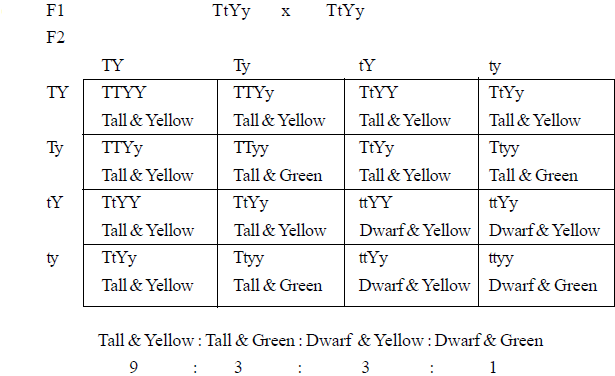
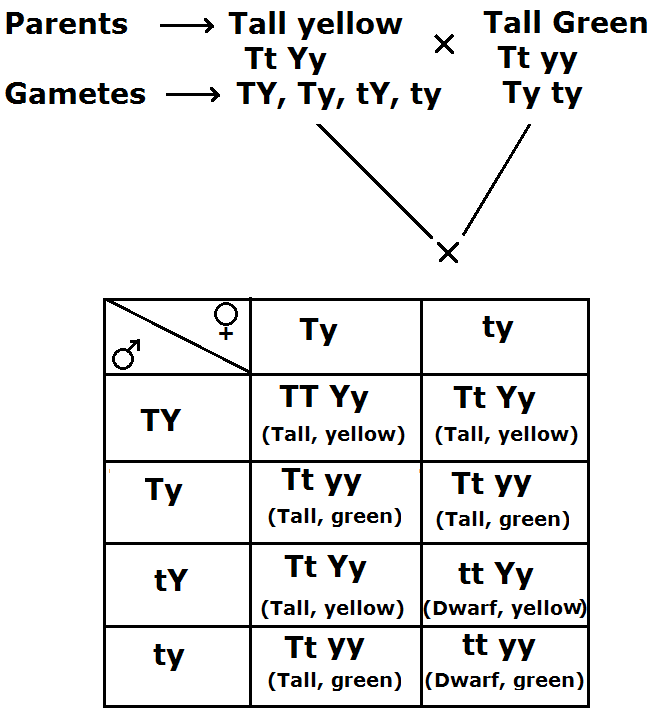
When a cross in made between tall plant with yellow seeds (TtYy) and tall plant with green seed (Ttyy), what proportions of phenotype in the offspring could be expected to be,
  1. Tall and green.
  2. Dwarf and green.
Answer
A cross between tall plant with yellow seeds (TtYy) & tall plant with green seed (Ttyy) is given below. Phenotype ratio:
  1. Tall and green = 3/8 or 37.5%
  2. Dwarf and green = 1/8 or 12.5%
View full question & answer
Question 43 Marks
Mention the advantages of selecting pea plant for experiment by Mendel.
Answer
Mendel selected pea plants to carry out his study on the inheritance of characters from parents to offspring.He selected a pea plant because of the following features:
  • Peas have many visible contrasting characters such as tall/ dwarf plants, round/ wrinkled seeds, green/ yellow pod, purple/ white flowers, etc.
  • Peas have bisexual flowers and therefore undergo self pollination easily.
  • Thus, pea plants produce offsprings with same traits generation after generation.
  • In pea plants, cross pollination can be easily achieved by emasculation in which the stamen of the flower is removed without affecting the pistil.
  • Pea plants have a short life span and produce many seeds in one generation.
View full question & answer
Question 53 Marks
Define and design a test-cross.
Answer
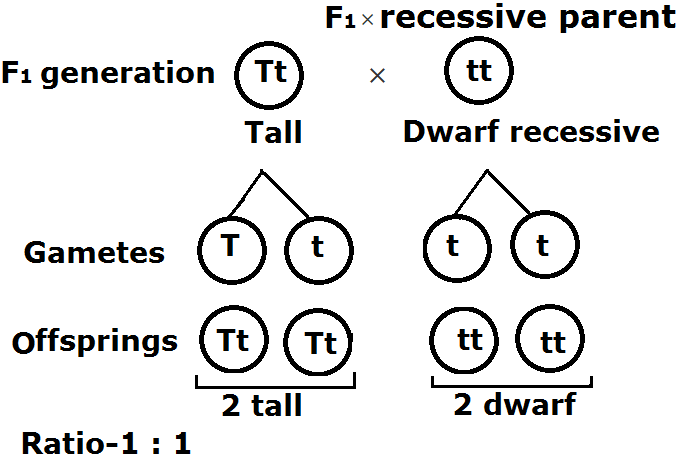
When an individual is crossed with the homozygous recessive parent It is called test cross.
Test cross helps in establishing hetero/ homozygosity of dominant trait.
View full question & answer
Question 63 Marks
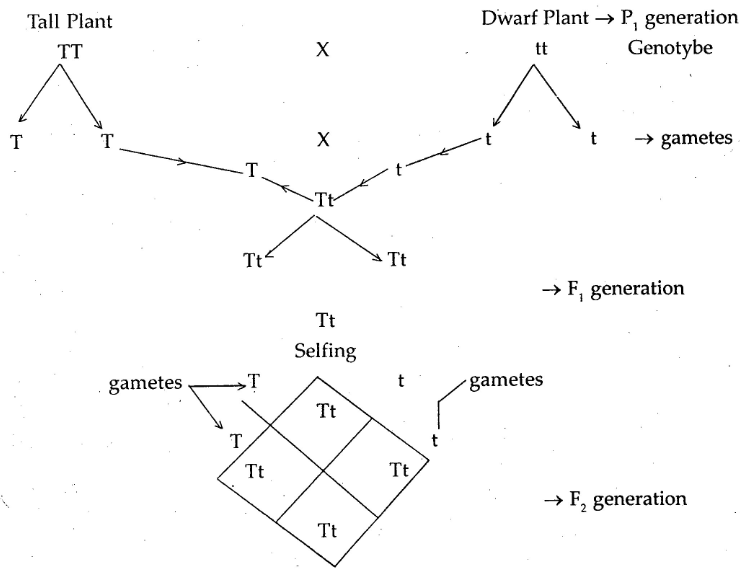
The $F_2$ progeny of a monohybrid cross showed phenotypic and genotypic ratio as 1 : 2 : 1, unlike that of Mendel’s monohybrid $F_2$ ratio. With the help of a suitable example, work out a cross and explain how it is possible.
Answer
Phenotypic ratio = Tall : dwarf
    3 : tt
Genotyopic ratio = TT : TY : tt
  = 1 : 2 : 1
A Punnet square used to understand a typical monohybird croos between tall and Dwarf plant.
View full question & answer
Question 73 Marks
Identify 'a', 'b', 'c', 'd', 'e' and 'f' in the table given below:
No. Syndrome Cause Characteristics of affected individual Sex Male/Female/Both
1 Down’s Trisomy of 21
‘a’ (i)
(ii)
'b'
2 ‘c’ XXY Overall masculine development ‘d’
3 Turner’s 45 with OX
‘e’ (i)
(ii)
‘f’
Answer
  1. Short statured/small round head/furrowed tongue/partially open mouth/palm is broad/physical development retarded/psychomotor development retarded/mental development retarded.
  2. Both/male and female.
  3. Klinefelter's syndrome.
  4. Male.
  5. Sterile ovaries/rudimentary ovaries, lack of secondary sexual characters.
  6. Female.
View full question & answer
Question 83 Marks
What is a test cross? How can it decipher the heterozygosity of a plant?
Answer
  • A cross to analyse whether genotype of dominant individual is homozygous or heterozygous.
  • On crossing with a recessive parent, if 50% of progeny have dominant trait and 50% have recessive trait then the plant is said to be heterozygous.
  • The above value points can be considered with the help of a test cross.
View full question & answer
Question 93 Marks
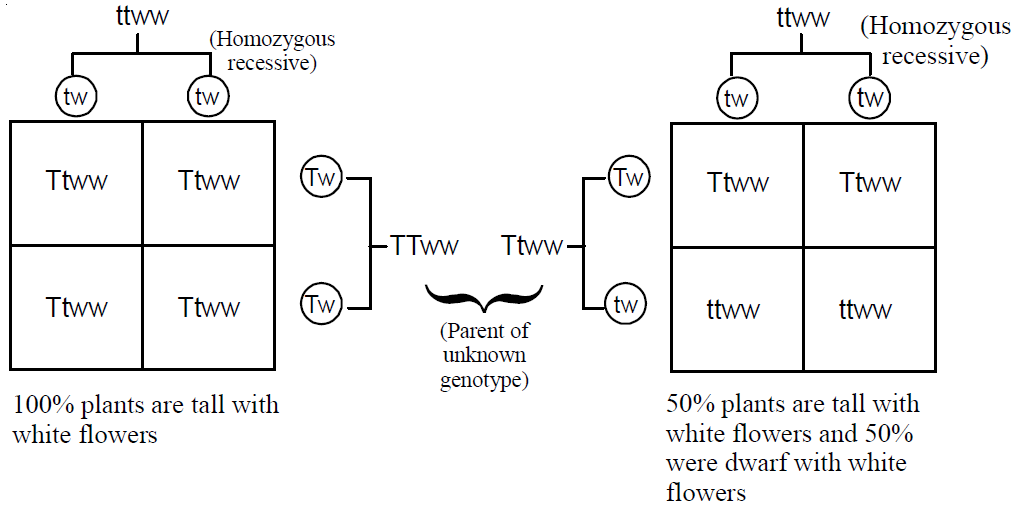
Two independent monohybrid crosses were carried out involving a tall pea plant with a dwarf pea plant. In the first cross, the offspring population had equal number of tall and dwarf plants, whereas in the second cross it was different. Work out the crosses, and explain giving reasons for the difference in the offspring populations.
Answer
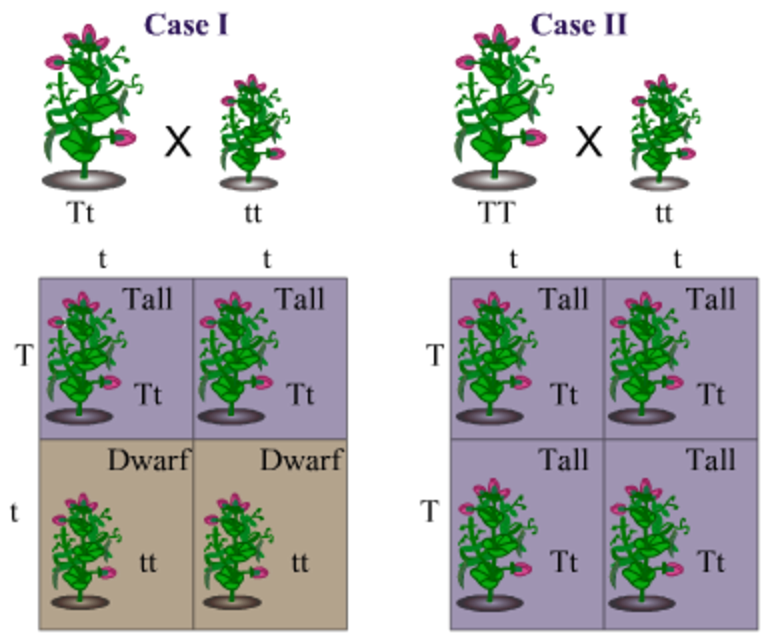
First Cross (Case I)
In the first cross between the tall plant and the dwarf plant, equal number of tall and dwarf plants are produced. This is because the tall plant is heterozygous dominant (Tt) and dwarf plant is homozygous recessive (tt). The progenies will be 50% tall and 50% dwarf.
Second Cross (Case II)
In the second cross between the tall plant and the dwarf plant, all the offsprings will be tall. This is because the tall plant is homozygous dominant (TT) and dwarf plant is homozygous recessive (tt).
The two monohybrid crosses can be represented as follows:
View full question & answer
Question 103 Marks
Why is pedigree analysis done in the study of human genetics? State the conclusions that can be drawn from it.
Answer
  1. Control crosses are not possible in case of humans beings.
  2. Analysis of traits in several generations of a family/To trace pattern of inheritance/Whether the trait is dominant or recessive/sex-linked or not.
View full question & answer
Question 113 Marks
Both Haemophilia and Thalassemia are blood related disorders in humans. Write their causes and the difference between the two. Name the category of genetic disorder they both come under.
Answer
Haemophilia Thalassemia
Single protein involved in the clotting of blood is affected. Defects in the synthesis of globin leading to formation of abnormal haemeoglobin.
Sex linked recessive disorder. Autosomal recessive disorder.
Blood does not clot. Results in anaemia.
Mendelian disorder = 1
View full question & answer
Question 123 Marks
During a monohybrid cross involving a tall pea plant with a dwarf pea plant, the offspring populations were tall and dwarf in equal ratio. Work out a cross to show how it is possible.
View full question & answer
Question 133 Marks
Why are human females rarely haemophilic? Explain. How do haemophilic patients suffer?
Answer
The sex-linked recessive disease, which shows to transmission from unaffected carrier female to some of the male progeny a single protein that is a part of the cascade of proteins involved in the clotting of blood is affected. An affected individual a simple cut will result in non-stop bleeding. The heterozygous female (carrier) for haemophilia may transmit the disease to sons. The possibility of a female becoming a haemophilic is extremely rare because mother of such a female has to be at least carrier and the father should be haemophilic (unviable in the later stage of life). The family pedigree of Queen Victoria shows a number of haemophilic descendants as she was carrier of the disease.
View full question & answer
Question 143 Marks
List the salient features of double helix structure of DNA.
Answer
DNA helix made up of two polynucleotide chains , each constituted by sugarphosphate- bases, the chains are antiparallel in polarity (5'$\rightarrow$3' and 3'$\rightarrow$5'), the bases are linked with H-bonds, Adenine pair with Thymine with two H- bonds while Guanine pair with Cytosine with three H-bonds, Coiling of the chain are in right handed fashion, Pitch of the helix is 3.4nm and there are 10bp per turn, The plane of one base pair stacks over the other in a double helix.
View full question & answer
Question 153 Marks
  1. Explain the phenomena of multiple alleles and co-dominance taking ABOblood group as an example.
  2. What is the phenotype of the following:
  1. $I^A$ i
  2. i i
Answer
  1. One gene I has three alleles IA, IB and i hence multiple allelism.
We inherit any two of them. When the genotype is IA IB, the individual has AB blood group since both IA and IB equally influence the formation of Antigen A and B - Codominance.
  1.  
  1. $I^A$ i-A blood group.
  2. i i - O blood group.
View full question & answer
Question 163 Marks
  1. Why are grasshopper and Drosophila said to show male heterogamity? Explain.
  2. Explain female heterogamity with the help of an example.
Answer
  1. In grasshopper males have one X only (XO type), in Drosophila males have one X and one Y (XY type) - Males in both produce 2 different kinds of gametes so heterogametic.
  2. In birds female has ZW, produce two kinds of gametes and so heterogametic.
View full question & answer
Question 173 Marks
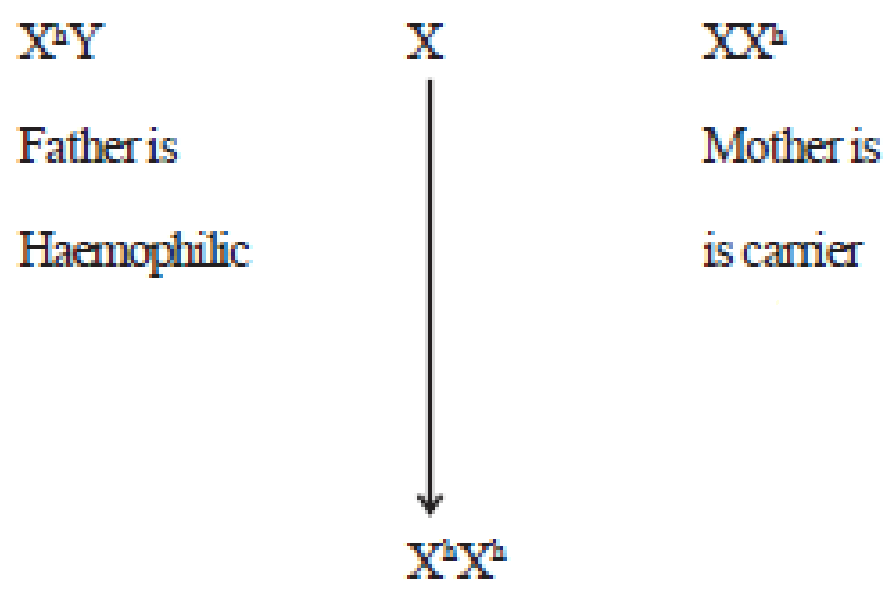
Recently a girl baby has been reported to suffer from haemophilia. How is it possible? Explain with the help of a cross.
Answer

Possibility of the daughter being haemophilic.
View full question & answer
Question 183 Marks

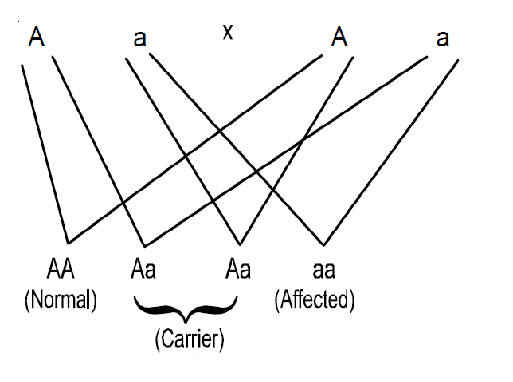
  1. Is the trait recessive or dominant?
  2. Is the trait sex-linked or autosomal?
  3. Give the genotypes of the parents in generation I and of their third and fourth child in Generation II.
Answer
  1. Recessive.
  2. Autosomal.
  3. Parents - Aa and Aa.
Third child - aa.

Fourth child - Aa.
View full question & answer
Question 193 Marks
A homozygous tall pea plant with green seeds is crossed with a dwarf pea plant with yellow seeds.
  1. What would be the phenotype and genotype of $F_1?$
  2. Work out the phenotypic ratio of $F_2$ generation with the help of Punnett square.
Answer
1. Phenotype of $F_1$ - Tall and YellowGenotype of $F_1$- TtYy
2.
Male gametes.
Female gametes.
Punnett sqaure.
Four phenotypes.
Ratio.
View full question & answer
Question 203 Marks
Human blood group is a good example of multiple allelism and co-dominance. Justify.
Answer
Multiple allelism: Generally in an individual/population, only two alleles of a trait govern the character, but in case of ABO blood group, three alleles IA, IB and i are found to govern blood group in human population.Co-dominance: Allele IA and IB when present in an individual, both being dominant express their own types of sugars/traits.
View full question & answer
Question 213 Marks
Explain the cause of chromosomal disorders in humans. Describe the effect of such disorders with the help of an example each involving.
  1. autosomes, and
  2. sex chromosomes.
Answer
Gain or loss of a chromosome. (due to nondisjunction)
  1. Down Syndrome- Additional copy of 21st chromosome/trisomy of 21.
  2. Klinefelter’s Syndrome- presence of an additional copy of X chromosome leading to XXY Turner’s Syndrome- absence of one of the X chromosome i.e. 45 with XO.
View full question & answer
Question 223 Marks
During a medical investigation, an infant was found to possess an extra chromosome 21. Describe the symptoms the child is likely to develop later in the life.
Answer
Short-statured, small round head, furrowed tongue, partially open mouth, broad palm with characteristic palm crease, physical psychomotor & mental development retarded, big and wrinkled tongue, broad flat face, flat back of head, many 'loops' on finger tips.
View full question & answer
Question 233 Marks
How would you find genotype of a tall pea plant bearing white flowers? Explain with the help of a cross. Name the type of cross you would use.
Answer

Test cross.
Both crosses.
Both interpretations.
View full question & answer
Question 243 Marks
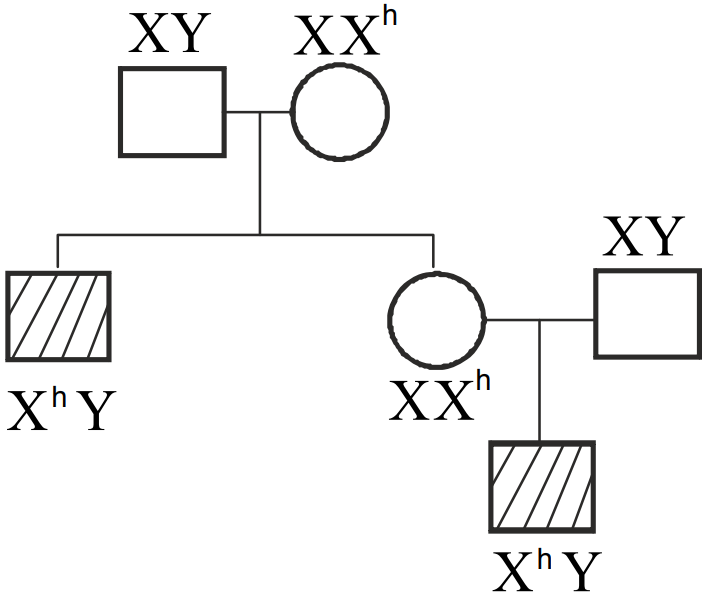
A cross between a normal couple resulted in a son who was haemophilic and a normal daughter. In course of time, when the daughter was married to a normal man, to their surprise, the grandson was also haemophilic.
  1. Represent this cross in the form of a pedigree chart. Give the genotypes of the daughter and her husband.
  2. Write the conclusion you draw of the inheritance pattern of this disease.
Answer
  1.  

Construction of pedigree chart
  1. Sex - linked recessive inheritance pattern.
View full question & answer
Question 253 Marks
Mendel published his work on inheritance of characters in 1865, but it remained unrecognised till 1900. Give three reasons for the delay in accepting his work.
Answer
  • The communication was not easy in those days, and his work could not be widely publicised.
  • His concept of genes as stable and discrete units that controlled the expression of traits and of the pair of alleles which did not ‘blend’ with each other was not accepted by contemporaries as an explanation for the apparently continuous variation seen in nature.
  • Mendel’s approach of using mathematics to explain biological phenomena was totally new and unacceptable to many of the biologists of his time.
  • Though Mendel’s work suggested that factors (genes) were discrete units, he could not provide any physical proof for the existence of factors and what they were made of.
View full question & answer
Question 263 Marks
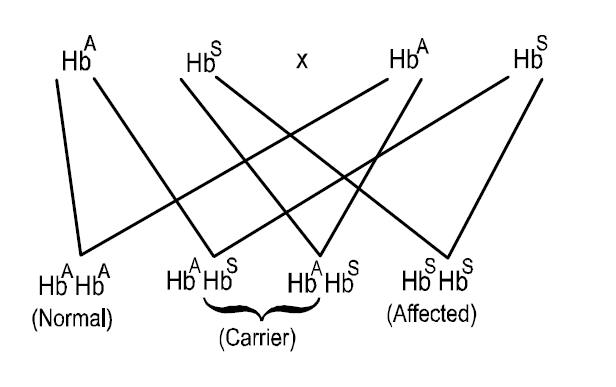
Give an example of an autosomal recessive trait in humans. Explain its pattern of inheritance with the help of a cross.
Answer
Sickle cell anaemia/Phenylketonuria/Thalassemia/O Blood group/Non - rolling of tongue/Fused or attached earlobes/Inability to taste PTC (phenylthiocarbamide).
AlternateAnswer
View full question & answer
Question 273 Marks
A teacher wants his/her students to find the genotype of pea plants bearing purple coloured flowers in their school garden. Name and explain the cross that will make it possible.
Answer
Test cross.
Purple flower to be crossed with white (homozygous recessive) flower.
If all flowers of $F_1$ are purple, then genotype is homozygous dominant/PP.
If 50% are purple and 50% are white, then genotype is heterozygous dominant/Pp.
(same thing can be shown with the help of crosses).
View full question & answer
Question 283 Marks
A colour blind child is born to a normal couple. Work out a cross to show how it is possible. Mention the sex of this child.
View full question & answer
Question 293 Marks
  1. Why is human ABO blood group gene considered a good example of multiple alleles?
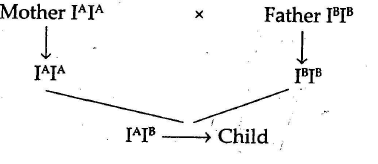
  2. Work out a cross up to F1 generation only, between a mother with blood group B (Homozygous). Explain the pattern of inheritance exhibited.
Answer
  1. Multiple alleles may show the dominant or intermediate phenotypes, while wild - type of series is usually dominant. Wild-type or dominant allele id represented by capital letters white other alleles, which are recessive are represented by lower case letter.
Number of genotype is case of multiple allelism.
is n/2 (n+1)=n alleles.
In ABO blood group three alleles regulate blood group leading to the formation of six genotypes.
Ex.: whether a person has type A, type B, type AB or type blood depends on the presence or absence of specific substances on the red blood cells. There are two of these substances-antigen A and B.
Phenotype Genotype Antigen
Type A $I^AI^A$ or $I^Ai$ A
Type $I^AI^A$ or $I^Ai$ B
Type AB $I_AI^B$ A and B
Type O ii None
Showing phenotype, Genotype and Antigen.
  1.  

Thus the child will have blood group AB. This pattern of inheritance is called co-dominance.
View full question & answer
Question 303 Marks
How are dominance, codominance and incomplete dominance patterns of inheritance different from each other?
Answer
Dominance: one allele expresses itself in the hybrid heterozygous condition, other is suppressed.
Co dominance: both the alleles of a gene express in a heterozygous hybrid containing two dominant alleles.
Incomplete dominance: Neither of the two alleles of a gene is completely dominant over the other in heterozygous condition, the hybrid is intermediate.
View full question & answer
Question 313 Marks
During his studies on genes in Drosophila that were sex-linked T.H. Morgan found F2 -population phenotypic ratios deviated from expected 9:3:3:1. Explain the conclusion he arrived at.
Answer
  1. Linkage, genes on the same chromosome were either closely associated or far apart.
  2. Higher percentage of parental combination and fewer percentage of recombinants are observed when two genes are located very close/tightly linked on the same chromosome.
  3. Higher percentage of recombinants and fewer percentage of parental combinations are observed when two genes are located far aparta/loosely linked on the same chromosome.
View full question & answer
Question 323 Marks
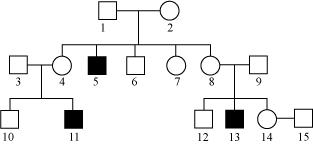
Haemophilia is a sex-linked recessive disorder of humans. The pedigree chart given below shows the inheritance of haemophilia in one family. Study the pattern of inheritance and answer the questions given.
  1. Give all the possible genotypes of the members 4; 5 and 6 in the pedigree chart.
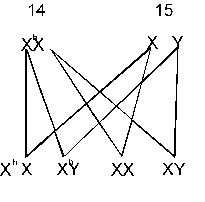
  2. A blood test shows that the individual 14 is a carrier of haemophilia. The member numbered 15 has recently married the member numbered 14. What is the probability that their first child will be a haemophilia male?
Answer
A.
$4 – X\ X^h$,
$X =$ normal
$5 – X^hY,$
$X^h=$ haemophilia
$6 – XY,$
B.

25% chances of haemophilia male.
View full question & answer
Question 333 Marks
Inheritance pattern of ABO blood groups in humans shows dominance, codominance and multiple allelism. Explain each concept with the help of blood group genotypes.
Answer
In the first case of inheritance of blood group there are three alleles $I^A, I^B$ and $i$ out of which we inherit any two of them - multiple allelism.In case of $A B$ group the alleles are $I^A$ and $I^B$ and both are expressed - codominance.
In case of $I^{\mathrm{A}} \mathrm{i}$ and $\mathrm{I}^{\mathrm{B}} \mathrm{i}$ which are heterozygous the dominant gene expresses - law of dominance.
View full question & answer
Question 343 Marks
Explain the pattern of inheritance of haemophilia in humans. Why is the possibility of a human female becoming a haemophilic extremely rare? Explain.
Answer
Sex-linked recessive disease, present on X chromosome, Mother should be carrier and father should be haemophilic for a daughter to be affected, The possibility of a female becoming a haemophilic in extremely rate because mother of a such female has to be at least carrier and the father should be haemophilic (unavailable in the later stages of life). Show criss-cross inheritance from mother to son and from haemophilic father to daughter.
View full question & answer
Question 353 Marks
Explain the mechanism of ‘sex determination’ in birds. How does it differ from that of human beings?
Answer
In birds, sex determination is of ZW-ZZ type. In this type the males are homogametic and have ZZ sex chromosomes, and females are heterogametic with ZW pair of sex chromosomes.
Parents: Male X Female
  ZZ   ZW
Gametes: (Z)(Z)   (Z)(W)
$F_1:$ ZW   ZZ
  Female   Male
Whereas, in human beings, the chromosomal mechanism of sex determination is of XX-XY type. The human male is heterogametic and have XY sex chromosomes and human female is homogametic with XX sex chromosomes.
View full question & answer
Question 363 Marks
  1. Explain linkage and recombination as put forth by T.H. Morgan based on his observations with Drosophila melanogaster crossing experiment.
  2. Write the basis on which Alfred Sturtevant explained gene mapping.
Answer
  1. The linkage is a term that describes the tendency of certain loci or alleles to be inherited together. Genetic loci on the same chromosome are physically close to one another and tend to stay together during meiosis, thus are genetically linked. Genetic recombination is the formation of new combinations of alleles in offspring as a result of the exchange of DNA sequences between chromosomes. It occurs naturally, as in sexual reproduction during meiosis or artificially, as a result of experiments on genetic engineering.
Thomas Hunt Morgan and his colleagues used fruitfly, or Drosophila melanogaster to study linkage. They showed how sexual reproduction gave rise to variations. Similar to Mendel’s dihybrid cross in peas, Morgan conducted dihybrid cross between yellow-bodied, white-eyed females and brown-bodied, red-eyed males. Shockingly, the self-crossing of $F_1$ generation did not give a ratio of 9 : 3 : 3 : 1 in the $F_2$ generation. The result showed a deviation from Mendel’s dihybrid cross.

Morgan observed that while crossing a set of characteristics, two genes did not segregate as per Mendel’s law. If two genes were present on the same chromosome, the probability of getting a parental combination was much higher in the next generation as compared to the non-parental combination. This physical association of genes was termed as linkage.

In addition, they noted that the probability recombination is dependent on how strong the linkage is. In other words, though there is a link between two genes on chromosomes, genes may or may not be tightly linked. Some genes have strong linkage giving less chance of recombination while another linkage of genes is weak (loosely linked) giving a higher chance of recombination.
  1. Alfred Sturtevant was a student of Morgan. He discovered the position of linked genes on a chromosome by calculating their frequency of genetic recombination by the process of gene mapping. This method of generating linkage map was extensively used during Human Genome Project.
View full question & answer
Question 373 Marks
Compare in any three ways the chromosomal theory of inheritance as proposed by Sutton and Bovery with that of experimental results on pea plant presented by Mendel.
Answer
Gregor Mendel: Through his work on pea plants, discovered the fundamental laws of inheritance. He deduced that genes come in pairs and are inherited as distinct units, one from each parent. Mendel tracked the segregation of parental genes and their appearance in the offspring as dominant or recessive traits. He recognized the mathematical patterns of inheritance from one generation to the next.
Mendel did not investigate how characteristics are sorted and combined on cellular level. Sutton and Boveri, working independently, suggested that chromosomes could be shown to bear the materials of heredity.
They noted that the behaviour of chromosomes was parallel to the behaviour of the gene and used chromosomes movement to explain Mendel's laws.
Sutton and Boveri: Argued that the pairing and separation of pair of chromosomes would lead to segregation of a pair of factors they carry. Sutton united the knowledge of chromosomal segregation with Mendelian principle and called it "chromosomal theory of inheritance".
View full question & answer
Question 383 Marks
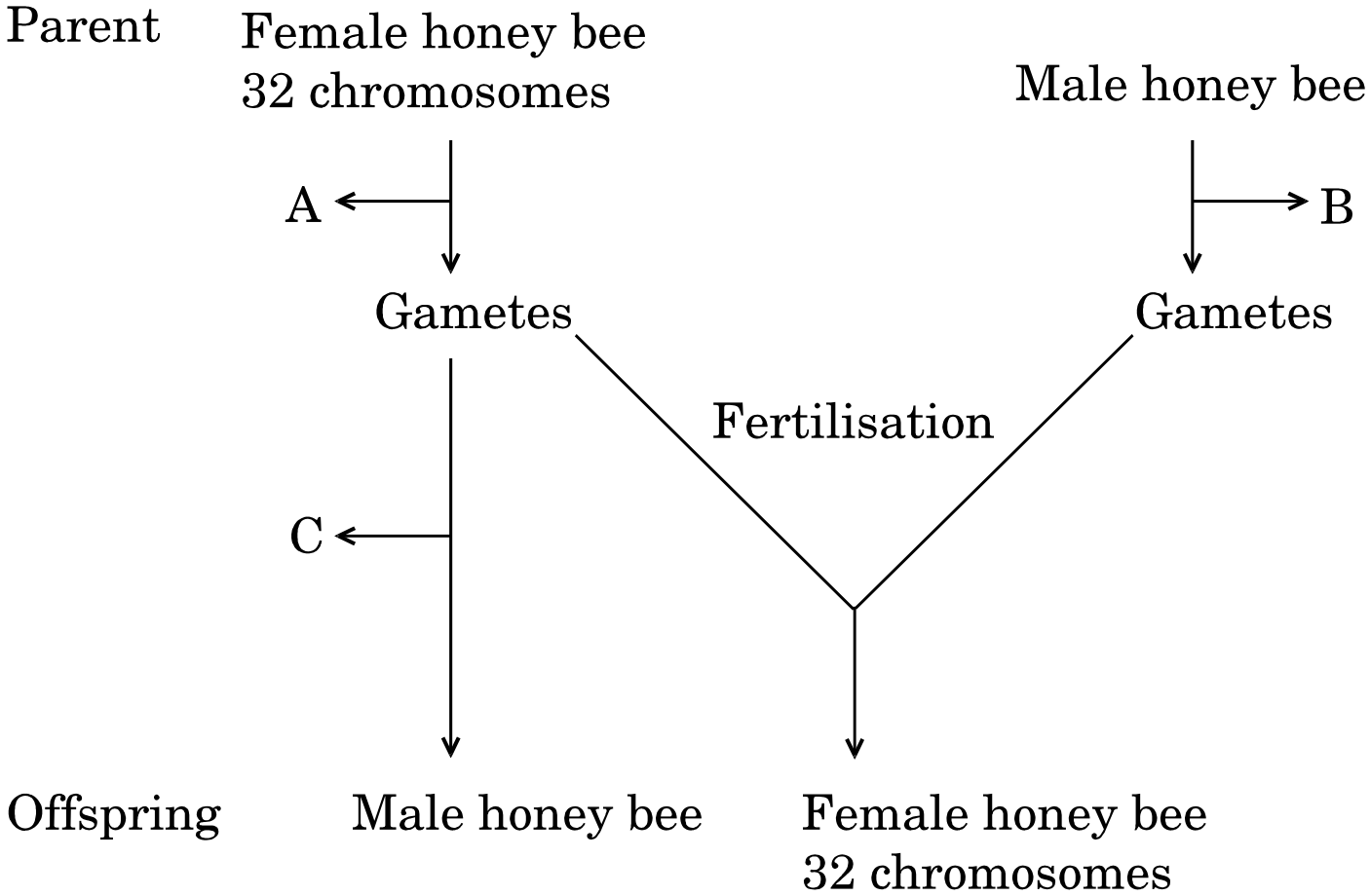
The cytological observations made in a number of insects led to the development of the concept of genetic/ chromosomal basis of sex-determination mechanism. Honey bee is an interesting example to study the mechanism of sex-determination. Study the schematic cross between the male and the female honey bees given below and answer the questions that follow:
  1. Identify the cell divisions ‘A’ and ‘B’ that lead to gamete formation in female and male honey bees respectively.
  2. Name the process ‘C’ that leads to the development of male honey bee (drone).
Answer
  1. ‘A’ - meiosis
‘B’ - Mitosis.
  1. ‘C’ - Parthenogenesis.
View full question & answer
Question 393 Marks
$F_1$ progeny of pea plant bearing violet flowers and snapdragon plan bearing red flowers were selfed to produce their respective $F_2$ progeny. Compare the phenotypes, the genotypes and the pattern of inheritance of their respective $F_2$ progeny.
Answer
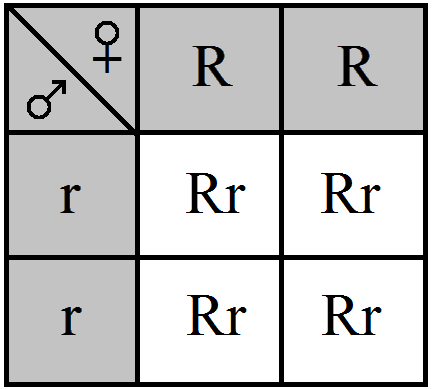
Let take pure breeding plants as parents, that is, red flower bearing plant and white flower bearing plant with ‘RR’ and ‘rr’ as their genotypes respectively. Here ‘R’ represents the dominant color of the flower that is red and ‘r’ for white color. Now, lets draw the punnett square for first generation $ (F_1):$

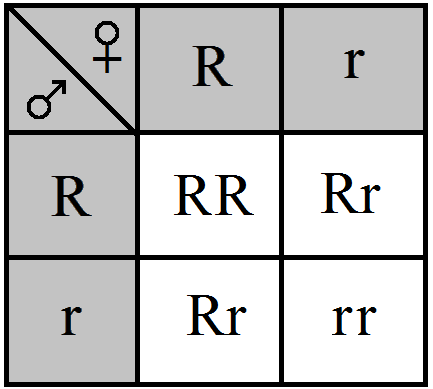
So, we get plants bearing pink flowers, that is, ‘Rr’ is the genotype of all the plants in $F_1$ generation. Now, lets take two plants from this generation. Cross pollination is undertaken. Now we get $F_2$ generation. Here’s the punnett square:

So, we get 25% (1/ 4) of the total number of plants bearing red flowers (RR), 25% (1/ 4) bearing white flowers (rr) and 50% (2/ 4 = 1/ 2) plants bearing pink flowers (Rr).
Hence, Genotype ratio = 1 : 2 : 1 [RR : Rr : rr]
and Phenotype ratio = 1 : 2 : 1 [red : pink : white]
This is due to incomplete tolerance where the dominant gene (red color) is not completely dominant over the recessive gene (white color).
View full question & answer
Question 403 Marks
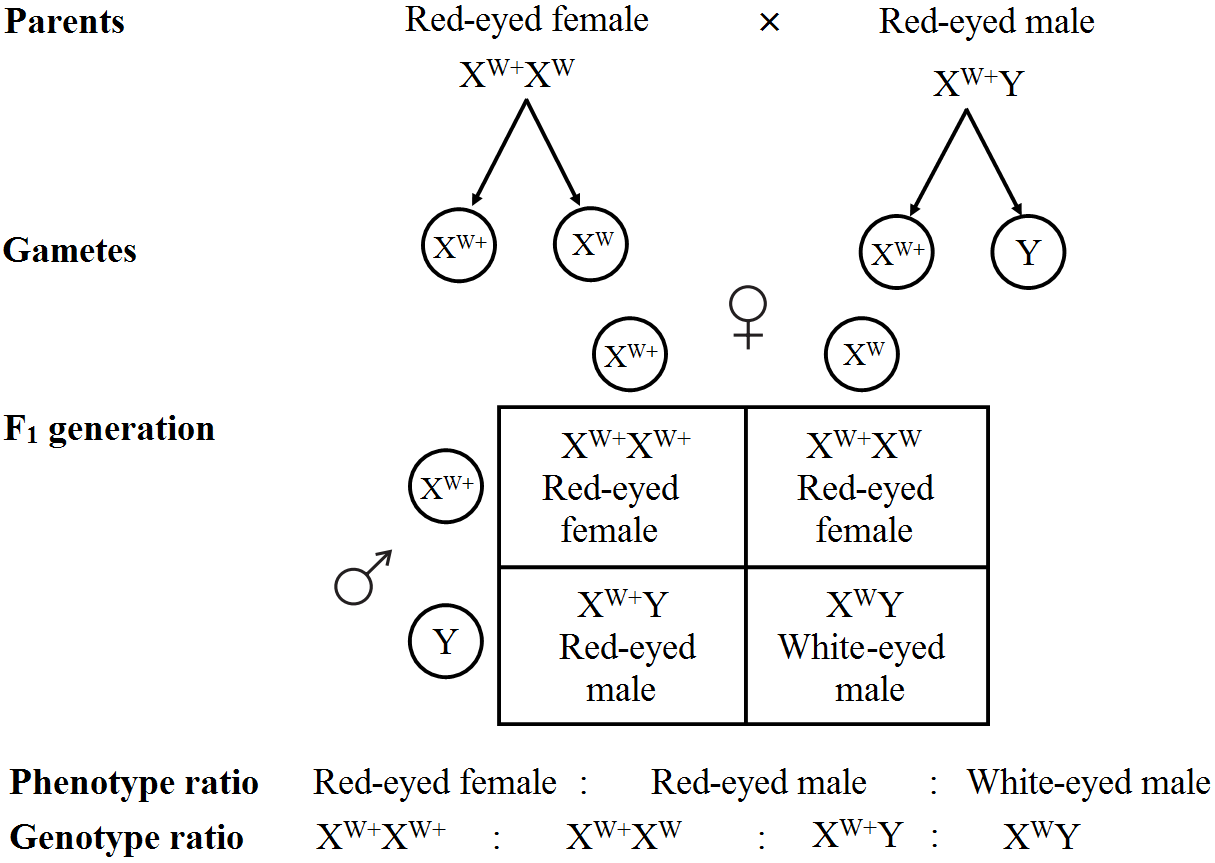
A red–eyed heterozygous female fruit fly is crossed with a red–eyed male. Work out all possible genotypes and phenotypes of the progeny. Comment on the pattern of inheritance of eye colour in fruit flies.
Answer
  1.  
  • The gene for eye colour is sex–linked and is present on X chromosome.
  • The character passes into the male from female and the male passes it to the female in the next generation. Male has only one X–chromosome and one Y–chromosome with no corresponding allele.
View full question & answer
Question 413 Marks
Explain the laws that Mendel derived from his monohybrid crosses.
Answer
Law of dominance and law of segregation are the two laws, Mendel derived from his monohybrid crosses.
  1. Law of dominance explains that in a dissimilar pair of factors of a trait, one of them expresses itself (dominant) and the other remains hidden (recessive).
  • It also explains the expression of both the traits in the F, progeny, in a ratio of 3 : 1.
  1. Law of segregation states that the members of an allelic pair that remained together in the parent/ hybrid, segregate during gamete formation and enter different gametes.
  • A homozygous parent produces all gametes that are similar while the heterozygous one produces two kinds of gametes, each having one allele for a trait.
View full question & answer
Question 423 Marks
Write the three basic facts that are highlighted in Mendel's Law of Dominance.
Answer
The three basic facts are as follows:
  1. Characters are controlled by discrete units, called factors.
  2. The factors occur in pairs.
  3. In a dissimilar pair of factors (heterozygous), one member of the dominates (dominant) and the other is recessive.
View full question & answer
Question 433 Marks
Although Mendel published his work on inheritance of characters in 1865, for several reasons, it remained unrecognised till 1900. Explain giving three reasons, why it did take so long.
Answer
Mendel's work remained unrecognised for the following reasons:
  1. His work could not be widely publicised as communication was not easy.
  2. His concept of 'factors' as stable and discrete units that controlled the expression of traits and that the pair of alleles which did not blend with each other, were not accepted by his contemporaries as the explanation of variation.
  3. Mendel's approach of using mathematical logic to explain the biological phenomena was new and unacceptable to many biologists.
  4. Though Mendel's work suggested that factors were discrete units, he could not provide any physical proof for the existence of factors or prove what they are made of.
View full question & answer
Question 443 Marks
In our society a woman is often blamed for not bearing male child. Do you think it is right? Justify.
Answer
From the concept of sex determination in humans, it is clear that Y chromosome which is present in males comes from the father and not from the mother. Hence, it is the man who should be blamed for not having a male child rather than the woman. But probability of an X or Y chromosome ending up in the zygote is equal, i.e. 50 : 50. So, it is purely a chance that a girl or a boy is borne and no one should be blamed or rewarded for that. The society should learn to respect the girl child as well.
View full question & answer
Question 453 Marks
What is artificial selection? Do you think it affects the process of natural selection? How?
Answer
Artificial selection is the selective breeding of plants and animals to include beneficial traits in them. This is also called selective breeding. While some selective breeding can be purely artificial, many others are natural breeding done in a controlled environment. From the point of ethics, it may be wrong to go for artificial selection. But if we follow the law of natural selection and survival of the fittest, then it can be safely assumed the even in case of artificial selection only those varieties are going to survive which are fit to survive. Hence, it can be inferred that artificial selection is not going to affect the process of natural selection.
View full question & answer
Question 463 Marks
What is the chromosomal basis of Turner’s syndrome? Mention the sex and any three symptoms of this disorder.
Answer
Turner’s syndrome:
Cause: Absence of one of the X chromosomes, resulting in the karyotype 44+XO.
Symptoms:
  1. Sterile female with rudimentary ovaries.
  2. Shield–shaped thorax.
  3. Webbed neck.
  4. Poor development of breasts.
  5. Short stature, small uterus, puffy fingers.
View full question & answer
Question 473 Marks
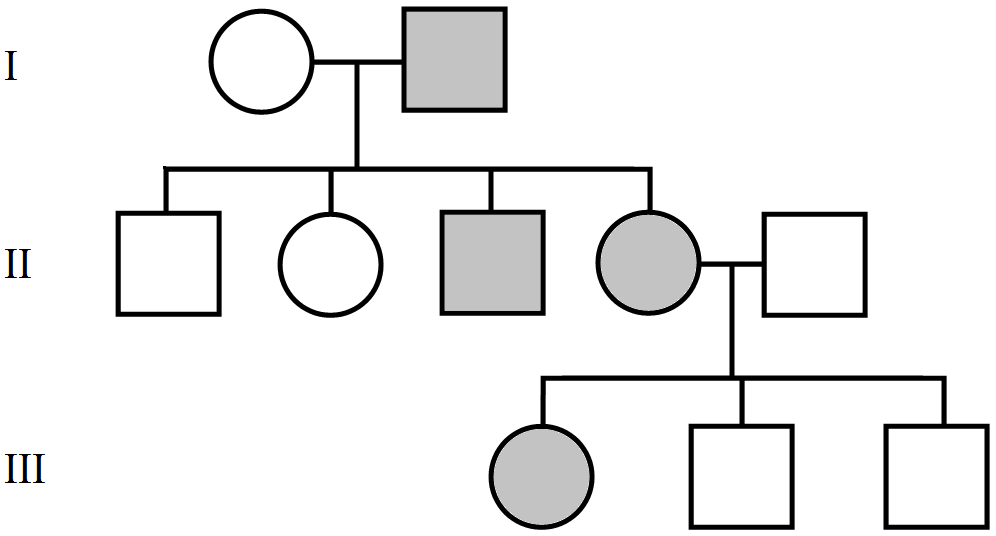
Study the given pedigree chart and answer the questions that follow:
  1. Is the trait recessive or dominant?
  2. Is the trait sex-linked or autosomal?
  3. Give the genotypes of the parents shown in generation I and their third child shown in generation II and the first grandchild shown in generation III.
Answer
  1. It is a dominant trait.
  2. It is autosomal
  3. Genotypes of parents in generation I:
Female aa; male Aa.

Genotype of third child in generation II: Aa.

Genotype of first grandchild in generation III: Aa.
View full question & answer
Question 483 Marks
In a Mendelian monohybrid cross, the $F_2$ generation shows identical genotypic and phenotypic ratios. What does it tell us about the nature of alleles involved? Justify your answer.
Answer
When plants of $F_11$ generation are allowed to reproduce without cross, the alleles segregate and one allele goes to one parent while another allele goes to another parent. This is in accordance with transfer of halved number of chromosome during meiosis. This segregation is a random process and there is 50% chance of a particular allele going to either the male gamete or the female gamete. Due to this, the genotype produced in $F_2$ generation is same as the phenotype produce in that generation. So, percentage of plants with pure genotype and those with mixed genotype will be same, i.e. 50%.
View full question & answer
Question 493 Marks
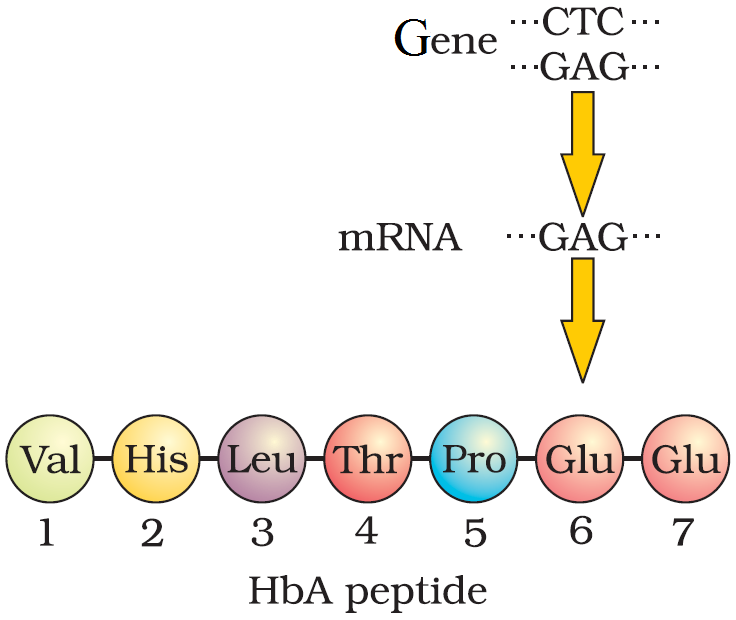
Given below is the representation of amino acid composition of the relevant translated portion of B-chain of haemoglobin, related to the shape of human red blood cells.
  1. Is this representation indicating a normal human or a sufferer from certain related genetic disease? Give reason in support of your answer.
  2. What difference would be noticed in the phenotype of the normal and the sufferer related to this gene?
  3. Who are likely to suffer more from the defect related to the gene representedthe males, the females or both males and females equally? And why?
Answer
  1. Normal human, because glutamic acid is not replaced by valine at 6th position.
  2. The normal person has circular and biconcave RBCs while sufferer has sickle shaped RBCs and suffering from sickle cell anemia.
  3. Both males and females because it is a autosomal hereditary disease not sex-chromosomal.
View full question & answer
Question 503 Marks
  1. Explain sex determination in humans.
  2. How do human males with 'XXY' abnormality suffer?
Answer
  1. Determination of Sex: In human beings the sex of the baby is determined at the time of fertilization.
  • The sex chromosome pattern in the human females is XX and that of male is XY. Therefore, all the haploid female gametes (ova) have the sex chromosome X, however, the haploid male gametes have either X or Y.
  • After fusion of the male and female gametes, the zygote would carry either XX or XY sex chromosomes depending on whether the sperm carrying X or Y chromosome fertilises the ovum. The zygote carrying XX sex chromosome would be a female baby and XY would be a male baby. Thus, the sex of the child is determined by the father and not by the mother.
  1. It is sex chromosomal trisomy called as Klinefelter's syndrome.
The symptoms are:
  • Tall stature with feminised physique.
  • Enlarged breast.
  • Sterility.
  • Small testes.
View full question & answer